The 2026 Turnkey Racing Simulator Checklist: Professional Engineering vs. Consumer Bundles
Spending $30,000 on a premium list of components doesn't guarantee a professional-grade experience; it often just creates a more expensive version of a hobbyist's technical headache. It's exhausting to face a mountain of high-end hardware and realize that "plug and play" is rarely a reality in this industry. You shouldn't have to spend your limited free time debugging driver conflicts or recalibrating load cell pedals when your goal is to refine your muscle memory for the next track day. We understand that at this level, you aren't looking for a toy, but a precision instrument.
This guide provides a rigorous framework to help you distinguish a true turnkey racing simulator engineered for motorsport fidelity from a mere collection of parts bundled together with a premium price tag. You'll learn exactly how to evaluate structural integrity and haptic synchronization to ensure your investment delivers authentic physics. We'll examine the 2026 checklist for professional engineering, covering everything from chassis resonance to the white-glove installation services that define a world-class home gallery setup.
Key Takeaways
- Learn to distinguish between consumer-grade bundles and professional engineering to ensure your investment meets genuine motorsport training standards.
- Identify the non-negotiable hardware specifications, such as 160mm chassis rigidity and 20Nm torque, required for a high-fidelity turnkey racing simulator.
- Discover the "hidden" value of expert software calibration and pre-configured profiles that translate raw hardware power into authentic track feedback.
- Understand why chassis-based motion systems like the Sigma Integrale DK2 provide superior tactile data for sensing traction loss compared to basic seat-movers.
- Explore how professional white-glove assembly and custom testing protocols eliminate technical troubleshooting, allowing you to focus entirely on your performance.
What is a True Turnkey Racing Simulator in 2026?
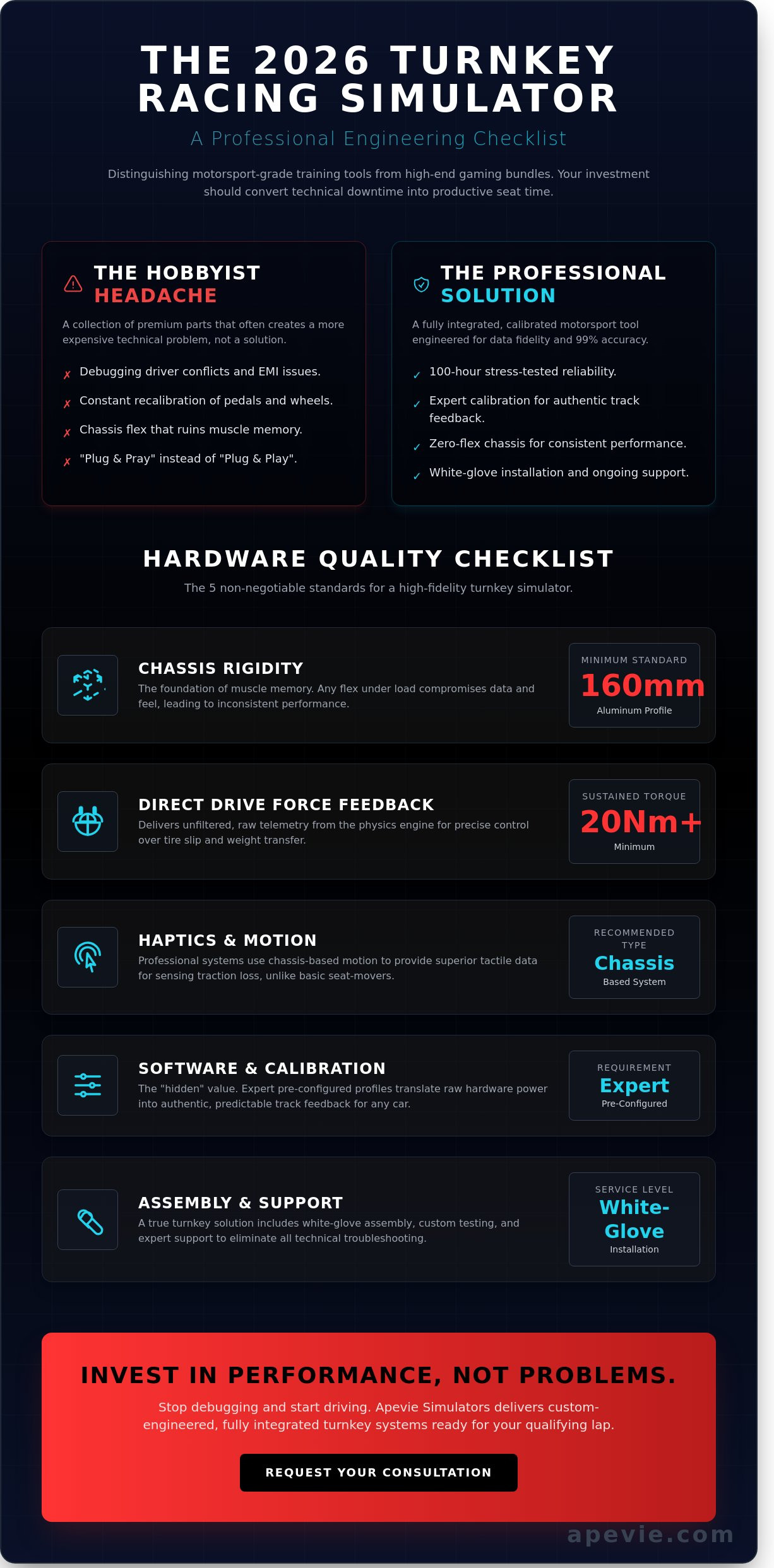
In 2026, a turnkey racing simulator represents a definitive shift from hobbyist assembly to precision engineering. It isn't merely a collection of high-end parts shipped in separate boxes; it's a fully integrated, calibrated motorsport training tool that arrives ready for a qualifying lap. For professional drivers and serious enthusiasts, the value lies in the total elimination of technical friction. You aren't just buying a wheel and a seat. You're investing in a validated feedback loop where steering torque, brake line pressure, and visual latency are synchronized to mimic a specific GT3 or Formula chassis with 99% accuracy.
The core of this experience is curation. Professional builders understand that specific pairings, such as a Simucube 2 Ultimate direct drive base and a Gomez Sim Industries (GSI) Hyper P1 steering wheel, matter because of data fidelity. These components are chosen because their communication protocols allow for a raw, unfiltered stream of telemetry. This level of curation ensures that the "noise" of the hardware doesn't interfere with the "signal" of the car's physics engine.
The Difference Between Gaming Rigs and Professional Simulators
The line between entertainment and training is drawn at fidelity. Consumer bundles often prioritize "canned" effects, such as artificial vibrations when you hit a rev limiter, which can actually mask important tire data. Professional systems focus on muscle memory. Sim racing at this level relies exclusively on PC-based ecosystems because console hardware lacks the processing power to handle complex 400Hz physics updates. Professional builders avoid "all-in-one" mass-market brands because proprietary ecosystems often limit your ability to integrate specialized hardware, like hydraulic Heusinkveld pedals or active belt tensioners.
Why Engineering Trumps Assembly
Many buyers fall into the "sum of its parts" fallacy. They assume that purchasing the most expensive components on the market will result in the best experience. In reality, these parts often conflict without expert tuning. A primary hurdle in high-torque systems is Electromagnetic Interference (EMI). Without shielded cabling and industrial-grade grounding, a motor peaking at 25Nm of torque can cause ghost inputs on your carbon fiber shifters.
Engineering a turnkey racing simulator involves stress-testing every connection for 100 hours of continuous operation to ensure 24/7 reliability. Companies like Apex Sim Racing provide the specialized dashboard enclosures and power management systems required to keep these rigs stable during grueling endurance events. This professional approach respects the user's time. A professional driver loses valuable training hours if they're forced to troubleshoot a driver conflict instead of refining their line through Eau Rouge. A turnkey solution converts that technical downtime into productive seat time, backed by expert support that consumer retail stores simply don't provide.
Ready to skip the technical headaches and start training? Contact Apevie Simulator for a consultation on a custom turnkey build tailored to your specific racing discipline.
The Hardware Quality Checklist: 5 Non-Negotiable Standards
A professional turnkey racing simulator isn't a collection of gaming peripherals; it's a precision instrument designed for mechanical sympathy and data accuracy. When you're hitting an apex at 240 km/h, the difference between a consumer bundle and professional engineering is felt in the lack of "slop" or flex in the system. High-end hardware must translate digital physics into physical resistance without filtering out the nuances that tell you when the rear tires are beginning to slide.
The global Racing Simulator Market Size reached USD 8.27 billion in 2022 and is projected to hit USD 15.38 billion by 2030. This growth is driven by a shift toward professional-grade components that offer 1:1 realism. For a setup to meet 2026 standards, it must pass a rigorous hardware checklist that prioritizes structural integrity over flashy RGB lighting.
Foundation and Force Feedback
The chassis is the most overlooked component in budget builds. A professional setup requires a 160mm aluminum profile base to ensure zero-flex performance. If the rig moves even a millimeter under heavy braking, your muscle memory suffers. Evaluating the sim rig for rigidity is your first step. Without a rock-solid foundation, the detail from a high-end motor is lost.
Direct drive fidelity is the next pillar. The Simucube 2 Pro has become the industry standard because it delivers 25Nm of peak torque with a response rate that consumer wheels can't match. You need this headroom not for sheer strength, but for dynamic range. A motor with 20Nm+ torque can replicate the sudden spike of a curb strike while maintaining the subtle vibrations of a flat-spotted tire. High-inertia wheels often mask these details, so we prioritize low rotational mass for maximum feedback clarity.
Braking and Steering Precision
In sim racing, you don't brake with your eyes; you brake with your left calf muscle. Analyzing sim racing pedals reveals that pressure-based systems are superior to travel-based ones. While entry-level load cells are a start, a pro needs the hydraulic feel of the Heusinkveld Ultimate+ or similar systems. These allow you to modulate 100kg of force with surgical precision, ensuring you hit the same braking marker lap after lap.
The checklist for a f1 steering wheel focuses on tactile feedback. We look for motorsport-grade carbon fiber and magnetic paddle shifters that provide a crisp, mechanical "click." Telemetry displays must be integrated directly into the wheel rim to keep your eyes on the track. Using components from Precision Sim Engineering ensures that every button press is intentional and every dial adjustment is felt through racing gloves.
Visual immersion completes the hardware suite. While VR offers depth perception, most professionals prefer triple 32-inch or 42-inch monitor setups for the 180-degree field of view and long-term comfort. If you want a system that integrates these standards seamlessly, consider a custom consultation for a bespoke turnkey solution tailored to your specific racing discipline.
The Software Ecosystem: Calibration and Integration
Buying a high-end rig involves more than just assembling aluminum profiles and bolting down motors. A turnkey racing simulator earns its value through the hundreds of hours spent on software refinement before the system ever reaches your floor. Most consumers underestimate the complexity of force feedback (FFB) curves and signal processing. Professional engineering ensures you receive pre-configured driver profiles for iRacing, Assetto Corsa Competizione (ACC), and rFactor 2. These profiles are meticulously tuned for specific car classes, eliminating the "dead zone" or "clipping" issues that often plague off-the-shelf consumer bundles.
For systems utilizing Simucube hardware, the True Drive software suite acts as the brain of the operation. Expert builders don't simply set the power to 100% and walk away. They calibrate damping, friction, and inertia settings to replicate the genuine mechanical resistance of a GT3 steering rack. On the OS level, a professional build includes stripping Windows of non-essential bloatware. This optimization reduces background CPU interrupts, ensuring the sim-cycle frequency remains stable at 1000Hz or higher. If a software conflict arises, remote support capabilities allow technicians to log in and recalibrate your system instantly, ensuring your seat time remains uninterrupted by technical hurdles.
PC Performance and Thermal Management
The requirements for a sim racing pc build in 2026 demand more than standard gaming specifications. Powering triple 4K monitors requires massive VRAM overhead, often exceeding 20GB to maintain texture quality without stuttering. GPU clock speeds are locked to prevent thermal throttling during two-hour endurance stints. Maintaining a consistent 144Hz refresh rate is a requirement, not a luxury. High frame rates reduce input lag to under 5ms, which is critical for preventing motion sickness and allowing for the micro-corrections needed at the limit of grip.
Peripheral Management and Cable Engineering
Reliability in a high-end rig often fails at the USB connection level. Industrial-grade, high-bandwidth USB hubs are used to prevent signal dropouts that can disconnect a wheel mid-corner. Cable management serves as a vital reliability factor rather than just an aesthetic choice. When cables are improperly shielded or tangled, Electromagnetic Interference (EMI) from high-torque direct drive motors can cause "ghost" inputs or pedal flickers. A professional turnkey racing simulator utilizes shielded cabling and a logical routing system to facilitate a single-button startup sequence. You can go from a cold system to the starting grid in under 60 seconds, mirroring the ease of starting a real car.
Ready to experience a simulator that works perfectly from the first turn? Contact Apevie Simulator for a professional consultation on your custom turnkey build.
Motion and Haptics: The Final Frontier of Realism
Static simulators often leave drivers guessing when the rear tires lose grip or how much weight has shifted during a heavy braking zone. A professional turnkey racing simulator bridges this sensory gap through sophisticated motion and haptic feedback. While entry-level kits often rely on seat-movers that pivot the chair alone, high-end engineering focuses on full-chassis motion. This approach replicates the physical forces acting on the entire car frame, providing a much more accurate representation of suspension travel and chassis twist. The distinction between these systems is not just about the range of movement, but the speed of communication. Latency is the silent killer of immersion. For a simulation to feel real, the physical response must occur within a 10ms threshold of the visual cue. Anything slower causes a sensory mismatch that leads to motion sickness and slower reaction times. Professional systems prioritize high-frequency response rates to ensure that what you see in the headset matches exactly what you feel in your spine.- Seat Movers: Disconnects the driver from the controls; can cause "motion sickness" due to conflicting visual and physical cues.
- Chassis Motion (DK2/D-BOX): Moves the entire rig; maintains consistent pedal and wheel distance; mimics real-world physics accurately.
- Traction Loss: A dedicated actuator that slides the rear of the rig to simulate oversteer, vital for GT3 and drift training.
The Physics of Sigma Integrale Systems
Sigma Integrale DK2 systems utilize direct-actuator technology to remove the mechanical play found in gear-driven or belt-driven alternatives. This precision allows drivers to feel the exact moment of traction loss. By sensing the slide 0.2 seconds earlier than through visual cues alone, racers can make micro-corrections that save lap times. Integrating these actuators directly into the core chassis architecture ensures that energy isn't lost through flexing components. This level of rigidity is a hallmark of a high-performance turnkey racing simulator.Tactile Transducers and Engine Harmonics
Vibration haptics aren't just for "rumble" effects; they provide essential telemetry data. Products like the Buttkicker Gamer Plus or high-end transducers from Clark Synthesis simulate engine RPM, gear shifts, and curb strikes. These should be driven by dedicated sound cards using telemetry-based software rather than standard game audio. This separation ensures you feel the engine's harmonics through your feet and the curb strikes through your seat. Layering these vibrations with chassis motion creates a multi-sensory environment that tricks the brain into total immersion. For those seeking the ultimate in component quality, integrating systems from Precision Sim Engineering can further refine the tactile interface of your cockpit.The Apevie Advantage: Custom Engineering and National Support
Choosing a turnkey racing simulator is an investment in your performance and your time. At Apevie, our philosophy is simple: we only curate and install the hardware we would trust in a professional race environment. We don't deal in consumer-grade plastic or entry-level bundles that flex under pressure. Every component, from the rigid aluminum profile chassis to the high-torque motors, is selected for its ability to provide consistent, 1:1 feedback during 24-hour endurance stints. Our engineers treat every build as a bespoke piece of motorsport machinery, ensuring that the tactile response you feel in the steering rack matches the telemetry of a real-world GT3 or LMP2 car.
The Apevie white-glove process eliminates the frustration of troubleshooting driver conflicts or cable failures. Before any system leaves our shop, it undergoes a rigorous 100-point testing phase. We stress-test the electronics for 48 hours to identify any potential hardware infant mortality issues. Once verified, we handle the complex logistics of shipping fully assembled systems across the United States. We use custom-built crates and specialized freight partners to ensure your rig arrives ready to plug in and drive. Our concierge support means you aren't left alone after delivery; we provide remote dial-in sessions to fine-tune your software settings and FOV (Field of View) for your specific room layout.
Personalized Component Selection
Our consultation process is designed to bridge the gap between your motorsport discipline and the digital world. If you're training for a Porsche Cup season, your pedal resistance and steering wheel diameter should reflect that reality. We offer deep customization options, including custom powder-coating for the chassis and personalized steering wheel plates to match your team's branding. Simucube and Heusinkveld serve as the indestructible foundation for every build we produce. These brands are the industry gold standard, offering the reliability and precision required for professional-grade simulation.
The Path to Your Turnkey Simulator
Moving from a consultation to your first hot lap typically takes between 4 to 6 weeks. This timeline allows our team to source premium components, execute precision assembly, and complete our extensive testing protocols. We understand that high-end gear requires protection, which is why every Apevie build includes a comprehensive warranty and hardware protection plan. You won't have to worry about component failures or technical glitches; we've got you covered so you can focus on hitting your apexes.
Ready to stop assembling and start driving? Explore our custom turnkey racing simulator builds today.
Defining Your Path to the Professional Grid
Choosing a simulator in 2026 isn't about buying the most expensive components; it's about how those parts communicate through precise engineering. A true turnkey racing simulator requires more than just bolting a Simucube 2 Pro to a frame. It demands meticulous software calibration and a motion system that translates telemetry into actionable data for the driver. Professional athletes rely on these systems because they mimic the high-frequency vibrations and pedal resistance found in real GT3 or Formula machinery. If your setup lacks the fine-tuned integration of Heusinkveld Ultimate+ pedals or custom-engineered haptics, you're practicing with a handicap.
Apevie bridges the gap between consumer gaming and professional motorsport. As an authorized Simucube and Heusinkveld dealer, we don't just ship boxes. We deliver custom-engineered systems designed for the rigors of national-level competition. Our team provides national white-glove delivery and on-site support to ensure your equipment performs exactly as intended from the first lap. Stop struggling with driver updates and cable management. Focus on your lap times while we handle the technical precision required for elite performance.
Design your professional turnkey racing simulator with Apevie
Your journey toward consistent podium finishes starts with the right foundation. We're ready to help you build it.
Frequently Asked Questions
What is included in a turnkey racing simulator package?
A professional turnkey racing simulator includes the cockpit, direct drive wheel base, hydraulic pedals, a high-spec PC, and the entire monitor array. Apevie builds feature industrial-grade components, such as the Heusinkveld Ultimate+ pedals used by professional drivers like Roman Ziemian. You won't spend days cable managing or installing drivers; the system arrives fully configured with simulation titles like iRacing or Assetto Corsa Competizione pre-loaded for immediate use.
How much space do I need for a professional triple-monitor sim rig?
You need a dedicated footprint of 1.5 meters in width and 2.1 meters in length for a standard triple 32-inch monitor setup. If you opt for larger 42-inch OLED displays, the width requirement increases to 2.4 meters. We recommend leaving an additional 0.5 meters of clearance around the perimeter. This space ensures you can enter the cockpit easily and allows for proper ventilation of the high-performance PC components.
Can a turnkey simulator be used for both F1 and GT3 racing?
Yes, modern turnkey racing simulator systems are highly versatile because of modular wheel rims and adjustable pedal faces. A professional build often uses a quick-release system like the Simucube SQR, allowing you to swap a formula-style rim for a round GT3 wheel in under 5 seconds. Software profiles within the system adjust the steering rotation from 360 degrees for F1 to 900 degrees for GT cars automatically.
Do I need a professional driver to help me set up the software?
You don't need a professional driver for technical setup, though Apevie provides expert calibration to ensure the physics feel authentic. Our engineers handle the complex telemetry configurations and force feedback tuning before the system ever reaches your door. While professional drivers often use these systems for track familiarization, the turnkey nature means the software is optimized for immediate use. You can focus on hitting your apexes rather than troubleshooting Windows updates.
What is the difference between a direct drive wheel and a gear-driven wheel?
Direct drive wheels connect the steering rim directly to the motor shaft, providing 100 percent of the torque and detail without mechanical loss. Gear-driven or belt-driven wheels use internal mechanisms that dampen subtle vibrations and introduce mechanical friction. A high-end direct drive base like the Simucube 2 Pro delivers 25Nm of peak torque. Entry-level gear systems often peak at just 2.2Nm, which means you miss critical data about tire slip and weight transfer.
Is a motion system necessary for professional racing training?
Motion systems aren't strictly necessary for lap time improvement, but they're vital for sustained muscle memory and inner-ear balance training. Actuators like the D-BOX G5 provide haptic feedback at frequencies up to 100Hz, simulating engine vibrations and curb strikes. Professional drivers use these cues to sense the car's limit before it's visible on screen. Without motion, you rely solely on visual cues and the force feedback felt through your hands.
How do you handle shipping and assembly for a turnkey system?
Apevie manages the entire logistics chain through a white-glove delivery service that includes on-site assembly and final calibration. We don't just drop a pallet at your door; our technicians assemble the rig in your designated room and perform a 50-point quality checklist. This process typically takes 4 to 6 hours depending on the complexity of the motion system. We ensure the seating position and pedal reach are ergonomically perfect for your specific height.
Are turnkey simulators compatible with consoles like PS5 or Xbox?
Most professional turnkey systems utilize high-end PC hardware because consoles lack the processing power for triple-screen rendering and advanced telemetry. While some bases like the Fanatec DD2 offer PlayStation compatibility, you'll lose the ability to run external data displays or sophisticated motion profiles. We build our systems around custom-spec PCs to ensure 144Hz refresh rates and 4K resolution, which are currently unattainable on standard gaming consoles.