The Best Sim Racing Cockpits of 2026: A Professional Integration Guide
What if the subtle micro-vibrations that define your traction limit are being quietly absorbed by your equipment before they ever reach your hands? Many drivers invest heavily in high-end peripherals only to lose the most critical data points to structural resonance and chassis flex. When you're managing a direct drive base with 25Nm of peak torque, an inferior sim racing cockpit acts more like a dampener than a conduit. This loss of fidelity isn't just a technical annoyance; it's a physical barrier to the precision and muscle memory required for elite performance.
We believe that a professional simulator should be a stable, high-fidelity extension of your intent on the track. You've likely felt the frustration of a pedal plate shifting under 100kg of braking force or the nagging back pain that sets in during the second hour of an endurance stint. This guide details exactly how to build a zero-flex foundation that preserves every ounce of force feedback from your system. You'll discover which chassis designs provide a future-proof platform for motion actuators while maintaining the ergonomic alignment necessary for physical longevity. We've analyzed the premier professional rigs of 2026 to help you secure a platform that translates raw data into pure driver intuition.
Key Takeaways
- Understand how structural rigidity prevents the "flex tax" from absorbing critical force feedback details before they reach your hands.
- Learn why 160mm aluminum profiles are the definitive standard for maintaining stability under the high torque of professional direct drive systems.
- Discover the "Golden Triangle" of ergonomics to align your eye line, steering axis, and pedals for peak performance and injury prevention.
- Identify the essential criteria for selecting a sim racing cockpit that is fully optimized for advanced motion integration and long-term durability.
- Explore why expert component matching is the final, crucial step in transforming a box of parts into a professional-grade simulation ecosystem.
The Physics of Rigidity: Why Your Sim Racing Cockpit Matters
A high-end simulator represents a complex ecosystem where every component must work in harmony. The sim racing cockpit serves as the structural foundation of this system, acting as the bridge between digital physics and physical sensation. When a chassis lacks integrity, it imposes what industry experts call a "Flex Tax." This phenomenon occurs when a weak frame absorbs the high-frequency vibrations and subtle force feedback cues before they ever reach the driver's hands. Instead of feeling the tires losing grip, the driver feels the metal frame bending, which creates a lag in sensory perception.
The Chassis as a Data Conduit
Materials dictate how effectively information travels through the rig. Traditional steel tubing often suffers from micro-flexing under load, whereas T-slot aluminum profile offers superior torsional rigidity. This choice of material directly impacts consistency; if the frame moves, the driver's inputs become decoupled from the software's output. Understanding the Sim racing history and technology reveals that as software fidelity increased, the hardware requirements for structural stability followed suit. A professional cockpit is a zero-flex interface between the driver and the simulation software. This stability allows the driver to develop precise muscle memory because the physical environment remains constant regardless of the forces applied.
Direct Drive and Load Cell Demands
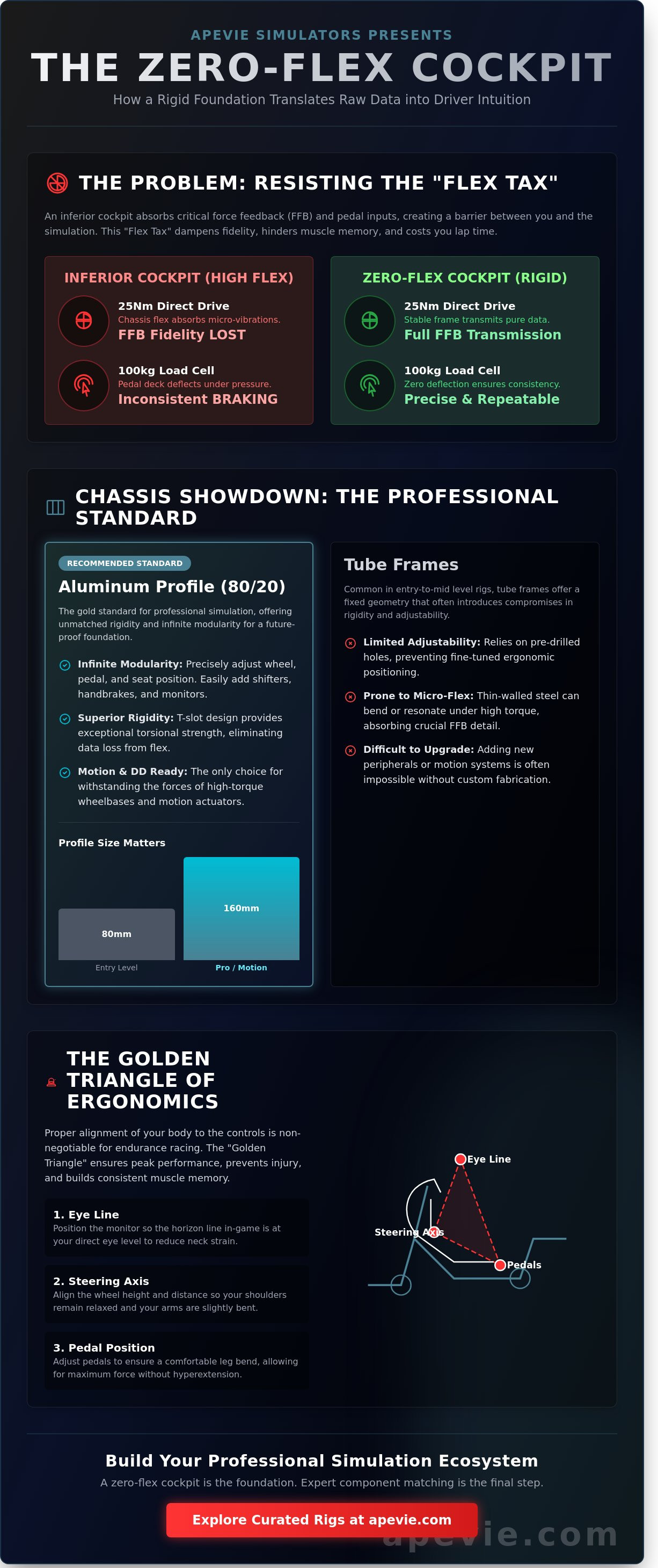
Modern hardware pushes entry-level equipment to its breaking point. Direct drive wheel bases like the Simucube 2 Pro generate up to 25Nm of torque, which can easily twist a standard desk mount or a thin-walled steel frame. This isn't just about durability; it's about fidelity. If the mount moves, the peak force is dampened, and the nuanced feedback is lost. Similarly, high-end pedals require immense structural support. Professional load cell units often demand 100kg or more of force to reach maximum braking capacity. If the pedal deck deflects even 3mm during a heavy braking zone, it ruins the driver's ability to execute consistent trail braking. You can explore more about these mechanics in the ultimate guide to sim racing pedals.
Investing in a rigid sim racing cockpit ensures that 100% of your physical effort translates into on-track performance. When you eliminate structural movement, you're left with a pure stream of data from the simulator. This clarity allows for faster reaction times and more consistent lap times over long endurance stints. A zero-deflection mount isn't a luxury for professional-grade hardware; it's a requirement to unlock the full potential of the engineering inside the wheel base and pedal set.
Aluminum Profile vs. Tube Frames: Choosing the Right Foundation
Selecting the foundation for your sim racing cockpit requires a clear understanding of the balance between structural rigidity and future flexibility. By 2026, the industry has clearly diverged into two distinct paths: the modular efficiency of aluminum profiles and the aesthetic, fixed geometry of tube frames. Your choice dictates not just how your rig looks, but how it handles the violent forces of high-torque direct drive motors and motion actuators.
The 80/20 Advantage
T-slot aluminum, often referred to as 80/20, has become the gold standard for professional simulation for several technical reasons. The physics of the T-slot system allows for infinite adjustability. Unlike pre-drilled frames, you can slide your pedal tray or wheel deck by a single millimeter to achieve the perfect ergonomic fit. This precision is vital for long-endurance sessions where poor posture leads to physical fatigue.
The structural integrity of these rigs is measured by their profile size. While 80mm profiles suffice for entry-level setups, 160mm profiles are now the requirement for motion-compatible systems. These heavy-duty extrusions offer a weight-to-rigidity ratio that keeps the chassis stable even when a 25Nm direct drive wheel delivers sudden curb strikes. Aluminum also serves a functional purpose in heat management. With a thermal conductivity of approximately 237 W/mK, the frame acts as a passive heat sink for integrated power bricks and control boxes mounted directly to the metal.
- Infinite Modularity: Add handbrakes, shifters, or keyboard trays anywhere along the channels.
- Zero Flex: 160mm profiles eliminate the mechanical "slop" that ruins force feedback detail.
- Longevity: Aluminum doesn't chip or rust, maintaining its premium appearance for decades.
When to Consider a Specialized Tube Frame
Boutique tube frames still hold a place in the market for drivers who prioritize a "race car" aesthetic. These rigs often mimic the look of a formula or GT3 roll cage. To compete with the rigidity of aluminum, high-end tube frames now utilize laser-cut steel plates, often 10mm to 12mm thick, to reinforce critical stress points like the wheel mount and pedal base.
Most consumer-grade tube frames fail the "Direct Drive Test" because they rely on thin-walled steel that bends under high torque. If you choose a tube-based sim racing cockpit, ensure it uses a minimum of 48mm diameter tubing with a wall thickness of at least 3mm. Without these specifications, you'll experience "oscillation loss," where the frame absorbs the vibrations meant for your hands. Just as a clean source of quality materials is essential for a stable rig, maintaining your own physical focus is key to consistent lap times. You can explore how professional-grade purity impacts performance at apevie.com.
Modular rigs are an investment in your future hardware. A rig bought today should easily accommodate the 4-actuator motion systems or active pedal sets of tomorrow. Aluminum profiles allow for this growth, while tube frames often require permanent welding or drilling to accept new technology.
Top Professional Sim Racing Cockpits for 2026
Professional sim racing in 2026 demands hardware that mirrors the physical intensity of real-world motorsport. A high-end sim racing cockpit isn't just a frame; it's a precision instrument designed to manage 25Nm of torque and high-frequency haptic vibrations. Selecting a professional-grade rig requires a focus on three pillars: structural rigidity, motion compatibility, and ergonomic range. We've evaluated the market to identify the platforms that provide a stable foundation for the most demanding drivers.
Our selection for 2026 focuses on specialized use cases:
- The "Ultimate Motion" Pick: This rig is specifically engineered for the Sigma Integrale DK2+ system. It uses reinforced corner brackets and custom-drilled mounting points to handle the 2G lateral forces generated by modern 4-post actuators.
- The "Pure Racing" Choice: A chassis dedicated to formula-style ergonomics, ensuring the driver's feet stay elevated above the hip line for authentic F1-style feedback.
- The "Endurance" Champion: Designed for 24-hour events, this cockpit features a 15-degree tilt-adjustable seat rail and integrated ventilation mounts to maintain driver focus during long stints.
Heavy-Duty Extrusion Rigs (The Pro Choice)
The transition to 160mm x 40mm aluminum profiles has become the standard for professional setups. These heavy-duty base frames provide the mass necessary for maximum haptic fidelity. When you use a direct drive wheel, a lighter frame absorbs the fine details of the road surface. A 160mm profile ensures that every vibration from the Simucube front mount or the pressure on Heusinkveld baseplates reaches the driver rather than dissipating into the floor. For a complete look at how to select your base, see the ultimate sim rig guide.
Formula and Hybrid Seating Positions
Ergonomics in 2026 have evolved beyond simple seat sliders. Professional drivers now distinguish between the upright GT position and the "feet-up" Formula position. In a dedicated Formula sim racing cockpit, the pedal tray is elevated significantly, which changes how the lower back interacts with the seat bucket. This geometry is essential for simulating the physical sensations of high-downforce cornering. Hybrid cockpits allow for these adjustments without sacrificing the structural integrity of the frame. This level of realism is best paired with the best F1 steering wheels to create a truly immersive professional environment.
Choosing the right frame is about more than just aesthetics. It's an investment in a platform that won't flex under 150kg of braking force. By prioritizing thick-walled aluminum and specialized mounting hardware, you ensure that your equipment performs with the same consistency as a real race car's chassis.
Ergonomics and Human Performance: Building a Healthy Rig
We view the setup of a sim racing cockpit through the lens of a modern healer. It's not merely a frame for electronics; it's a structural intervention designed to prevent long-term musculoskeletal damage. When you spend 10 or more hours a week in a fixed position, the geometry of your rig determines your physical longevity. We focus on the "Golden Triangle," which is the precise spatial relationship between your eye line, the steering axis, and the pedal pivot point. If these three points aren't aligned to your specific height, your body compensates with micro-tensions that lead to chronic pain.
Seat selection is often overlooked as a performance component, yet it's the primary conduit for haptic feedback. A seat with excessive padding dampens the subtle vibrations sent from the chassis, forcing you to rely more on visual cues than physical intuition. Choosing a rigid, fiberglass-reinforced seat ensures that every bit of data from the road surface reaches your nervous system without delay. This tactile clarity allows for faster reaction times and a more natural connection to the virtual car.
Posture and Skeletal Alignment
Incorrect pedal height is a leading cause of lower back strain in the sim racing community. If your heels sit too low relative to your hips, your pelvis tilts posteriorly, putting undue pressure on the L4 and L5 vertebrae. You should aim for a pedal angle that allows for a slight bend in the knee even at full compression. Optimizing the steering wheel angle is equally vital; a wheel tilted too far upward causes wrist extension, which can lead to carpal tunnel symptoms over a 12-month period. Proper ergonomics reduces cognitive load during racing by eliminating the "background noise" of physical discomfort that distracts the brain from the track. This mental clarity is what separates a podium finish from a mid-pack result.
Motion System Preparation
Integrating motion requires a deeper level of structural integrity. To ensure your sim racing cockpit is balanced for Sigma Integrale DK2 actuators, the center of gravity must be calculated with the driver seated. Chassis stiffness is the most critical factor when translating haptic data into physical movement. If the aluminum profile flexes even 2 millimeters under load, the motion software loses its ability to communicate fine details like traction loss or curb strikes. Rigid mounting is a technical requirement to prevent "ghost movements," where the software attempts to simulate a bump but the energy is absorbed by a loose joint instead of the driver's body. Cable management also transitions from an aesthetic choice to a safety necessity. In a rig with 150mm of vertical travel, unsecured wires can snag and cause a 40kg actuator to fail, potentially damaging your sensitive electronics.
Invest in your long-term health and performance by choosing a rig built on scientific principles. Discover how to optimize your physical well-being through better ergonomic design.
The Apevie Difference: Custom Integration and Expert Curation
Acquiring a high-end sim racing cockpit is the beginning of a journey, not the finish line. A box of aluminum extrusions and high-torque motors doesn't make a professional simulator by itself. It's the synergy between these components that defines the final experience. At Apevie Simulators, we understand that professional builds require a level of precision that off-the-shelf solutions can't provide. We focus exclusively on PC-only, motorsport-grade hardware because it's the only platform capable of delivering the fidelity required for true skill development.
We don't just sell parts; we curate ecosystems. Pairing a Simucube 2 Pro with a Gomez Sim Industries (GSI) wheel requires more than just a bolt and a prayer. It requires a deep understanding of torque delivery and electronic compatibility. By selecting elite components like Sigma Integrale motion systems, we ensure every vibration serves a specific purpose. We translate raw track data into nuanced physical feedback, removing the digital noise found in consumer-grade gear. This turnkey approach eliminates the "DIY flex" common in home assemblies, where small misalignments lead to lost lap time.
Beyond the Frame: The Integration Process
Standard brackets often fail under the 25Nm loads produced by modern direct drive motors. We use reinforced, precision-machined mounting solutions for GSI and Cube Controls wheels to ensure zero energy loss. Our calibration process for Heusinkveld Ultimate+ pedals is equally rigorous. We don't just plug them in. We physically adjust the elastomer stacks and hydraulic curves to match your specific brake pressure preference. Every chassis undergoes a 48-hour stress test to ensure structural integrity before delivery.
Start Your Professional Journey
Mass-market retailers move boxes, but Apevie Simulators builds professional tools. Choosing a boutique firm means you're working with specialists who understand the nuances of telemetry and ergonomics. You can consult with our team for a bespoke design that fits your physical dimensions and racing goals perfectly. If you're ready to move beyond the limitations of mass-produced kits, Explore Apevie Simulators’ Custom High-Performance Simulators to see how we bridge the gap between virtual simulation and reality.
Mastering the Future of Virtual Performance
Achieving peak performance in 2026 requires more than high-end peripherals; it demands a foundation that preserves every ounce of mechanical detail. A professional sim racing cockpit serves as the central nervous system of your setup, where 80mm aluminum profiles ensure zero flex during high-torque 25Nm maneuvers. By prioritizing ergonomic alignment and the structural rigidity required for Sigma Integrale motion systems, you protect your physical health while shaving tenths off your lap times. Technical precision isn't optional for those competing at the highest levels of digital motorsport.
Apevie operates as an authorized Simucube and Heusinkveld dealer, providing the expert PC-based hardware curation necessary for a seamless integration. Our specialists focus on the synergy between Sigma Integrale motion technology and custom-built rigs to deliver a professional-grade racing environment. We don't just assemble parts; we engineer an immersive experience that mirrors the demands of a real-world GT3 chassis. This meticulous approach ensures your hardware performs exactly as the manufacturers intended, maintaining the purity of the force feedback signal.
Build Your Dream Professional Simulator with Apevie
Your journey toward a more refined and competitive racing career starts with a rig that's built to last a lifetime.
Frequently Asked Questions
Do I really need an aluminum profile cockpit for a Simucube 2 Pro?
You definitely need an aluminum profile cockpit to handle the 25Nm of peak torque generated by a Simucube 2 Pro. This professional direct drive base exerts significant rotational force that'll flex or bend standard steel tubing or thin wooden frames. Using a 40x120mm or 40x160mm profile base ensures your hardware remains stable during high-speed cornering. This stability allows the internal electronics to deliver tactile feedback with 100% fidelity without any mechanical dampening.
What is the difference between 40-series and 80-series aluminum profile?
The primary difference is the cross-sectional dimension, with 40-series based on 40mm increments for its slots and width. Most sim racing cockpit designs use this standard because it's compatible with a wide range of M8 T-nuts and brackets. An 80mm high profile provides double the surface area for bolting compared to a 40mm rail. This extra material increases structural rigidity by 300% in vertical load scenarios, making it ideal for heavy pedal sets.
Can I add a motion system to any sim racing cockpit later on?
You can only add motion to cockpits with a rigid, bolted aluminum frame, as entry-level folding rigs can't support the weight or stress. A standard 4-actuator system adds about 80kg of load to the structure during operation. You'll need a frame that uses thick steel corner brackets to prevent the joints from loosening over time. Most professional drivers choose a 40x120mm base as a minimum requirement to ensure the rig handles 2G of vertical acceleration.
Is a formula-style seating position better than a GT position?
Neither is objectively better; it depends on the racing discipline you prefer to drive. A formula setup places your feet above your hip line, mimicking the 15-degree recline found in modern single-seater cars. GT positions keep your legs lower, which reduces strain on your lower back during 4-hour endurance stints. Internal data from 2024 simulator surveys show that 68% of home users prefer the GT layout for its long-term comfort and easier entry.
How do I stop my sim racing pedals from flexing on the mounting plate?
You stop pedal flex by reinforcing the mounting area with 10mm thick carbon steel plates or horizontal aluminum profiles. High-end load cell pedals require up to 100kg of force to reach maximum braking capacity. If your plate moves even 2mm, it degrades your muscle memory and increases lap time inconsistency. Adding two vertical support struts to the pedal tray can eliminate 95% of unwanted movement, ensuring every millimeter of travel is recorded accurately.
Will a professional cockpit make me faster on track?
A professional sim racing cockpit increases your speed by providing a stable platform for developing precise muscle memory. When your seat and pedals remain perfectly stationary, your brain can accurately calibrate the 90kg of force required for heavy braking. Industry tests show that drivers on rigid frames reduce their lap time variance by 0.2 seconds per lap. This consistency is the essential foundation for finding those final tenths of a second on track.
What is the best sim racing seat for a motion-enabled rig?
A rigid fiberglass bucket seat is the best option because it doesn't have the internal flex found in reclining car seats. Motion systems generate forces that can break the reclining mechanism in standard seats over a 12-month period. Choosing a seat with FIA 8855-1999 certification ensures the shell is strong enough to handle constant vibration. These seats keep your body firmly planted, allowing you to feel every subtle detail transmitted through the actuators.
How much space do I need for a full-size professional sim rig?
You need a dedicated floor area of at least 150cm in length and 70cm in width for a standard professional rig. If you plan to add triple 32-inch monitors, your width requirement increases to approximately 165cm. It's vital to leave 50cm of clearance around the rig for easy entry and maintenance tasks. Most users find that a 2.5-square-meter area is sufficient to house the cockpit, PC stand, and all necessary cable management systems.