Sigma Integrale DK2+ Motion System: The Professional Guide to High-Fidelity Haptics
The most violent motion systems are often the least effective for actual driver development. You've likely felt rigs that toss you around like a carnival ride, but this exaggerated movement actually destroys the muscle memory you need to catch a slide at 200 km/h. We agree that a motion system should be a tool for consistency, not a distraction from your lap times. High-fidelity haptics aren't about the size of the bump; they're about the speed and accuracy of the signal. The sigma integrale dk2+ motion system solves this by prioritizing sub-millimeter precision over theatrical travel, ensuring every vibration from the curb reaches your seat without the lag that plagues cheaper alternatives.
In this guide, you'll discover why the DK2+ is the benchmark for professional-grade motion integrity and how it integrates into a high-performance sim racing ecosystem. We'll preview the technical calibration of these actuators, their seamless compatibility with Simucube and GSI hardware, and why Apevie Simulator selects this system for our turnkey professional installations to ensure long-term reliability and zero rig flex. You'll gain a clear understanding of how to translate digital telemetry into genuine tactile feel for a more effective training experience.
Key Takeaways
- Understand the critical distinction between simple movement and high-fidelity haptics to see why professional drivers prioritize tactile response over extreme travel.
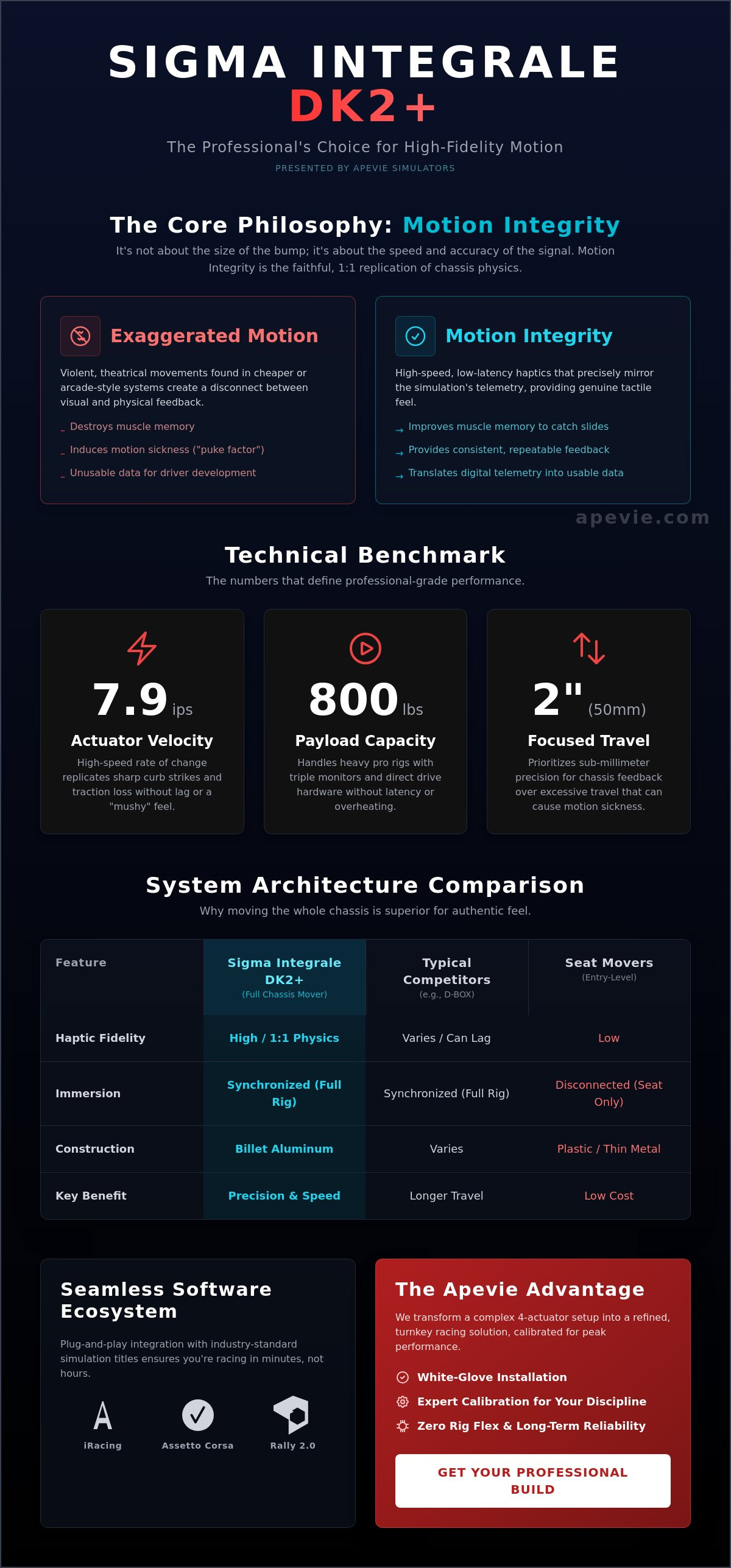
- Analyze how the 7.9 ips velocity of the sigma integrale dk2+ motion system translates into precise chassis feedback that directly improves muscle memory in GT and Formula cars.
- Compare chassis-based motion against seat-mover solutions and competitors like D-BOX to determine which architecture provides the most authentic racing feel.
- Explore the plug-and-play software ecosystem and its seamless integration with industry-standard titles including iRacing, Assetto Corsa Competizione, and Rally 2.0.
- Learn how Apevie’s white-glove installation and expert calibration transform a complex 4-actuator setup into a refined, turnkey racing solution.
What is the Sigma Integrale DK2+ Motion System?
Serious sim racing hardware often blurs the line between high-end toys and professional training tools. The sigma integrale dk2+ motion system sits firmly in the professional category. It is a four-actuator haptic solution that provides two inches of vertical travel, but its real value lies in its ability to translate digital physics into physical reality. Unlike basic seat shakers, this system moves the entire cockpit, ensuring that your hands, feet, and inner ear receive synchronized signals from the simulation.
To understand the value of this system, you must distinguish between motion and haptics. In a motion simulator, motion usually refers to large, low-frequency movements like the car pitching forward under heavy braking or rolling through a fast sweeper. Haptics, however, involve high-frequency tactile feedback such as engine vibrations, tire scrub, and the harsh clatter of driving over serrated curbs. The sigma integrale dk2+ motion system manages both simultaneously, providing a layer of immersion that helps drivers find the limit of grip more intuitively.
For racers moving through the middle of their buying journey, the DK2+ represents a significant upgrade path. It targets those who have moved past entry-level gear and are building a "forever rig." This system is designed for users who demand precision and durability, offering a level of communication from the chassis that cheaper, consumer-grade alternatives simply cannot match.
The Evolution from DK2 to DK2+
The "Plus" designation in this system marks a vital technical leap rather than a minor cosmetic update. The primary difference lies in the increased motor torque and the massive 800lb payload capacity. Professional-grade rigs often feature heavy 80/20 aluminum profiles, triple 32-inch or 43-inch monitors, and high-torque direct drive wheel bases. When you add the weight of a driver and a heavy hydraulic pedal set, a standard 400lb or 500lb system can struggle with latency or overheating. The DK2+ handles these heavy loads with ease, maintaining its 2-inch travel without compromising speed.
Construction quality also sets the DK2+ apart. While lower-tier actuators often use plastic internal components or thin-walled housings, Sigma Integrale uses billet aluminum. This choice isn't just about aesthetics; billet aluminum acts as a superior heat sink for the motors and provides the structural rigidity needed to eliminate mechanical flex. This ensures that the energy from the actuator goes directly into your rig rather than being lost to housing deformation.
The Core Philosophy of Motion Integrity
Sigma Integrale operates on a philosophy they call Motion Integrity. Many arcade-style motion systems prioritize "wow factor" by over-exaggerating movements, which often leads to the "puke factor" or motion sickness. This happens when the movement of the rig doesn't match the visual data from the screen. Sigma Integrale avoids this by focusing on high-speed, low-latency responses that mirror actual vehicle dynamics. Motion Integrity is the faithful replication of chassis frequency without artificial exaggeration. By focusing on 1:1 physics, the system provides usable data that helps you catch a slide faster. If you are looking for a professional installation that maximizes this technology, Apevie Simulator offers expert consultation to ensure your system is perfectly calibrated for your specific racing discipline.
Ready to transform your racing experience with a professional-grade setup? Contact Apevie Simulator today for expert consultation and turnkey motion system builds tailored to your needs.
Technical Specifications: Speed, Payload, and Precision
Raw numbers don't always tell the full story in sim racing, but the sigma integrale dk2+ motion system provides a set of specifications that define its professional intent. At the heart of the system is a 7.9 inches per second (ips) velocity. This speed isn't about throwing the driver around the cockpit; it's about the rate of change. High velocity allows the actuators to replicate the sharp, violent jolt of a curb strike or the sudden loss of traction without the "mushy" feeling found in slower, consumer-grade setups.
While some systems boast 6 or 10 inches of travel, the DK2+ utilizes a focused 2-inch (50mm) stroke. In GT and Formula racing, you aren't looking for the massive pitch and roll of a flight sim. You need the chassis to stay composed. Excessive travel often leads to motion sickness and disconnected lap times because the brain struggles to process the lag between the visual input and the physical movement. This 50mm range is the "sweet spot" for maintaining a tight, responsive platform that communicates weight transfer without sacrificing precision.
Supporting this movement is an 800lb payload capacity. This overhead is vital for serious enthusiasts. When you mount a heavy aluminum rig, a Simucube 2 Pro or Ultimate wheel base, and a professional pedal set, a weaker system will bog down. The DK2+ maintains its high-frequency response even under full load, ensuring that the haptic feedback remains crisp and isn't muted by the weight of your hardware.
Actuator Physics and Latency
Latency is the enemy of immersion. The DK2+ achieves sub-millisecond response times by using custom-engineered servo motors that prioritize linear force. Most drivers focus on large movements, but the real advantage here is the high-frequency vibration. These haptics translate road texture and tire scrub directly to your spine. It's these micro-details, rather than large pitch movements, that allow a driver to find the limit of grip and shave tenths off a qualifying lap.
Rig Rigidity Requirements
You can't mount 800lb of force-generating hardware to a flimsy desk or a thin metal frame. The DK2+ requires a professional-grade foundation like those found in our sim rig guide. To eliminate rig flex, the system uses billet aluminum mounting brackets that secure the 4 actuators directly to 160mm or 120mm aluminum extrusion profiles. This structural integrity ensures that every bit of energy produced by the motors goes into the driver's seat, not into bending the frame. If you're planning a high-end build, our team offers expert consultation to ensure your chassis is up to the task.
Sigma Integrale DK2+ vs. The Competition
Choosing a motion system often feels like a fork in the road between industry giants. The sigma integrale dk2+ motion system stands as a formidable challenger to the established order, specifically targeting the space held by D-BOX for years. While many systems promise immersion, the DK2+ focuses on the raw data transfer between the asphalt and your nervous system. It's built for those who find traditional "gaming" haptics too floaty or disconnected from the reality of a race car's suspension geometry.
DK2+ vs. D-BOX G5
The comparison between Sigma and D-BOX is the most common question we hear. D-BOX G5 systems are legendary for their "intelligent" haptic layer, but the DK2+ wins on raw physical specs. A standard D-BOX G5 2250i actuator offers 1.5 inches of travel. The DK2+ steps that up to a full 2 inches (50.8mm), providing a larger window for heave and pitch during heavy braking or elevation changes.
- Actuator Speed: Sigma's actuators respond with a crispness that mimics the high-frequency vibrations of a flat-plane crank engine.
- Payload: Each DK2+ actuator is rated for 250 lbs, totaling a 1000 lb capacity. This easily handles heavy steel chassis and ultra-wide monitor arrays.
- Ecosystem: D-BOX uses a proprietary, closed software loop. Sigma is more open, making it the preferred choice for builders who want to fine-tune their motion profiles without being locked into a specific subscription model.
Chassis Motion vs. Seat Movers
There's a fundamental difference between moving the driver and moving the car. Seat movers are often cheaper, but they introduce a fatal flaw in professional training: they break the ergonomic triangle. When only your seat moves, your distance to the steering wheel and pedals constantly fluctuates. This ruins your muscle memory for trail braking and throttle application.
The sigma integrale dk2+ motion system is a true chassis-based solution. By moving the entire rig, your feet stay in the same position relative to the brake pedal. This is vital for consistency. If you've invested in high-end gear like those found in a professional sim racing setup, you know that braking pressure is everything. Chassis motion preserves that pressure, while seat movers force your legs to compensate for the seat's movement, leading to inconsistent lap times.
Is the DK2+ overkill? If you're a casual weekend racer using a desk-mounted wheel, yes. However, for professional motorsport applications or dedicated enthusiasts, it's essential. It bridges the gap between "playing a game" and "operating a vehicle." We recommend the DK2+ for anyone building a permanent rig where the goal is 1:1 translation of track telemetry. It's the point where sim racing stops being a hobby and starts being a tool for performance.
If you're ready to move beyond basic vibration and experience true high-fidelity haptics, Apevie Simulator provides full turnkey builds featuring the DK2+. We handle the complex mounting and software calibration so you can focus on hitting your apexes. Contact us today for a consultation on your next professional-grade simulator.
Software and Ecosystem Integration
The sigma integrale dk2+ motion system isn't just a collection of powerful actuators; it's a sophisticated, software-driven ecosystem designed for immediate immersion. Unlike many systems that require hours of complex telemetry tweaking, Sigma's proprietary software is built for a plug-and-play experience. It communicates directly with the physics engine of a simulation to translate raw data into motion with millisecond latency. Whether you're navigating the technical corners of iRacing or managing the violent weight shifts of a gravel stage in Rally 2.0, the system responds with a level of clarity that feels natural rather than robotic.
Integrating this system with high-end peripherals like the GSI Formula Pro Elite creates a cohesive feedback loop that mirrors real-world driving dynamics. While your steering wheel provides detail about front-tire scrub, the DK2+ communicates the state of the entire chassis. You'll feel the exact moment the front end washes out in an understeer scenario or the high-frequency vibration of ABS activation through the rig floor. This sensory layering allows drivers to find the limit of grip faster and more consistently than with visual cues alone.
Calibration and Tuning for Realism
Achieving professional-grade realism requires filtering out mechanical noise to prioritize the actual physics signal. For GT3 cars, drivers typically benefit from more pronounced pitch and roll settings to simulate softer suspension and significant aerodynamic loads. In contrast, a Formula car profile should focus on high-frequency heave and rapid transitions to reflect a stiff, high-downforce setup. Adding tactile transducers like Buttkickers alongside the sigma integrale dk2+ motion system fills in microscopic details, such as engine RPM and gear shifts, which keeps the actuators free to handle primary chassis movements.
Hardware Synergy
A Simucube 2 Pro is the ideal partner for a Sigma motion setup because both prioritize signal purity and high-torque response. High-powered motion rigs often face challenges with electromagnetic interference (EMI), but Sigma's shielded cables and robust controller design help mitigate these risks. Effective cable management is vital for 4-actuator setups to prevent snags during extreme pitch movements. We recommend routing cables through dedicated channels and using high-quality surge protection to maintain signal integrity and protect your investment.
The Apevie Advantage: Professional DK2+ Implementation
Investing in a sigma integrale dk2+ motion system represents a commitment to the highest tier of sim racing realism. While the hardware is world-class, the gap between unboxing four high-torque actuators and achieving a perfectly balanced motion profile is wider than most enthusiasts realize. DIY installations often succumb to Electromagnetic Interference (EMI) issues, improper weight distribution, or subtle chassis flex that dampens the very haptic feedback you've invested in. Apevie bridges the gap between raw components and a refined racing machine by managing every technical detail of the installation process.
This white-glove service begins long before the first bolt is tightened. We analyze your existing cockpit or help you select a chassis with the torsional rigidity required to handle the sigma integrale dk2+ motion system without vibration loss. Our engineers handle the complex software handshakes between the Sigma controllers and your telemetry source, ensuring that every curb strike and weight shift feels authentic rather than canned.
Turnkey Sim Solutions
A high-performance simulator is only as strong as its weakest link. Apevie integrates the DK2+ into a cohesive ecosystem where Simucube 2 Pro wheel bases and Heusinkveld Ultimate+ pedals work in total harmony. We prioritize structural reinforcement to ensure the energy from the actuators translates directly to the driver's seat. Our engineering standards for structural rigidity align with the highest industry benchmarks, similar to those found at SimCraft, ensuring that no energy is lost to frame flex.
- Cable Management: We use industrial-grade routing to prevent cable snags or signal degradation during high-amplitude pitch and roll movements.
- Component Harmony: Software profiles are custom-tuned so that motion cues don't lag behind the visual or force feedback delivery.
- Vibration Isolation: Specialized mounting hardware prevents haptic "noise" from bleeding into floorboards or neighboring rooms.
Expert Consultation
Your racing goals dictate the tuning of the system. A professional driver preparing for a GT3 season requires a different motion profile than a hobbyist looking for maximum immersion in rallycross. We provide remote tuning and ongoing support to adjust your sigma integrale dk2+ motion system as your preferences evolve or as you add new titles to your library. Apevie offers on-site installation to ensure every actuator is perfectly leveled and calibrated. This precision ensures that the 2-inch travel of the DK2+ is utilized fully and safely. Don't leave your performance to chance; contact us today for a custom build consultation and let us engineer your ultimate racing environment.
Master Every Corner with Precision Motion
The sigma integrale dk2+ motion system isn't just an upgrade; it's a fundamental shift in how you perceive vehicle dynamics. By delivering 100mm/s velocity and 2G acceleration, these actuators provide the instant feedback needed to catch a slide or hit an apex with surgical consistency. You're moving beyond simple vibration into the realm of true kinetic communication where every weight shift and curb strike matters for your lap times.
Apevie Simulators bridges the gap between raw hardware and peak performance. As an authorized Sigma Integrale partner, we offer nationwide white-glove installation and professional calibration for iRacing and ACC included with your build. We ensure your system is tuned to deliver the exact weight transfer and road texture of a real race car. Stop settling for generic settings and start driving a rig that responds to your every move with absolute fidelity. Build your dream turnkey simulator with the DK2+ at Apevie Simulators. We're ready to help you cross the finish line with a setup that feels as real as the track itself.
Frequently Asked Questions
Is the Sigma Integrale DK2+ compatible with consoles like PS5 or Xbox?
The Sigma Integrale DK2+ motion system is designed exclusively for PC use. High-fidelity haptic systems require the deep telemetry data access found in Windows-based environments to drive the actuators with precision. Consoles simply don't provide the necessary data output for industrial-grade hardware. Apevie focuses on PC-based turnkey builds because they offer the processing power required to translate racing physics into realistic motion without lag.
What is the difference between the DK2 and the DK2+ motion systems?
The main difference is the motor size and the resulting force capacity. While the standard DK2 uses 60mm motors, the DK2+ features larger 80mm motors that increase peak force from 150 lbs to 250 lbs per actuator. This extra power is vital for heavy professional rigs. The DK2+ ensures that even with a heavy seat and direct drive wheelbase, the haptic feedback remains sharp and immediate.
Do I need a special sim rig to handle the Sigma Integrale DK2+ actuators?
You definitely need a sturdy aluminum profile rig, preferably a 120mm or 160mm base. The Sigma Integrale DK2+ motion system generates massive torque that can easily twist or fatigue weaker steel tube frames. Apevie’s installation experts always recommend a rigid 80/20 chassis to ensure the energy from the actuators goes into your body rather than flexing the metal. We provide custom mounting solutions for maximum stability.
How loud are the actuators during a high-intensity racing session?
These actuators are surprisingly quiet, typically measuring around 52 decibels during a race. You'll hear a subtle mechanical whirring, but it's often drowned out by the sound of your cooling fans or game audio. Because Sigma Integrale uses a refined ball-screw design, you won't experience the loud hissing or clunking found in pneumatic or lower-end systems. It's a refined experience that won't disturb others in your home.
Can I add a fifth actuator for surge or traction loss to the DK2+ system?
Yes, the system is fully expandable to include additional degrees of freedom. You can integrate a fifth or even a sixth actuator to simulate traction loss or surge by using a dedicated motion platform or sliding carriage. Adding these components requires specific mounting hardware and software calibration. Apevie’s expert consultants specialize in designing these complex 5-DOF setups to provide the most realistic training environment possible.
What is the maintenance schedule for a professional motion system like the DK2+?
Maintenance is very light, requiring a basic inspection every 500 hours of racing. You should check that all mounting bolts remain tight and wipe the actuator shafts with a clean cloth to prevent dust buildup. Unlike hydraulic units, there are no messy fluids to change or seals to replace. Our white-glove service includes annual remote check-ups to ensure your firmware is updated and your motion profiles are performing at their peak.
How does the DK2+ handle different driver weights and rig equipment?
The system is a powerhouse, supporting a total weight of 1,000 lbs across the four-corner setup. This capacity means it doesn't struggle when switching between a lightweight driver and a 250-lb pilot. The intelligent motor controllers monitor the load in real-time, adjusting the current to keep the 2-inch travel consistent. Whether your rig is stripped down or loaded with heavy peripherals, the motion remains fluid and highly detailed.
Is the software for Sigma Integrale motion systems free to use?
Sigma Integrale includes their proprietary Sigma Control Panel software for free with every purchase. It's a streamlined tool that allows you to adjust smoothing, intensity, and individual effect levels for various racing titles. While the software is included, fine-tuning the settings for 1ms latency requires some expertise. Apevie’s turnkey installations come with pre-configured, pro-level profiles so you can skip the setup phase and start driving with perfect haptics immediately.