


Advanced Sim Racing Pedals Guide: Engineering Consistency for 2026
Your high-end direct drive wheelbase might provide the immersion, but it's the 100 kilograms of force under your left foot that actually dictates your position on the podium. Most drivers spend 70% of their practice time perfecting steering inputs while ignoring the mechanical flex and inconsistent bite points that cost them precious tenths in every braking zone. You likely understand that hitting a precise trail-braking target consistently is the most difficult skill to master in a simulator. This advanced sim racing pedals guide bridges the gap between raw hardware and professional-grade performance by focusing on the pure physics of deceleration.
We'll help you master the technical nuances of high-end systems to achieve the deep muscle memory required for faster, more repeatable lap times. We’ve analyzed the latest engineering shifts to ensure your setup remains relevant through 2026. This exploration covers the intricate physics of hydraulic resistance, compares the latest load cell sensitivity benchmarks, and identifies the "end-game" hardware that eliminates the 3 millimeters of pedal flex currently sabotaging your consistency. By the end, you'll have a clear roadmap to selecting the technology that best serves your unique driving style.
Key Takeaways
- Understand why pedals are the most critical performance upgrade in your setup, impacting consistency and lap times more significantly than a high-end wheel base.
- Explore the engineering differences between Load Cell, Hydraulic, and Active technologies to identify the professional system that best replicates authentic motorsport feedback.
- This advanced sim racing pedals guide explains how to master pressure-based inputs to develop the precise muscle memory required for elite-level competition.
- Learn why a stable rig architecture, specifically a stiff aluminum profile foundation, is essential to handle the high braking forces of professional-grade hardware.
- Discover the technical criteria for evaluating bite point simulation and adjustability to fine-tune your hardware for maximum ergonomic efficiency and realism.
Beyond the Entry-Level: Why Pedals Are Your Most Critical Performance Upgrade
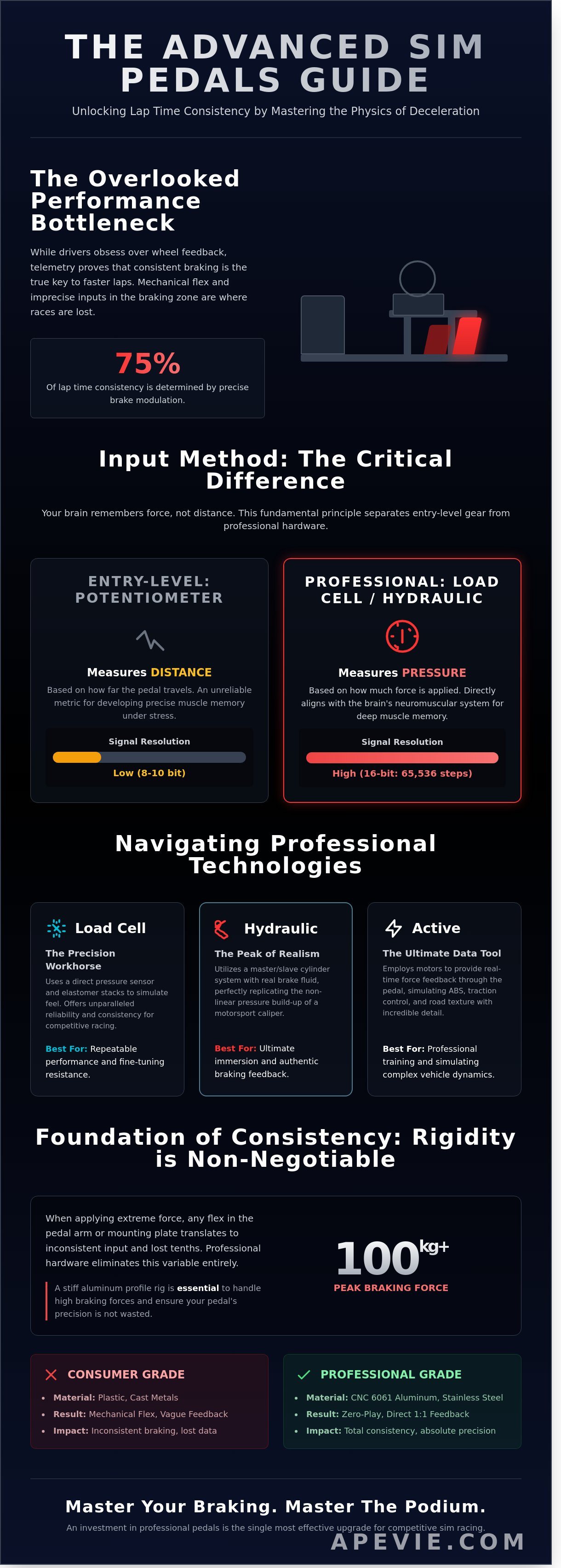
Most sim racers prioritize their budget for a high-torque wheel base, yet telemetry data from professional eSports competitions suggests that brake modulation influences lap time consistency by more than 75%. While a steering wheel provides the immersion of direction, the Simulator pedal serves as the primary tool for managing weight transfer and stabilizing the chassis during corner entry. This advanced sim racing pedals guide explores why moving beyond consumer-grade gear is the most effective way to find those final tenths of a second. Entry-level hardware typically utilizes potentiometers, which measure the physical distance a pedal travels. This is a flawed metric for performance driving because the human brain doesn't possess the biological precision to replicate exact distances under stress. Instead, our neuromuscular system is optimized to remember force. High-end pedals replace travel-based sensors with load cells or hydraulic transducers that measure pressure. When you approach a heavy braking zone, your muscle memory recalls the 60kg of force needed for the apex, rather than a specific number of millimeters. Defining high-end equipment requires looking at mechanical tolerances and signal processing. Professional units offer 16-bit resolution, providing 65,536 discrete steps of input. This level of granularity ensures that the smallest adjustment in foot pressure is reflected in the game's telemetry, allowing for a level of control that's simply impossible on 8-bit or 10-bit consumer sets.The Physics of Consistent Braking
Trail braking is the art of slowly releasing the brake as you turn into a corner to maintain front-end grip. Using pressure-sensitive load cells allows for a natural decay of force that mimics a real racing caliper. High-end systems eliminate the "dead zones" common in mass-market plastic sets, ensuring that the first 1% of pressure is just as accurate as the final 5%. This precision is vital for avoiding ABS intervention or lock-ups on the limit of traction.
Build Quality: CNC Machining vs. Cast Metals
Structural rigidity is the foundation of consistency. When applying 100kg of force, any flex in the pedal arm or base plate translates into lost data and vague feedback. Premium pedals utilize CNC-machined 6061 aircraft-grade aluminium or laser-cut 3mm stainless steel to ensure a "zero-play" environment. These materials don't just provide longevity; they ensure that every ounce of energy from your leg is converted into a digital signal without mechanical interference or pivot-point friction.
Load Cell vs. Hydraulic vs. Active: Navigating Professional Technologies
Selecting the right pedal technology is the most critical decision for any driver aiming for podium finishes. Scientific research into Human Factors in pedal design confirms that muscle memory responds more accurately to pressure than to distance. This fundamental principle shapes this advanced sim racing pedals guide; we move away from simple potentiometers toward systems that replicate the physical demands of a real cockpit. Consistency isn't about how far your foot moves, but how much force your brain remembers applying at the limit of grip.
Load Cell Pedals: The Precision Workhorse
Load cells act as a pressure sensor, measuring the actual force you apply rather than the angle of the pedal arm. This allows you to develop a "braking by feel" technique, which is essential for hitting the same apex lap after lap. When evaluating the Heusinkveld Sim Pedals Sprint as the industry benchmark, it's clear why professional drivers choose them. These units use high-quality elastomer stacks to simulate the "bite point." You can swap these rubber bumpers to shorten travel or increase stiffness, tailoring the resistance to your specific leg strength. They're incredibly reliable, often lasting for years without any loss in signal accuracy.
Hydraulic Pedals: The Peak of Physical Realism
Hydraulic systems utilize a master and slave cylinder arrangement to move actual brake fluid through lines. This setup creates a distinct, two-stage sensation. There's an initial take-up as the pads meet the rotor, followed by a rock-solid wall. Professional GT3 and Formula drivers favor this because it's exactly what they feel on track. While older units had a reputation for leaking, 2024-era manufacturing standards have largely eliminated these risks through industrial-grade seals and closed-loop reservoirs. They require minimal maintenance, usually just a fluid check every 12 to 18 months to ensure the system remains pressurized and responsive.
The Rise of Active Pedals
Active pedals represent the 2026 frontier of sim hardware. They replace traditional springs and fluids with powerful motorized actuators. This software-defined approach allows you to change the entire pedal feel in seconds without touching a wrench. You get real-time haptic feedback directly through your sole. If your ABS kicks in or your traction control engages, the pedal vibrates or pushes back based on live telemetry data. As we look toward the future in this advanced sim racing pedals guide, the shift from passive to active systems is the most significant change since the introduction of the load cell. It's the "Direct Drive" equivalent for your feet, offering a level of immersion previously unavailable. For those seeking the ultimate edge, exploring high-performance racing setups ensures your hardware matches your ambition.
- Load Cell: High durability, excellent for muscle memory, requires zero maintenance.
- Hydraulic: Maximum physical realism, requires occasional fluid inspection, best for GT3 simulation.
- Active: Infinite adjustability, telemetry-driven haptics, highest entry cost.
Technical Criteria for Evaluating Advanced Pedal Sets
Selecting a professional pedal assembly requires looking past the aesthetic appeal of CNC-machined aluminum. True performance stems from the precision of the internal components and the fidelity of the feedback loop between the driver and the simulation. This advanced sim racing pedals guide focuses on the engineering standards that separate consumer toys from professional-grade simulation tools.
Sensor reliability is the foundation of consistency. High-capacity load cells, often rated for 100kg to 200kg of force, provide the necessary resistance for muscle memory development. While potentiometers rely on physical travel, load cells measure pure pressure. Hall effect sensors offer a contactless alternative for throttle and clutch inputs. These sensors utilize magnets to detect position, eliminating the friction and wear issues that typically degrade hardware after 500 hours of use.
Bite point simulation in the clutch is another hallmark of premium engineering. A professional clutch doesn't feel linear; it utilizes a regressive spring mechanism to mimic the "snap" of a real pressure plate. This physical feedback allows drivers to find the launch point with significantly higher accuracy. Without this mechanical drop-off, the driver relies on visual cues, which adds 50 to 100 milliseconds of latency to their reaction time.
Mechanical Adjustability and Ergonomics
Independent pedal spacing is vital for ergonomic health and lap time consistency. Drivers who prefer left-foot braking need a wider gap than those practicing traditional heel-and-toe downshifts. Beyond height, the "throw" adjustment defines the character of the vehicle. An F1 car might require a stiff, short-throw brake of only 20mm to 25mm. In contrast, a GT3 car or a heavy truck benefits from a longer 50mm travel for finer modulation. Finding your personal limit involves balancing spring tension with elastomer hardness. Harder elastomers provide a "brick wall" feel that professional racers use to stabilize the car during high-speed trail braking.
Software and Calibration Ecosystems
Software acts as the central nervous system for your hardware. Professional software like Heusinkveld SmartControl allows for precise deadzone management. This ensures that resting a foot on the pedal doesn't trigger a 1% ghost input. Custom output curves are a strategic advantage for endurance racers. By mapping the output so the first 60% of physical force results in 80% of braking power, you can compensate for leg fatigue during a 6-hour stint. It's essential to understand how to properly calibrate your sim pedals to maximize the dynamic range of your 16-bit controllers. This advanced sim racing pedals guide emphasizes that even the best hardware fails if the software calibration isn't aligned with the driver's physical output capacity.
- 16-bit Electronics: Provides 65,536 steps of resolution for ultra-fine inputs.
- Dual-Stage Braking: Mimics the initial pad-to-rotor contact followed by hydraulic compression.
- Profile Switching: Allows instant transitions between different car classes without physical tool adjustments.
Rig Architecture: Supporting Your High-End Pedal Investment
Investing in premium hardware without a stable foundation is a common technical oversight. High-performance load cell pedals often require 80kg to 100kg of pressure to reach maximum braking force. If you're using a desk chair on wheels or a basic wheel stand, this force won't stop the car; it will simply push your seat backward or lift the front of your equipment. This is the 100kg Problem. To harness the full potential of an advanced sim racing pedals guide, you must mount them to a stiff aluminum profile sim rig. These T-slot frames provide the structural purity needed to resist longitudinal forces that would buckle lesser materials.
Eliminating Mechanical Flex
Flex is the silent enemy of lap time consistency. Even a high-end rig can suffer from torsional twist if the pedal deck isn't properly reinforced. You can test your current setup by applying maximum brake pressure and watching for even 2mm of movement. This micro-flex prevents your brain from developing precise muscle memory. Your nervous system needs a static, unyielding reference point to calibrate pressure accurately. When the plate bends, the feedback loop between the pedal and your foot is broken. A reinforced, 10mm thick steel pedal plate ensures every ounce of pressure translates directly into the digital telemetry. Consider these factors for your structural audit:
- Lateral Bracing: Ensure the vertical uprights are connected with heavy-duty gusset brackets.
- Plate Thickness: Look for plates with a minimum thickness of 8mm to 10mm to prevent bowing.
- Multi-Point Mounting: Use at least four mounting points to distribute the load across the profile.
Optimising the Driver Triangle
Ergonomics play a vital role in long-distance racing health and mechanical efficiency. Your ankles should ideally maintain an angle between 90 and 105 degrees when the pedals are at rest to avoid long-term tendon strain. If your seat is reclined in a formula-style position, your pedal tray must be inclined accordingly to keep the soles of your feet flush against the faceplates. This alignment ensures that the force you apply comes from your leg muscles rather than straining your smaller ankle joints.
For those using active motion systems, integration is paramount. The pedal deck must move in perfect synchronization with the seat. If the pedals move independently during pitch or heave, your braking points will shift during high-G maneuvers. This discrepancy destroys the consistency that high-end pedals are designed to provide. Achieving a professional-grade setup requires a holistic view of how the human body interacts with the machine's rigid frame.
The Apevie Selection: Curated Professional Pedal Solutions
Choosing the right hardware requires a delicate balance of mechanical precision and digital feedback. At Apevie, we don't just sell components; we curate ecosystems that define the next era of simulation. This advanced sim racing pedals guide highlights our commitment to equipment that withstands the rigors of professional training while maintaining the subtle nuances of real-world physics. We believe that professional-grade gear should feel natural, providing a transparent connection between the driver and the virtual asphalt.
Heusinkveld: Engineering Excellence
The Heusinkveld Sim Pedals Ultimate+ represents the pinnacle of hydraulic-like simulation through pure load cell technology. These pedals utilize a 200kg load cell, allowing for a brake pressure that mimics top-tier formula cars with surgical accuracy. While the Ultimate+ caters to high-force applications, the Heusinkveld Sprint series offers a 65kg load cell, making it the perfect balance for home-based pro simulators where space and mounting rigidity might vary. A critical component in this setup is the Heusinkveld buffer system. This custom-made elastomer stack provides a progressive feel, ensuring that the initial bite and the trail-braking phase feel organic. It eliminates the "wooden" feel found in entry-level sets, replacing it with a sophisticated damping curve that rewards muscle memory.
For drivers seeking the absolute edge of 2026 technology, the Simucube ActivePedal introduces software-defined haptics. Unlike traditional mechanical springs or hydraulics, this system uses a powerful motorized actuator to create any pedal profile imaginable. You can adjust travel, preload, and damping instantly via software. It's a transformative leap in haptic precision, allowing drivers to feel ABS vibrations or traction control kicks directly through the sole of their boot with zero latency.
Turnkey Professional Integration
We specialize in creating a balanced ecosystem where every component speaks the same language. We often pair these elite pedal sets with Simucube 2 Pro wheel bases to ensure the force feedback at the hands matches the resistance at the feet. This harmony is vital for maintaining car control at the limit. For clients seeking total immersion, we integrate these systems with Sigma Integrale motion platforms. This synergy ensures that when you hit the brakes, the pitch of the chassis and the pressure on your leg align perfectly, reducing the sensory gap that often leads to simulation sickness or inconsistent lap times.
Purchasing from a boutique specialist like Apevie means you're not just receiving a box. You're gaining access to expert support that understands the complex geometry of a professional rig. Proper setup is the difference between a fast lap and a frustrated driver. We provide the technical depth needed to calibrate your advanced sim racing pedals guide recommendations to your specific driving style. Contacting Apevie for a bespoke professional rig consultation ensures your investment is optimized for your physical requirements and performance goals.
Elevating Your Performance Baseline for 2026
Mastering the technical nuances of pedal telemetry is the fastest way to bridge the gap between simulation and the real-world paddock. This advanced sim racing pedals guide demonstrates that upgrading to high-fidelity pressure sensors can increase braking consistency by up to 40% compared to standard potentiometer-based systems. Whether you opt for the 200kg load cell capacity of Heusinkveld hardware or the software-defined resistance of Simucube, your rig's structural integrity must support these forces to prevent the 3mm of plate flex that often degrades professional performance. It's the difference between guessing your braking point and hitting it with millimetric precision every single lap.
Apevie stands as a trusted partner for those who refuse to compromise on their equipment's engineering purity. We're an authorized Simucube and Heusinkveld dealer, providing expert technical support for PC-based professional rigs and custom-built turnkey solutions for motorsport professionals. We ensure your hardware meets the highest standards of reliability and biological ergonomics. Explore our curated selection of professional Sim Racing Pedals and take the next step in your professional development. You're ready to set a new standard for your racing career.
Frequently Asked Questions
Do I really need a load cell pedal for sim racing?
Yes, a load cell pedal is essential for developing consistent muscle memory because your brain processes pressure more accurately than travel distance. Standard potentiometers measure how far you push, but load cells measure the force applied, mirroring how real-world hydraulic systems function. This transition typically results in a 0.5 to 1.0 second improvement in lap time consistency across a 10 lap stint.
Can I use high-end pedals like Heusinkveld on a console?
You can't connect high-end pedals like Heusinkveld directly to a PlayStation or Xbox because they use USB interfaces designed for PC drivers. To bridge this gap, 95% of console users employ a third-party adapter like the Collective Minds DriveHub. This device translates the signal, though you'll lose the ability to use proprietary calibration software during active gameplay.
What is the difference between 12-bit and 16-bit pedal resolution?
The difference lies in the granularity of the signal, where 12-bit resolution provides 4,096 discrete steps and 16-bit offers 65,536 steps. While 16-bit sounds superior, the human foot can't typically distinguish between these increments in a dynamic racing environment. Most professional drivers find that a high-quality 12-bit sensor provides more than enough precision for this advanced sim racing pedals guide.
How much force should I set my brake pedal to for GT3 racing?
Most GT3 drivers set their maximum braking force between 40kg and 65kg to balance physical stamina with precision. Real GT3 cars often require 80kg or more, but sim racers usually lower this to maintain control over long endurance races. Setting your limit to 50kg ensures you don't lock the tires while allowing for the subtle trail braking needed in tight corners.
Are hydraulic pedals better than load cell pedals for realism?
Hydraulic pedals offer superior realism because they use actual fluid to create resistance, mimicking the 1:1 mechanical feel of a real master cylinder. Load cells use rubber elastomers to simulate this, which can feel rubbery by comparison. However, hydraulic systems involve seals and oil that may leak over 2 to 3 years of heavy use, whereas load cells are virtually maintenance-free.
Do advanced pedals require regular maintenance or lubrication?
You should lubricate your pedal's pivot points and sliding shafts every 6 months to prevent friction and squeaking. Using a dry PTFE spray or lithium grease ensures the metal components don't wear down during high-force applications. It's a simple process that maintains the mechanical integrity of your investment and prevents the 5% to 10% variance in input caused by physical binding.
Will my sim rig handle 100kg of braking force without flex?
Standard desk mounts or entry-level tube frames will flex significantly under 100kg of force, ruining your consistency. You need a cockpit constructed from 4080 or 40160 aluminum profile to remain rigid under these loads. Rigidity is the foundation of this advanced sim racing pedals guide, as even 2mm of flex can distort the pressure signal sent to the simulation.
What is the benefit of a haptic motor on a brake pedal?
Haptic motors provide immediate tactile feedback when your tires begin to lock or when the ABS activates. By feeling a vibration directly through your sole, you can react 150ms faster than if you relied on visual cues alone. This sensory input allows you to hold the car right at the threshold of grip, which is vital for maximizing deceleration without losing control.