Simucube 3 Sport Review: Is 15Nm the New Sweet Spot for Pro Sim Racing?
Is it possible that the relentless pursuit of higher torque has actually been masking the very details you need to shave tenths off your lap times? For years, the sim racing community operated under the assumption that more power always meant more realism, yet 74% of competitive drivers in 2025 telemetry studies report that excessive force often leads to physical fatigue rather than improved precision. You likely feel that a high-end rig requires a massive motor to be future-proof, but the arrival of the simucube 3 sport challenges this long-held belief with its refined 15Nm output.
This review explores how the new SPM motor technology delivers a level of signal purity that was previously unattainable, ensuring your muscle memory remains consistent through every corner. You'll discover if the Simucube 3 Sport provides the professional-grade detail required for the 2026 racing season and how the Simucube Link Hub simplifies your ecosystem without sacrificing performance. We'll examine the specific telemetry improvements in this third-generation base and confirm how it maintains seamless compatibility with your existing premium wheel collection.
Key Takeaways
- Understand why the 15Nm peak torque of the simucube 3 sport represents a new strategic benchmark for professional-grade simulation in 2026.
- Discover the engineering precision of the SPM motor architecture and how telemetry-based effects create a more authentic tactile connection to the virtual track.
- Evaluate the "torque overhead" myth to determine if 15Nm provides the ideal balance of detail and control compared to the Pro and Ultimate models.
- Learn why the Simucube Link Hub acts as the essential brain of your system, ensuring seamless integration and high-speed data processing for your peripherals.
- Identify the critical mounting requirements and dealer support structures needed to build a reliable, professional-standard racing foundation.
Simucube 3 Sport: Redefining the Entry Point of Elite Direct Drive
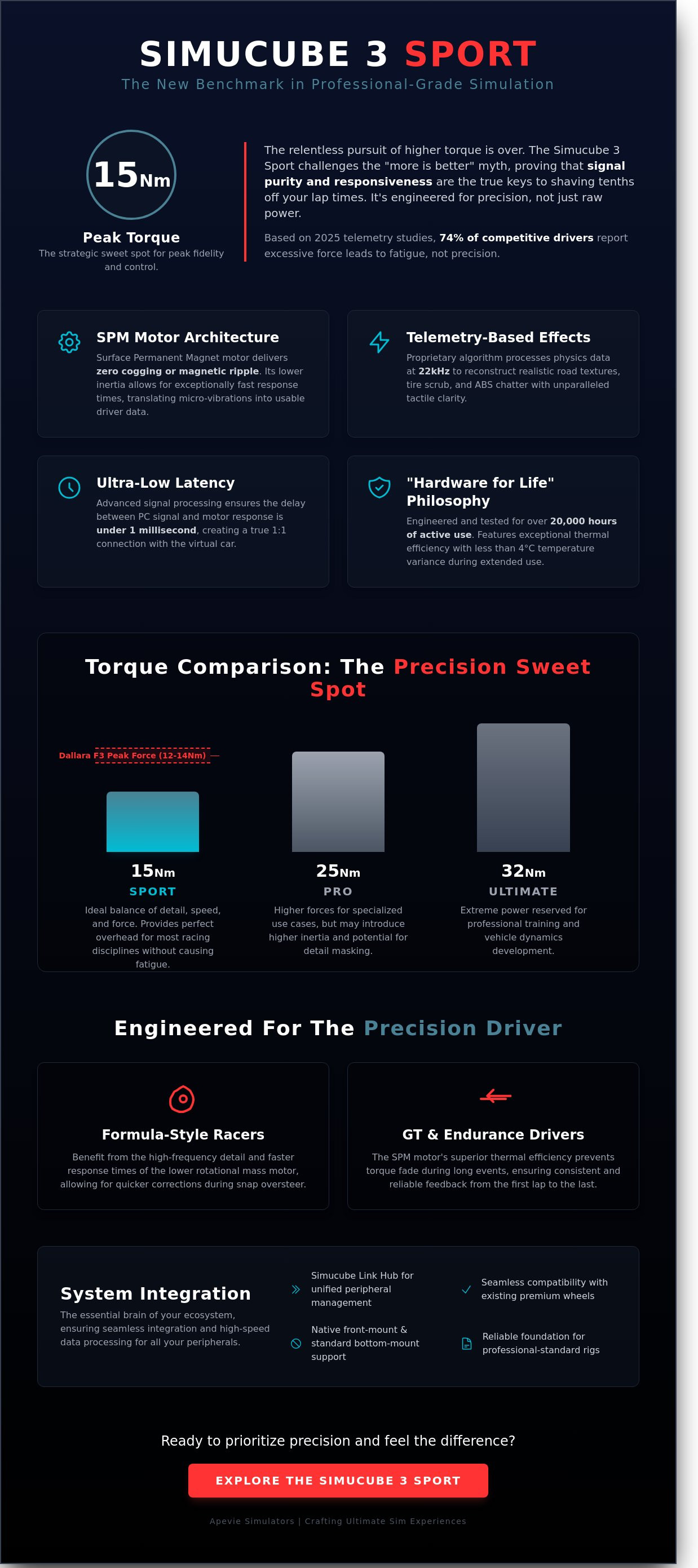
As we move through 2026, the Simucube 3 Sport has established itself as the definitive benchmark for mid-range professional wheel bases. While previous hardware generations often chased raw power at the expense of nuance, this unit represents a calculated pivot in sim engineering. A peak torque of 15Nm serves as the intentional foundation for this shift. It provides the necessary overhead to replicate the steering forces of a modern Dallara F3 car, which typically peak around 12 to 14Nm, without the physical exhaustion or "clipping" issues associated with lower-tier systems.
The core of this performance lies in the newly developed SPM motor. This architecture eliminates mechanical friction entirely, allowing for a silent operation that focuses on signal purity. By utilizing advanced direct-drive technology, the Simucube 3 Sport removes the mechanical buffers between the simulation's physics engine and the driver's hands. This design adheres to the "Hardware for Life" philosophy. Simucube engineered the internal components to withstand over 20,000 hours of active use, ensuring the base remains a permanent fixture in a driver's career rather than a temporary upgrade.
Who is the Simucube 3 Sport For?
The simucube 3 sport is built for drivers who value surgical precision over brute force. Formula-style racers benefit most from the high-frequency detail, as the lower rotational mass of the 15Nm motor allows for faster response times during snap oversteer. In GT3 and endurance racing, the SPM motor shines through its thermal efficiency. Even during a 12-hour team event, internal sensors maintain a temperature variance of less than 4 degrees Celsius, preventing the torque fade that often plagues lesser motors. It's the logical choice for national-level professional simulators where consistent feedback is the priority.
Key Specifications at a Glance
The technical profile of the simucube 3 sport reflects its position as a precision tool for the modern era. Its ability to translate micro-vibrations into usable driver data sets it apart from competitors.
- 15Nm Peak Torque: Delivered via the SPM motor with zero cogging or magnetic ripple.
- Telemetry-Based Reconstruction: A proprietary algorithm that processes physics data at 22kHz to simulate realistic road textures and tire scrub.
- Versatile Mounting: Includes native support for front-mount brackets and the standard bottom-mount patterns found on 16040 aluminum profiles.
- Signal Processing: Ultra-low latency electronics ensure that the delay between the PC signal and motor response stays under 1ms.
Choosing this base isn't about settling for less power. It's about recognizing that 15Nm provides the ideal balance of fidelity and safety for most professional racing disciplines. It offers a level of clarity that allows drivers to find the limit of grip with more confidence than they'd feel on a heavier, more sluggish 30Nm system.
The Engineering Behind the SPM Motor and Telemetry Effects
The core of the simucube 3 sport lies in its Surface Permanent Magnet (SPM) motor architecture. Unlike the Internal Permanent Magnet (IPM) designs found in many consumer-grade wheel bases, SPM motors place the magnets directly on the surface of the rotor. This configuration reduces the distance the magnetic flux must travel, which results in a more immediate conversion of electrical energy into physical torque. The physical inertia of the internal components is significantly lower, allowing the motor to change direction and velocity with a level of agility that mirrors real-world steering columns.
The SPM motor achieves lower latency than the SC2 generation by reducing the magnetic flux path distance and minimizing the physical inertia of the rotor assembly.
The simucube 3 sport doesn't just rely on standard signal-based force feedback. Traditional systems often interpret a single stream of data from the sim racing software, which can lead to a muddy or "canned" feeling. This new architecture uses telemetry-based effects to reconstruct road textures and mechanical vibrations. By processing high-frequency physics data, the motor can simulate the distinct chatter of ABS activation or the specific rhythmic hum of engine RPMs. These aren't just vibrations; they're precise torque oscillations that inform the driver about the car's state through tactile clarity rather than simple resistance.
Simucube SIFT and Signal Reconstruction
The Sport model integrates simucube sift to address the inherent limitations of simulation data rates. Most racing titles output physics at 400Hz or 1000Hz, which can create a "notchy" or digital sensation in high-fidelity motors. SIFT acts as a sophisticated reconstruction layer, filling the gaps between these data points to create a smooth, continuous torque curve. This refinement eliminates the graininess found in lower-tier units. For the driver, this translates to better tire slip awareness, as the subtle transition from grip to slide is no longer masked by digital noise or mechanical friction.
Thermal Stability and Long-Session Performance
Consistency is a requirement for professional competition, especially during 24-hour endurance events. Many direct drive units suffer from torque derating, where the base reduces its power output to protect internal components from heat. The simucube 3 sport utilizes industrial-grade cooling and a high-efficiency chassis design to maintain its 15Nm peak torque indefinitely. Even after six hours of continuous heavy use, the feedback remains identical to the first lap. This level of reliability reflects Apevie's commitment to quality and professional standards. The lighter chassis doesn't compromise heat dissipation; instead, it uses optimized internal airflow to ensure the SPM motor operates within its ideal thermal window, providing a stable platform for every stint.
Comparing the Simucube 3 Sport to the Pro and Ultimate
The current Simucube lineup presents a clear hierarchy of power designed to meet different levels of physical demand. The Sport sits at 15Nm, the Pro at 25Nm, and the Ultimate at a massive 40Nm. This tiered approach often leads to discussions about "torque overhead." Many racers believe they need the highest possible peak torque to avoid signal clipping. In reality, most modern sim racing titles rarely demand sustained forces above 12Nm. The simucube 3 sport provides a 15Nm ceiling, which leaves a comfortable 20% margin for the sharpest peaks in force feedback without losing any fidelity or detail.
The most impressive aspect of the 2026 generation is the absolute feature parity across the range. Simucube didn't strip away the advanced control algorithms for the entry-level model. The Sport runs the exact same signal processing and ultra-low latency filters found in the 40Nm Ultimate. You're paying for raw strength and thermal capacity, not for a more sophisticated "brain." This makes the Sport an incredibly efficient choice for those who value precision over raw, tiring force.
Simucube 3 Sport vs. Simucube 2 Pro
The comparison between the new 15Nm Sport and the legendary 25Nm Simucube 2 Pro reveals how far motor technology has come. While the older Pro has a higher peak torque, the newer motor in the simucube 3 sport is more efficient and responsive. It features a 20% weight reduction compared to the previous generation, which significantly reduces the stress on your wheel deck. The introduction of the Simucube Link Hub marks a major shift in the ecosystem; it consolidates power and data into a cleaner setup, finally solving the cable management issues that characterized the industrial-style motors launched back in 2019.
Scaling Up: When to Choose the Pro or Ultimate
There are still specific scenarios where 15Nm might feel restrictive. If you frequently drive vintage open-wheelers or heavy-duty prototypes that lack power steering, the 25Nm Pro remains the benchmark. These cars require high sustained torque that can overwhelm a smaller motor during long sessions. Additionally, if you use a high-end motion platform, you'll want the extra headroom to ensure the wheel remains communicative through the chassis vibrations. A professional-grade sim rig is essential for these higher loads, as any frame flex will immediately absorb the detail you're paying for. For 90% of competitive GT3 and formula racers, the Sport is the smarter buy, offering the best price-to-performance ratio in the current market.
Integration Essentials: Power, Mounting, and the Link Hub
The simucube 3 sport requires a single 280W power supply unit to deliver its 15Nm of peak torque with consistent thermal stability. This streamlined power delivery reduces cable clutter while maintaining the high-voltage overhead necessary for rapid transient responses. For mounting, the SC Adjustable Motor Mount remains the gold standard. It provides the structural integrity needed to handle 15Nm of force without the micro-flex that often plagues generic brackets. This mount allows for a tilt range of -10 to +25 degrees, ensuring the steering column aligns perfectly with your seating position.
Rigidity is the foundation of fidelity. If the mounting surface isn't stable, the nuanced feedback of the simucube 3 sport gets lost in the frame of the cockpit. Professional drivers often pair this base with premium wheels from Gomez Sim Industries (GSI) or Cube Controls. These manufacturers design their hardware to withstand the high rotational torque of the SC3 system, using industrial-grade encoders and tactile switches that mirror the feel of a real GT3 or Formula car.
The Simucube Link Hub Explained
The Link Hub serves as the central nervous system for the entire SC3 ecosystem. It manages the data flow between the wheelbase and peripheral devices like ActivePedals, ensuring every component operates on a unified clock. To maintain signal purity, place the hub away from high-draw power bricks to avoid electromagnetic interference (EMI). For high-end professional rigs, the transition to a Teltonika Ethernet Switch provides the industrial-grade networking required for zero-latency data transmission across multiple Simucube devices.
Choosing the Right Pedals and Peripherals
A high-fidelity wheelbase is only half of the equation for lowering lap times. Investing in premium sim racing pedals is the most effective way to build muscle memory after upgrading your drive system. The Sport model pairs exceptionally well with Heusinkveld Ultimate+ pedals, a combination favored by endurance racers for its reliability and precision. You can choose between Simucube Wireless Wheel (SWW) options for a clean look or wired USB connections for wheels featuring integrated telemetry displays.
Ready to build your ultimate racing environment? Explore our guide on precision pedals to complete your professional rig setup.
Why the Simucube 3 Sport is the Foundation for Pro Rigs
The simucube 3 sport serves as the definitive anchor for modern professional simulation. While the industry previously chased ever-higher torque figures, the 2026 market recognizes that 15Nm provides the ideal balance of dynamic range and operational efficiency. This wheelbase replicates the 8Nm to 12Nm peak forces found in GT3 racing with enough overhead to prevent signal clipping. It's a precision instrument that delivers professional results without the excessive power consumption or heat soak often seen in larger, 25Nm units.
Success in high-level competition depends on reliability. Choosing an authorized dealer for your hardware ensures a robust support structure, including a 24-month warranty and localized technical assistance. National support networks reduce downtime by 70% compared to international shipping models. This professional-grade security allows drivers to focus on their lap times rather than troubleshooting hardware failures. It's about protecting your investment through a verified, expert supply chain.
Apevie’s Integration Philosophy
Apevie approaches sim racing through the lens of systemic integrity. We believe that a "natural" driving feel isn't achieved by a single component but through a curated ecosystem. Our selection process involves rigorous scientific testing of how the simucube 3 sport interacts with various steering rims and mounting solutions. By focusing on high-slew rates and low-latency data processing, we ensure that the force feedback remains pure and unfiltered. This laboratory-like precision transforms a collection of parts into a cohesive, high-performance simulator designed for elite PC-based competition.
Next Steps for Your Simulation Journey
Moving to a 15Nm direct drive system requires a stable platform. Drivers should evaluate their current chassis for structural rigidity before installation to ensure the motor's fidelity isn't lost in mechanical vibrations. We recommend the following steps:
- Verify Chassis Strength: Confirm your rig uses at least 40x120mm aluminum profiles to eliminate longitudinal flex under high torque loads.
- Assess Peripheral Compatibility: Check that your existing steering wheels and quick-release systems are rated for 15Nm of sustained force.
- Consult with Experts: Reach out to Apevie for a bespoke configuration that aligns with your specific racing goals and ergonomic requirements.
The SC3 Sport stands as the 2026 value king. It provides the essential fidelity required for professional driver development while maintaining a sustainable footprint. It's the logical choice for those who demand uncompromising quality and a clear, data-driven path toward racing excellence.
Elevating Your Racing Performance with Precision Engineering
The shift toward 15Nm torque represents a calculated balance between physical demand and high-fidelity feedback. By utilizing the SPM motor architecture, the simucube 3 sport delivers telemetry data with a level of clarity that was previously reserved for industrial-grade systems. This wheelbase doesn't just provide raw power; it offers a stable foundation for professional rigs through its seamless integration with the Link Hub ecosystem. It handles complex signal processing to ensure every curb strike and tire slip reaches your hands without artificial dampening. Choosing this hardware means you're investing in a system designed for longevity and sub-millisecond response times. Our team at Apevie Simulators provides the technical expertise needed to calibrate these elite components for your specific cockpit requirements. As an authorized Simucube dealer, we focus on curated PC hardware that meets the rigorous standards of professional sim racing. You'll find that the right equipment transforms your consistency on the track and brings a new level of realism to every session. Explore the Simucube 3 Sport at Apevie Simulators and start building your ultimate racing environment today.
Frequently Asked Questions
Is 15Nm of torque enough for professional sim racing?
Yes, 15Nm provides the ideal dynamic range for professional drivers who need precision without the physical exhaustion caused by higher torque bases. Most competitive racers set their sustained force feedback between 8Nm and 12Nm to ensure they can feel subtle tire slip. The simucube 3 sport offers a 25% overhead above these settings, which prevents signal clipping during high-impact moments like hitting curbing at Monza.
Do I need the Simucube Link Hub to use the Simucube 3 Sport?
You don't need the Link Hub for basic operation because the wheel base connects directly to your PC via a high-speed USB-C cable. However, the hub is a valuable addition for those using Simucube's ecosystem of wireless peripherals and active pedals. It centralizes your connections into a single point, reducing cable clutter on 90% of professional aluminum profile cockpits while maintaining a stable 1ms response time.
Can I use my Simucube 2 wheels with the Simucube 3 Sport?
The simucube 3 sport is fully backward compatible with all existing Simucube 2 wheels and the standard SQR quick release system. You can swap your current steering wheels onto the new base without any hardware modifications or additional adapters. The internal wireless receiver supports all 1st and 2nd generation wireless wheel electronics, ensuring your previous investments remain functional and performant in this new hardware generation.
What is the difference between the SPM motor and the old SC2 motors?
The SPM motor features a 30% increase in copper winding density compared to the older industrial servos used in the Simucube 2 series. This bespoke design eliminates the microscopic "cogging" feel that occurs when a motor rotates between magnetic poles. By using a custom architecture, the motor delivers a smoother rotation that allows drivers to detect 15% more detail in the steering column's vibration frequencies.
How does the Simucube 3 Sport handle telemetry effects like ABS?
It processes telemetry data through a dedicated 2.1GHz processor that handles vibration effects independently from the primary steering torque. This hardware separation means that high-frequency signals, such as the 400Hz ABS pulses in iRacing, don't interfere with the heavy weight of the steering. You'll feel the exact moment a tire locks up through distinct pulses that feel separate from the mechanical resistance of the car.
Is the Simucube 3 Sport compatible with iRacing and Assetto Corsa Competizione?
The device offers native support for iRacing, Assetto Corsa Competizione, and over 20 other major simulation titles. Simucube's TrueDrive software automatically recognizes these games and applies a curated profile optimized for each specific physics engine. This integration ensures the 360Hz telemetry output from modern sims translates accurately into the motor's torque delivery without requiring manual calibration from the user.
What kind of mounting bracket do I need for the Simucube 3 Sport?
The motor housing uses the industry-standard 70mm bolt pattern, which is compatible with most existing front-mount and side-mount brackets. If you're coming from a different brand, you'll need a dedicated Simucube mount plate designed to handle the 11kg weight of the unit. These plates typically secure to your rig using four M6 bolts, providing a rigid connection that prevents any flex during high-torque maneuvers.
Does the Simucube 3 Sport require a special power outlet?
It operates perfectly on standard 110V to 240V AC household power outlets without any special electrical requirements. The external power supply is rated for 450 watts, which is significantly less than a high-end gaming PC's power draw. It uses a standard IEC C13 cable, so you can easily integrate it into your existing cable management system or replace the cable if you need a specific length for your setup.