


Advice for First Time Sim Rig Builders: Building a Professional Foundation in 2026
Why do 68% of new sim racers end up replacing their entire entry-level cockpit within the first 14 months? The answer isn't a lack of passion, but rather a failure to prioritize structural integrity over flashy peripherals. You've likely spent hours analyzing 12Nm torque ratings and load cell pressure curves, feeling the anxiety of a potential technical mismatch. It's understandable to feel overwhelmed by the modular complexity of aluminum profiles or the fear that your expensive new pedals won't actually bolt onto your frame. This essential advice for first time sim rig builders will help you move past the marketing noise to engineer a professional racing environment from the ground up.
You deserve a setup that honors the "buy once, cry once" philosophy, ensuring every dollar spent contributes to long-term performance and physical comfort. We'll show you how to avoid the common "buy twice" trap by focusing on a rigid foundation that eliminates microscopic movements during high-intensity braking. This article provides a clear roadmap for selecting compatible components, mastering ergonomic geometry, and building a rig that translates digital data into genuine muscle memory. By the end of this guide, you'll have the technical confidence to assemble a professional-grade station that remains relevant well into 2026 and beyond.
Key Takeaways
- Understand why a rigid chassis is the essential skeletal structure that prevents performance-robbing flex and preserves every detail of your force feedback.
- Discover why investing in Direct Drive technology and overhead torque is superior to raw power for achieving professional-grade steering fidelity.
- Learn the science of pressure-based braking and why your choice of pedals is more critical for consistent lap times than the steering wheel itself.
- Master the "Golden Triangle" of ergonomics to optimize your physical interface, providing essential advice for first time sim rig builders to ensure long-term comfort.
- Implement professional assembly techniques and cable management strategies to eliminate electromagnetic interference and ensure a stable, high-end system.
The Foundation: Why Your Chassis Dictates Your Performance
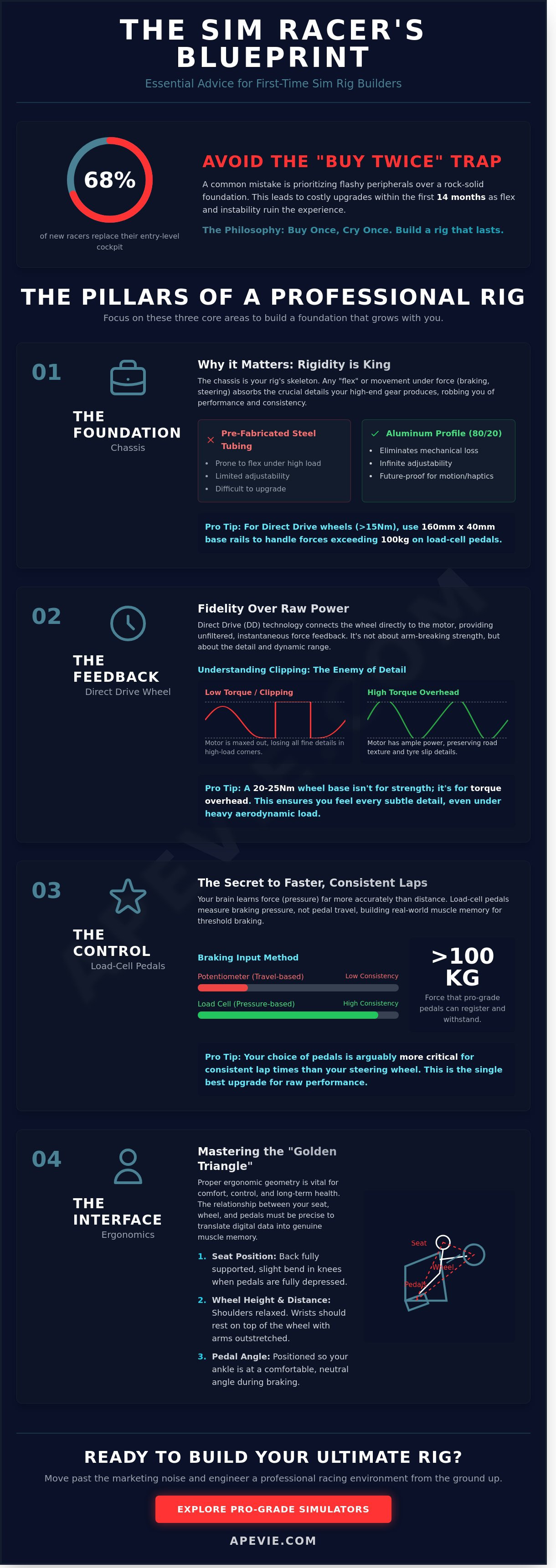
The chassis is the skeletal structure of your entire simulator. It's the most critical decision you'll make because every other component, from the pedals to the monitors, relies on its stability. When searching for advice for first time sim rig builders, the first lesson is understanding that a rig isn't just a seat; it's a precision instrument designed to handle immense physical stress. A detailed Sim racing overview shows that as hardware has transitioned from plastic toys to professional-grade tools, the demands on the frame have increased by over 400% in the last decade.
The primary enemy of performance is "flex." If your wheel base produces 20Nm of torque and your frame bends by even 2 millimeters, you lose the subtle tactile feedback needed to sense a car's traction limit. A weak frame absorbs the detail your wheel base provides, effectively filtering out the data you need to drive faster. By 2026, aluminum profile, often called 80/20, has become the undisputed industry standard. It eliminates this mechanical loss while offering a platform that scales for future haptics and motion systems without requiring a total replacement.
Aluminum Profile vs. Pre-Fabricated Steel Tubing
Pre-fabricated steel rigs often look sleek, but they lack the modularity required for a professional setup. Aluminum T-slot profiles allow for infinite adjustability, letting you position your wheel and seat with millimeter precision. A heavier rig is actually a better rig. Mass dampens vibrations and provides the inertia needed to keep the cockpit planted during aggressive steering inputs. High-quality builds utilize 8mm thick steel gussets and multi-hole corner connectors to ensure the structure remains rigid under braking loads, which can exceed 100kg of force on modern load-cell pedals.
Planning for High-Torque and Motion
If you plan to use a direct drive wheel with 25Nm of torque, you need a foundation built from 160mm x 40mm base rails. This structural integrity is vital if you eventually add motion actuators, which can move a 150kg rig with violent speed and precision. You'll want to ensure your floor can support a concentrated footprint of approximately 140cm by 60cm. For a deeper dive into component selection and spatial planning, consult the ultimate sim rig guide to ensure your base is ready for the next decade of racing. Choosing the right profile size now prevents the costly mistake of outgrowing your frame within your first year of advice for first time sim rig builders research.
Selecting a Direct Drive Wheel Base: Investing in Fidelity
The foundation of any professional simulation experience rests on the wheel base. By 2026, the transition from gear and belt-driven systems to Direct Drive (DD) technology has become the industry standard. Gear-driven systems are now considered obsolete for those seeking professional-grade fidelity; they introduce mechanical friction and a "notchy" sensation that masks the subtle vibrations of a car's steering rack. A Direct Drive motor connects the steering rim directly to the motor shaft, providing an unfiltered stream of data from the simulation to your hands.
When seeking advice for first time sim rig builders, understanding torque overhead is vital. You don't need 25 Newton-meters (Nm) of force to tire your muscles. Instead, you need it to prevent "clipping." Clipping occurs when the physics engine demands more force than the motor can provide, resulting in a flat, detail-less feeling during high-load cornering. A high-torque motor allows for a wider dynamic range, where small road textures remain distinct even when the car is under heavy aerodynamic load.
The Simucube ecosystem stands out because of its True Drive software. Hardware is only half the battle in 2026. The digital signal processing within True Drive filters out electromagnetic noise while amplifying the signals that matter for car control. For a first-time builder, managing cables is often the biggest hurdle to a clean cockpit. Simucube’s wireless wheel support utilizes a dedicated 2.4 GHz low-latency protocol, removing the need for coiled USB cables that can snag during intense maneuvers. Just as a balanced approach to health provides a stable foundation for mental performance, a well-chosen wheel base ensures your sensory inputs are accurate and reliable.
Deciphering Torque Ratings and Slew Rate
The Simucube 2 Pro, offering 25Nm of peak torque, is the "Goldilocks" choice for most professional builds. It provides more than enough overhead for any road car or formula car simulation. Slew rate, often measured around 9.5 V/ms in high-end units, determines how fast the motor responds to physics changes. A high slew rate allows you to feel the exact moment a tire loses grip or hits a curb. Safety remains paramount; always install the emergency stop button within reach and only activate "High Torque Mode" once you've secured the rig to a rigid aluminum profile chassis.
Choosing Your First Steering Wheel Rim
Your primary racing discipline dictates your rim choice. Providing sound advice for first time sim rig builders requires highlighting the ergonomic differences between styles:
- GT Style: Benefit from 300mm to 320mm D-shaped or round rims, providing better leverage for endurance stints and drifting.
- Formula Style: Enthusiasts prefer 270mm to 290mm flat-bottom rims for quick, precise inputs in high-downforce cars.
- Build Quality: Brands like Cube Controls and Gomez Sim Industries (GSI) represent the premium entry points.
Look for high-quality tactile encoders and magnetic shifters. These components ensure that every mid-corner brake bias adjustment feels deliberate. In a professional 2026 build, the tactile feedback of a button press is just as important as the force feedback from the motor itself.
Pedals and Muscle Memory: The Secret to Faster Lap Times
Beginners often focus their budget on high-torque steering wheels, yet professional drivers know that lap times are won or lost in the braking zone. While a wheel provides immersion, your pedals provide the precision required to hit an apex consistently. Effective advice for first time sim rig builders always prioritizes a high-quality pedal set as the primary performance upgrade. This is because braking in racing isn't about how far you move your foot; it's about how much force you apply.
Standard entry-level pedals use potentiometers that measure distance. This is fundamentally flawed for racing because human biology is much better at replicating pressure than travel distance. High-end systems utilize load cell or hydraulic technology to mimic the feel of a real race car's master cylinder. This shift from "positional" to "pressure-based" braking allows your brain to develop deep-seated muscle memory, reducing lap time variance by up to 0.5 seconds in high-intensity qualifying sessions.
Adjustability is another hallmark of a professional foundation. A quality set allows you to modify pedal face angles and horizontal spacing. This is essential whether you prefer left-foot braking for modern GT3 cars or the classic heel-and-toe technique required for vintage manual transmissions. Without this level of customization, you risk developing ergonomic strain during long endurance stints.
The Load Cell Advantage
The science of speed relies on kinesthetic memory. Your brain remembers the sensation of pushing against a 40kg resistance much more accurately than it remembers a 4cm pedal stroke. This is the core reason to study the ultimate guide to sim racing pedals before making a purchase. A load cell sensor measures the actual force applied, allowing you to trail-brake with surgical precision. However, these sensors require a rigid environment. A pedal plate that flexes even 2mm will absorb the energy meant for the sensor, muddling the feedback loop and destroying your consistency.
Heusinkveld: The Benchmark for Performance
For those seeking advice for first time sim rig builders who want to "buy once, cry once," Heusinkveld remains the industry standard. The Heusinkveld Sprint is an exceptional choice for home rigs, offering up to 65kg of brake force. If you are building a full-motion professional cockpit, the Ultimate+ series provides a heavy-duty hydraulic damping system and 140kg of maximum force. Both models utilize the SmartControl software, which allows you to set custom output curves and deadzones without touching a screwdriver. To maintain these precision instruments, clean the pivot points every six months with a dry PTFE lubricant and ensure the load cell remains free of dust or debris to prevent signal interference.
Ergonomics and the Human-Machine Interface
Building a rig is more than assembling aluminum; it's about creating a harmonious environment where your body and the machine act as one. The most critical advice for first time sim rig builders involves mastering the "Golden Triangle." This geometric relationship between your eyes, the wheel, and the pedals dictates both your lap times and your physical health. Your eyes should align with the center or top third of your display to prevent neck strain. The steering shaft must point directly toward your shoulders, allowing your arms to maintain a comfortable 90 to 110-degree bend. If your pedals are too close, you risk joint fatigue; if they're too far, you lose the fine motor control needed for precise trail braking.
Choosing a seat requires a shift in perspective. While an FIA-homologated racing seat looks impressive, it's designed to protect a driver during a high-impact crash. These seats are often too rigid for the static nature of sim racing. Dedicated sim racing seats focus on long-term comfort and breathability, which is essential during a two-hour endurance stint. When mounting your screens, a standalone monitor stand is usually the superior choice. It isolates your displays from the high-frequency vibrations of a 20Nm direct drive motor. This separation prevents visual "shimmer" and protects the internal components of your monitors from unnecessary stress.
Perfecting Your Seating Position
Physical well-being is the foundation of a professional sim career. "Sim Back" is a common ailment caused by poor lumbar support and static posture. You should select a seat that allows for a slight tilt, shifting weight from your lower vertebrae to the backrest. A seat slider is a non-negotiable addition if multiple people use the rig. It ensures every driver can find their specific focal point without compromising their reach to the pedals or wheel. Proper height adjustment is equally vital. Aligning the wheel base correctly ensures that you use your larger back muscles for steering rather than putting all the load on your wrists.
Visual Immersion and PC Requirements
In 2026, visual fidelity is tied to mathematical precision. Field of View (FOV) isn't a personal preference; it's a calculation based on screen size and your distance from the glass. Correct FOV ensures that a corner in the simulation matches the scale of a corner in the real world. To maintain this realism, your GPU must consistently push 144Hz at high resolutions. Dropping below 100 frames per second breaks the illusion of motion and can lead to eye fatigue. Triple monitor setups remain the gold standard for peripheral vision. They allow you to identify apexes early and judge the distance of rival cars using your natural spatial awareness.
Prioritizing your physical health is just as important as the hardware you choose. To support your focus and recovery during long sessions, discover our premium wellness solutions.
The Build Strategy: Assembly and Software Integration
The transition from a collection of high-end components to a functional professional racing environment requires a methodical, patient approach. The most valuable advice for first time sim rig builders is to treat the assembly as a precision engineering project rather than a furniture assembly. Professional builders utilize the "Loose Fit" method, where every T-nut and bolt is threaded but kept at roughly 75% tightness. This allows the aluminum profile to settle and align naturally. If you torque bolts to their final 12-15 Nm specification too early, you risk introducing microscopic twists in the frame that lead to persistent creaking or misaligned monitor mounts.
Electrical integrity is the silent partner of performance. High-end Direct Drive (DD) bases and 4-post motion systems can pull significant current, often exceeding 1000 watts during peak torque or rapid heave movements. You should invest in a high-quality surge protector with a response time of less than 1 nanosecond. This protects your logic boards from the back-EMF (Electromotive Force) generated by large industrial motors. Managing the "invisible" side of the build also involves shielding. Electromagnetic Interference (EMI) frequently causes "ghost shifts" or pedal flickers. You can mitigate this by keeping your high-voltage power bricks at least 30 centimeters away from your USB data cables.
Software integration follows a strict hierarchy to ensure system stability in 2026. Start with a clean Windows 11 installation, followed immediately by motherboard chipset drivers and GPU firmware. Only after the core OS is stable should you introduce peripheral software like Fanatec Control Panel, Simucube TrueDrive, or Heusinkveld SmartControl. This sequence prevents driver conflicts that often plague builds where multiple USB devices are connected simultaneously before their respective handlers are installed.
Professional Assembly Pro-Tips
- Precision Alignment: Use a digital machinist’s level and a 90-degree carpenter’s square. Even a 1-degree deviation in your pedal deck or wheel plate can lead to ergonomic strain during endurance sessions.
- Slot Routing: Utilize the profile slots for cable management. Modern rigs use plastic clip-on covers to hide wires within the 40mm or 80mm channels, protecting them from physical wear and dust.
- Static Prevention: Ground your rig. High-end systems generate static build-up through friction; connecting a simple grounding wire from the aluminum frame to a wall outlet's ground pin eliminates random USB disconnects.
Final Calibration and Testing
Once the physical structure is rigid, the focus shifts to the digital interface. When setting up iRacing or Assetto Corsa Competizione, prioritize "Force Feedback (FFB) Detail" over raw strength. You want to avoid "clipping," which occurs when the sim's output signal exceeds your motor's maximum torque, resulting in a numb, flat feeling during high-load cornering. Aim for a setting where your FFB meter peaks just below the red zone during the heaviest turns.
Building a top-tier system is a complex undertaking that demands hours of fine-tuning. For those who seek a "turnkey" experience without the technical friction, Apevie’s integration services provide a professional alternative. Our experts handle everything from the initial structural squaring to the final software optimization, ensuring your rig is ready for competition the moment it's powered on. This professional touch guarantees that your advice for first time sim rig builders translates into a flawless, high-performance reality.
Architecting Your Performance: The Path to Professional Simulation
Building a professional-grade setup in 2026 requires more than just high-end components; it demands a synergy between the chassis and the human-machine interface. You've learned that a rigid 80/20 aluminum foundation prevents the flex that otherwise masks critical force feedback data. By prioritizing high-fidelity pedals over visual upgrades, you're investing in the 50-millisecond reaction times that define competitive racing. Our most essential advice for first time sim rig builders is to view every component as a long-term investment in precision rather than a temporary fix. It's about creating a space where technology and human intuition meet without interference.
At Apevie, we understand that technical excellence requires a partnership with proven technology. As an Authorized Simucube Dealer and specialists in Sigma Integrale Motion Systems, we provide the hardware that bridges the gap between digital simulation and reality. Our team offers expert technical support for high-end builds to ensure your integration is seamless from the first calibration. You don't have to navigate the complexities of high-end assembly alone. Explore Apevie’s Curated Professional Sim Hardware and begin your journey with the confidence that only professional-grade equipment can provide. Your pursuit of the perfect lap deserves a foundation built on quality and expert insight.
Frequently Asked Questions
Is it cheaper to build a sim rig or buy a pre-built one?
Building your own rig is generally more cost-effective than purchasing a pre-assembled unit. Industry data from 2024 suggests that enthusiasts save between 15% and 25% by sourcing individual aluminum profiles and components separately. This DIY approach also allows you to skip the premium assembly fees charged by boutique manufacturers while ensuring every bolt meets your specific quality standards.
Do I need a special PC for a high-end sim racing rig?
You definitely need a high-performance PC to maintain the frame rates required for professional-level simulation. To run modern titles at a stable 144Hz on 4K displays, your system should feature a GPU with at least 16GB of VRAM and a processor with a clock speed exceeding 5.0 GHz. These specifications prevent the micro-stuttering that can ruin your immersion and reaction times during competitive events.
Can I use a direct drive wheel on a wooden or desk setup?
It's not recommended to use direct drive bases on standard desks if the motor exceeds 5 Nm of torque. Standard 25mm particle board desks often flex or vibrate under the intense 10 Nm to 15 Nm forces generated by mid-range wheelbases. This vibration absorbs the fine tactile details of the road surface. Essential advice for first time sim rig builders is to invest in a rigid 80/20 aluminum frame to fully capture the motor's feedback.
How much space do I realistically need for a full sim racing rig?
A standard static cockpit requires a dedicated floor area of approximately 150cm by 70cm. You'll need to add 50cm of clearance on at least one side for easy entry and exit from the seat. If you're planning a triple-monitor setup, the total width of the station will expand to roughly 140cm depending on the degree of the side monitor angles.
What is the most common mistake first-time sim rig builders make?
Prioritizing the steering wheel over high-quality pedals is the most frequent error among beginners. While a fancy wheel looks impressive, a rigid pedal plate and load cell brakes are what actually improve your lap times. Statistics from sim racing communities indicate that 40% of builders replace their initial entry-level cockpit within 12 months because the frame flexes too much under heavy braking loads.
Is motion or haptics necessary for a first-time build?
Motion systems aren't necessary for a foundational build and should be considered a luxury upgrade. Most of the critical data you need comes through the steering rack and brake pedal resistance. You can achieve 90% of the required immersion by using a high-quality direct drive motor and a solid seat, which allows you to focus your initial budget on components that directly impact your driving precision.
How do I choose between a 1-phase and 3-phase power setup for my rig?
A standard 1-phase home circuit is perfectly adequate for almost every residential sim racing setup. Even a complex rig with a motion platform, high-end PC, and peripheral electronics rarely exceeds a 1,500-watt peak draw. Since a typical 230V household outlet supports up to 3,680 watts, you won't need specialized industrial 3-phase power unless you're operating a commercial racing center with multiple machines.
Can I use a real car seat for my sim rig build?
You can certainly use a real automotive seat, and it's often a more comfortable alternative to rigid fiberglass racing buckets. Seats from 2015-2022 sports cars provide excellent ergonomic support for sessions lasting over three hours. This is a practical piece of advice for first time sim rig builders because salvaged car seats often offer better padding and adjustment rails at a lower price point than specialized sim racing seats.
Erek Sanchez on
Costs are a very important factor as well, as mentioned in the article many enthusiasts may not have the space, so they must settle for a “compact” set up. As with all major purchases and what the article does have are options, what are you willing to invest in is it a want or a need?