Best Direct Drive Steering Wheels 2026: The Professional Sim Racer’s Buying Guide
Chasing the highest peak torque number on a spec sheet is often the fastest way to mask the very telemetry details you need to actually go quicker on track. You've probably felt that frustrating sensation where a wheel feels heavy yet strangely numb, or perhaps you've dealt with a Quick Release that flexes right when you're leaning into a high-speed corner in iRacing. Finding the best direct drive steering wheels isn't just about raw power; it's about the fidelity of the signal reaching your hands and the stability of the hardware beneath it.
We understand that the jump to professional-grade hardware can feel overwhelming when you're caught between confusing torque ratings and proprietary ecosystems. This guide clears the fog by explaining how high-fidelity force feedback actually works to lower your lap times and which setups offer the most stable, flex-free experience. We'll compare the latest 2026 industry leaders, from the 25 Nm Simucube 3 Pro to the versatile Fanatec GT DD Pro, to help you build a future-proof cockpit that won't require another upgrade in two years. By the end, you'll know exactly which wheelbase provides the seamless software integration and mechanical precision your racing career demands.
Key Takeaways
- Understand why the shift to 1:1 motor-to-shaft architecture and low-inertia motors is essential for capturing high-resolution telemetry data.
- Learn why the best direct drive steering wheels prioritize high slew rates and fidelity over raw torque to ensure you're receiving clear signals rather than just heavy resistance.
- Discover why the 15-25Nm range has become the professional standard for maintaining headroom and preventing signal clipping during intense racing.
- Identify the hidden performance costs of sub-par Quick Release systems and how mounting flex can completely negate the precision of a high-end motor.
- Explore how professional turnkey integration solves the complexity of balancing high-torque steering with advanced motion systems for a cohesive driving experience.
Why Direct Drive Steering Wheels Define Professional Sim Racing in 2026
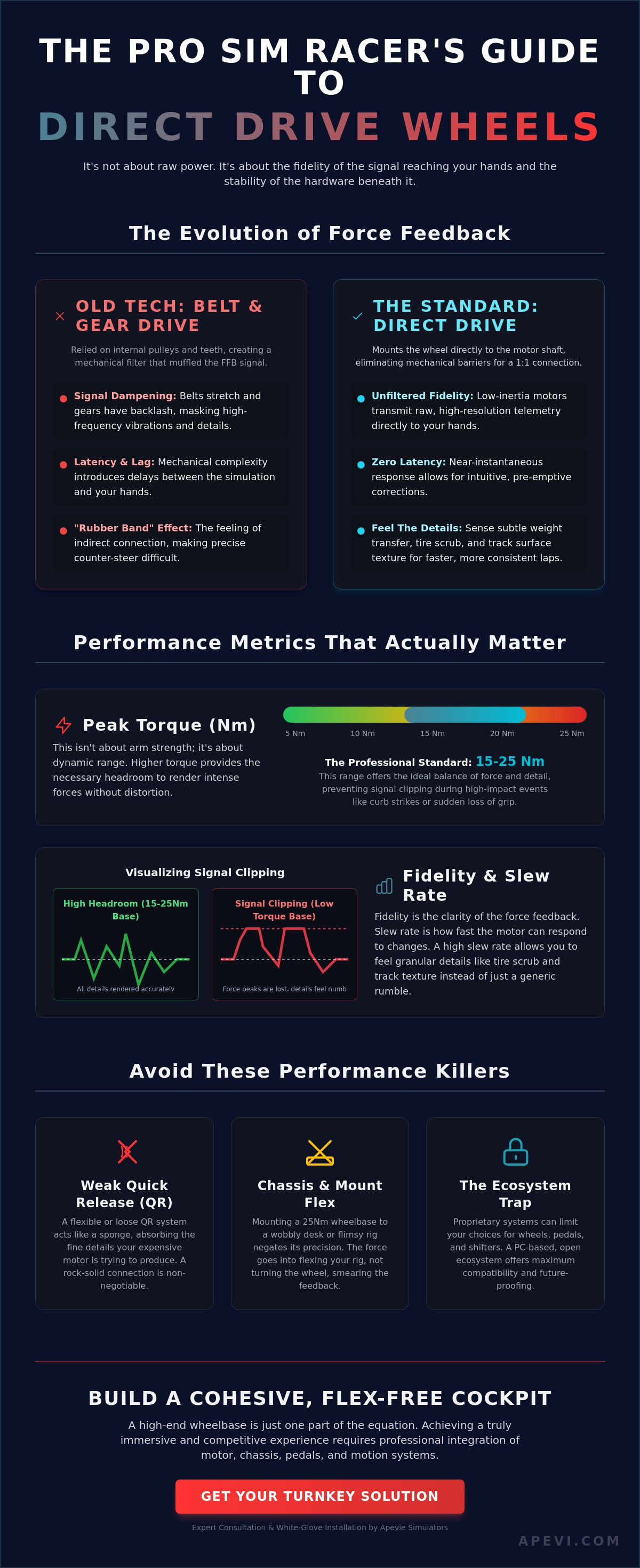
The landscape of sim racing hardware has undergone a fundamental shift over the last few years. In 2026, the search for the best direct drive steering wheels isn't just about finding the motor with the highest torque; it's about eliminating every mechanical barrier between the simulation's physics engine and your fingertips. Older belt-driven or gear-driven systems relied on internal pulleys and plastic teeth to multiply force. This design created a mechanical filter that "muffled" the signal, making it nearly impossible to feel subtle weight transfers or the exact moment your tires lose grip. Modern Direct Drive Technology removes these layers by mounting the steering rim directly onto the motor shaft.
This 1:1 architecture is the foundation of professional racing. By 2026, the industry has moved toward low-inertia motors that respond with near-zero latency. These current models focus on reducing the internal weight of the motor's rotor, which allows the wheel to change direction faster than ever before. When you're driving at the limit in iRacing or Assetto Corsa Competizione, these motors allow you to catch a snap-oversteer moment before your eyes even register the movement on screen. It's a transition from reactive driving to intuitive, high-resolution telemetry. You aren't just playing a game; you're interpreting data through your palms.
The Death of the Belt: Why Direct Drive is Non-Negotiable
The primary reason top-tier racers have abandoned belts is fidelity. Belts stretch and slip, even if only by microns, which creates a "rubber band" effect that masks high-frequency vibrations. In contrast, the latest direct drive wheel bases utilize high-resolution encoders, often exceeding 24-bit resolution. This means the motor can communicate tens of thousands of distinct positions within a single rotation. You don't just feel a generic force; you feel the specific texture of the track surface and the granular scrub of the front tires. This level of detail is why the best direct drive steering wheels are now considered essential equipment for anyone serious about competitive lap times.
PC-Based Simulation vs. Console Limitations
While some brands offer "universal" wheels compatible with consoles, professional sim racing remains a PC-dominant discipline. Console platforms often limit the signal frequency of force feedback, effectively "bottlenecking" a high-end motor. A professional PC setup allows for raw, uncompressed data streams that high-performance hardware can translate into pure tactile information. If you're building a serious setup, focusing on a dedicated PC ecosystem ensures compatibility with the most advanced telemetry software and peripherals. For those who prefer a professional touch, turnkey solutions from experts like CXC Simulations often highlight why PC integration is the gold standard for high-fidelity racing.
Key Performance Metrics: Torque, Fidelity, and the Ecosystem Trap
The marketing for the best direct drive steering wheels often revolves around a single number: peak torque measured in Newton-meters (Nm). While torque provides the physical resistance needed to simulate a heavy steering rack, focusing solely on this metric is a mistake. Professional drivers look for a "sweet spot" between 15Nm and 25Nm. This range isn't about exhausting your arms; it's about dynamic range. High-performance motors in this category allow you to feel the subtle nuances of a car's limit without the signal becoming a muddy mess of vibration.
Peak Torque vs. Holding Torque: What Actually Matters?
If your motor is constantly running at its limit, it will "clip." This means the software cannot represent a sudden spike in force, like hitting a curb, because the motor is already at 100% capacity. High-torque bases provide the headroom to deliver these spikes accurately. This accuracy is vital for developing consistent muscle memory. When you choose a professional wheelbase, you're buying the ability to feel the difference between a minor slide and a total loss of traction without the signal flattening out. It's the difference between a generic rumble and a precise data point.
Slew Rate and Force Feedback (FFB) Detail
Raw power is useless if the motor is slow to react. This is where "Slew Rate" comes in. It measures how fast the motor can change its torque output. A high slew rate allows for crisp, immediate Haptic feedback, letting you feel the grain of the asphalt. Compare a high-tier unit like the Simucube 2 Pro to mid-tier competitors, and the difference isn't just the strength; it's the sharpness of the information. Newer low-inertia motors excel here by reducing internal rotating mass, which translates to a more transparent connection to the virtual road.
The "Ecosystem Trap" is another critical factor to consider. Some brands use proprietary Quick Release (QR) systems that prevent you from using third-party rims without expensive adapters. Before committing, consider the software. Tools like Simucube True Drive or Moza Pit House are the brains of the operation. They allow you to fine-tune damping, friction, and inertia to match specific cars. If you're unsure how to balance these technical variables, reaching out for expert simulator consultation can ensure your components work in perfect harmony to create the best direct drive steering wheels experience possible.
Top Direct Drive Steering Wheel Recommendations for 2026
Selecting the best direct drive steering wheels for a professional rig requires looking beyond the motor base. While the base provides the force, the steering rim is your primary interface for every input. In 2026, the market has matured to offer specialized solutions that cater to different racing disciplines, from endurance GT racing to high-downforce formula cars. We've tested the latest hardware to identify which combinations provide the most consistent performance and mechanical reliability.
The Simucube 3 Pro has established itself as the 2026 flagship for those seeking ultimate fidelity. With a massive 25 Nm of torque and a revised motor architecture, it offers a level of transparency that was previously reserved for industrial-grade simulators. It isn't just about the strength of the feedback; it's about the lack of internal friction. This allows the wheel to spin with a natural lightness when the car is stationary, then load up with immense, precise weight as you build speed through a corner.
Elite Rims: GSI and Cube Controls
Many sim racers make the mistake of pairing a high-end base with a flexible, consumer-grade rim. To truly utilize a 25 Nm motor, you need a steering wheel built from billet aluminum and carbon fiber. The Gomez Sim Industries (GSI) Formula Pro Elite remains a gold standard for professional cockpits. Its construction is incredibly rigid, ensuring that every vibration from the motor reaches your hands without being absorbed by plastic components. The tactile feedback from its magnetic shifters and dual-clutch paddles provides a mechanical "click" that is essential for consistent gear changes under pressure.
For those who prioritize Italian design and ergonomics, Cube Controls offers the F-Core. This rim provides high-end features like carbon fiber front plates and CNC machined aluminum knobs at a more accessible price point. The ergonomics are designed for long-stint comfort, which is critical for endurance racers in events like the 24 Hours of Le Mans on iRacing. If you're looking for bespoke rim options that match this level of quality, exploring the offerings at Precision Sim Engineering can provide additional professional-grade alternatives for your build.
The Moza Ecosystem: Precision and Accessibility
Moza Racing has redefined the price-to-performance ratio in 2026. Their R16 and R21 bases offer 16 Nm and 21 Nm of torque respectively, paired with the Moza Pit House software suite that has become one of the most user-friendly in the industry. The ecosystem's standout feature is the Moza Vision GS rim. This wheel integrates a high-resolution telemetry display directly into the center of the rim, allowing you to monitor tire temperatures and lap deltas without looking away from the track. This integration reduces cognitive load during a race, allowing you to focus entirely on your braking markers and turn-in points.
Avoiding Common Mistakes: Quick Releases, Flex, and Software
Even the best direct drive steering wheels on the market cannot perform to their potential if the surrounding hardware is inadequate. High-torque motors generate immense rotational energy. If this energy isn't managed correctly, it manifests as vibration, mechanical noise, or worst of all, physical flex. Many buyers focus entirely on the wheelbase price while ignoring the hidden costs of mounting brackets and Quick Release (QR) systems. A premium wheelbase paired with a sub-par QR system creates a mechanical "dead zone" that masks the very telemetry data you paid to receive.
Eliminating Flex in the Steering Column
Once you move beyond 10Nm of torque, an aluminum extrusion sim rig becomes a necessity rather than a luxury. Thin steel plates or desk mounts will bend under the load of a Simucube 3 or a Fanatec Podium wheel base. This flex acts as a filter, absorbing high-frequency details like tire scrub or ABS vibration. The Simucube SQR system is widely regarded for its zero-flex design, whereas the Moza and Fanatec QR standards prioritize speed of rim changes. If you're building a professional setup, ensure your rig's steering deck is reinforced to handle these peak loads. This structural integrity is just as vital as having professional sim pedals to maintain a balanced, consistent platform.
Managing the connection between the rim and the base is also a matter of cable management. While wireless rims from brands like Simucube or Moza eliminate the "cable tangle" during high-rotation turns, some professional drivers still prefer the reliability of a physical USB connection. If you choose a wired setup, use a coiled cable with high-quality strain relief to prevent the connector from snapping during a sudden collision or a 900-degree rotation.
The Software Learning Curve
Software tuning is the final hurdle. Default settings in Simucube True Drive or Fanatec Control Panel are rarely optimized for specific titles like iRacing or ACC. You must understand the three pillars of FFB tuning: damping, friction, and inertia. Damping prevents the wheel from feeling "springy," while friction adds realistic weight to the steering rack. Without proper tuning, high-torque wheels can suffer from oscillation, where the wheel shakes violently when you take your hands off. Professional integration services take the guesswork out of this process, ensuring your hardware is calibrated for maximum fidelity from the first lap. For those who want a perfectly tuned, ready-to-race system, exploring a turnkey simulator build is often the most efficient path to performance.
Professional Turnkey Solutions: Why Expert Integration Trumps DIY
Assembling a rig from a collection of boxes is a rite of passage for many, but there's a distinct threshold where the complexity of high-end hardware outpaces the DIY approach. When you invest in the best direct drive steering wheels, you aren't just buying a motor; you're introducing a powerful industrial component into a delicate ecosystem of electronics and motion. A 25 Nm wheelbase generates forces that can physically rattle a rig to pieces or create electromagnetic interference that disrupts your pedals or shifters. Achieving true synergy requires more than just bolting parts together; it requires professional integration.
The challenge intensifies when you add a motion platform into the mix. A high-torque steering base and a motion system must work in perfect synchronization to provide a realistic sense of weight and balance. If the steering feedback and the chassis movement are even slightly out of phase, the immersion is broken. Your brain will struggle to process the conflicting signals, which often leads to motion sickness or inconsistent lap times. This is where expert calibration becomes the deciding factor between a gaming setup and a genuine training tool.
Beyond the Parts List: The Apevie Difference
Our approach centers on rigorous testing and component synergy. We design custom builds that often feature the Sigma Integrale DK2 Motion system, selected specifically for its ability to mirror the high-frequency response of a direct drive motor. We ensure that GSI rims communicate perfectly with Simucube bases without the need for cumbersome third-party adapters that introduce points of failure. Every system undergoes a white-glove installation process, where we handle the software tuning, cable management, and ergonomic adjustments that define a professional simulator. This ensures the best direct drive steering wheels perform exactly as the engineers intended.
Start Your Professional Sim Journey
Investing in a turnkey racing simulator package ensures that every variable is accounted for before the first lap. Consulting with experts allows you to skip the expensive trial-and-error phase often associated with high-end gear. We provide ongoing support and hardware optimization to ensure your rig remains at the peak of performance as software updates and new titles evolve. If you're ready to move beyond the limitations of consumer-grade equipment, you can shop our curated collection of professional steering wheels or reach out to Apevie Simulators for a bespoke consultation on your next build.
Master the Art of Professional Force Feedback
Transitioning to professional-grade hardware is a significant step toward competitive consistency. You've learned that raw torque is secondary to high slew rates and that even the finest motor is wasted without a flex-free chassis. By prioritizing fidelity and a stable ecosystem, you ensure your muscle memory translates directly into lower lap times. Choosing from the best direct drive steering wheels is about more than just a purchase; it's about building a precise telemetry instrument that communicates every nuance of the track.
Apevie Simulators is an authorized Simucube and Moza dealer, providing the expert guidance needed to navigate these technical waters. Whether you require white-glove installation or a custom pro-grade turnkey simulator build, we ensure your components are perfectly calibrated for your specific racing goals. Don't let technical complexity or mechanical flex hold back your driver development. The limit of your performance is now entirely in your hands.
Upgrade to a Professional Direct Drive Steering Wheel
Frequently Asked Questions
What is the best direct drive steering wheel for iRacing?
The Simucube 3 Pro is widely considered the premier choice for iRacing due to its seamless software integration and high-resolution telemetry. Its True Drive software allows for granular control over damping and friction, which is essential for interpreting iRacing's complex physics engine. Many professional competitors prefer this base because it offers the highest signal-to-noise ratio, ensuring that every tire scrub and weight transfer is felt with absolute clarity.
How much torque (Nm) do I actually need for sim racing?
For a professional experience, a range of 15 Nm to 25 Nm is ideal to ensure sufficient headroom and prevent signal clipping. While you won't often use the full 25 Nm for sustained force, having that power available allows the system to reproduce sudden spikes, like hitting a curb, without flattening the feedback. This dynamic range is what separates the best direct drive steering wheels from entry-level consumer units.
Can I use a Moza wheel on a Simucube base?
You cannot use a Moza wheel on a Simucube base natively because they use different proprietary Quick Release standards and electronic connectors. However, you can make this combination work by using a third-party USB conversion kit for the wheel and a Simucube-compatible QR adapter. This setup requires a physical USB cable running from the wheel to your PC, as the wireless telemetry systems of these two brands are entirely incompatible.
Do I need a special rig for a direct drive wheel?
Yes, a rigid aluminum extrusion rig is essential for any direct drive motor producing more than 10 Nm of torque. Standard desks or thin steel wheel stands will flex under the rotational force, which effectively absorbs the fine details of the force feedback. A stable platform ensures that 100% of the motor's energy is transferred to your hands rather than being lost to mechanical movement or unwanted vibrations.
What is the difference between a formula wheel and a GT wheel?
The primary differences are diameter and ergonomic shape. Formula wheels are typically smaller, ranging from 270mm to 290mm, and rectangular to allow for the quick, sharp inputs required in high-downforce cars. GT wheels are usually larger, between 300mm and 320mm, and often feature a D-shape or round rim. This provides better leverage and comfort for cars with slower steering racks or for disciplines like drifting and rally.
Are wireless steering wheels reliable for professional racing?
Modern wireless systems from brands like Simucube and Moza are extremely reliable and offer near-zero latency, making them suitable for professional competition. These systems use dedicated sub-GHz or Bluetooth protocols to ensure that button inputs and telemetry data are transmitted without interference. They eliminate the risk of cable snag during high-rotation saves, though some endurance racers still prefer wired connections for the absolute peace of mind of a physical link.
How do I calibrate my direct drive wheel for Assetto Corsa Competizione?
Calibration for Assetto Corsa Competizione involves setting your wheelbase to its maximum torque in its own software and then adjusting the "Gain" in-game to avoid clipping. You should utilize the specific ACC profiles provided in software like Simucube True Drive or Moza Pit House. These profiles are tuned to handle the game's unique road effects and steer lock settings, ensuring the feedback feels weighted and informative rather than artificially bouncy.
Is a 5Nm direct drive wheel enough for a beginner?
A 5 Nm direct drive wheel is an excellent starting point for a beginner and provides a massive leap in fidelity compared to older gear or belt-driven wheels. It offers enough detail to learn the fundamentals of car control and weight transfer without the heavy physical fatigue of high-torque systems. While it lacks the headroom of the best direct drive steering wheels used by professionals, it's a highly capable entry into the ecosystem.