Professional Sim Racing Accessories: The 2026 Buyer’s Guide to Elite Rig Upgrades
What if the primary factor limiting your consistency isn't your driving line, but the mechanical fidelity of your hardware interface? You've likely experienced the frustration of information overload when trying to distinguish between 'arcade' grade gear and true motorsport-grade components. It's often difficult to justify the investment in professional sim racing accessories until you understand how they reduce cognitive load and refine haptic feedback. At Apevie Simulators, we believe a rig should be more than a gaming station; it should be a high-fidelity extension of the driver.
This guide will help you master the technical nuances of elite hardware to build a performance-oriented cockpit. We'll explore how zero-flex mounting solutions and precision-engineered gear, such as Gomez Sim Industries wheels and Simucube bases, create a tactile environment that builds reliable muscle memory. By the end of this guide, you will have a clear framework for selecting the upgrades that offer the greatest return on consistency and mimic the ergonomics of a real-world GT or Formula seat.
Key Takeaways
- Learn why transitioning from mass-market gear to professional sim racing accessories made from CNC-machined aluminium and carbon fibre is essential for haptic fidelity.
- Discover how to choose the right steering interface, such as the Gomez Sim Industries Formula Pro Elite, to ensure ergonomic alignment with your preferred racing discipline.
- Understand the performance benefits of dedicated Data Display Units (DDUs) that keep your focus on the track while providing critical real-time telemetry.
- Identify the role of zero-flex mounting solutions and micro-adjustable monitor stands in achieving a perfect Field of View and reducing cognitive load.
- Master a strategic audit framework to identify flex points in your current setup and prioritize upgrades that provide the highest return on consistency.
Defining Professional Sim Racing Accessories: Beyond Gaming Gear
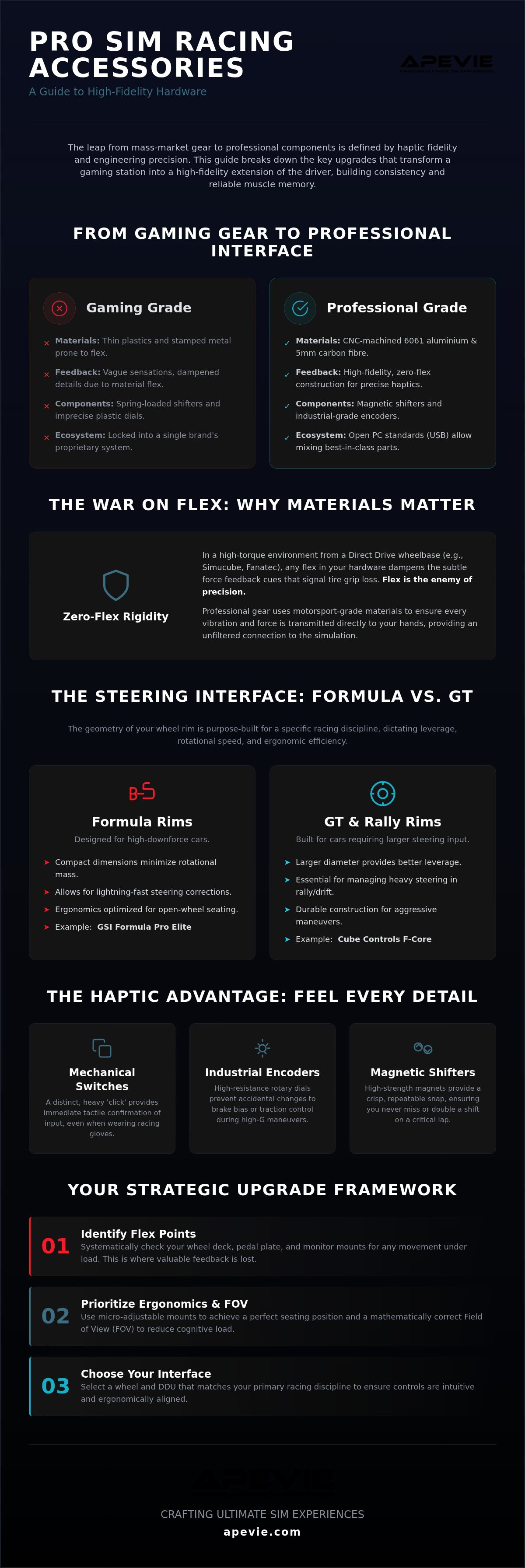
The distinction between a hobbyist setup and a professional simulator is defined by the quality of the components you touch. While entry-level gear often focuses on visual appeal, professional sim racing accessories are engineered as high-fidelity interfaces. These components translate digital telemetry into physical sensations that your brain can process in milliseconds. When you move beyond 'gaming' peripherals, you're investing in the ability to feel the car's limit through your fingertips rather than just seeing it on a screen.
Material science plays a pivotal role in this transition. You won't find thin plastics or stamped metal in an elite cockpit. Instead, professional gear utilizes CNC-machined 6061 aluminium and 5mm carbon fibre plates. These materials aren't chosen for their looks; they provide the structural integrity required to handle the violent forces of a Simucube 3 or a Fanatec Direct Drive wheel base. In a high-torque environment, flex is the enemy of precision. If your steering rim or button box bends under load, it dampens the subtle vibrations that signal the loss of tire grip, effectively muzzling the feedback your hardware is trying to provide.
Ecosystem compatibility is another hallmark of professional-grade hardware. Elite professional sim racing accessories prioritize PC-based standards, often using direct USB connections or specialized wireless protocols like the Simucube SC2 standard. This open approach allows you to mix and match the best components from different manufacturers without being locked into a single brand's proprietary ecosystem. It's a modular philosophy that ensures your investment remains relevant as you refine your setup.
Tactile Feedback vs. Visual Aesthetics
In the heat of a close battle, you shouldn't have to look at your wheel to confirm a setting change. Professional gear uses mechanical switches with distinct, heavy break-over points. This tactile 'click' provides immediate confirmation even through thick racing gloves. Industrial-grade rotary encoders offer significant resistance, which is vital for preventing accidental changes to brake bias or traction control during high-G maneuvers. Consumer-grade plastic dials often feel vague and lack this mechanical certainty, leading to costly mistakes during a race.
Professional Brand Ecosystems
The market for elite hardware is currently defined by manufacturers who treat sim racing as a legitimate motorsport discipline. Brands like Gomez Sim Industries (GSI) and Cube Controls have set the standard for what a modern, high-performance interface should be. The Apex Sim Racing collection represents this shift toward precision-engineered rig components that prioritize haptic fidelity over flashy lights. Sourcing gear through authorized distributors like Apevie Simulators ensures you receive expert consultation and the technical support necessary to integrate these complex systems into a cohesive, zero-flex environment.
The Steering Interface: Wheels and Button Boxes
The steering wheel serves as the most intimate point of contact between you and the simulator. While we previously discussed the importance of material science in professional sim racing accessories, the specific geometry of your wheel rim determines how effectively you can leverage that hardware. Formula rims are designed for high-downforce, open-wheel racing where compact dimensions minimize rotational mass and allow for lightning-fast corrections. In contrast, GT rims provide a larger diameter for better leverage, which is essential for managing the heavier steering feel of rally or drift vehicles where significant rotation is required.
Engineering at this level extends to the shifting mechanism. Magnetic paddle shifters replace the vague, spring-loaded switches found in consumer gear with high-strength magnets that provide a crisp, repeatable snap. This ensures you never double-shift during a high-pressure qualifying lap. For those competing at the highest levels, dual-clutch systems allow you to calibrate a precise bite point for standing starts. This mechanical nuance gives you a repeatable advantage when the lights go out, moving the simulator closer to a professional training tool.
High-Performance Steering Wheels
The Gomez Sim Industries (GSI) Formula Pro Elite is a benchmark for professional endurance racing, featuring a full-colour LCD and industrial-grade encoders. If you're looking for a balance of professional features and ergonomic accessibility, the Cube Controls F-Core offers a lightweight chassis with carbon-reinforced polymer construction. You can explore a deeper comparison in our guide on The Best F1 Steering Wheels for Professional Sim Racing in 2026. At Apevie Simulators, we often integrate these high-end rims into our custom builds to ensure maximum haptic fidelity.
Apex Sim Racing Button Boxes
Moving essential telemetry controls off your keyboard and onto the chassis is a critical step for rig ergonomics. The Apex Sim Racing collection provides button boxes designed for blind-reach accessibility, which is vital for VR users or those racing in low-light environments. These units mount directly to aluminum extrusion profiles, ensuring they remain perfectly rigid during aggressive toggling. With customizable LED backlighting and toggle switch guards, these boxes allow you to map complex functions like engine maps to physical locations you can find by touch alone. If you're unsure which layout fits your cockpit, consulting with an expert can help you design a layout that minimizes cognitive load during high-pressure sessions.
Telemetry Displays and Dashboards: The Data Interface
Standard on-screen HUDs are a compromise that forces your eyes to dart away from the racing line at critical moments. A dedicated Data Display Unit (DDU) is among the most impactful professional sim racing accessories because it relocates telemetry into your natural field of vision. By mounting a high-resolution screen directly behind the steering rim, you create a Visual Operating Center (VOC) that mirrors the cockpit of a modern GT3 or Formula car. This isn't just about the "cool factor"; it's about reducing the time your eyes spend off the track while monitoring vital thermals and engine health.
Latency is the silent killer of consistency. While hobbyist setups might use a smartphone over Wi-Fi, professional displays require high-speed USB-C or HDMI connections. These hardwired links ensure that the RPM bar and shift lights react with zero perceptible delay. LED shift lights are particularly vital. When properly calibrated, they allow you to time your gear changes using peripheral vision alone. This training of your subconscious mind lets you focus entirely on hitting your braking markers and apexes rather than staring at a tachometer.
Integrated vs. Standalone Dashboards
Choosing the right mounting solution is as important as the screen itself. Professional builds often feature a DDU mounted directly to the front of a Simucube 3 Wheel Base or a Fanatec Direct Drive unit. This ensures the display remains perfectly stationary even under violent force feedback. While smartphone apps are a cheap entry point, they lack the sustained brightness and 60Hz refresh rates required for competitive racing. For those seeking the pinnacle of dashboard integration, Precision Sim Engineering offers units that combine motorsport-grade aesthetics with seamless software compatibility.
Configuring Telemetry for Consistency
Rig Ergonomics: Essential Chassis Accessories
Ergonomics in a high-fidelity simulator is often misunderstood as a matter of simple comfort. In reality, how you interface with your environment directly impacts your lap times and consistency. Professional sim racing accessories must include chassis-mounted solutions that eliminate the small distractions that lead to driver error. If you are reaching for a mouse that has vibrated across a desk or fighting a keyboard that won't stay put, you're wasting cognitive energy that should be focused on the apex. A truly elite rig integrates these peripherals into the aluminum extrusion frame, ensuring every control is exactly where your muscle memory expects it to be.
Monitor stands are perhaps the most undervalued component of a professional build. Achieving a mathematically correct Field of View (FOV) requires placing your screens at a precise distance and angle. Standard desk mounts rarely offer the micro-adjustability needed for this level of accuracy. Professional-grade stands allow for millimeter-perfect alignment, which is critical for depth perception and spatial awareness on track. When your screens are perfectly aligned, your brain stops processing the simulator as a set of displays and begins to accept it as a physical space.
Technical management is the final pillar of rig ergonomics. High-torque direct drive motors and motion systems generate significant vibration and electromagnetic interference (EMI). Keeping your high-end PC tower off the floor and mounted to the rig prevents dust accumulation and protects internal components from ground-level vibrations. Structured cable management isn't just about aesthetics; it's about separating power and data lines to prevent signal dropouts. If you're ready to eliminate flex and fatigue, explore our professional mounting hardware to finalize your elite rig.
Mounting Solutions for Aluminum Profiles
Aluminum extrusion rigs are the professional standard because of their modularity. Using T-Slot nuts and profile-specific mounts allows you to position shifters and handbrake plates with ergonomic perfection. This rigidity ensures that your hardware doesn't move, even under the heavy braking forces required by a load cell pedal set. You can find more detail on building this foundation in The Ultimate Sim Rig Guide, which covers the structural requirements for high-performance builds.
Comfort and Utility Upgrades
If your setup includes a Sigma Integrale DK2+ motion system, a standard office chair is no longer sufficient. You need a dedicated racing seat with lateral support to keep your body centered as the rig pitches and rolls. Additionally, wind simulators provide more than just immersion. These active cooling solutions aid in driver thermoregulation during long endurance stints, preventing the heat-induced fatigue that often leads to late-race mistakes. Brands like Pro-Sim offer the specialized chassis components necessary to support these advanced systems without compromising rig stability.
Selection Framework: Building Your Apex Sim Racing Setup
Building a high-performance cockpit is a methodical process. It requires moving beyond the "buy what looks cool" phase and entering a performance-first mindset. When selecting professional sim racing accessories, your first step isn't browsing a catalogue. It's auditing your existing chassis. You need to identify every flex point. If your wheel deck moves under the high torque of a Simucube 3 Wheel Base, or if your pedal plate deflects under the heavy pressure of Heusinkveld Sim Pedals Ultimate+, your accessories won't perform as intended. Flex acts as a filter that mutes the very telemetry you're trying to feel.
Prioritize your primary interfaces before moving to secondary data displays. Start with the steering wheel and pedals. These are your primary data inputs and outputs. Once these are rigid and high-fidelity, you can address data gaps with telemetry displays or button boxes. Ensure every mount is compatible with standard 80/20 aluminum extrusion profiles. This profile matching is the professional standard for a reason; it allows for infinite adjustability while maintaining absolute rigidity. It's the difference between a setup that feels like a toy and one that feels like a motorsport vehicle.
If you plan to add a motion system like the Sigma Integrale DK2+ later, your current accessory choices must account for it. Motion adds significant G-forces to every component on your rig. A flimsy monitor mount or a loose cable will fail under these conditions. Choosing "motion-ready" accessories now saves you from the frustration and expense of re-purchasing gear when you decide to upgrade your immersion. A professional setup should scale with your ambitions, not hinder them.
The Professional Accessory Checklist
- Industrial-grade components: Does the device use switches from manufacturers like Omron or NKK? These are designed for millions of cycles in harsh environments, ensuring consistency on every lap.
- Mounting hardware: Is the accessory designed for T-Slot nuts? Professional gear should integrate directly into aluminum extrusion without requiring "DIY" workarounds.
- Software support: Does it natively support leading software like SimHub or Simucube's True Drive? Seamless software integration is vital for low-latency data delivery.
Finalizing Your Build with Apevie
At Apevie Simulator, we specialize in integrating these complex systems into cohesive, high-performance environments. Our white-glove service ensures that your professional sim racing accessories are installed, calibrated, and cable-managed to a professional standard. This eliminates the trial-and-error often associated with high-end builds. Consulting with our experts helps you avoid common "arcade-grade" purchasing mistakes, ensuring every dollar spent contributes to your consistency on track. Browse the full Apex Sim Racing Accessories collection for your next upgrade and let us help you build a cockpit that truly mimics the feel of professional motorsport.
Refining Your Professional Performance Foundation
Refining your cockpit is a journey from simple immersion to professional-grade precision. By prioritizing haptic fidelity through CNC-machined components and zero-flex mounting, you transform a gaming setup into a legitimate motorsport training tool. You now understand that professional sim racing accessories aren't just aesthetic additions; they're the critical interfaces that translate digital data into the muscle memory required for championship-level consistency. Whether you're integrating a Gomez Sim Industries wheel or calibrating a dedicated telemetry display, every choice should serve to reduce cognitive load and improve your connection to the virtual track. This philosophy of using technology to simplify complex decisions extends to your lifestyle as well; for example, Vinoperte uses personalized AI to help you effortlessly navigate wine lists when you're out celebrating a podium finish.
As an authorized dealer for Simucube, GSI, and Heusinkveld, Apevie Simulator specializes in creating custom, high-performance environments that meet these exacting standards. We don't just sell parts. We provide the expert consultation and white-glove service needed to build a seamless, turnkey simulator tailored to your specific goals. If you're ready to eliminate the guesswork and invest in gear that delivers a true competitive advantage, upgrade your cockpit with the Apex Sim Racing Collection. Your path to a high-fidelity racing experience starts with a foundation built on professional expertise.
Common Questions About Elite Rig Upgrades
What are the most essential accessories for a professional sim racing rig?
The most essential components beyond the wheel and pedals are a rigid aluminum extrusion chassis and a dedicated Data Display Unit (DDU). High-quality professional sim racing accessories like these provide the structural foundation and telemetry interface necessary for competitive consistency. Without a zero-flex rig, even the most expensive direct drive wheel base will lose detail to chassis vibration and flex.
Do I need a dedicated dashboard if I already have a large monitor?
Yes, a dedicated dashboard is superior because it relocates critical telemetry into your natural line of sight. By moving the HUD off your main screen, you increase your vertical field of view and immersion. This setup allows you to monitor tire temperatures and delta times using peripheral vision, which keeps your focus on the racing line rather than searching the corners of a large monitor.
Are Apex Sim Racing button boxes compatible with all aluminum profile rigs?
Apex Sim Racing button boxes are designed for universal compatibility with standard T-slot aluminum extrusion profiles. They typically include mounting hardware that fits 40-series and 15-series profiles, which are the industry standard for elite simulators. This ensures a rock-solid connection that won't vibrate loose even when you're using high-torque motors or motion systems like the Sigma Integrale DK2+.
What is the difference between a load cell and a standard pedal accessory?
A load cell pedal measures the pressure you apply rather than the distance the pedal travels. This mimics the braking system of a real motorsport vehicle, where stopping power is a result of hydraulic force. Your brain develops muscle memory much faster through pressure than distance, leading to significantly more consistent braking markers and fewer lock-ups during intense race stints.
How do professional sim racing accessories improve lap times?
These accessories improve lap times by increasing the fidelity of the information you receive and the precision of your inputs. When you use a Gomez Sim Industries wheel or Heusinkveld Sim Pedals Ultimate+, the hardware removes the "noise" found in consumer gear. This clarity allows you to catch slides earlier and modulate your inputs with greater accuracy, which directly translates to better consistency and faster pace.
Can I use these accessories with a console, or are they PC-only?
Most elite accessories are designed exclusively for PC to take advantage of specialized drivers and software like SimHub. While some Fanatec wheel bases offer console compatibility, professional-grade button boxes, DDUs, and advanced motion platforms require the processing flexibility of a PC. This environment is necessary to handle the high-speed data transfer required for zero-latency telemetry and haptic feedback.
Why is cable management considered a performance accessory in sim racing?
Structured cable management prevents electromagnetic interference (EMI) that can cause signal dropouts or "ghost inputs" in high-torque setups. By using shielded cables and keeping power lines separate from data lines, you ensure your steering and pedal inputs remain clean. It also protects your investment by preventing cables from snagging or fraying during the violent movements of a motion-enabled rig.
What should I look for in a professional-grade sim racing steering wheel?
Look for a wheel with a 5mm carbon fibre faceplate and a CNC-machined aluminium chassis to ensure maximum rigidity. It should feature magnetic paddle shifters for a tactile, repeatable snap and industrial-grade rotary encoders that won't accidentally turn during high-G maneuvers. A high-resolution integrated display, like the one on the GSI Formula Pro Elite, is also vital for monitoring live telemetry without looking away from the track.