Fanatec Wheelbase Buying Guide: Choose the Right Direct Drive Base
Choosing a fanatec wheelbase is not as simple as picking the model with the highest torque rating. A 25 Nm base can be more capacity than you need, while a lower-output option may leave less headroom than you want. Your driving style, platform, steering wheel, and rig all affect which base makes sense.
If you’re comparing CSL, ClubSport, and Podium, you likely want to know what the extra torque gives you and whether the base will work with your wheel and platform. This guide compares the 5 Nm and 8 Nm CSL bases, 15 Nm and 18 Nm ClubSport models, and 25 Nm Podium DD. It also covers the practical compatibility rule: PlayStation compatibility comes from the base, while Xbox compatibility comes from the wheel. Use the comparisons to match a base to the way you race, rather than choosing by the biggest number alone.
Key Takeaways
- Choose a fanatec wheelbase by weighing your platform, driving style, steering wheel, and rig together, not by torque rating alone.
- Compare CSL, ClubSport, and Podium as distinct tiers, then focus on the model differences that matter for your setup.
- Check platform support on the exact product listing before choosing a base; compatibility can vary across models.
- Consider how your current wheel connection and rig fit affect your choice, especially if you plan to upgrade later.
- Use the pros and cons framework to decide whether additional torque suits your needs or adds capacity you may not use.
What a Fanatec Wheelbase Does, and What Torque Tells You
Start with more than the wheelbase’s newton-metre rating. Consider what you drive, which platform you use, and how the base pairs with your steering wheel and rig. Those details help you judge whether a torque rating gives you useful headroom or simply exceeds the force you want to feel.
The wheelbase turns force-feedback information from a simulation into steering force at the wheel. In a direct-drive setup, a motor in the base applies that force to the connected steering wheel. The simulation may signal changing cornering loads, kerb strikes, or surface texture, but what reaches your hands depends on the game’s output and your settings. For background on the system, see this overview of direct-drive sim racing wheel technology.
Torque, measured in newton-metres (Nm), describes the rotational force a base can produce. It helps compare available output, but it does not describe the full quality of the feedback or tell you what force to use. A higher rating means more potential output. It does not automatically make every signal clearer or better suited to every driver.
Peak torque describes the base’s available maximum, while your preferred operating level is the force you choose to feel during a session. Keep that distinction in mind when comparing models: you’re choosing both available capacity and a base that suits your intended use.
How direct-drive force feedback reaches the steering wheel
When the simulation calculates steering forces, the wheelbase motor applies corresponding resistance or movement through the wheel. A corner’s changing load, a kerb, or a shift in road surface can each produce a different force-feedback signal when the game models it. The base reflects what the simulation sends, shaped by the force-feedback settings you use.
Those settings matter. Adjusting the overall strength changes how forceful the wheel feels, while other available controls can affect the character of the feedback. A heavier setting may suit one driver and feel tiring or distracting to another. When comparing impressions, account for the game, settings, steering wheel, and how securely the base is mounted.
Why the highest torque rating is not automatically the best fit
A base’s maximum rating is its capacity, not a recommended setting or a promise that you’ll use all its output. Your experience, preferred driving intensity, and steering wheel all influence what feels comfortable and informative. The rest of the rig matters too: movement or flex in the mounting surface can affect how consistently you feel the feedback.
Think about your usual sessions. If you prefer lighter steering forces, a higher maximum may not change your day-to-day settings. If you want more headroom, that capacity may matter, provided your wheel and rig suit the setup. Neither choice guarantees more realism or faster lap times. Aim for feedback you can comfortably interpret and control.
Before comparing torque figures, write down the factors that will shape your experience:
- Driving style: Consider the cars and types of racing you spend the most time driving.
- Force preference: Decide whether you like light, moderate, or more forceful steering feedback.
- Simulation and settings: Remember that the game’s force-feedback signals and your configuration affect what you feel.
- Wheel and mounting: Account for the steering wheel you’ll use and the rigidity of the rig supporting the base.
This gives torque a useful context. Rather than treating Nm as a score, compare it with the forces you want, the feedback your simulations provide, and the rest of your setup. That is a more practical starting point for deciding which tier deserves a closer look.
How to Choose a Fanatec Wheelbase for Your Platform and Setup
Begin with the factors that determine whether a base will work in your setup, not with its torque figure. Follow this order: platform, driving needs, torque tier, wheel connection, then rig. If you’re buying your first premium base, this sequence helps you avoid focusing on output before confirming the hardware fits your system. If you’re upgrading, it also shows which parts of your current setup you can keep and what may need to change.
- Platform: Identify where you’ll race, then check the exact product listing for the base’s stated platform support and licensing. Don’t assume every Fanatec base is interchangeable.
- Driving needs: Consider the cars and simulations you use, how often you race, and the steering force you prefer. These needs help narrow the torque range that makes sense for you.
- Torque tier: Compare available torque after settling platform compatibility. A higher rating may offer more capacity, but it does not determine console support or guarantee a better fit.
- Wheel connection: Match the steering wheel to the base and the connection details listed for each. Product listings may specify QR2 or QR2L, so compare the exact configuration instead of assuming all quick releases are identical.
- Rig: Consider how the base will mount and whether your rig can support the forces you plan to use. Include this in your decision before committing to an upgrade.
Check platform and wheel compatibility before comparing torque
Platform licensing and game compatibility are separate from a base’s Nm rating. The Gran Turismo DD Pro listing identifies PlayStation 5 performance. Do not apply that platform statement to other bases or configurations. Read the listing for the specific product you’re considering, and distinguish its stated platform support from whether an individual game supports your chosen hardware.
This check matters for new buyers and upgraders alike. A base that suits your preferred force level may still be the wrong choice if it does not meet your platform needs. Treat compatibility as a requirement, then compare the options that remain.
Match the base to the wheel, rig, and upgrade plan
Think of the steering wheel and base as a pairing. A formula-style driver might compare F1 steering wheel options alongside the base connection shown in the product listing. If you already own a wheel, its connection is a practical starting point. If you plan to change wheels later, consider how that affects your upgrade path.
Rig fit deserves equal attention. Higher force settings can make a flexible mounting setup more noticeable, so assess the frame and mounting point rather than treating the base as an isolated component. Apevie’s professional sim rig guide offers a useful reference for evaluating that foundation.
Once these checks are clear, compare specific Fanatec options against your platform, wheel, and rig. Browse the Fanatec wheelbase collection with those requirements in mind, then weigh torque tiers against your driving needs.
Fanatec CSL vs ClubSport vs Podium: Compare the Torque Tiers
The Fanatec range covers different levels of available steering force, from a lower-output starting point to higher-output bases for drivers who want more headroom. Compare the torque ratings first, then decide whether that capacity fits your driving preferences and setup. The figures help frame the decision, but they do not rank the bases for every driver.
| Family | Model | Torque rating |
|---|---|---|
| CSL | CSL DD QR2L | 5 Nm |
| CSL | CSL DD QR2 | 8 Nm |
| ClubSport | ClubSport DD | 15 Nm |
| ClubSport | ClubSport DD+ | 18 Nm |
| Podium | Podium DD | 25 Nm |
| Podium | Podium DD1 | Up to 20 Nm |
| Podium | Podium DD2 | Up to 25 Nm |
Across these named bases, the range spans 5 Nm to 25 Nm. That spread is useful context, but it does not mean every driver needs the highest figure. Your preferred force level, wheel, platform, and rig all influence which tier makes sense.
When a CSL DD may be the practical starting point
The CSL DD QR2L at 5 Nm and CSL DD QR2 at 8 Nm are distinct torque choices within the CSL family. The ratings identify the difference in stated torque, but do not establish other similarities or differences between the listings. A separate Boost Kit 180W listing is designed specifically for the CSL DD, but its name alone should not be taken as a stated torque rating.
If you’re choosing your first premium direct-drive base, consider which of these options matches the force level you want and your upgrade plans. If you’re satisfied with a lower operating force, the higher rating may not change your preferred settings. If you want more available capacity, compare the 8 Nm option with the next tiers and consider how well your rig supports them.
When ClubSport or Podium torque tiers merit consideration
The ClubSport DD is rated at 15 Nm and identified with FullForce; the ClubSport DD+ is rated at 18 Nm. Consider these options if higher stated torque is a priority, but assess platform compatibility and rig fit separately. The ratings alone do not settle either question.
The Podium DD is rated at 25 Nm, while the Podium DD1 is rated up to 20 Nm and the Podium DD2 up to 25 Nm. Compare each with your preferred force level and setup rather than assuming one is universally superior. To review the named options together, browse the Fanatec wheelbase collection and use the ratings as a starting point.
Common Fanatec Wheelbase Buying Mistakes, and How to Avoid Them
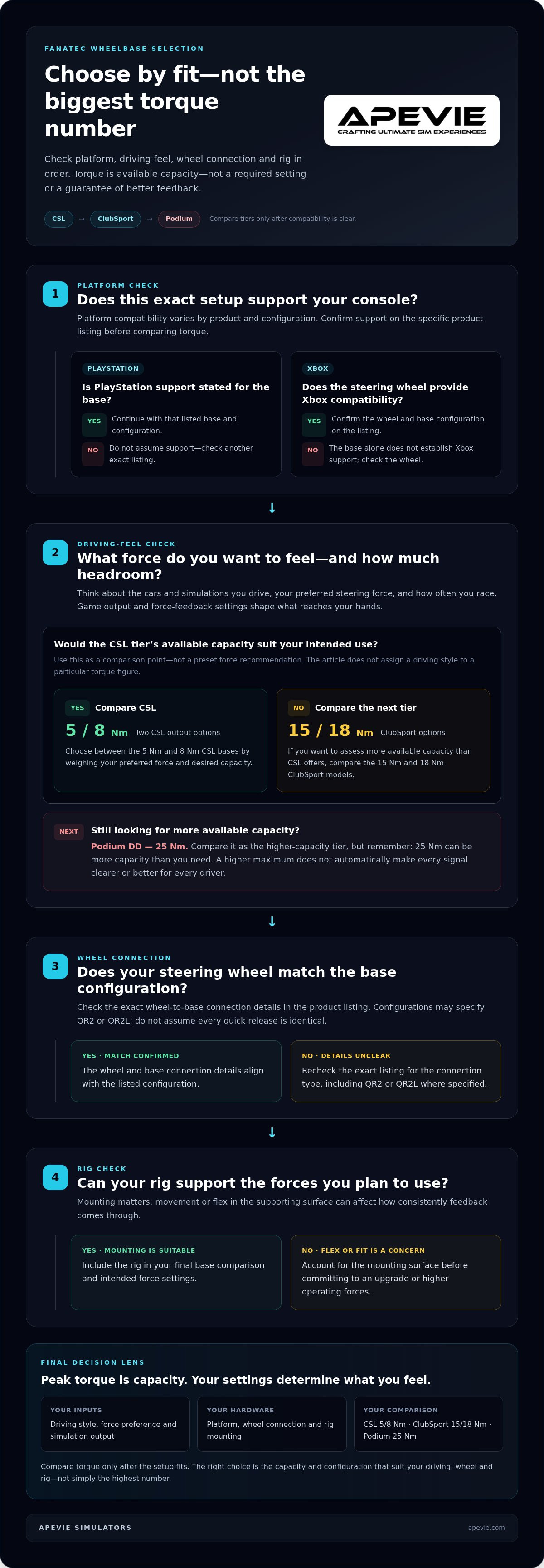
A wheelbase can look like an obvious upgrade, but treating one specification as the whole decision can lead to a poor fit. Torque matters, as do platform support, the exact product listing, steering wheel, cockpit, and the balance of the controls. Use this pros and cons framework to separate useful capacity from details that could affect your setup.
- More torque: pros. A higher rating offers more available force for drivers who want to use it, or prefer additional capacity beyond their current operating level.
- More torque: cons. It may not benefit a driver who prefers lighter forces, and it makes rig fit more important. A flexible cockpit can undermine the sense of a stable, consistent setup.
- Choosing by Nm alone: pros. Torque figures make it easy to compare stated output across models.
- Choosing by Nm alone: cons. The number says nothing by itself about platform support, the wheel connection, or whether your cockpit suits the forces you intend to use.
Use the rating as one filter, not the final verdict. If you’re buying your first premium base, start with what your platform and current rig can support. If you’re upgrading, consider whether your existing wheel and cockpit remain part of the plan. If you’re also reviewing overall control balance, this sim racing pedals guide can help put the wheelbase in context with the rest of your setup.
Don’t mistake a package name for a wheelbase-only listing
Product names can look similar while describing different listing types. The GT DD Pro Wheel Base and the GT DD Racing Wheel Pro have distinct names. Don’t treat the second title as another way of naming the wheelbase-only listing, and don’t infer included components from the name alone. Compare the exact title and description on each listing to understand which product you’re evaluating.
This check is especially useful when comparing a base with a product explicitly named as a racing wheel. Review the stated product details before comparing features or planning around existing equipment. Similar wording does not establish that two listings contain the same components.
Don’t overlook the rest of the sim rig
A wheelbase works as part of a system. Consider how securely the cockpit supports it and whether the mounting arrangement suits your setup, without assuming a particular pattern or included accessory. Pedals also affect the overall control balance. Aim for a coherent driving position and input setup rather than choosing each component in isolation.
Keep a short checklist beside the product page: platform support, exact listing type, wheel connection, cockpit fit, and how the pedals complement your driving setup. This helps prevent a strong torque rating from distracting you from practical mismatches. For a considered comparison, browse Apevie’s Fanatec wheelbase collection and assess each listing against that checklist.
Find Your Fanatec Wheelbase in Apevie's Collection
Build your shortlist around the force level and driving platform that suit your setup, then narrow it to a specific model. Apevie’s collection brings together CSL, ClubSport, Podium, and Gran Turismo options, so you can compare different torque ratings without treating one tier as the automatic choice. The options below are organized by buyer priority, not by a claim that one base is universally better.
A shortlist by buyer priority
If you’re choosing a fanatec wheelbase, use the model names and stated ratings to identify a sensible starting point. Then compare the exact product listing with your platform, wheel, and cockpit plans.
- Lower stated torque: The CSL DD QR2L is listed at 5 Nm, while the CSL DD QR2 is listed at 8 Nm. These are distinct torque choices; the ratings alone don’t establish other differences between the listings.
- Gran Turismo focus: The GT DD Pro is the official Gran Turismo wheelbase option. It gives Gran Turismo-focused shoppers a clear model to investigate, while its exact product listing remains the reference for configuration details.
- Higher stated torque: The ClubSport DD is listed at 15 Nm and the ClubSport DD+ at 18 Nm. For Podium, the listed descriptions are 25 Nm for the Podium DD, up to 20 Nm for the Podium DD1, and up to 25 Nm for the Podium DD2.
These ratings help you form a shortlist, not a performance ranking. A driver who prefers a lower force level may find the CSL options more aligned with their needs, while someone prioritizing higher stated torque may compare ClubSport and Podium. Your choice should still reflect how you drive and the rest of your simulator.
Turn the shortlist into a complete simulator decision
Before settling on a model, check that its platform support suits your system and that the specific steering wheel connection works with your plans. Then consider the cockpit: the wheelbase should suit the rig supporting it, not just the force rating on the product page. If you’re upgrading, account for the components you’ll keep and any changes you’re planning.
Apevie brings Fanatec hardware into a broader premium sim-racing and turnkey simulator offering. A custom simulator build can bring the base together with the rest of your driving setup, including its platform, wheel, and cockpit, rather than treating the wheelbase as a standalone specification.
Once you’ve narrowed the choice to a family and torque tier, compare the current model listings directly. Browse Fanatec wheelbases in Apevie’s collection to find options that fit your shortlist.
Build Your Next Simulator Around the Right Base
Your shortlist is most useful when it becomes a plan for the complete simulator. Before choosing a fanatec wheelbase, decide what you want to keep, what you may upgrade later, and how the base will work with your platform, steering wheel, and cockpit. This gives each specification a purpose and helps prevent a single headline number from setting the direction for your whole build.
Apevie’s collection brings together CSL, ClubSport, Podium, and Gran Turismo options, with listings that identify torque levels and QR2 or QR2L connections. Use the exact product details to narrow your choice, then consider how the rest of your setup supports your driving goals. A considered match can serve as a sound foundation, whether you’re selecting one component or planning a complete simulator.
Ready to choose your base? Browse Apevie’s Fanatec wheelbase collection and find the option that fits your platform, wheel, and rig. For a complete custom simulator, explore Apevie’s turnkey builds and professional installation service.
Frequently Asked Questions
What is the difference between a Fanatec CSL DD and ClubSport DD?
They’re different base families, so compare the exact model listings rather than treating the family name as a complete specification. For a useful side-by-side assessment, use the same game, car, steering wheel, and force-feedback settings, then note whether either option better suits your preferred driving feel. If you’re upgrading, also write down which parts of your existing setup you intend to keep.
Is the Fanatec Gran Turismo DD Pro compatible with PlayStation 5?
Yes, the Gran Turismo DD Pro listing identifies PlayStation 5 support. Before buying, match the exact base listing to the games you plan to play, since platform support and an individual game’s supported controls are separate considerations. If you switch between titles, check each game’s wheel setup options after connecting your equipment so you can configure the controls for that simulation.
How much torque do I need in a Fanatec wheelbase?
There isn’t one torque rating that suits every driver. Instead of choosing from a number alone, write down what you want to feel during your usual sessions: lighter steering, stronger resistance, or room to adjust your settings. If you can test your preferred force level, note how it feels over a full session, not just a few corners. Comfort and control are useful decision criteria.
Can I use a Fanatec wheelbase with any steering wheel?
Don’t assume that every wheel pairs with every base. Before choosing, record the complete model name of the wheel you own or plan to buy, then compare it with the full base listing. This is especially useful if you’re building the setup in stages, because a planned wheel change can affect which base configuration makes sense. Base and wheel names are more useful than brand alone for this check.
What does QR2 mean on a Fanatec wheelbase?
QR2 is a quick-release designation in the product details. For your shortlist, preserve the exact suffix shown in each model name rather than reducing every listing to “QR2.” Then compare the wheel and base descriptions together. The label helps identify the connection specified for a product, but it should not be treated as proof that any two separately named components are automatically compatible.
Is the Fanatec Podium DD the same as the Podium DD2?
No, they’re separate models. Don’t use a similar torque description as a shortcut for deciding that their design or configuration is the same. Open each product description and compare the details for the specific listing you’re considering. This is particularly helpful if you’re looking at a model by name from older setup notes, since the listing itself should guide your current component decision.
Do I need the Fanatec Boost Kit 180W for a CSL DD?
Not necessarily. Whether it belongs in your setup depends on the exact CSL DD configuration you’re considering and the power provision described for that setup. Treat the kit as a separate buying decision rather than assuming it’s required or included with a base. Compare the kit and base listings before finalizing your component plan, especially if you’re assembling a system from items selected separately.