Our Products: The 2026 Buying Guide to Premium Sim Racing Hardware
The highest Newton-meter rating on a direct drive base won't actually make you faster on the track. You likely agree that the current market for high-end hardware feels like a technical arms race where numbers like 30Nm or 400Hz telemetry rates often distract from the actual driving feel. When you browse our products, you'll notice a shift toward precision and ecosystem harmony rather than just raw specifications. We understand the anxiety of spending thousands on a Simucube 2 Pro only to worry if it's compatible with your existing steering wheel or a specific motion platform.
This guide provides a professional framework for selecting elite hardware that works together from day one. You'll gain a clear understanding of how a Simucube base pairs with Heusinkveld Ultimate+ pedals to create a balanced feedback loop. We'll break down the 2026 lineup of wheels, bases, and D-BOX G5 motion systems so you can invest with total confidence. Instead of generic advice, we offer direct comparisons and a decision matrix to help you choose the right gear for your specific racing discipline. Our goal is to ensure your simulator performs as a cohesive unit rather than a collection of expensive, mismatched parts.
Key Takeaways
- Understand the technical distinction between consumer peripherals and professional hardware where high-fidelity force feedback is essential for developing precise muscle memory.
- Learn how to select the ideal wheel diameter and shape based on your racing discipline to ensure ergonomic comfort for both qualifying sprints and long-stint endurance sessions.
- Discover why the wheel base and pedal set function as the engine of your ecosystem, and explore how our products provide the consistent braking markers required for competitive lap times.
- Create a customized performance blueprint by matching your simulator's torque ceiling to your physical rig and specific software requirements like iRacing or Assetto Corsa Competizione.
- Evaluate the advantages of professional turnkey solutions, including expert cable management and white-glove installation, to bypass the complexities of high-end hardware calibration.
Defining Professional-Grade Sim Racing Hardware
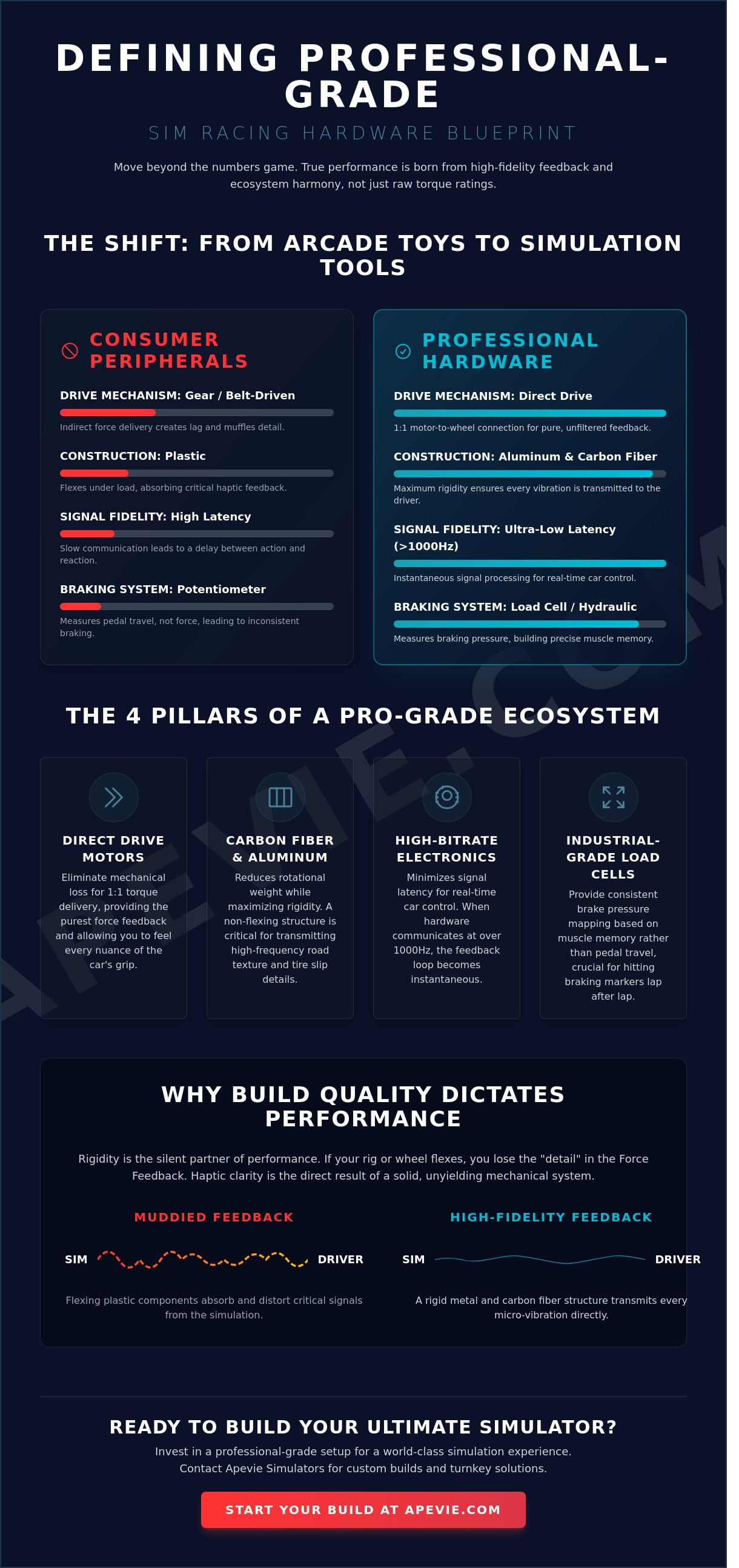
Serious sim racing isn't about playing a game; it's about professional training. When we select components for our products at Apevie Simulators, we look for hardware that bridges the gap between digital and physical reality. Professional PC-based hardware differs from consumer-grade arcade peripherals through data fidelity and mechanical integrity. While entry-level wheels use plastic gears and small motors, professional systems aim to accurately simulate auto racing by translating raw telemetry into precise tactile information. This high-fidelity force feedback (FFB) is the only way a driver can develop the muscle memory required to catch a slide or hit consistent apexes across a 24-hour endurance stint.
The technical foundation of this realism relies on high-bandwidth electronics. Professional wheel bases and pedals process signals at rates exceeding 1000Hz, effectively eliminating the input lag that plagues mass-market setups. When your hardware communicates with the PC at this frequency, the feedback loop between your hands and the virtual tires becomes instantaneous. This precision requires build materials that don't flex under pressure. We prioritize aviation-grade aluminum and race-grade carbon fiber because they ensure that every vibration from the steering rack reaches the driver's fingertips without being absorbed by cheap plastic housing.
The Shift from Arcade to Simulation
The transition from gear-driven or belt-driven wheels to Direct Drive (DD) technology represents the biggest leap in simulation history. In a DD system, the steering wheel attaches directly to the motor shaft, providing unfiltered torque. Professional components can replicate the 10 to 15Nm of sustained torque found in real GT3 cars, with peaks reaching 25Nm or higher. This raw power allows for a linear delivery of force, which is essential for long-term driver development. Using high-end gear from brands like Precision Sim Engineering ensures that the resistance you feel in the virtual cockpit matches the physical demands of the track, leading to better consistency and faster lap times.
Why Build Quality Dictates Performance
Build quality is directly tied to haptic clarity. A plastic-molded wheel will flex and creak under high torque, which muddies the feedback signals sent to the driver. In contrast, the carbon fiber structure of the CONSPIT 300 GT provides a rigid platform that transmits every micro-vibration of the road surface. Rigidity is the silent partner of performance; if your rig or your wheel flexes, you lose the "detail" in the FFB. Beyond performance, premium investments in our products offer significantly higher longevity and resale value. A professional aluminum cockpit or a hydraulic pedal set won't wear out after a season of heavy use, making them a smarter financial choice for the dedicated enthusiast.
- Direct Drive Motors: Eliminate mechanical loss for 1:1 torque delivery.
- Carbon Fiber Construction: Reduces rotational weight while maximizing rigidity.
- High-Bitrate Electronics: Minimizes signal latency for real-time car control.
- Industrial-Grade Load Cells: Provide consistent brake pressure mapping based on muscle memory rather than pedal travel.
Choosing the right hardware is the first step in building a world-class simulation experience. If you're ready to move beyond hobbyist gear and invest in a professional-grade setup, contact Apevie Simulators for a consultation on custom builds and turnkey solutions.
Selecting the Right Steering Wheel for Your Discipline
The steering wheel serves as the primary conduit between driver and machine. It's not just a control interface; it's a sophisticated sensory tool that translates tire slip and track texture directly into your palms. Choosing the correct diameter and shape fundamentally changes how you interact with a car's physics. A smaller wheel increases steering speed but requires more physical effort, while a larger rim provides the leverage needed for high-torque maneuvers in heavy vehicles. As sim-racing esports has exploded, the hardware has evolved from simple peripherals into professional-grade instruments. Within our products, we prioritize equipment that maintains this high-fidelity feedback over hours of intense competition.
Formula and Open-Wheel Precision
Open-wheel racing demands lightning-fast reactions and minimal steering lock. The 280mm to 300mm range is the industry sweet spot here, allowing for rapid corrections without overextending your shoulders. The CONSPIT PW1 Formula Wheel ($1799.0) represents the pinnacle of this category, featuring F1-grade craftsmanship and a rigid chassis that eliminates signal dampening. For drivers who rely on real-time telemetry, the Moza FSR2 Formula Wheel ($599.0) provides a high-definition integrated display. This allows you to monitor brake bias and tire temperatures without taking your eyes off the apex. If you're building a bespoke cockpit, brands like Precision Sim Engineering offer similar professional-grade solutions for open-wheel enthusiasts.
GT and Endurance Versatility
GT3 and endurance racing require a balance between agility and long-term comfort. The Simucube Valo GT-23 ($949.0) is often cited as the ultimate daily driver because its 320mm diameter suits almost any modern race car. During a multi-hour stint, ergonomics become a critical performance factor. The Simagic GT Neo ($269.0) offers a high-performance entry point with carbon fiber construction and tactile buttons that you can find by feel alone. Integrated Quick Release systems are vital for these disciplines; they allow you to swap between a GT rim and a formula wheel in seconds as you change car classes throughout a race weekend.
Specialty Wheels: Trucking and Classic Racing
Authenticity in simulation often requires breaking away from the standard 300mm rim. The Moza Racing TSW Truck Wheel ($209.0) brings a massive 400mm diameter to the simulator, providing the physical presence and leverage required for heavy vehicle operation. For those who prefer the soul of vintage machinery, the Simagic P-325C Steering Wheel ($59.0) offers a classic, leather-wrapped round feel. Round rims are superior for drifting and classic racing because they allow the wheel to slide through your grip smoothly during counter-steering. You can find these specialized options in our curated collection of high-performance sim racing wheels.
Beyond the Wheel: Bases, Pedals, and Motion
The wheel base acts as the central nervous system of your setup, translating digital telemetry into physical resistance. While the steering wheel is your primary interface, the base determines the fidelity of that communication. High-fidelity feedback isn't just about strength; it's about the speed of signal processing. When we select components for our products, we prioritize hardware that maintains a 1:1 relationship between the car's steering rack and the driver's hands. This clarity allows a racer to feel the exact moment the front tires scrub across the asphalt, providing the data needed to adjust mid-corner.
Direct Drive Bases and Pedals
Choosing between Simucube models often comes down to peak torque and slew rate. The Simucube 2 Sport offers 17Nm, which suffices for many GT3 enthusiasts. The 25Nm Simucube 2 Pro remains the industry standard for 2026 because it provides enough headroom to avoid signal clipping during high-load corners. For those seeking the absolute pinnacle of fidelity, the Ultimate model pushes 32Nm, though this requires a rigorous physical training regimen. Beyond steering, upgrading to sim racing pedals is the most effective way to shave tenths off your lap times. Muscle memory relies on pressure, not distance. High-end load cell technology replicates the stiff, hydraulic feel of a real racing brake, allowing you to hit the same braking markers with millisecond precision every single lap.
- Simucube 2 Sport: 17Nm torque, perfect for space-conscious or GT-focused builds.
- Simucube 2 Pro: 25Nm torque, the sweet spot for professional-grade feedback and detail.
- Simucube 2 Ultimate: 32Nm torque, featuring superior electronics for the lowest possible latency.
Integrating Haptic and Motion Systems
Motion systems like the Sigma Integrale DK2 transform a static simulator into a dynamic vehicle. By using four actuators to move the entire chassis, this system communicates suspension travel and weight transfer that a wheel base alone cannot convey. It's a significant jump from simple seat movers, which only tilt the driver's body. Integrating haptic feedback provides the sensory data needed to detect tire slip and understeer before they result in a spin. This level of immersion is detailed in this Sim Racing Hardware Guide, which highlights how hardware choices impact driver development. Compatibility is also vital; for instance, the Simucube Tahko wireless wheel must sync perfectly with its base to ensure zero latency in shift commands.
Professional Cockpit Foundations
A high-torque motor is useless if the frame beneath it bends under load. An aluminum profile sim rig provides the necessary rigidity to handle the 25Nm of force generated by professional bases. Flex acts as a filter, absorbing the subtle vibrations that tell you when the front tires are losing grip. We utilize heavy-duty T-slot extrusions to ensure a rock-solid foundation for every component. For the final touch of tactile luxury, we often look to Precision Sim Engineering for bespoke rims that mirror the ergonomics of modern LMP and Formula cockpits. These components are essential when we curate our products for clients who demand zero compromises in their training environment.
Building Your Performance Blueprint: A Tiered Selection Guide
Buying high-end gear without a clear plan is the fastest way to waste money on hardware that doesn't work together. To help you navigate our products and the wider market, we've developed a five step framework to ensure your rig is balanced and effective. A mismatched setup isn't just frustrating; it actually slows your progression by providing inconsistent feedback.
- Step 1: Identify your primary sim. iRacing and Assetto Corsa Competizione (ACC) reward high-fidelity feedback for GT3 cars, while Rally or Trucking sims require larger, rounder rims for rapid hand-over-hand movements.
- Step 2: Set a torque ceiling. Don't buy a 25Nm base if you're mounting it to a wooden desk. A 10-12Nm base is the sweet spot for most racers, but professional rigs need the overhead of a 20Nm motor to avoid signal clipping during high-load cornering.
- Step 3: Match ergonomics to car class. If you're chasing F1 lap times, a 280mm formula rim is essential. Using a large 330mm round wheel for open-wheelers feels sluggish and inaccurate.
- Step 4: Prioritize pedals. A $1,000 wheel on $200 pedals is a common mistake. Your muscle memory lives in your braking foot; invest in high-quality load cells before buying a wheel with a built-in screen.
- Step 5: Verify technical overhead. High-end peripherals require stable power and dedicated USB bandwidth. Ensure your PC has enough discrete USB controllers to handle the data flow from multiple high-frequency devices.
The Professional Entry Tier
For racers transitioning from consumer gear to real performance, the Moza Racing RS V2 Wheel ($369.0) paired with a mid-range Direct Drive base provides a massive leap in tactile feedback. The Simagic GTS ($289.0) offers perhaps the best price-to-performance ratio for pros who want a sturdy, leather-wrapped rim without the boutique price tag. If you need to jump between PC and Xbox, the Moza Racing ESX ($129.0) delivers the necessary flexibility while maintaining the precision of the Moza ecosystem.
The Elite Performance Tier
When compromise isn't an option, pairing the Cube Controls CSX-3 ($1245.0) with a Simucube 2 Pro creates a world-class telemetry environment. The CSX-3 features a vibrant display that puts vital engine data directly in your line of sight. The Gomez Sim Industries (GSI) Formula Pro Elite has also become a standard-setter for its rock-solid construction and tactile buttons. For a futuristic approach, the MOZA Vision GS Wheel ($699.0) integrates a circular touchscreen UI that allows for real-time adjustments mid-race. You can find these specialized components and more within our products catalog.
Ready to assemble your dream setup? Explore our full range of premium sim hardware and get expert advice on your custom build.
Why Choose a Turnkey Simulator Solution?
Building a high-end racing rig often starts as a passion project but quickly turns into a complex engineering challenge. You might have the best hydraulic pedals and a 25Nm direct drive motor, but without precise calibration, they're just expensive metal. Most enthusiasts spend over 30 hours just managing cables and troubleshooting driver conflicts before they even turn a single lap. A turnkey solution eliminates this frustration. Our expert team handles the white-glove installation, ensuring every component in our products lineup works in perfect harmony from the moment you sit in the cockpit.
Software calibration is where most DIY builds falter. Syncing telemetry data across motion platforms, tactile transducers, and peripheral displays requires deep technical knowledge. Apevie curates components specifically for their synergy. We don't just sell parts; we provide a balanced ecosystem where the force feedback from your wheel matches the vibration in your seat. This meticulous approach removes the compatibility headaches that plague mixed-brand setups. To finish the immersion, we guide you through choosing between 180-degree triple monitor arrays or the latest high-refresh-rate VR headsets, depending on whether you prioritize peripheral vision or spatial depth.
Standout Steering Wheels for 2026
The steering wheel is your primary touchpoint with the virtual track. For 2026, three models define the premium market. The MOZA Racing Essenza SCV12, priced at $1299.0, is a stunning limited-edition hypercar replica designed for collectors who demand absolute authenticity. If you switch between disciplines, the Simagic FX Pro Formula Wheel ($549.0) remains the hybrid king, featuring a sharp 4.3-inch integrated display for real-time telemetry. For those focused on endurance racing, the Cube Controls GT Pro ZERO ($710.0) sets the gold standard for ergonomics, featuring tactile buttons that are easy to locate during intense 24-hour stints.
Ready to Build Your Dream Rig?
Selecting the right hardware is a personal journey that depends on your driving style and space requirements. Whether you're looking for a specific wheelbase or a complete motion-integrated chassis, our products are selected to meet the highest standards of professional sim racing. We offer expert advice for custom rig integration to ensure your hardware pairing is flawless. You don't have to guess which bolt fits which profile; we've already done the testing for you.
Architecting Your Professional Sim Racing Future
Investing in premium hardware is about more than just buying parts; it's about building a consistent, high-fidelity feedback loop between you and the virtual track. Choosing between a Simucube 2 Pro and a Moza R21 isn't just about raw torque numbers. It's about matching your wheelbase and load-cell pedals to your specific racing discipline to ensure every input is translated with absolute clarity. We've curated our products to ensure that every component, from Cube Controls steering wheels to multi-axis motion systems, meets the rigorous standards of real-world racing experts.
As an authorized dealer for Simucube, Moza, and Cube Controls, we provide the technical foundation required for serious competition. Transitioning to a high-performance setup shouldn't involve guesswork or endless troubleshooting. By opting for a custom high-performance turnkey simulator build, you're securing a professional-grade blueprint designed for precision. The right hardware doesn't just make you faster; it makes every corner more predictable and rewarding. Your journey toward a professional-grade cockpit starts with a commitment to quality components and expert consultation. We're here to help you navigate these choices and build a rig that performs as well as it looks.
Shop the Complete Apevie Collection of Premium Sim Hardware
We look forward to helping you build the ultimate racing environment.
Frequently Asked Questions
What is the difference between Simucube 2 Sport, Pro, and Ultimate models?
The primary differences lie in peak torque and signal processing speed. The Sport offers 17Nm of torque, the Pro provides 25Nm, and the Ultimate reaches 32Nm. While the Pro serves as the benchmark for 90% of serious racers, the Ultimate features a 24-bit encoder for the highest resolution feedback available. These units represent the core of our products in the direct drive category, offering distinct levels of fidelity.
Is the CONSPIT PW1 Formula Wheel compatible with non-CONSPIT wheel bases?
You can use the CONSPIT PW1 with any wheel base that supports a standard 70mm bolt pattern and USB connection. It isn't locked to the CONSPIT ecosystem. The wheel connects directly to your PC via a dedicated coiled cable; this ensures compatibility with bases from Simucube or Simagic. This flexibility allows you to integrate premium Formula hardware into your existing setup without replacing your entire drive system.
Do I need a specific PC build to run high-end Moza or Simagic hardware?
High-end peripherals like those from Simagic or Moza require a modern PC to process high-frequency telemetry data without lag. You'll need at least an Intel i7 or AMD Ryzen 7 processor paired with an NVIDIA RTX 40-series GPU to maintain 144Hz refresh rates. Stable frame rates are essential; input lag at the wheel can disrupt your muscle memory during high-speed cornering. A powerful build ensures your hardware performs as intended.
What are the benefits of a 400mm truck wheel like the Moza TSW?
A 400mm wheel like the Moza TSW provides the authentic leverage and physical rotation characteristic of heavy-duty commercial vehicles. Standard 300mm racing rims are too small for accurate truck maneuvering. The larger diameter allows for finer steering adjustments when reversing trailers or navigating tight industrial zones in simulators like Euro Truck Simulator 2. It changes the physical ergonomics to match real-world truck cabin dimensions, which improves your immersion during long hauls.
Can I use Cube Controls wheels wirelessly with Simucube bases?
Certain Cube Controls models feature integrated Simucube Wireless technology for a cable-free experience. These versions connect directly to the Simucube 2 base via a low-latency Bluetooth protocol. You won't need a USB cable; this eliminates the risk of wire tangling during 1080-degree rotations. It's a clean solution for drivers who prioritize a minimalist cockpit aesthetic. This wireless integration maintains professional-grade response times without the clutter of traditional data cables.
Is a motion system necessary for competitive sim racing at a high level?
Motion systems aren't required to be fast, but they significantly improve your ability to sense traction loss through your vestibular system. A 4-point actuator system provides vertical heave and pitch, which helps you identify the exact moment the rear tires lose grip. While many top eSports drivers use static rigs, motion adds a layer of biological feedback that makes consistent long-distance racing more intuitive. It bridges the gap between visual cues and physical reality.
What makes the Simucube Valo GT-23 a better daily driver than a Formula rim?
The Simucube Valo GT-23 is more versatile than a Formula rim because its 320mm diameter and ergonomic shape suit multiple racing disciplines. Formula rims are often too narrow for rally or drift maneuvers. The GT-23 provides a comfortable grip for endurance sessions and works perfectly for GT3, touring cars, and even street car simulations. It's the most balanced option among our products for daily training across a wide variety of car classes.
How do I choose between leather and Alcantara for my Simagic wheel grips?
Choose leather for longevity and Alcantara if you always wear racing gloves. Leather resists skin oils and maintains its texture for years with minimal cleaning. Alcantara offers superior grip and a premium feel, but the fibers will mat down within 500 hours of use if you drive with bare hands. If you prefer the tactile sensation of a suede-like finish, be prepared for regular maintenance to keep the material supple and clean.