Professional F1 Racing Simulators: The 2026 Engineering Guide for Elite Performance
What if the most expensive component in your rig is actually the one preventing you from feeling the limit of the car? Many enthusiasts discover that high-torque gaming gear often masks subtle telemetry data with generic vibrations, leaving them overwhelmed by complex DIY calibration. It's a common frustration to spend more time troubleshooting motion system compatibility than actually finding the apex. Achieving elite performance requires a shift from consumer-grade peripherals to an engineered F1 racing simulator environment.
We understand that true realism is found in the synergy of hardware that replicates the active aerodynamics and power unit modes of the 2026 season. This guide will show you how to engineer a professional-grade setup that translates real-world physics into millisecond-perfect performance. We'll examine the essential hardware stack, the role of high-frequency motion bandwidth, and why a turnkey solution from Apevie Simulators ensures your rig provides the 1:1 force feedback required for professional competition.
Key Takeaways
- Learn why a professional F1 racing simulator requires a PC-based ecosystem to process the complex telemetry that standard gaming consoles cannot handle.
- Discover how Simucube 3 wheel bases and high-torque wheels from Gomez Sim Industries replicate the intense physical steering demands of the 2026 racing season.
- Understand the technical advantages of full-chassis motion systems, such as the Sigma Integrale DK2+, for simulating authentic suspension travel and kerb strikes.
- Compare the ergonomics of open-wheel simulator cockpits against GT-style rigs to determine the optimal seating position for formula-style immersion.
- Identify why professional white-glove installation is essential for calibrating multi-vendor hardware into a seamless, high-performance turnkey solution.
Beyond the Arcade: What Defines a True F1 Racing Simulator in 2026?
Professional racing isn't about the plastic peripherals you find in a retail store. It's an engineering challenge where every component must work in unison to replicate the violent, precise nature of a modern grand prix car. A true F1 racing simulator in 2026 is a sophisticated PC-focused ecosystem that prioritizes data fidelity over simple visual flair. While entry-level kits focus on "looking" the part, elite systems use industrial-grade motors and haptic actuators to translate raw telemetry into physical sensation. We've moved past the era of visual immersion; today's priority is tactile immersion, where the driver feels the exact moment the rear tires lose grip through the steering column and chassis.
The 2026 technical regulations have introduced active aerodynamics and complex power unit "Boost" modes that demand high-refresh-rate physics engines. To replicate these accurately, a simulator needs to process physics loops at frequencies far beyond what standard consumer hardware can handle. This shift ensures that every kerb strike and aerodynamic load change is communicated to the driver with sub-5ms latency, providing the same training environment used by professional drivers to prepare for the world championship.
PC-Based Simulation vs. Console Limitations
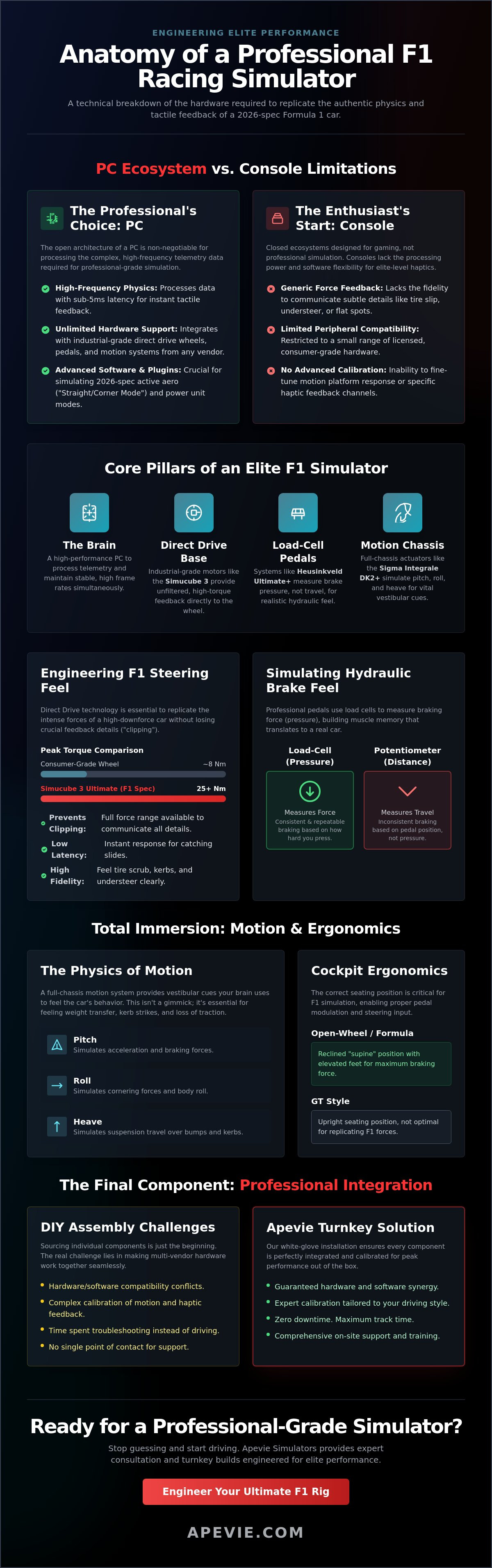
Consoles are closed ecosystems that struggle with the granular telemetry data required for professional-grade haptics. A professional full motion racing simulator requires the computational headroom of a high-end PC to drive components like the Simucube 3 Wheel Base and Gomez Sim Industries (GSI) wheels. PCs allow for the integration of custom plugins in platforms like iRacing and Assetto Corsa, which are essential for simulating the 2026 season's active aero "Straight Mode" and "Corner Mode." Without the open architecture of a PC, you lose the ability to fine-tune the frequency response of your motion platform or the specific bite point of your clutch paddles.
The Anatomy of a Professional Sim Rig
The foundation of any elite setup is an aluminum extrusion sim rig. This modular "80/20" framing provides the structural rigidity needed to withstand the 25Nm+ of torque generated by modern direct drive bases without flexing. The core pillars of this architecture include:
- The Brain: A high-performance PC capable of maintaining stable frame rates while simultaneously processing motion and haptic telemetry.
- The Direct Drive Base: Industrial motors that provide unfiltered feedback directly to the steering shaft.
- Load-Cell Pedals: Systems like the Heusinkveld Sim Pedals Ultimate+ that measure pressure rather than distance, mimicking real hydraulic brake feel.
- Motion Chassis: Actuators that simulate pitch, roll, and heave to give the driver essential vestibular cues.
By treating the F1 racing simulator as a cohesive engineering project rather than a collection of toys, you ensure that every millisecond of data translates into a competitive advantage on track.
Precision Control: Engineering the F1 Steering and Pedal Feel
Steering an elite F1 racing simulator requires more than just a motor; it requires a direct, unfiltered link to the virtual front axle. High-downforce formula cars demand immense physical effort, particularly in high-speed corners where the steering rack weight increases significantly. To replicate this, professional systems utilize direct drive technology that provides the necessary torque overhead to prevent signal clipping. When a motor reaches its maximum output, it loses the ability to communicate subtle details like vibrations from a flat-spotted tire or the lightening of the wheel during understeer. By using industrial-grade motors, we ensure that the tactile data remains clear even under the heaviest cornering loads.
Direct Drive Technology: The Simucube Advantage
Selecting the right base depends on the level of physical realism you want to sustain. The Simucube 3 Pro offers a balanced experience for most enthusiasts, while the Ultimate version provides the 25Nm+ of torque required to match the peak steering forces of a real 2026-spec car. Simucube’s low-latency motor drivers eliminate steering lag by processing signal inputs at speeds that match the car’s internal telemetry. This speed is essential when catching a snap of oversteer at 200 mph. Matching these bases with high-end wheels like the Gomez Sim Industries (GSI) Formula Pro Elite adds another layer of precision. The GSI wheel features a rigid, CNC-machined chassis and an integrated telemetry display, whereas the Cube Controls F-Core offers a lighter, more agile alternative for those who prefer a more reactive steering feel. Both options utilize magnetic shifters to provide a crisp, mechanical gear change that feels identical to a real formula cockpit.
Formula Braking: Heusinkveld and Hydraulic Systems
The brake pedal is the most critical component for achieving consistent lap times. In a formula car, drivers don't modulate the brake by how far the pedal moves, but by how much pressure they apply with their leg. This is why load-cell technology is the standard for professional rigs. The Heusinkveld Sim Pedals Ultimate+ are engineered to withstand over 100kg of force, allowing you to build the muscle memory needed to hit the same braking point lap after lap. While hydraulic systems offer a slightly smoother initial travel, high-end load-cell pedals provide the rock-solid "wall" feel that F1 drivers prefer for late-braking maneuvers.
The Role of an F1 Simulator Driver often centers on perfecting this pedal modulation to optimize energy recovery systems. Engineering this level of consistency into your home setup is a complex task. For a deeper analysis of these components, you can read The Ultimate Guide to Sim Racing Pedals. If you're looking for an expertly calibrated system, consulting with Apevie Simulators can help you select the perfect balance of torque and pedal resistance for your driving style.
The Physics of Immersion: Why Motion Systems are Vital for Formula Simulation
Motion in a professional F1 racing simulator isn't a luxury; it's a critical telemetry channel. While visual and audio cues provide the "what" of a racing incident, motion provides the "when." For elite drivers, the vestibular system—the inner ear's balance mechanism—detects a slide or a lock-up milliseconds before the visual evidence appears on screen. This sensory shortcut allows for instinctive corrections that simply aren't possible on a static rig. By integrating motion, we bridge the gap between playing a game and operating a vehicle, turning the simulator into a legitimate development platform.
The distinction between "seat movers" and full-chassis systems is fundamental to this realism. Seat movers tilt only the driver's chair, which can break the ergonomic relationship between your hands and the steering wheel. In contrast, a full-chassis system moves the entire aluminum frame, including the pedals and wheel base. This setup ensures that your physical inputs remain consistent even as the rig pitches under heavy braking or rolls through a high-speed corner. Academic institutions often use these setups for virtual engineering lessons to study vehicle dynamics, proving that motion is a tool for precision, not just entertainment.
Sigma Integrale vs. D-BOX: Choosing Your Haptic Engine
Choosing the right motion hardware depends on whether you prioritize large-scale movement or high-frequency detail. The Sigma Integrale DK2+ system excels at simulating suspension travel and significant weight transfers. Its high-travel actuators are perfect for replicating the violent "porpoising" or kerb strikes common in modern formula cars. Conversely, the D-BOX G5 haptic system is the industry standard for high-frequency vibrations. It excels at communicating engine RPM, tire slip, and road textures that actuators with more travel might smooth over. For a comprehensive breakdown of these technologies, consult The Professional Guide to Haptic Systems.
Chassis Rigidity and Motion Compatibility
Handling the forces of a 4-point motion system requires a chassis with zero structural flex. An aluminum extrusion sim rig is the only viable foundation for this level of performance. When a Sigma Integrale DK2 system fires its actuators to simulate a 150 mph kerb strike, the resulting energy would cause a lesser steel or plastic frame to twist, absorbing the detail you're trying to feel. Beyond physical strength, professional builds require meticulous cable management and EMI shielding. High-performance actuators can generate electromagnetic interference that disrupts the sensitive signals from your direct drive wheel or load-cell pedals. Proper grounding ensures that your F1 racing simulator remains a high-fidelity instrument of speed.
Specifying Your F1 Rig: From Open-Wheel Cockpits to Visual Fidelity
Designing an elite F1 racing simulator requires a departure from traditional desk-bound setups or even standard GT-style rigs. In a modern formula car, the driver’s heels are often level with or higher than their hips. This "feet-up" seating position isn't just for aerodynamics in the real world; it changes how you interact with the pedals. By adopting a dedicated Open Wheel Simulator Cockpit, you ensure that your leg muscles engage the Heusinkveld pedals at the correct angle. This specific geometry is vital for long-stint comfort and prevents the lower back strain often associated with upright seating positions.
While many enthusiasts start with a GT Simulator Cockpit, the transition to a formula-specific layout is often the point where lap times begin to stabilize. The lowered center of gravity and reclined posture allow for better weight distribution of the driver's body, which is essential when managing the high-pressure braking zones discussed in previous sections. A professional-grade rig must be constructed from heavy-duty aluminum extrusion to handle the violent forces of a Simucube 3 base. If the frame flexes even slightly under load, the tactile detail from the front tires is lost.
The Formula Seating Position
Ergonomic accuracy is the foundation of consistency. Selecting an Open Wheel Simulator Cockpit that supports high-torque wheel bases ensures that every bit of telemetry reaches your hands without being absorbed by the frame. This rigidity is especially important when using high-performance peripherals that require precise mounting angles. For more on selecting the right interface for your hands, read The Best F1 Steering Wheels for Professional Sim Racing.
Visual Immersion: Seeing the Apex
Visual fidelity in 2026 is measured by peripheral vision and motion clarity. While an Ultrawide Curved Monitor Setup offers a clean, single-panel look, it often lacks the 180-degree field of view provided by a Triple Monitor Setup. Using three 32-inch 1440p displays allows you to see the apex of a corner through the side window, a critical requirement for precision racing. To track the rapid movements of a car at 200 mph, these displays should support 240Hz+ refresh rates to eliminate ghosting and provide the smoothest possible image.
VR Headsets for Sim Racing offer the ultimate in depth perception, allowing you to judge the distance to the car ahead with natural binocular vision. However, for long-endurance sessions, many professional drivers still prefer the physical comfort and clarity of triple screens. Beyond visuals, high-fidelity acoustics are essential. High-end headphones or haptic transducers mounted to the seat provide audio cues like tire scrub and engine vibrations that visual data alone cannot convey. If you're ready to engineer a world-class setup, consult with Apevie Simulator to spec a F1 racing simulator tailored to your specific performance goals.
Turnkey F1 Solutions: Why Professional Installation Trumps DIY
Assembling a high-performance F1 racing simulator is a systems engineering challenge that goes far beyond basic mechanical assembly. When you combine industrial-grade hardware like a Simucube 3 wheel base with a Sigma Integrale DK2+ motion system and GSI steering wheels, you're managing multiple communication protocols that must be perfectly synchronized. A DIY approach often leads to hardware fatigue, where you spend more time troubleshooting driver conflicts or EMI issues than actually driving. Professional integration from Apevie Simulators ensures that every bit of telemetry data is processed with sub-5ms latency, providing the crisp, immediate feedback required for elite competition.
The brain of the system is a frequent point of failure in home builds. Off-the-shelf gaming PCs are designed for general graphics performance, but they rarely have the specialized BIOS configurations or high-speed I/O priority needed for advanced sim racing. The custom PC builds provided by Apevie Simulators are engineered specifically to handle sustained physics loops and complex haptic outputs without thermal throttling. This foundation is essential for maintaining a stable 240Hz+ refresh rate on triple 1440p monitors while simultaneously driving a full-chassis motion platform.
Bespoke Integration and Calibration
Calibration is the bridge between raw hardware and a professional training tool. We meticulously tune Simucube True Drive profiles for specific F1 titles to ensure the steering weight and haptic feedback align with 2026 technical regulations. Motion profile optimization is equally critical; it requires balancing the heave and pitch forces to provide authentic suspension travel without inducing the sensory mismatch that causes motion sickness. The White Glove Simulator Installation Service from Apevie Simulators includes comprehensive EMI mitigation, using shielded cabling and dedicated grounding to protect your sensitive load-cell pedal signals from the electromagnetic interference generated by high-power motion actuators.
Turnkey Racing Simulator Packages from Apevie Simulators
Apevie Simulators provides a structured roadmap from your initial consultation to your first competitive laps. We believe that professional-grade hardware requires professional-grade assembly to ensure its longevity and accuracy. The project roadmap includes:
- On-Site Consultation: Assessing your space for ergonomics, acoustics, and power requirements.
- Precision Assembly: Mounting all components on an aluminum extrusion sim rig for zero-flex performance.
- White-Glove Installation: Expert setup in your home or facility, including full software calibration and driver training.
- Ongoing Performance Support: Technical assistance and remote tuning to ensure your system evolves with 2026 season updates.
Ready to build the ultimate F1 environment? Contact Apevie Simulators for a professional consultation.
Mastering the 2026 Grid: Your Path to Professional Simulation
Engineering an elite F1 racing simulator is a journey that begins with technical precision and ends with millisecond-perfect performance. We've explored how industrial-grade Simucube bases and Sigma Integrale motion systems translate the complex 2026 regulations into a tangible physical reality. A true professional rig is more than just a seat; it's a meticulously calibrated ecosystem where every component communicates with zero lag. By focusing on tactile immersion and ergonomic accuracy, you bridge the gap between virtual practice and real-world results.
As an Authorized Simucube Dealer, Apevie selects only the highest-grade motorsport hardware to ensure your setup meets these rigorous standards. Our expert white-glove installation service takes the guesswork out of complex software tuning and EMI mitigation. We don't just assemble parts; we engineer a turnkey environment tailored to your specific competitive goals. You deserve a system that's ready for high-stakes competition the moment you step into the cockpit.
Explore Custom Turnkey F1 Simulator Builds by Apevie and start your pursuit of professional-grade performance today. The grid is waiting.
For enthusiasts who demand the same level of bespoke engineering and luxury in their downtime as they do in their simulator, you can explore Private Yacht Charters to experience the pinnacle of Mediterranean lifestyle concierge services.
Frequently Asked Questions
Is a professional F1 racing simulator better than a high-end gaming PC setup?
A professional simulator is a complete, integrated ecosystem, whereas a gaming PC is merely one component. A professional F1 racing simulator combines industrial-grade haptics, a direct drive wheel base, and a rigid chassis with a bespoke PC. While a high-end PC provides the visual frames, the simulator provides the tactile data and physical resistance necessary for legitimate driver training and muscle memory development.
How much space do I need for a full-motion F1 simulator rig?
You should allocate a dedicated footprint of approximately 2.5 meters by 1.5 meters for a full-motion setup. This space accommodates the physical movement of the chassis and the mounting of triple 32-inch monitors. It's also vital to maintain a safety buffer around the Sigma Integrale actuators to ensure they don't strike walls or furniture during high-velocity pitch and roll maneuvers.
Can I use a professional F1 simulator with a gaming console like PS5 or Xbox?
Professional hardware from brands like Simucube and Sigma Integrale isn't compatible with gaming consoles. These components require the open architecture of a PC to process the granular telemetry data used in 2026 season simulations. Consoles lack the driver support and high-frequency output needed to run sophisticated motion platforms or advanced steering wheels like the GSI Formula Pro Elite.
What is the difference between Simucube 2 and Simucube 3 wheel bases?
Simucube 3 introduces significantly lower latency and faster signal processing compared to the previous generation. These improvements allow the motor to communicate the subtle aerodynamic shifts of the 2026 technical regulations with greater transparency. While the Simucube 2 remains a capable base, the Simucube 3 provides the necessary torque overhead to sustain 1:1 steering weight in high-downforce corners without signal clipping.
Why are load-cell pedals essential for Formula 1 style racing?
Load-cell pedals are essential because they measure pressure rather than the distance the pedal travels. In a real formula car, braking is modulated by how hard you press your foot against a rock-solid pedal. This pressure-based sensing is what allows drivers to build consistent muscle memory. Without it, you'll struggle to hit your braking points with the precision required for elite competition.
How long does a white-glove simulator installation typically take?
A standard white-glove installation usually takes between six to eight hours to complete. This timeframe includes the mechanical assembly of the aluminum extrusion rig, meticulous cable management, and the software calibration of your motion profiles. We don't conclude the installation until every component is synchronized and you've completed several successful test laps to verify the system's performance.
Do I need VR for a realistic F1 simulation experience?
VR isn't a requirement for realism, and many professional drivers actually prefer a triple monitor setup. Triple 32-inch displays provide a stable 180-degree field of view and high visual clarity without the physical fatigue of a headset. While VR offers excellent depth perception, a well-calibrated screen setup is often more comfortable for long-stint endurance racing and provides a more stable training environment.
Are motion systems like Sigma Integrale DK2 difficult to maintain?
Professional motion systems like the Sigma Integrale DK2 are engineered for high-duty cycles and require very little physical maintenance. The actuators are industrial-grade units that don't need regular lubrication or mechanical adjustment. Most maintenance is handled through software and firmware updates, ensuring your F1 racing simulator remains compatible with the latest physics engines and vehicle dynamics updates.