The Best Load Cell Pedals for Professional Sim Racing in 2026
If you're still missing apexes because your brake pedal feels like a sponge, you aren't fighting a lack of talent; you're fighting your hardware. Most racers start with potentiometer-based pedals that measure how far you push, which is an unnatural way to navigate a high-speed corner. Real race cars rely on pressure, and your biological systems are far better at memorizing force than travel distance. You've likely felt the frustration of inconsistent braking points or the distracting flex of a cheaper rig during heavy deceleration in high-downforce cars.
Investing in the best load cell pedals is the single most effective way to stabilize your performance and finally master the delicate art of trail braking. By switching to hardware that mimics a true hydraulic system, you allow your muscle memory to take over, leading to repeatable lap times. This guide explores the technical precision of industry leaders like the Heusinkveld Sprint and the heavy-duty Ultimate+ series. We'll break down how these professional-grade sensors work and provide a framework to help you choose the equipment that fits your specific simulator setup.
Key Takeaways
- Understand why measuring pressure rather than travel distance is the biological key to building repeatable muscle memory and consistent braking points.
- Learn to identify high-quality construction materials and elastomers that provide the progressive resistance needed to mimic a real race car's hydraulic feel.
- Compare the technical specifications of the Heusinkveld Sprint and Ultimate+ to determine which of the best load cell pedals fits your specific performance goals.
- Discover why high-force braking requires a rigid aluminum extrusion rig to eliminate chassis flex that otherwise compromises your trail braking accuracy.
- See how professional consultation and turnkey installation ensure your high-end hardware's perfectly calibrated for your simulator environment.
The Physics of Braking: Why Load Cell Sensors Define Consistency
Most enthusiasts begin their journey with entry-level pedals that rely on potentiometers. These sensors measure the distance the pedal travels. While this works for casual gaming, it creates a significant barrier to professional-level performance. In a real GT3 or Formula car, the brake pedal hardly moves at all. Instead, the braking system relies on hydraulic pressure. To replicate this, the best load cell pedals utilize a specialized sensor that measures the force you apply rather than the angle of the pedal arm.
Mastering threshold braking requires you to find the exact point where the tires are on the verge of locking up without actually triggering the ABS or sliding. On a distance-based pedal, you're trying to hold your foot at a precise millimeter of extension while bouncing over curbs or fighting steering rack vibrations. It's a recipe for inconsistency. Load cells solve this by allowing you to rely on the natural tension in your leg muscles, which is much easier for the human brain to repeat lap after lap.
Pressure vs. Distance: The Biological Advantage
Human biology is specifically tuned to remember force through a process called proprioception. Your brain is significantly more accurate at recalling the effort required to push against 40kg of resistance than it is at remembering if your foot moved three or four inches forward. This is why drivers who upgrade to professional hardware often see an immediate reduction in "flat-spotting" tires or mid-corner lock-ups in simulators like iRacing.
The transition from consumer gear to a professional load cell setup usually requires a short adjustment period. You aren't just learning a new piece of hardware; you're retraining your nervous system to prioritize pressure. Once that connection is made, trail braking becomes an intuitive process of slowly releasing tension rather than trying to accurately slide a sensor back to its zero point.
To complement this nervous system retraining and build the core stability required for high-force braking, you can discover Avenir Athletic Pilates to improve your athletic precision and control.
Load Cell Ratings and What They Actually Mean
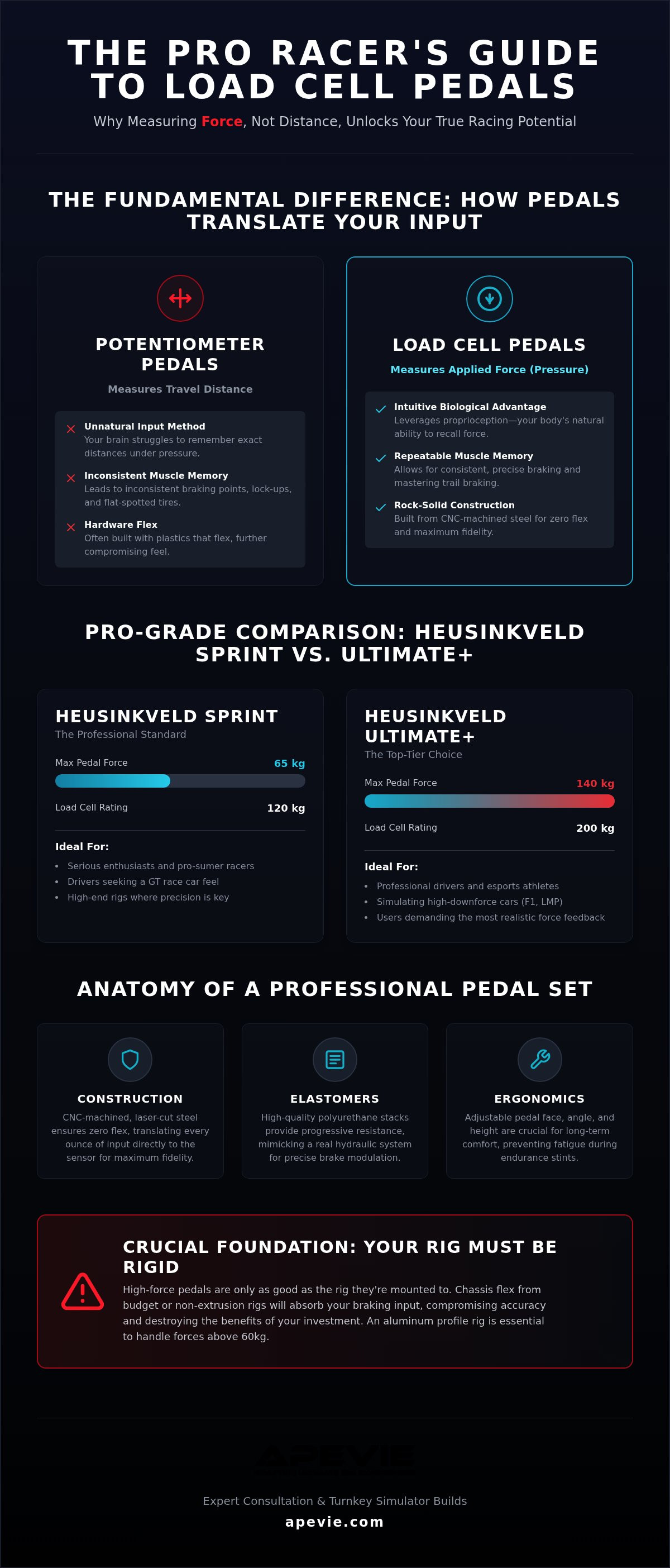
Technically, What is a Load Cell? A load cell is a transducer that converts force into a measurable electrical signal for sim software. When you see ratings like 60kg, 100kg, or 200kg, these refer to the maximum capacity of the sensor itself. However, the sensor rating is different from the actual force required to reach 100% braking in your software. For example, the Heusinkveld Sprint uses a 120kg load cell but is designed to handle up to 65kg of actual pedal force.
A higher rating doesn't necessarily make a pedal "better," but it provides more headroom for calibration. Professional drivers often prefer the Heusinkveld Ultimate+ because its 200kg load cell allows for up to 140kg of actual foot pressure. This mimics the extreme loads found in top-tier motorsport, providing the resistance needed for high-downforce cars where the initial braking strike must be incredibly firm. Choosing the best load cell pedals for your rig depends on whether you want a setup that feels like a modern road car or the punishing, stiff response of a dedicated racing machine.
Key Features to Evaluate in Professional Load Cell Pedals
When searching for the best load cell pedals, the material choice determines long-term durability and structural integrity. While budget options often use cast aluminum or plastic, professional units like the Heusinkveld series utilize CNC machined, laser-cut steel. This rigidity is vital. Any flex in the pedal arm itself translates to "lost" data for your brain. High-grade steel remains the industry standard because it maintains its shape even under 100kg of repeated force, ensuring that every ounce of pressure you apply is accurately recorded by the sensor.
The "feel" of a professional brake isn't just about the sensor; it's about the elastomers. These polyurethane components determine the progressive resistance of the pedal. High-quality elastomers don't degrade or change density with heat during a long endurance race. They allow the pedal to feel slightly compliant initially before rapidly stiffening, mimicking the way brake pads meet a rotor. This progressive curve is what allows you to modulate the brakes with surgical precision during the final stages of a corner entry.
The Importance of Pedal Geometry and Ergonomics
Ergonomics are often overlooked until you're two hours into a race stint. The best load cell pedals offer significant adjustability in pedal face angle and height. This prevents ankle fatigue by ensuring your foot meets the pedal at a natural angle. You should also consider the spacing. Professional rigs often require specific gaps between the brake and throttle to facilitate the heel-and-toe technique. Whether you prefer a floor-mounted setup for GT racing or an inverted configuration for a formula-style feel, physical adjustability is the key to sustained comfort and performance.
Electronics and Controller Resolution
The precision of your input depends on the controller's resolution. Most modern professional pedals use 12-bit or 16-bit controllers, providing thousands of discrete steps of resolution. This allows for incredibly fine modulation that distance-based sensors simply cannot match. However, high resolution is useless without proper shielding. Direct drive wheel bases generate significant electromagnetic interference (EMI). Professional hardware, such as the units found in the Apevie Pedals Collection, prioritizes industrial-grade electronics and shielded cabling to ensure your signal remains clean and jitter-free.
Software integration completes the hardware package. Advanced tools like Heusinkveld SmartControl allow you to set custom output curves and deadzones. You can calibrate the pedal so that 80% of your physical force equals 100% in-game, or create a non-linear curve for better trail braking control. If you're building a high-end simulator, exploring a curated selection of professional hardware ensures your inputs are never the bottleneck in your performance.
Heusinkveld Sprint vs. Ultimate+: The Professional Standard
Heusinkveld has long been the benchmark for professional sim racing hardware. Their engineering philosophy centers on using laser-cut stainless steel, which provides a level of structural rigidity that cast aluminum simply cannot match. Within this ecosystem, two models stand out as the best load cell pedals for different types of drivers: the Sprint and the Ultimate+. While they share the same DNA, the choice between them often comes down to your rig's rigidity and your specific performance goals.
The build quality across both sets is industrial. Laser-cut steel ensures that these aren't just peripherals; they're high-performance tools designed to withstand years of abuse. However, the way they translate your physical input into digital data differs significantly in terms of raw force capacity and mechanical feedback.
Heusinkveld Sprint: The Versatile Workhorse
The Sprints are designed for serious enthusiasts who want professional performance without needing a rig built for a literal tank. These pedals handle up to 65kg of actual pedal force, which is more than enough for GT3 racing and endurance stints. They're particularly well-suited for 80/20 aluminum profile rigs where space and weight are considerations. Using the SmartControl software, you can tweak output curves to match anything from a vintage road car to a modern open-wheeler. For a deeper dive into the engineering behind these components, check out The Ultimate Guide to Sim Racing Pedals.
Heusinkveld Ultimate+: For the No-Compromise Simulator
If you're training for real-world motorsport or competing in top-tier esports, the Ultimate+ series is the necessary step up. The primary differentiator is the integrated hydraulic damping system. This isn't just for show; it mimics the physical sensation of pads hitting a rotor, where the pedal becomes significantly stiffer the harder you press. It creates a "two-stage" feel that's essential for high-downforce cars.
With a massive 140kg force capacity at the pedal face, these pedals require a professional-grade sim rig to avoid chassis flex. Without a rigid foundation, that extra force is wasted as energy absorbed by the frame rather than the sensor. Drivers training for real-world events prefer the Ultimate+ because the physical exertion required to hit 100% braking pressure matches the cockpit environment of a real GT or Formula car, ensuring your training translates perfectly to the track.
Mounting and Rig Requirements for High-End Pedals
Selecting the best load cell pedals is a significant performance upgrade, but their effectiveness is entirely dependent on the rigidity of your simulator. If you mount a set of Heusinkveld Ultimate+ pedals to a standard office desk or a lightweight wheel stand, you won't see the consistency you're paying for. These professional units are designed to handle up to 140kg of actual foot pressure. Without a rigid connection, that energy doesn't reach the sensor. Instead, it goes into sliding your chair backward, flexing your floor plate, or bending your pedal tray. You simply cannot use high-end load cells on a carpeted floor; the physical exertion required for professional braking demands a chassis that stays perfectly still.
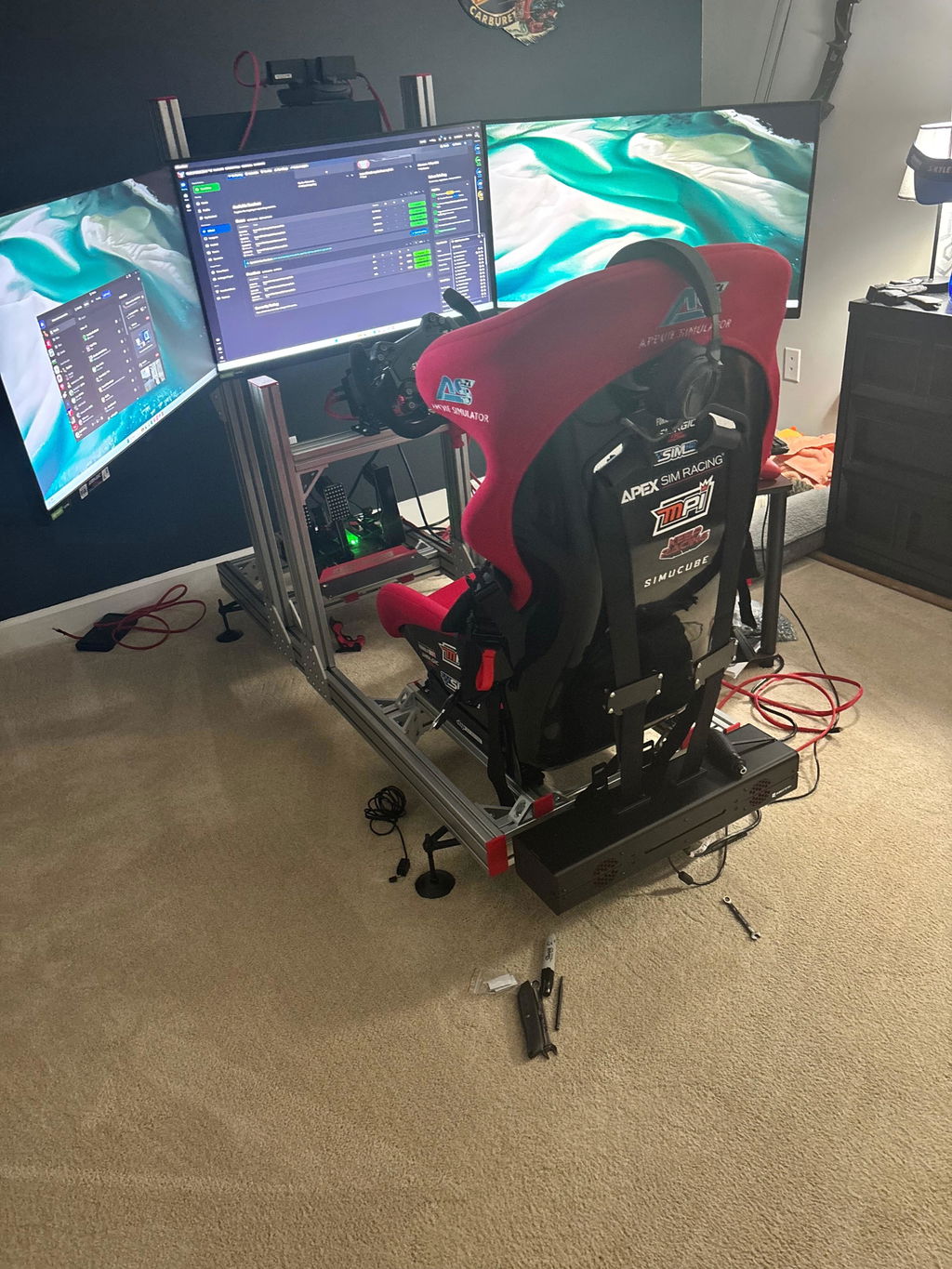
Aluminum extrusion rigs, commonly known as 80/20, are the industry standard for managing these extreme forces. This material provides a modular, incredibly stiff foundation that can withstand the 100kg+ strikes common in GT3 and Formula racing. A professional build ensures that every bit of pressure from your leg is translated into digital data rather than wasted as structural movement. If you want to ensure your hardware is properly integrated into a stable foundation, you should consult with our experts for a turnkey simulator build that eliminates these mechanical variables.
Chassis Flex: The Silent Performance Killer
Consistency in sim racing is built on repeatable inputs. Even 1mm of flex in your pedal tray can lead to inconsistent lap times because it changes the physical point where the sensor registers 100% braking. Professional builds use thick, reinforced steel plates to bridge the gap between the aluminum profiles and the pedals. You can identify flex in your current setup by having someone watch your pedal tray while you perform an emergency stop. If there's any visible movement, your muscle memory is being compromised by a moving target. Reinforcing these points is essential for mastering the delicate transition from full pressure to trail braking.
Ergonomic Calibration for Maximum Performance
Once your pedals are mounted to a rigid base, you must calibrate them to your physical capabilities. The best load cell pedals allow you to set a "Max Force" in the software. This shouldn't be set to the hardware's maximum limit just because it's available; it should match what you can comfortably and repeatedly press during an endurance stint. Proper calibration also includes setting a small deadzone to prevent "brake dragging," where the weight of your foot on the pedal might trigger a 1% brake signal. Aligning the pedal faces with your seating position ensures you have optimal leverage, preventing knee strain and allowing for the surgical precision required at the apex.
Sourcing Your Professional Pedal Set via Apevie Simulators
Selecting the best load cell pedals is a decision that impacts every braking zone for years to come. While general electronics retailers offer a standard checkout experience, sourcing your hardware from a specialized boutique like Apevie Simulators provides a layer of expert consultation that ensures your investment is optimized for your specific rig. We understand that a professional simulator is a complex ecosystem. The relationship between your pedal pressure, your seat position, and your chassis rigidity determines your ultimate ceiling as a driver. If these elements aren't aligned, even the finest hardware will underperform.
Our approach focuses on quality and engineering integrity. We've curated a selection of the industry's most reliable brands, including Heusinkveld and Simucube, because they meet the rigorous demands of professional motorsport training. We don't just ship boxes; we provide the technical foundation required to master trail braking. This includes white-glove installation services and post-sale calibration assistance to help you translate raw hardware potential into repeatable lap times. Our team ensures that your sensors are mapped correctly and your elastomers are chosen to match your preferred car class.
Custom Turnkey Solutions
Apevie specializes in integrating high-performance components into a seamless, turnkey environment. When you're choosing between the Heusinkveld Sprint and the Ultimate+ models, our consultation process helps you identify which set aligns with your physical strength and rig capabilities. We exclusively focus on PC-based professional hardware, intentionally avoiding arcade-grade equipment that lacks the fidelity required for serious competition. By matching your pedals to a sufficiently rigid chassis, we eliminate the mechanical variables that often hinder developing drivers. This holistic view of the simulator ensures that your hardware works in harmony with your motion system and direct drive wheelbase.
Our support extends far beyond the initial purchase. Professional sim racers often face challenges with software calibration or electromagnetic interference in high-torque setups. We provide the troubleshooting and expert guidance needed to keep your simulator performing at its peak. This commitment to long-term driver success is what differentiates a professional motorsport firm from a standard hardware vendor. We take pride in helping our clients find the "sweet spot" in their brake settings, ensuring the pedal feel remains consistent from the first lap to the final corner of an endurance race.
Ready to Upgrade Your Consistency?
The transition to professional-grade braking is the most significant step you can take toward shaving tenths off your personal bests. By removing the guesswork of distance-based sensors and embracing the precision of pressure-based measurement, you unlock a new level of car control. Your muscle memory deserves hardware that responds with the same consistency as a real racing caliper. It's time to stop fighting your equipment and start focusing on your racing line.
We invite you to explore our carefully selected range of elite hardware. Whether you're building your first high-end rig or refining a professional esports setup, our team is here to ensure every component is perfectly calibrated for your needs. Explore the Apevie Pedals Collection to find the industry standard equipment that will redefine your braking performance and bring a new level of realism to your home simulator.
Retrain Your Muscle Memory for the Podium
Retraining your biological systems to prioritize pressure over distance is the most significant leap a driver can make toward professional-level consistency. By choosing the best load cell pedals, you replace unpredictable leg movements with a precise, force-based input that mirrors real-world motorsport. Whether you opt for the versatile Heusinkveld Sprint or the hydraulically damped Ultimate+, ensure your chassis is rigid enough to handle the massive braking forces these sensors require.
Apevie Simulators is here to guide you through this transition. As an authorized dealer for Heusinkveld and Simucube, we provide a curated selection of professional-grade hardware designed for those who refuse to compromise on quality. Our expert white-glove installation services take the headache out of setup, ensuring your equipment is perfectly integrated and calibrated for your turnkey rig. Mastering your brake modulation is the key to finally shaving those elusive tenths off your lap times.
Upgrade to Professional Load Cell Pedals at Apevie Simulators
We look forward to helping you build the foundation for your next victory on track. Precision is a choice; make it today.
Frequently Asked Questions
Are load cell pedals really worth the extra money for a casual racer?
Load cell pedals are the most significant upgrade you can make to your simulator. Even for a casual racer, the ability to build muscle memory through pressure rather than foot travel leads to immediate consistency. While potentiometer pedals rely on the distance you push, the best load cell pedals measure the force applied. This biological advantage helps you avoid lock-ups and find your braking points with much higher accuracy lap after lap.
Can I use high-end load cell pedals with a desk and an office chair?
Using professional load cells with a standard office chair is almost impossible. The force required to actuate a professional brake pedal, often exceeding 60kg, will simply push your chair backward or flex your desk. To get the performance you paid for, you need a rigid foundation. We recommend mounting these pedals to an aluminum extrusion rig that can withstand heavy braking strikes without any structural movement or lost data.
What is the difference between a load cell and a hydraulic sim racing pedal?
A load cell sensor measures force electronically, while a hydraulic system uses fluid to create physical resistance. Many professional sets, such as the Heusinkveld Ultimate+, actually use both. The load cell captures the digital input for the simulator, while a hydraulic damper provides the realistic "two-stage" feel as the pads meet the disc. This combination offers the most authentic racing experience by mimicking the mechanical feedback of a real caliper.
Do I need to calibrate my load cell pedals every time I play?
You don't need to calibrate your pedals every time you start your simulator. High-end hardware stores its calibration data directly on the pedal controller. Once you've used software like SmartControl to set your deadzones and maximum pressure, those settings stay active across all your racing titles. You'll only need to open the software again if you physically change the elastomers or adjust the pedal's mechanical throw to suit a different car.
How much force should I set my load cell brake to for iRacing?
Your maximum force setting should be based on your physical comfort and rig stability. Most drivers find that a setting between 45kg and 60kg offers enough resistance for precise modulation without causing leg fatigue during long stints. In iRacing, you want to ensure that your 100% physical pressure matches the 100% input in the software. This allows you to lean on the brake confidently without constantly triggering the ABS or flat-spotting tires.
Are Heusinkveld pedals compatible with consoles like PlayStation or Xbox?
Load cell sensors are industrial-grade transducers that typically last for years, even under the stress of daily professional use. They're rated for millions of compressions, making them much more durable than the potentiometers found in cheaper gear. While the sensor itself is very robust, you might eventually need to replace the polyurethane elastomers. These components can soften over time, but they're inexpensive and simple to swap out to maintain a stiff pedal feel.
What is trail braking and how do load cell pedals help with it?
Trail braking is the art of gradually releasing the brake as you transition into a corner's apex. The best load cell pedals are essential for this because your brain is naturally better at modulating pressure than distance. By feeling the tension in your leg muscles, you can "bleed off" the pressure with surgical precision. This helps keep the car's weight balanced on the front tires, providing the grip needed to rotate the car effectively.