The Professional Guide to Choosing a Sim Racing Steering Wheel in 2026
Your steering wheel isn't just a handle for turning; it's a high-fidelity data conduit designed to translate every ripple of the asphalt directly into your palms. Most racers realize that as they move toward direct drive systems, the choice of a sim racing steering wheel becomes a question of signal preservation rather than just button layouts. You've likely felt the frustration of information overload, trying to determine if a premium rim will truly solve your consistency issues or simply complicate your setup with compatibility headaches.
We understand that at the professional level, you're looking for a tool that matches the 11 Nm or higher output of elite motor bases. This guide will provide you with the technical clarity needed to choose a wheel that fits your specific racing discipline, whether you're chasing millisecond gains in GT3 or mastering formula-style precision. You'll learn how to master the nuances of ergonomics and seamlessly integrate high-end hardware from Gomez Sim Industries or Cube Controls into your Simucube or Fanatec ecosystem. By the end of this article, you'll have the confidence to transform your simulator into a precision instrument, mirroring the high-performance turnkey solutions we provide at Apevie Simulator.
Key Takeaways
- Understand how a high-end wheel acts as a data-transfer device, preserving the high-frequency vibrations from your direct drive motor that cheaper materials often absorb.
- Identify the technical markers of a professional sim racing steering wheel, including why magnetic shifters and 6061 aluminum are essential for competitive reliability.
- Learn to select the correct rim diameter for your discipline, balancing the rapid inputs of 280mm Formula wheels with the ergonomic comfort of 320mm GT rims.
- Master the technical checklist for mounting and connectivity, covering industry standards like SQR quick releases and the trade-offs between wired and wireless setups.
- Discover how to integrate premium hardware from Gomez Sim Industries and Cube Controls into a cohesive, high-performance ecosystem designed for maximum precision.
The Role of a Professional Sim Racing Steering Wheel: Data over Decoration
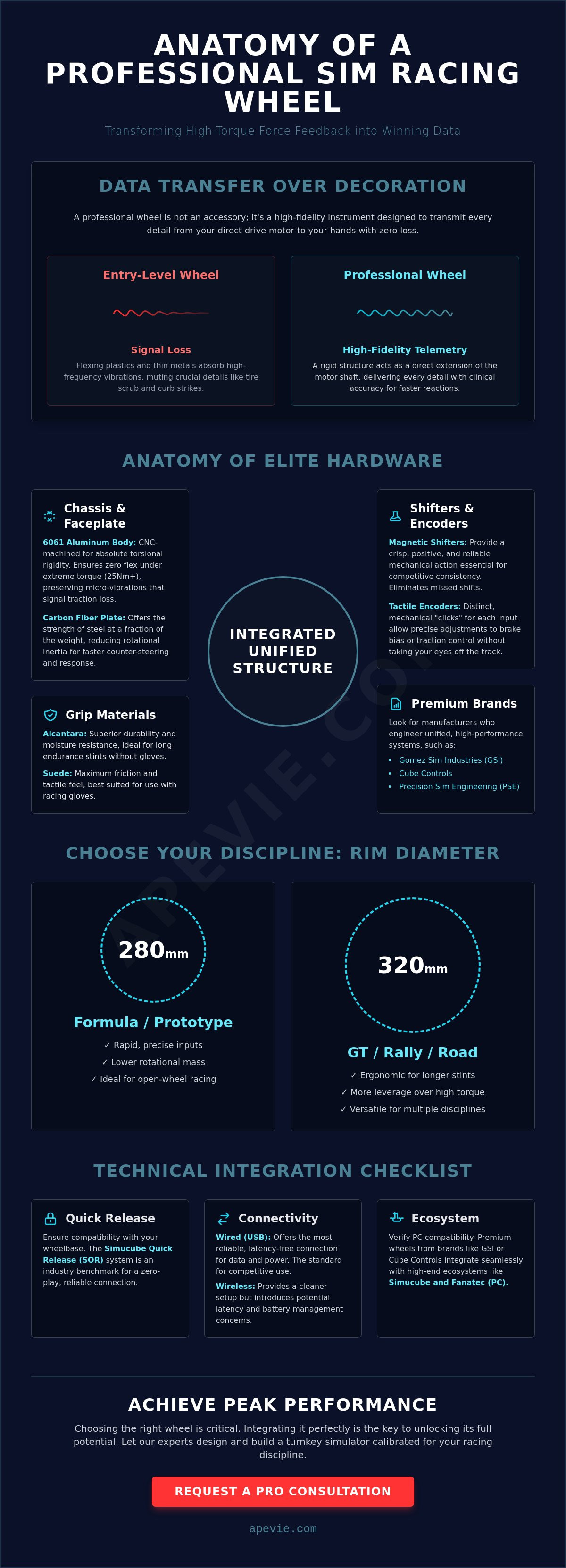
A professional sim racing wheel serves as the primary haptic interface between the driver and the digital physics engine. It's the only point of contact that translates torque, vibration, and tire slip into physical sensation. While entry level wheels often focus on aesthetic appeal or console compatibility, professional units prioritize the preservation of data. Every design choice in a high end rim aims to reduce the distance between the simulation's code and the driver's central nervous system.
"Signal loss" is a phenomenon where the high frequency vibrations generated by a direct drive base are absorbed by the steering wheel's structure before they reach your hands. Cheap plastics and thin metals act as dampers. They effectively mute the subtle "scrub" of a tire or the sharp kick of a curb. Professional rims are designed as rigid extensions of the motor shaft. This ensures that every bit of telemetry is delivered with clinical accuracy, allowing you to react to a slide before your eyes even register the movement on screen.
There's a fundamental difference between a simple "button box" bolted to a generic rim and an integrated, all in one professional unit. Dedicated racing wheels from manufacturers like Gomez Sim Industries or Cube Controls are engineered as unified structures. This integration eliminates the mechanical play often found in modular setups. It provides a solid, monolithic feel that's essential for consistent performance during long endurance stints where equipment fatigue can lead to driver error.
Torsional Rigidity and Force Feedback Fidelity
Flex is the enemy of precision. When you're dealing with a high end base capable of 25Nm of torque, the mechanical stress on the wheel is immense. If the rim bends even a fraction of a millimeter during high torque cornering, it acts as a low pass filter. This flex hides the micro vibrations that tell you when the front tires are beginning to understeer. Professional hardware uses CNC machined 6061 aluminum to ensure zero flex. This rigidity allows the driver to feel the exact moment of traction loss, providing the confidence to push the car to its absolute limit without fear of unpredictable hardware behavior.
The Impact of Unsprung Mass on Steering Speed
Weight matters, but not just for your physical comfort. In sim racing, the wheel's weight is "unsprung mass" for the motor. A heavier wheel has higher rotational inertia, which means the motor has to work harder to change direction or deliver a sharp snap of counter steer. Lighter, stronger wheels allow for faster rotational acceleration and recovery. This is why brands like Precision Sim Engineering utilize carbon fiber faceplates. These materials offer the structural integrity of steel at a fraction of the weight. The result is a more responsive and lively steering feel that can be the difference between catching a snap oversteer and hitting the barrier.
Anatomy of Elite Hardware: Materials, Shifters, and Displays
When you transition from consumer grade gear to a professional sim racing steering wheel, the most immediate difference is the tactile quality of the materials. Elite hardware utilizes a hierarchy of industrial grade components designed for longevity and sensory precision. 6061 aluminum serves as the backbone for most high end chassis, providing a rigid platform that refuses to flex even under the most violent force feedback peaks. Faceplates often feature multi-layered carbon fiber, which reduces rotational weight while maintaining structural integrity. For the grips, the choice between Alcantara and Suede is more than aesthetic; Alcantara offers superior durability and moisture resistance for long stints, while genuine Suede provides maximum friction for those who prefer racing with gloves.
The interface components, specifically rotary encoders and thumb wheels, allow you to manage complex in-car systems like brake bias or traction control without lifting your eyes from the apex. Unlike the soft, mushy dials on entry level rims, professional encoders provide a distinct, mechanical "click" for every increment. This tactile feedback is essential because it prevents over-adjusting during high-G cornering. The integration of high-resolution telemetry displays further separates professional gear from the rest. A built-in LCD provides critical data like tire temperatures, fuel deltas, and RPM LEDs directly in your line of sight, which is often more efficient than relying on cluttered on-screen dashboards.
Magnetic Hall-Effect Shifters and Dual-Clutch Systems
Reliability in shifting is non-negotiable. Professional wheels have largely moved away from mechanical microswitches in favor of magnetic Hall-effect sensors. These non-contact sensors don't wear out over time and provide a crisp, instant "tactile snap" that eliminates the risk of accidental double-shifts. The importance of this precision is supported by academic research on force feedback, which highlights how haptic clarity directly influences driver performance. For those competing in standing-start disciplines, dual-clutch paddles are a necessity. They allow you to find the perfect bite point for consistent, wheel-spin-free launches. You can find this level of tactile excellence in the Ascher Racing F64-USB V3, which remains a benchmark for shifter feel.
Encoders, Buttons, and Ergonomic Layouts
The layout of a professional sim racing steering wheel is a study in ergonomics. Button tension is carefully calibrated; they require enough force to prevent accidental activation from a stray thumb, yet remain easy to press with a quick flick. 7-way "funky switches" are another staple, allowing you to navigate multi-layered menus or adjust pit strategies mid-race with a single input. The Cube Controls F-Core demonstrates how thoughtful button placement can reduce hand fatigue during endurance racing. If you're unsure which layout suits your hands best, our team at Apevie Simulator can provide expert guidance during a professional consultation to ensure your hardware matches your physical requirements.
Choosing Your Discipline: Formula, GT, or Multi-Purpose Rims?
The architecture of a professional sim racing steering wheel is dictated by the physics of the car you intend to drive. While a beginner might look for a single rim to cover every scenario, serious enthusiasts understand that wheel diameter and shape are functional requirements, not just stylistic choices. Diameter significantly influences how you perceive the output of your direct drive motor. A smaller 280mm wheel provides a shorter lever arm, making the force feedback feel sharper and more immediate. Conversely, a 320mm GT rim increases leverage, which can make a high-torque base feel smoother and more manageable during long endurance stints.
Formula-style wheels typically fall between 280mm and 300mm. These compact dimensions are necessary for the rapid, high-precision inputs required in high-downforce cars where you rarely need to rotate the wheel beyond 180 degrees. GT wheels usually range from 300mm to 320mm and often feature a D-shape or an open-top design. This shape isn't just for aesthetics; it provides essential clearance for your legs and ensures an unobstructed view of your integrated telemetry display or on-screen dashboard. If your racing interests include rally, drifting, or street car simulation, a 360-degree round rim is a non-negotiable necessity. Attempting to catch a slide in a drift car with a rectangular formula rim is a recipe for physical injury and inconsistent lap times.
The Formula vs. GT Ergonomic Debate
Hand positioning and wrist angle vary wildly between disciplines. A 270mm rim forces a tighter, more aggressive stance that can lead to fatigue if used for multi-hour GT3 races. In contrast, a 310mm rim allows for a more relaxed shoulder position. The Gomez Sim Industries Formula Pro Elite has become a hybrid benchmark in the industry because its 300mm width sits in the "goldilocks" zone, offering enough stability for GT cars while remaining responsive enough for formula titles like F1 2026. Your choice should ultimately align with the sim title where you spend 80% of your competitive time.
Interchangeable Rims and Universal Hubs
Many professional drivers opt for a modular approach using universal hubs. This allows you to swap different rim shapes onto a single button box, giving you the flexibility to move from a round rally rim to a flat-bottomed GT rim in seconds. While modular systems offer versatility, purpose-built wheels often provide superior torsional rigidity because they lack the extra mechanical joints of a hub-and-rim combo. High-end sim rigs often feature two or three dedicated wheels on wall mounts, each pre-configured for a specific car class. This ensures that when you switch from a GT3 car to a Formula 4, the haptic interface matches the digital car's steering rack perfectly.
The Technical Checklist: Quick Releases, Mounting, and PC Ecosystems
The mechanical and digital connection between your sim racing steering wheel and the motor base is where many high-end setups fail to reach their full potential. Even the most rigid carbon fiber rim loses its effectiveness if the mounting system introduces mechanical play or "slop." In the professional space, the 70mm bolt pattern has emerged as the universal language, allowing boutique wheels to interface with industrial-grade direct drive bases. This standardization ensures that your investment remains future-proof, even if you decide to upgrade your motor base later. Beyond the physical mount, the method of data transmission defines the reliability of your inputs during a race.
While wireless technology has improved significantly by 2026, many professional drivers still prefer the absolute reliability of a high-quality USB coiled cable. These cables eliminate any risk of signal interference or latency that can occasionally plague Bluetooth connections in environments with multiple electronic devices. However, modern bases have introduced inductive power delivery, which transfers electricity through the motor shaft to the wheel. This innovation eliminates the need for internal batteries or external charging, providing a "best of both worlds" scenario where the wheel remains wireless for rotation but is powered directly by the base. Ensuring your chosen hardware supports these standards is vital for a clean and reliable cockpit.
Quick Release Systems and Mechanical Slop
Zero-play in the quick release (QR) is just as critical as the rigidity of the wheel's chassis. If there's even a fraction of a millimeter of movement in the connector, the high-frequency force feedback data discussed earlier will be dampened. Ball-bearing QRs, such as the Simucube SQR system, offer a robust, self-centering connection that maintains its integrity over years of use. Wedge-style connectors are also popular for their simplicity and solid lock. If you own multiple wheels, standardizing your QR system across all rims is the most efficient way to manage your collection. This allows for seamless transitions between different racing disciplines without recalibrating your hardware.
Telemetry Integration and Software Configuration
The software ecosystem is the "brain" that brings your hardware to life. SimHub has become the industry standard for mapping custom LED patterns, allowing you to configure RPM lights, flag warnings, and spotter alerts with surgical precision. Professional wheels also feature "on-the-fly" tuning, which lets you adjust force feedback strength or steering linearity directly through the wheel's hardware menu. This prevents you from having to minimize your sim to change settings mid-session. Many Apex Sim Racing components offer deep integration with these software suites, ensuring that your telemetry data is always visible and accurate. If you want to ensure every component in your ecosystem is perfectly synchronized, you can book a professional consultation with our installation team to design a seamless, turnkey solution.
The Apevie Standard: Integrating Premium Wheels into Turnkey Simulators
Choosing a professional sim racing steering wheel is a significant milestone, but it's only one component of a high-performance ecosystem. At Apevie Simulator, we see the wheel as the final link in a chain that includes the motor base, the chassis, and the motion system. If any link is weak, the fidelity of the entire simulation suffers. We curate our hardware selections from industry leaders like Gomez Sim Industries (GSI) and Cube Controls because their engineering standards match our commitment to reliability. Our goal is to move you beyond the frustration of researching individual parts and into the driver's seat of a fully synchronized machine.
The technical integration of these components is where the most value is found. A premium wheel requires precise firmware synchronization and custom telemetry mapping to function correctly. We handle the intricate SimHub configurations and LED profile setups so that your hardware communicates perfectly with the simulation software from the moment you power it on. This meticulous approach ensures that you aren't just buying a collection of expensive parts, but a precision instrument designed for competitive longevity.
Professional Consultation and White-Glove Installation
Our experts help you match your wheel choice to other critical components, such as your sim racing pedals and motion systems. For example, a high-torque wheel requires a pedal set like the Heusinkveld Sim Pedals Ultimate+ to maintain a balanced physical effort across all inputs. Through our White-Glove Simulator Installation Service, we deliver a "ready-to-race" setup where every driver and software setting is pre-configured. This eliminates the steep learning curve of high-end hardware. You also gain the peace of mind that comes with national support, ensuring your simulator remains at peak performance long after the initial build.
Customizing Your Elite Racing Experience
Your hardware should reflect your long-term motorsport goals. If you intend to compete at the highest levels of virtual GT3 or Formula racing, investing in "end-game" hardware like Precision Sim Engineering early in your journey is often the most cost-effective path. It prevents the cycle of constant upgrades and provides a stable platform for developing your skills. Whether you're building a dedicated home setup or a corporate activation rig, the synergy between your sim racing steering wheel and the rest of your hardware is what creates true immersion. To start your journey toward a professional-grade setup, view our turnkey simulator packages or schedule a consultation with our expert team today.
Mastering the Haptic Connection
Selecting a professional sim racing steering wheel in 2026 is no longer about finding the most buttons; it's about securing a rigid, high-fidelity interface that respects the physics of your simulator. You've learned that material choice, from CNC-machined aluminum to carbon fiber faceplates, directly impacts the clarity of the force feedback signal. Matching your rim's diameter and ergonomic layout to your primary discipline ensures you maintain precision without physical fatigue. These technical details are what separate a gaming peripheral from a professional racing tool.
Integrating these nuances into a stable, reliable ecosystem requires a methodical approach to software and mechanical mounting. As an authorized Simucube and GSI dealer, Apevie Simulator provides a curated selection of professional motorsport hardware designed to withstand the highest torque demands. We bridge the gap between complex technical specifications and a ready-to-race experience through our national white-glove installation service. Build your dream professional simulator with Apevie today and ensure every component is perfectly calibrated for your racing journey. The path to professional-grade consistency starts with hardware that never compromises on signal integrity.
Frequently Asked Questions
What is the best diameter for a sim racing steering wheel?
The ideal diameter for a sim racing steering wheel depends entirely on the vehicle class you drive most frequently. Formula wheels typically range from 280mm to 300mm to allow for rapid, tight inputs. GT cars benefit from 300mm to 320mm rims for better leverage and endurance comfort. Larger 350mm round rims are reserved for rally and drifting where you need to catch the wheel during high-rotation maneuvers.
Are wireless sim racing wheels as fast as wired ones?
Modern wireless systems from brands like Simucube offer latency figures that are indistinguishable from wired connections for the human nervous system. However, wired USB coiled cables remain the professional standard for high-interference environments. If you race in a room with multiple wireless devices, a physical cable ensures a dedicated, uninterrupted data stream for your inputs and telemetry.
Can I use a GSI or Cube Controls wheel on a Fanatec base?
You can use boutique wheels from Gomez Sim Industries or Cube Controls on a Fanatec base by using a Fanatec Podium Hub. This hub acts as the mechanical interface and electronic "handshake" required to enable force feedback on the base. Since these wheels are independent USB devices, they connect directly to your PC, while the hub handles the attachment to the steering shaft.
Why are professional sim racing wheels so much more expensive than console wheels?
Professional hardware is engineered to withstand the massive mechanical stress of direct drive motors that often exceed 20Nm of torque. Console wheels use molded plastics and gear drives that would literally snap under these forces. Elite rims utilize CNC-machined 6061 aluminum, genuine carbon fiber, and industrial-grade Hall-effect sensors to ensure the hardware remains a precision instrument over thousands of hours of use.
Do I need a screen on my steering wheel if I use VR?
Integrated LCD screens are functionally useless if you race exclusively in VR since the headset obscures your physical environment. If VR is your primary display method, you should prioritize a sim racing steering wheel with superior haptic buttons and rotary encoders. Focus your investment on tactile feedback and ergonomic comfort rather than visual displays you can't see while wearing the headset.
What is the difference between a load cell and a magnetic shifter?
These two technologies serve completely different purposes in a simulator. A load cell is a pressure-sensitive sensor used in pedals to measure braking force, whereas a magnetic shifter uses magnets to create a crisp, tactile "snap" when you pull a paddle. Magnetic shifters usually pair with Hall-effect sensors to detect the shift without physical contact, which prevents the mechanical wear common in standard microswitches.
How do I maintain the Alcantara grips on my steering wheel?
Preventing the buildup of skin oils is the most effective way to maintain Alcantara grips. We recommend always racing with gloves to preserve the fabric's natural texture. If the material becomes matted, you can restore it by gently wiping the surface with a damp microfiber cloth and a dedicated Alcantara cleaner. Avoid using excessive water or harsh chemicals that can degrade the integrity of the fibers.
Is carbon fiber necessary for a sim racing wheel, or is it just for aesthetics?
Carbon fiber is a functional choice because it significantly reduces the unsprung mass of the steering assembly. A lighter wheel has lower rotational inertia, which allows the direct drive motor to deliver sharper, more detailed force feedback. While it looks premium, its primary purpose is to ensure the motor can accelerate and change direction with the speed required for high-level competitive racing.