
Choosing the Best Sim Racing Cockpits and Chassis: A Professional Buyer’s Guide
What if the high-fidelity feedback from your Simucube 3 or Fanatec Podium is being swallowed by your frame before it ever reaches your hands? Many sim racers invest thousands in high-end peripherals only to realize that their existing cockpits / chassis act more like a dampener than a structural foundation. It's frustrating to feel your brake plate flex under the pressure of Heusinkveld Ultimate+ pedals or hear the creak of a budget rig when a Sigma Integrale DK2 motion system kicks in. You've likely felt that vague, mushy sensation during heavy cornering that signals your hardware is working against itself.
We understand that a truly professional simulator is an investment in precision and ergonomic longevity. This guide will show you how to select a rigid, high-performance chassis that handles extreme torque and motion systems without a hint of flex. We'll explore the engineering behind aluminum extrusion rigs, compare GT and Open Wheel configurations, and explain how to future-proof your setup for 2026 and beyond. By the end, you'll know exactly what's required to create a zero-flex environment that preserves every detail of haptic data from your high-end hardware.
Key Takeaways
- Learn why structural rigidity is essential to prevent high-torque wheel bases like the Simucube 3 from losing critical haptic detail through frame vibration.
- Understand the advantages of aluminum extrusion over tubular frames, specifically regarding modularity and the ability to mount heavy-duty hardware like Heusinkveld Sim Pedals Ultimate+.
- Evaluate whether a GT or Formula seating position best suits your driving style and long-term ergonomic comfort during professional-grade endurance sessions.
- Identify the specific structural requirements needed to support high-performance motion systems such as the Sigma Integrale DK2+ without compromising the lifespan of your components.
- Discover how to navigate the Apevie collection of professional-grade cockpits / chassis to find a future-proof foundation for your custom turnkey build.
The Chassis as the Foundation: Why Rigidity is Non-Negotiable
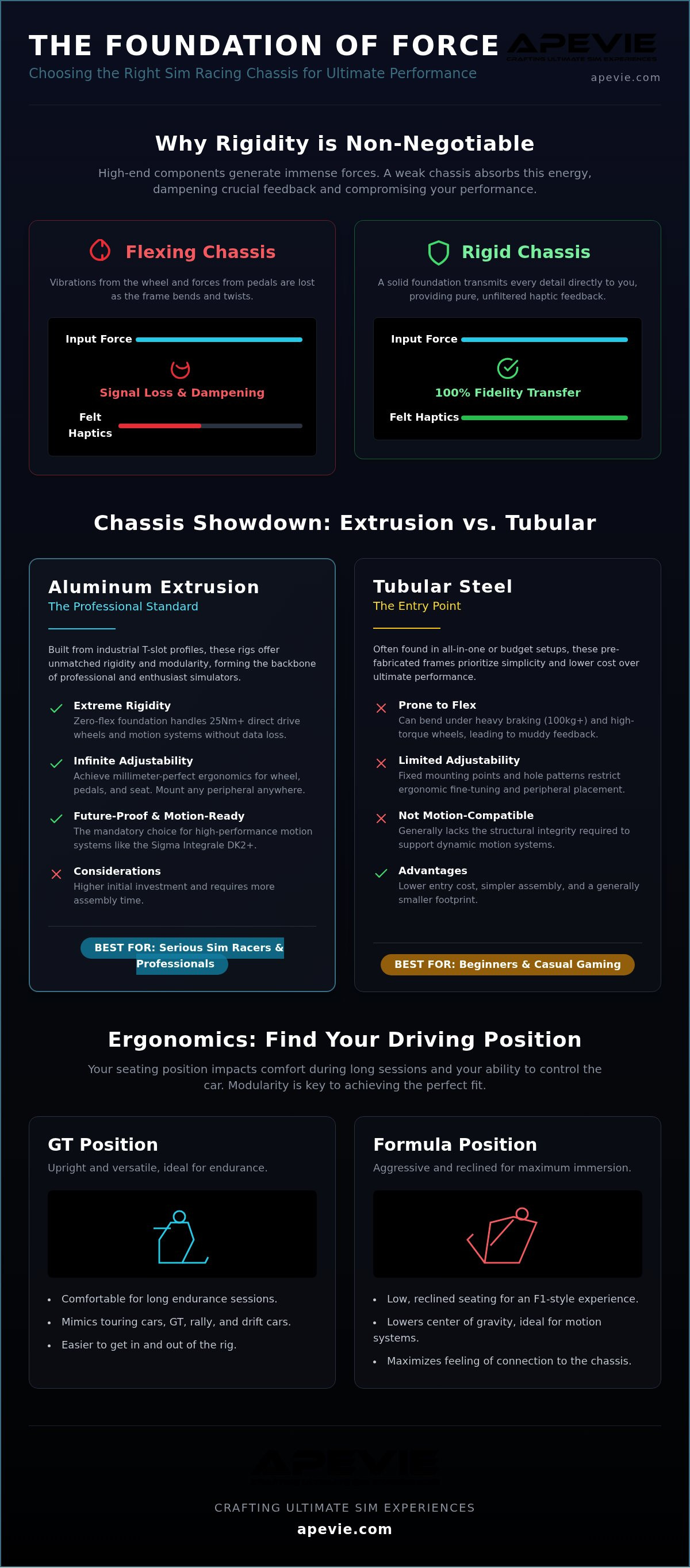
The chassis is the structural spine of your simulator. In the world of professional sim racing, we don't view the frame as mere furniture or a place to sit. It's a high-performance engineering solution designed to maintain the integrity of every signal sent from your PC to your body. While entry-level arcade setups prioritize aesthetics or portability, professional-grade hardware demands a foundation that can withstand immense physical forces. If your frame moves, your data is compromised. Without a stable base, even the most expensive direct drive wheel becomes an expensive toy rather than a precision tool.
Understanding Flex and Haptic Fidelity
Structural movement, often referred to as flex, is the primary enemy of haptic fidelity. When you use a high-end wheel base like a Simucube 3 or a Fanatec Podium, the motor generates subtle vibrations and high-frequency details that represent tire grip, kerb strikes, and road texture. If your cockpits / chassis isn't rigid, these vibrations are absorbed by the frame's bending or twisting. This creates "noise" in the haptic signal, effectively filtering out the very information you paid for. You end up with a dampened, muddy sensation that makes it harder to react to the car's limit.
Rigidity is the ability to resist up to 25Nm of rotational torque without any measurable deflection. Entry-level tubular frames, often made from thin-walled steel, might look sleek, but they lack the structural mass needed for high-torque applications. Industrial aluminum extrusion rigs provide the necessary mass and bracing to ensure that 100% of the motor's output reaches your hands. This is why professional builds almost exclusively rely on heavy-duty T-slot profiles that can be braced at every critical joint.
The Importance of a Heavy-Duty Pedal Foundation
The steering wheel isn't the only component that tests your frame's limits. High-end load-cell pedals, such as the Heusinkveld Sim Pedals Ultimate+, require a reinforced pedal plate that refuses to budge. When you're threshold braking at the end of a long straight, you might be applying over 100kg of force. If the pedal plate flexes even a few millimeters, it destroys your muscle memory. You're no longer measuring pressure; you're measuring the distance the metal bends.
Consistency in sim racing comes from a repeatable physical sensation. A moving foundation makes it impossible to find the same braking point lap after lap. You can read more about the physics of pedal performance in our Ultimate Guide to Sim Racing Pedals. At Apevie, we ensure every turnkey build uses a heavy-duty foundation to prevent this braking inconsistency, allowing you to focus on your lap times rather than your equipment's limitations.
Aluminum Extrusion vs. Tubular Chassis: Which is Right for You?
Selecting the construction method for your simulator is the most critical decision in the building process. In the current 2026 market, the debate usually centers on two distinct philosophies: the industrial modularity of aluminum extrusion or the pre-fabricated elegance of tubular designs. This choice dictates not just how your rig looks, but how it handles the massive forces generated by modern direct drive systems. For professionals, the decision often comes down to the rigidity-to-torque ratio required by their specific hardware.
The Pros and Cons of Aluminum Profile Rigs
Aluminum Extrusion Sim Rigs, often referred to as 80/20 or T-slot rigs, are the gold standard for high-performance builds. These systems use heavy-duty aluminum profiles that allow for infinite adjustability. You can move your wheel mount, pedal plate, or seat by a single millimeter to achieve perfect ergonomics. This modularity is essential when mounting professional accessories like handbrakes, shifters, or button boxes, as you can bolt them anywhere along the profile's channel.
The real advantage lies in structural integrity. A Simucube 3 wheel base can peak at 25Nm of torque, which is enough to twist a lesser frame. The thick cross-sections of an aluminum cockpits / chassis provide the mass and bracing required to keep your force feedback crisp. If you plan on upgrading to a Sigma Integrale DK2 motion system, an extrusion rig is virtually mandatory. It provides the necessary mounting points and weight-bearing capacity to handle the violent, high-frequency movements of four-point motion actuators without structural fatigue.
When to Consider a Pre-Fabricated Tubular Chassis
Tubular frames, such as the Fanatec GT Cockpit, offer a different value proposition. They're designed for users who want a "plug and play" experience with a sleeker, more integrated aesthetic. These rigs often look less like industrial equipment and more like a piece of high-end furniture, making them popular for home offices or living rooms. Assembly is generally faster because the components are pre-welded or use a simplified bolt-together system.
However, this convenience comes with trade-offs. Tubular designs are often fixed in their geometry, meaning you have limited control over the height and angle of your peripherals. While they are suitable for mid-range Fanatec ClubSport gear, they often struggle with the extreme pressures of Heusinkveld Ultimate+ pedals. If you're looking for a future-proof foundation that can grow with your hobby, we recommend exploring our curated selection of professional-grade chassis to ensure your base can handle tomorrow's upgrades.
Ergonomics and Seating: GT vs. Formula Seating Positions
Choosing a driving position is more than a matter of personal comfort; it's a fundamental engineering decision that dictates your physical relationship with the simulator. While your cockpits / chassis provides the structural frame, the seating geometry determines how you perceive speed, distance, and weight transfer. In 2026, professional sim racers generally choose between two distinct archetypes: the upright GT position or the reclined Formula layout. Each offers unique physiological advantages that can either enhance or hinder your performance depending on the discipline you're training for.
In VR or triple monitor setups, your eye level relative to the horizon is critical. A GT position places your eyes higher, offering a better view of the car's corners and the immediate track surface. Conversely, a Formula position drops your eye line, forcing you to look "up" at the track, which creates a more claustrophobic and authentic sense of being inside a carbon fiber monocoque. If your monitor mounts aren't adjustable, switching between these positions can ruin your perspective, making it essential to choose a chassis that supports your primary racing category.
When integrating a Sigma Integrale DK2+ motion system, the seat's construction becomes a haptic component. You want a rigid shell with minimal padding. Excessive cushioning acts as a filter, dampening the high-frequency vibrations that signal tire slip or kerb strikes. A firm, supportive seat ensures every movement of the chassis is transmitted directly to your spine, providing the tactile data you need to react in real-time.
GT Cockpit Ergonomics for Endurance Racing
The GT seating position is characterized by an upright backrest and pedals positioned below the hip line. This is the most ergonomic choice for long-duration sessions because it distributes your body weight across the lower back and thighs more naturally. It's also far easier to get in and out of an upright rig, which is a practical consideration for daily training. For a deeper look at how to optimize this layout, see The Ultimate Sim Rig Guide. This configuration is ideal for those racing GT3, touring cars, or rally stages where frequent ingress and egress are common.
Formula and Open Wheel Specialty Rigs
Achieving an authentic F1 feel requires a specialized "Open Wheel Simulator Cockpit" where your feet are elevated above your hip line. This reclined position shifts the center of gravity and changes how you apply pressure to the brake pedal, engaging different muscle groups in your legs. It's a highly immersive setup that pairs perfectly with high-end peripherals like those found in our guide to The Best F1 Steering Wheels. While less practical for endurance racing, the Formula position is unmatched for those seeking the specific physiological demands of high-downforce racing.
Future-Proofing for Motion: DK2 and DK2+ Compatibility
Many sim racers make the mistake of assuming any aluminum rig can handle the addition of a motion platform. There is a significant difference between a chassis that is "compatible" with motion and one that is truly "motion-ready." A motion-ready foundation is engineered to handle the vertical acceleration and high-frequency haptic data generated by systems like the Sigma Integrale DK2. Without sufficient structural mass and rigidity, your cockpits / chassis will vibrate excessively, wasting the energy of the actuators and muddying the feedback you feel in the seat.
The weight of your frame plays a vital role in actuator performance. If a rig is too light, the actuators don't have enough resistance to push against, which can lead to a "floaty" sensation. Conversely, a heavy-duty aluminum extrusion rig provides a stable anchor. This stability is essential for preserving the micro-details of road texture. When using high-frequency systems, you must also be wary of "frame rattle." Every loose bolt or thin bracket becomes a source of unwanted noise, which is why we prioritize industrial-grade fasteners and thick-walled profiles in all our turnkey builds.
Structural Integrity for Actuator Mounting
Mounting actuators like the Sigma Integrale DK2+ requires precise placement at the four corners of the frame to maintain an optimal center of gravity. Budget frames made from thin-walled tubing often fail under these conditions. The constant cycling of motion forces can lead to metal fatigue and eventual cracking at the weld points. For a deeper dive into how these forces interact with your body, consult The Professional Guide to Haptic Systems. We recommend using heavy 40x120mm or 40x160mm profiles for the base frame to ensure long-term durability under motion stress.
Cable Management and Peripheral Expansion
A professional 2026 simulator is a complex ecosystem of wiring. Between the motion actuators, direct drive wheel, and high-end pedals, you'll have dozens of cables that need a home. One advantage of T-slot aluminum is the ability to hide wires within the profile channels using specialized cover strips. This keeps the build clean and prevents cables from snagging during motion sequences. T-slot nuts also allow you to mount triple monitor stands directly to the chassis, creating a unified structure that moves as one piece.
If you're planning a future upgrade to motion, it's cheaper to buy the right foundation now than to replace your entire rig later. You can explore our range of professional motion-ready chassis to find a frame that will support your ambitions for years to come.
Selecting Your Apevie Cockpit: From Parts to Turnkey Solutions
At Apevie, we don't view the frame as a secondary purchase. We treat it as the most critical engineering choice in your build. Our 2026 collection of cockpits / chassis is curated specifically for enthusiasts who demand zero-flex performance and a future-proof foundation. We've spent years testing these frames with high-torque Simucube 3 wheel bases and Gomez Sim Industries (GSI) steering wheels to ensure that every haptic detail is preserved. Whether you're building a DIY rig or looking for a professional turnkey solution, our selection focuses on structural integrity and ergonomic precision.
Choosing the right base is a personal process that depends on your primary racing discipline and your long-term goals for motion. We offer expert consultation to help you navigate the technical requirements of mounting high-end hardware. If you're planning to integrate a Sigma Integrale DK2 motion system, we'll guide you toward the specific aluminum profiles that offer the necessary mass and mounting points. Our goal is to ensure you don't have to rebuild your simulator every time you upgrade a peripheral.
Standout Chassis Options in Our Collection
Our inventory is categorized to match the specific physiological needs of different racing styles. We prioritize heavy-duty Aluminum Extrusion Sim Rigs for racers who want the ultimate in modularity and rigidity. These frames are the bedrock of our high-performance builds, providing a stable platform for Heusinkveld Sim Pedals Ultimate+ and heavy-duty direct drive systems.
- GT Simulator Cockpits: Optimized for an upright seating position, these rigs are perfect for long endurance sessions in GT3 or touring cars.
- Open Wheel Simulator Cockpits: These frames provide the reclined, feet-up geometry essential for authentic Formula and single-seater immersion.
- Motion-Ready Foundations: Heavy-profile extrusion rigs specifically braced to handle the vertical acceleration of 4-post motion actuators.
Why Order Your Chassis Through Apevie Simulators?
We provide more than just hardware; we offer a professional partnership. Our White Glove Simulator Installation Service is designed for the serious buyer who wants to skip the frustration of complex assembly. We handle the alignment, cable management, and hardware calibration, delivering a ready-to-race system to your door. This isn't a "gaming setup" that you'll outgrow. It's a professional-grade simulator built to the same standards we use for corporate event activations and professional driver training; similarly, for those managing the business side of such professional ventures, Apex Tax Solutions LLC provides the specialized software needed for tax preparers and EROs.
If you're unsure which frame suits your Simucube or Fanatec gear, our team of active racers is here to provide honest, experience-based advice. We understand how a few millimeters of seat adjustment or a slightly stiffer pedal plate can change your entire experience. You can browse our professional Cockpits and Chassis collection to find the structural foundation for your next build, or contact us for a custom turnkey package consultation.
Build Your Future on a Zero-Flex Foundation
Investing in high-end peripherals like the Simucube 3 or Heusinkveld Ultimate+ pedals is only half the battle. Without a rigid structural spine, you're losing the very precision you've paid for. We've established that aluminum extrusion is the superior choice for those who demand infinite adjustability and a motion-ready platform capable of supporting the Sigma Integrale DK2+ system. By selecting one of our professionally engineered cockpits / chassis, you ensure that every haptic signal is transmitted directly to your senses rather than being absorbed by a flexing frame.
As an authorized Simucube and Heusinkveld dealer, Apevie Simulators provides the expertise and white-glove installation services needed to deliver a truly turnkey experience. Our frames are engineered specifically for high-torque direct drive systems to ensure your 2026 season is your most consistent yet. Upgrade your foundation with our professional Cockpits & Chassis and feel the difference that structural integrity makes in every corner. We look forward to helping you build a simulator that remains a high-performance asset for years to come.
Frequently Asked Questions
What is the difference between an aluminum profile rig and a standard racing seat?
Aluminum profile rigs are modular structural frames built from T-slot extrusion, while standard racing seats are often just a chair attached to a fixed frame. A profile rig allows you to mount wheel bases, pedals, and accessories at any height or angle. Standard seats often use thin tubular steel that flexes under load. A professional chassis provides the rigidity needed for high-end gear like Simucube 3 wheel bases or Heusinkveld pedals.
Can any sim racing cockpit handle a direct drive wheel base?
No, many entry-level cockpits / chassis lack the structural integrity to manage the 20Nm+ torque of a direct drive base. Using a powerful motor on a weak frame leads to flex, which absorbs force feedback detail. You need a heavy-duty aluminum extrusion rig or a specifically reinforced GT cockpit to ensure the vibrations reach your hands instead of shaking the entire frame apart or causing metal fatigue over time.
Do I need a special chassis to install a motion system like Sigma Integrale?
Yes, you need a motion-ready chassis with high structural mass. Systems like the Sigma Integrale DK2+ generate violent vertical forces that can fatigue thin-walled metal. An aluminum extrusion rig with 40x120mm or 40x160mm base profiles is ideal because it provides the rigidity required for the actuators to push against. Static rigs often require additional bracing to handle high-frequency haptic data without rattling during intense driving sequences.
Is a Formula seating position better than a GT position for F1 games?
It depends on your immersion goals for 2026. A Formula position, with feet elevated and a reclined backrest, replicates the physiological experience of a modern F1 car. This geometry changes how you apply pressure to load-cell pedals. However, a GT position is often more comfortable for long endurance sessions. If you exclusively race open-wheelers, an Open Wheel Simulator Cockpit is the most authentic choice for professional-grade training and immersion.
How much space does a full aluminum extrusion sim rig require?
Most professional aluminum extrusion rigs occupy a footprint of approximately 140cm to 160cm in length and 60cm to 80cm in width. If you add a triple monitor setup or a Sigma Integrale motion system, the required width can expand significantly to nearly 2 meters. It's best to plan for a dedicated space that allows for easy ingress and cable management around the back of the frame for a clean look.
What is white-glove installation for sim racing rigs?
White-glove installation is a premium service where Apevie experts handle the entire setup process. This includes building the aluminum chassis, mounting the Simucube base, calibrating Heusinkveld pedals, and organizing all wiring. We ensure the ergonomics are perfectly tailored to your height and driving style. It removes the technical headache of assembly, delivering a turnkey racing simulator that is ready for competition the moment our team finishes the onsite calibration.
Can I add a triple monitor mount to any sim racing chassis?
While many frames support monitor mounts, aluminum extrusion cockpits / chassis offer the most secure integration. T-slot profiles allow you to bolt heavy-duty monitor arms directly to the main frame, ensuring the screens move in sync with a motion system. Cheaper tubular rigs may require a standalone monitor stand, as their thin frames can't support the weight of three 32-inch curved displays without sagging or creating unwanted screen wobble.
Why are professional sim rigs made from aluminum extrusion?
Aluminum extrusion is used because it offers an unrivaled strength-to-weight ratio and infinite modularity. The T-slot design allows you to adjust every component by a single millimeter, which is essential for professional ergonomics. It's also incredibly rigid, making it the only reliable choice for high-performance simulators using 25Nm wheel bases and 4-post motion platforms. It allows for easy expansion as you add new peripherals, button boxes, or haptic systems.