Heusinkveld Pedals Guide: Choosing Between Sprint and Ultimate+ in 2026
Your lap time consistency isn't failing because you're braking too late; it's failing because your current hardware can't accurately translate your muscle memory into digital precision. You've likely felt that specific frustration when a delicate trail braking maneuver turns into an unpredictable lock-up during the final laps of a high-pressure race. It's a common plateau for enthusiasts using entry-level load cells that lack the sophisticated dampening required for true professional-grade performance. When you can't feel the bite point, you're just guessing, and guesswork is the enemy of the podium.
This Heusinkveld pedals guide will help you master the nuances of elite hardware and explain why a refined resistance profile is the genuine secret to finding that missing tenth of a second. We'll explore how moving beyond basic spring tension to authentic hydraulic-style resistance can transform your braking zones from a point of anxiety into a competitive advantage. We'll compare the versatile Heusinkveld Sim Pedals Sprint with the heavy-duty Ultimate+ to help you decide which set provides the "set and forget" reliability your simulator deserves. You'll learn exactly how these systems handle high-force inputs and which mounting requirements you'll need to consider for a seamless professional installation.
Key Takeaways
- Understand why pressure-based braking systems are superior to travel-based pedals for developing the muscle memory required for elite lap time consistency.
- Use this Heusinkveld pedals guide to evaluate the mechanical differences between the 65kg Sprint series and the 140kg hydraulic-damped Ultimate+ pedals.
- Identify the structural requirements for high-force hardware, including why a zero-flex mounting solution is critical for accurate telemetry and trail braking feel.
- Compare the industry-standard Heusinkveld lineup with modern hydraulic alternatives like the Conspit CPP series to determine which technology suits your driving style.
- Learn how to choose between the compact, reliable Sprint set and the authentic Formula-style resistance profile offered by the Ultimate+ system.
The Engineering of Consistency: Why Pedals Matter More Than Wheels
Many drivers mistakenly believe that a high-torque direct drive wheel is the fastest route to lower lap times. While a Simucube 3 or Fanatec Podium Wheel Base provides vital feedback, your braking performance dictates your entry speed, line, and ultimate exit. This Heusinkveld pedals guide focuses on the physics of deceleration. High-end pedals transform braking from a visual guessing game into a repeatable physical action. In simulators like iRacing or Assetto Corsa Competizione (ACC), the difference between a podium and a lock-up often comes down to the resolution of your brake input. The Engineering of Consistency relies on the biological fact that human muscle memory is significantly more accurate at replicating pressure than it is at replicating distance.
Load Cell Technology vs. Standard Sensors
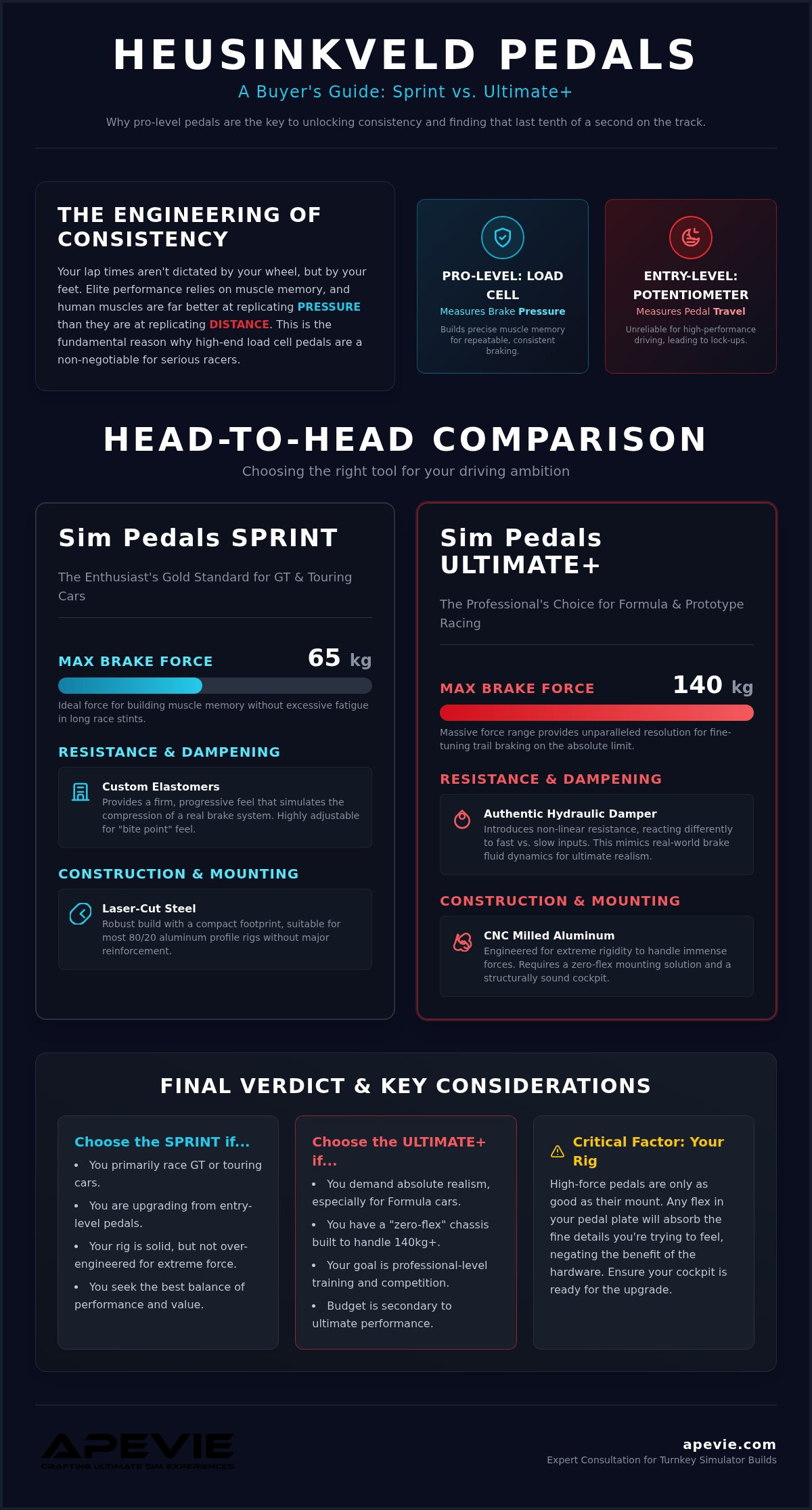
Standard entry-level pedals use potentiometers or Hall effect sensors to measure how far the pedal has moved. This is fundamentally flawed for racing. In a real GT3 car, the pedal barely moves once the pads touch the rotors; instead, you modulate the force of your leg. Load cell technology, found in the Heusinkveld Sim Pedals Sprint and Ultimate+, measures this exact force rather than position. The Sprint set offers up to 65kg of brake force, while the Ultimate+ allows for a massive 140kg. Having this headroom is vital for professional simulation. It isn't about being a bodybuilder. It's about having a wider range of sensor resolution to fine-tune your trail braking curve, which prevents the sudden tire lock-ups that ruin a qualifying lap.
Authentic Resistance and Dampening
Achieving a professional feel requires more than just a sensor; it requires sophisticated resistance. High-quality elastomers are used to simulate the physical compression of a brake system. These components provide the "initial bite" feel, where the pedal is slightly softer during the first few millimeters of travel before becoming rock hard. At Apevie Simulators, we prioritize these mechanical nuances when designing a custom build.
While elastomers do a great job, hydraulic systems like those in the Ultimate+ take it a step further. Hydraulics introduce non-linear resistance and natural dampening. This means the pedal responds differently to a fast, aggressive stomp than it does to a smooth, progressive release. This transparency in telemetry is what allows pro-level drivers to find that last tenth of a second in heavy braking zones. For those investing in a Turnkey Racing Simulator Package, choosing the right dampening profile is the single most important hardware decision you'll make. It ensures that your hardware doesn't just work, but actively assists you in maintaining consistency over long race stints.
Heusinkveld Sprint vs. Ultimate+: A Comparative Analysis
Choosing between the two flagship models from Heusinkveld requires an honest assessment of your racing goals and your current hardware foundation. This Heusinkveld pedals guide breaks down the mechanical and technical differences that separate the enthusiast-grade Sprint from the professional-grade Ultimate+. While both sets share a reputation for bulletproof reliability, they serve very different niches in the sim racing ecosystem. Understanding these distinctions is the first step toward achieving the consistency that separates the midfield from the podium.
Heusinkveld Sim Pedals Sprint: The Enthusiast's Choice
The Sprints are widely regarded as the gold standard for high-level hobbyists and GT racers. Constructed from laser-cut steel, they offer a compact footprint that fits perfectly on most 80/20 aluminum rigs without requiring massive reinforcements. The brake pedal utilizes a load cell capable of measuring up to 65kg of force. For many, this is the "sweet spot." It provides enough resistance to build muscle memory without needing a dedicated gym routine to finish a long race stint.
Integration is seamless thanks to the 12-bit electronics and the Heusinkveld SmartControl software. This tool allows you to map custom output curves and set deadzones with surgical precision. It's particularly useful for drivers who switch between different car classes and need to adjust their brake sensitivity on the fly. If you're looking for a balance of performance and ease of use, the Sprints remain the industry benchmark for home simulators.
Heusinkveld Sim Pedals Ultimate+: Professional Grade Performance
When you step up to the Ultimate+, you're no longer just buying a peripheral; you're investing in industrial-grade machinery. The defining feature here is the custom-made hydraulic dampers on every pedal. These dampers provide a non-linear resistance that perfectly replicates the feel of a modern Formula or LMP braking system. They don't just measure force; they simulate the fluid dynamics of a real racing car's hydraulic lines.
The Ultimate+ load cell supports up to 140kg of force at the pedal. This extreme resistance is essential for professional simulation where replicating the physical demands of a real cockpit is the priority. However, this force comes with a caveat. You absolutely need a professional sim rig to handle these loads. Without a rigid foundation, the force you apply will simply flex your pedal plate rather than stopping the car. If you want to explore even more specialized hydraulic options, you might also consider the Conspit hydraulic pedal lineup as a high-performance alternative to the Heusinkveld standard.
Both systems are designed for high-use environments and require minimal maintenance. The Sprints are essentially "set and forget," while the hydraulic seals on the Ultimate+ should be checked periodically to ensure long-term consistency. Regardless of your choice, both models provide the transparency in telemetry needed to master trail braking in any high-pressure race situation.
Critical Factors for Pedal Integration and Setup
Investing in elite hardware is only half the battle. The way you integrate these components into your cockpit determines whether you actually experience the precision you paid for. This Heusinkveld pedals guide wouldn't be complete without addressing the physical environment. If your mounting surface moves even slightly, the sophisticated telemetry provided by a high-force load cell is effectively neutralized. Your brain expects a solid resistance to build muscle memory. When the rig flexes, that feedback loop is broken, leading to inconsistent braking markers and missed apexes.
Ergonomics play a vital role in long-stint performance. Proper pedal height and angle are not just about comfort; they're about leverage. For GT-style seating, pedals are often mounted lower with a slight tilt. In a Formula-style position, they should be higher, allowing your legs to push straight out. Achieving this balance requires a versatile mounting solution. Many professional drivers opting for a Turnkey Racing Simulator Package rely on expert consultation to ensure the pedal geometry matches their physical proportions exactly.
The "Three-Pedal" versus "Two-Pedal" debate is also more relevant than ever in 2026. While the nostalgic appeal of a clutch is strong, modern GT3, LMP, and Formula cars utilize steering wheel paddles for gear shifts. If you primarily race modern classes, a two-pedal setup allows for wider spacing, which reduces hip fatigue and improves left-foot braking ergonomics. However, for rally enthusiasts or those racing historic h-pattern cars, the Heusinkveld clutch remains an essential tool for authentic car control.
Eliminating Rig Flex
Rigidity is the foundation of performance. Even 1mm of flex can ruin the benefit of a high-end load cell because it introduces a "mushy" feeling that mimics a travel-based sensor. Standard entry-level cockpits often require reinforcement plates to handle the forces generated by professional pedal sets. Using a dedicated baseplate creates a unified mounting structure, distributing the force across the entire frame rather than a single thin sheet of metal. At Apevie Simulators, we recommend aluminum extrusion rigs for any build involving professional-grade pedals to ensure zero-flex stability.
Software Calibration and Deadzones
Calibration is where you fine-tune the hardware to your specific physical capabilities. It's vital to set a small "rest" deadzone at the beginning of the pedal travel to prevent ghost braking caused by the weight of your foot. For cars without ABS, mapping a non-linear brake curve can help you modulate the final 10% of pressure, which is where most lock-ups occur. Heusinkveld SmartControl is the industry standard for pedal tuning because it allows for instant profile switching and real-time telemetry visualization without restarting your simulator. This level of control ensures your hardware remains a "set and forget" solution across multiple racing platforms like ProSimu or iRacing.
Modern Alternatives: Why the Conspit CPP Series is Gaining Ground
While this Heusinkveld pedals guide has focused on the industry-standard reliability of the Sprint and Ultimate+ series, the high-end simulator market has expanded to include specialized hydraulic alternatives. Drivers who demand integrated haptic feedback alongside hydraulic resistance are increasingly looking toward Conspit. Their "N+1" design philosophy focuses on adding layers of sensory input that traditional load cell pedals sometimes lack. It isn't just about the force you apply; it's about the information the pedal sends back to your foot.
The primary differentiator for Conspit is the integration of vibration motors directly into the pedal assembly. In simulators like iRacing, these motors provide a physical pulse when you trigger the ABS or lock a tire. This haptic layer bridges the gap between digital telemetry and physical sensation. While Heusinkveld focuses on pure mechanical transparency, Conspit uses active feedback to help you find the limit of grip faster. If you're building a rig for maximum immersion, comparing these two philosophies is essential.
CONSPIT CPP EVO Hydraulic Pedals ($849.0)
The CPP EVO is precision-engineered to provide authentic hydraulic resistance that rivals the Heusinkveld Ultimate+. It uses a professional-grade master cylinder design to create a progressive, non-linear feel that is nearly indistinguishable from a real racing cockpit. One of the most significant advantages of the EVO series is the ability to perform full adjustments of pedal travel and resistance without using any tools. This makes it a favorite for multi-driver setups or enthusiasts who enjoy fine-tuning their experience between different car classes. The 3-pedal EVO version stands as a direct competitor to the Ultimate+, offering a similar level of pro-level realism with the added benefit of integrated haptic motors.
CONSPIT CPP-Lite Series ($536.0 - $640.0)
For racers who want hydraulic feel without the footprint or price of a full professional system, the CPP-Lite series offers a compelling middle ground. This next-generation hydraulic system is designed specifically for lap speed and stability. It provides a more consistent braking platform than most entry-level load cells, helping you maintain a stable car during aggressive trail braking maneuvers. The integrated brake vibration is a standout feature at this price point, giving you a tactical advantage in sensing tire lock-up before it ruins your stint. You can find the full technical specs and configuration options in our Conspit Collection.
Choosing between these brands often comes down to your preference for haptic feedback versus mechanical purity. If you value a "set and forget" hardware solution with decades of proven reliability, Heusinkveld remains the king. However, if you want your pedals to actively communicate tire slip through haptics, the Conspit ecosystem is a modern alternative you shouldn't ignore. Explore the latest Conspit hydraulic pedal technology to see how these haptic features can transform your braking consistency.
Final Verdict: Which Pedal Set Should You Buy?
Choosing the right hardware is ultimately an exercise in aligning your equipment with your specific competitive goals. This Heusinkveld pedals guide has shown that while the Sprint and Ultimate+ series remain industry benchmarks, the emergence of haptic-enabled hydraulic systems like the Conspit CPP EVO offers a new path for those seeking maximum immersion. There's no single "best" set; there's only the set that matches your rig's structural limits and your driving style. Professional consultation is often the key to ensuring these high-force components work in harmony with your cockpit.
- Choose Heusinkveld Sprints if you prioritize a "set and forget" experience with industry-standard reliability. They provide the best balance of performance and easy rig integration for GT3 racers.
- Opt for Heusinkveld Ultimate+ if you require the most authentic hydraulic Formula-style resistance. The 140kg force capability is essential for replicating the heavy, short-travel feel of high-downforce machinery.
- Select Conspit CPP EVO if you want modern haptic integration. Being able to feel tire lock-up through the pedal sole provides a tactical advantage that traditional load cells can't replicate.
Matching Pedals to Your Racing Discipline
Your preferred car class should dictate your pedal geometry and setup. GT3 racing often benefits from a slightly longer pedal throw to help with delicate trail braking maneuvers, whereas Formula cars require a rock-hard pedal with minimal travel. Proper spacing is equally vital; two-pedal setups allow for a more ergonomic left-foot braking position that reduces hip strain during long endurance stints. If you're racing historic cars or rally stages, the addition of a high-quality clutch pedal is non-negotiable for authentic car control. You can find deeper engineering insights in our Guide to High-End Sim Racing Pedals.
The Apevie Advantage: Turnkey Integration
At Apevie Simulator, we understand that high-end hardware is only as effective as its installation. We specialize in integrating these professional components into custom high-performance rigs, ensuring that every bolt is torqued and every sensor is calibrated for zero-flex performance. Our white-glove installation and calibration services are available for national US clients, providing a stable foundation that lets you focus entirely on your lap times. Don't settle for a generic gaming setup when you can have a tailored professional racing solution. Explore the Conspit collection for your next professional upgrade and contact our experts to begin your custom build today.
Mastering Your Braking Performance
Finding the right pedal set is the final step in bridging the gap between simulation and reality. This Heusinkveld pedals guide has outlined how the choice between the 65kg Sprint and the 140kg Ultimate+ depends on your specific racing discipline and the structural limits of your cockpit. While Heusinkveld remains the benchmark for mechanical purity and reliability, modern alternatives like the Conspit series introduce haptic feedback that provides an entirely new layer of tire slip awareness.
Apevie Simulators stands as an authorized dealer and professional PC focused hardware specialist. We provide expert turnkey rig calibration and white-glove installation to ensure your high-force components perform exactly as intended without a hint of rig flex. Whether you prioritize the industry standard reliability of the Sprints or the authentic hydraulic resistance of the Ultimate+, your consistency in the braking zone will be the ultimate reward for your investment. It's time to stop guessing your brake markers and start hitting them with surgical precision every single lap.
Upgrade Your Sim Rig with the Conspit Professional Collection
Your journey toward elite lap time consistency begins with the right foundation. We look forward to helping you build a simulator that matches your passion for performance.
Frequently Asked Questions
Do I need a special rig to use Heusinkveld Ultimate+ pedals?
Yes, you definitely need a rigid aluminum extrusion rig to handle the forces involved. The 140kg force capability of the Ultimate+ can easily flex standard pedal plates found on entry-level cockpits. This flex ruins the precision of the load cell telemetry and makes your braking inconsistent. Apevie Simulators typically pairs these pedals with heavy-duty GT or Open Wheel frames to ensure a completely stable foundation for professional use.
What is the difference between a load cell and hydraulic sim pedals?
A load cell measures force through electrical resistance, while hydraulic pedals use fluid pressure to create a non-linear resistance profile. This Heusinkveld pedals guide highlights that while the Sprints are pure load cell, the Ultimate+ and Conspit CPP EVO use hydraulic dampers to simulate the compression of real brake pads. Hydraulics provide a more authentic "bite point" sensation, which is critical for mastering trail braking in high-performance cars.
Can I use Heusinkveld pedals on a console like PS5 or Xbox?
No, Heusinkveld pedals are designed exclusively for PC-based simulators and connect via a dedicated USB controller. They require the Windows-based SmartControl software for initial calibration and profile mapping. While some third-party adapters exist for console use, they often compromise the high-resolution 12-bit signal. Apevie focuses on professional PC hardware to ensure the electronics operate at their full potential without the latency issues common in console adapters.
How often do hydraulic sim pedals like the Conspit CPP EVO need maintenance?
Modern hydraulic pedals are engineered for low maintenance, typically requiring only a seal check once a year. High-use environments might need occasional lubrication of the pivot points to prevent squeaking or friction. The Conspit CPP EVO utilizes industrial-grade components to minimize the risk of fluid leaks. If you notice a change in the resistance profile or a "mushy" feel in the pedal travel, it's usually time for a professional inspection.
Is the Heusinkveld SmartControl software compatible with all racing sims?
Yes, SmartControl acts as a universal calibration layer that works independently of the specific racing title. Once you save a profile to the pedals, those settings apply to any software, including iRacing, Assetto Corsa Competizione, and various rally sims. This software is essential for setting rest deadzones and mapping the non-linear brake curves that help you prevent tire lock-ups in cars that don't utilize modern ABS systems.
Why should I choose Conspit pedals over Heusinkveld in 2026?
You should choose Conspit if you want integrated haptic feedback alongside a modern hydraulic system. While Heusinkveld offers legendary mechanical reliability and a "set and forget" design, the Conspit CPP series provides vibration motors that communicate tire slip directly to your foot. This active feedback loop can help you find the limit of grip faster than a traditional static pedal set, making it a favorite for drivers seeking maximum immersion.
Does Apevie Simulators offer installation for Heusinkveld and Conspit hardware?
Yes, Apevie Simulators provides white-glove installation and expert rig calibration for both brands. We don't just bolt the hardware down; we adjust the geometry, spacing, and software curves to match your specific physical proportions and preferred racing discipline. This service is available for national US clients who want a turnkey high-performance solution that works perfectly from the very first lap without the hassle of troubleshooting.
What is the benefit of the integrated vibration motors in Conspit pedals?
Integrated vibration motors provide physical haptic feedback for critical events like ABS activation and front-wheel lock-up. This sensory input allows you to react to the car's behavior through touch rather than waiting for a visual cue on your screen. By feeling the slip through the brake pedal, you can modulate your pressure more effectively. This is a massive advantage for maintaining consistency during high-pressure race situations where every tenth of a second counts.