Professional Racing Simulator Setup for Sale: 2026 Buyer’s Guide to Elite Performance
Is your simulator a high-fidelity training tool or just an expensive gaming peripheral that gathers dust because the motion feels slightly "off"? Many enthusiasts find themselves paralyzed by the complexity of component compatibility, fearing they'll spend $30,000 on a system that lacks true realism. It's frustrating to invest in a premium racing simulator setup for sale only to realize you don't have the hundreds of hours required to calibrate the telemetry or mount a Sigma Integrale DK2+ motion system correctly.
We understand that for a professional driver or a serious enthusiast, time is the most valuable asset. You deserve a solution that builds genuine muscle memory and remains relevant for years to come. This 2026 buyer's guide will show you how to evaluate elite hardware like Simucube 3 wheel bases and Heusinkveld Ultimate+ pedals to ensure your investment translates directly to real-world motorsport performance.
We'll explore the critical differences between DIY assembly and professional turnkey builds, providing a clear framework to help you choose a system that delivers professional-grade immersion from the moment you sit in the cockpit.
Key Takeaways
- Learn why professional-grade simulation requires a dedicated PC architecture to support the high-fidelity telemetry essential for real-world muscle memory.
- Discover why the Simucube 3 wheel base and Sigma Integrale DK2+ motion system have become the 2026 benchmarks for unfiltered haptic feedback.
- Evaluate the long-term ROI of a professional racing simulator setup for sale that includes white-glove installation compared to the hidden technical costs of DIY rigs.
- Identify the specific ergonomic and torque requirements needed to differentiate between elite Formula and GT endurance training configurations.
- Understand how expert calibration and a consultation-first approach ensure your turnkey system remains a relevant motorsport tool for at least five years.
Evaluating Professional Racing Simulator Setups for Sale in 2026
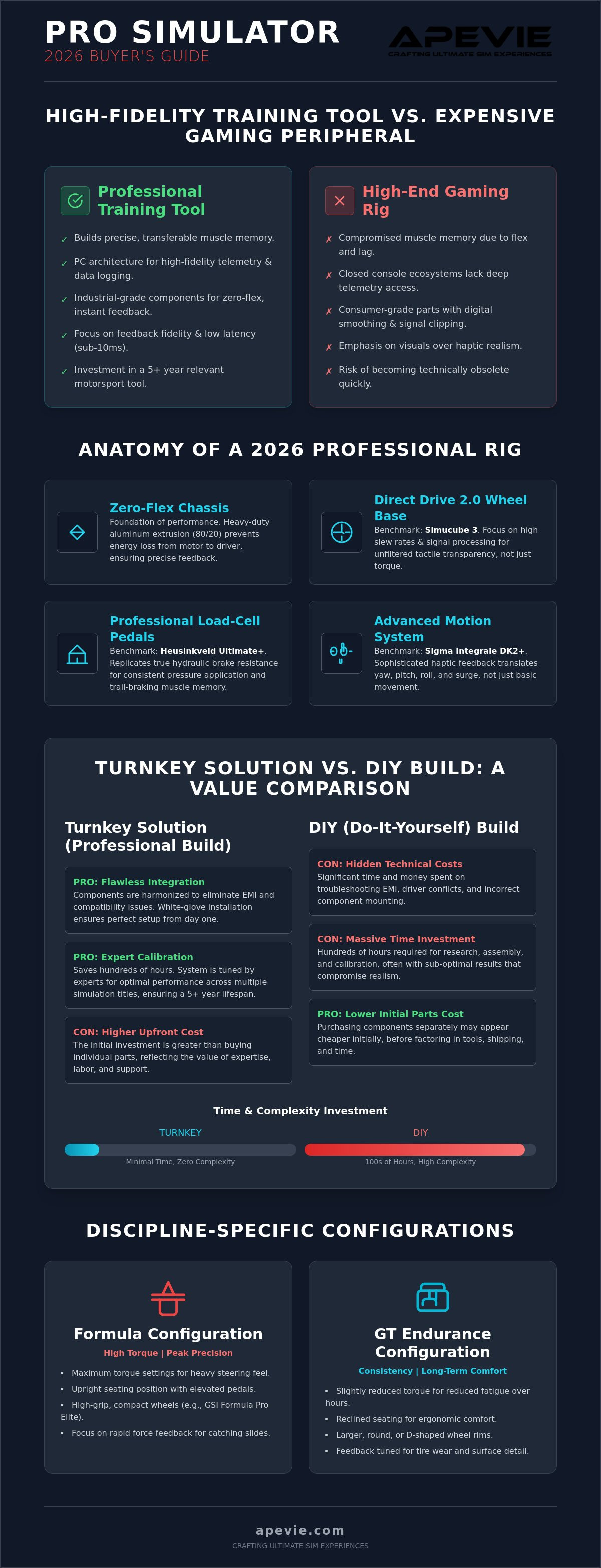
A professional racing simulator is no longer a luxury peripheral; it's a precision-engineered motorsport tool designed for cognitive training and track acclimation. Just as professional track riders depend on the mechanical precision of drivetrain components from Drive Systems USA to ensure every bit of power reaches the asphalt, sim racers require high-fidelity hardware to translate digital physics into physical sensations. In 2026, the distinction between a high-end gaming rig and a professional simulator is defined by the fidelity of the feedback loop. When you're searching for a professional racing simulator setup for sale, the primary goal isn't entertainment. It's the development of precise muscle memory that translates directly to the cockpit of a GT3 or Formula car. This requires hardware capable of replicating the exact resistance of a hydraulic brake system and the nuanced vibrations of a tire scrub through a high-torque direct drive wheel base.
The transition from casual gaming to serious simulation has been driven by the availability of industrial-grade components. Pros exclusively utilize PC-based systems because they offer the processing power required for complex physics engines and high-frequency telemetry output. For a setup to be considered professional in 2026, it must meet specific technical benchmarks. We look for force feedback fidelity that avoids signal clipping, pedal pressure consistency that mirrors real-world load cells, and haptic latency measured in single-digit milliseconds. The history of sim racing has led us to a point where the synergy between these components is more important than any individual spec sheet.
The Anatomy of a Professional-Grade Rig
The foundation of any elite system is a zero-flex chassis. We utilize heavy-duty aluminum extrusion, often referred to as 80/20, to ensure that the energy from the motor is transferred to the driver rather than being lost in frame flex. If the steering column moves even a millimeter under load, your muscle memory becomes compromised. The "brain" of this ecosystem is a dedicated industrial PC, optimized to handle triple 4K displays without dropping frames. Choosing a turnkey racing simulator setup for sale ensures that the PC, firmware, and hardware drivers are harmonized by Apevie Simulators, preventing the common EMI (electromagnetic interference) issues that plague DIY builds.
Why Console-Based Setups Fail the Professional Test
While consoles have made strides in visual fidelity, they remain closed ecosystems that lack the necessary depth for professional driver development. The most significant limitation is the lack of raw telemetry access. Professional coaching requires detailed data logs to analyze brake migration, throttle application, and steering geometry; data that console titles simply don't export with enough granularity. To build a foundation that remains relevant for the next five years, the open-platform flexibility of a high-performance PC is the only viable path. You can learn more about this in The Ultimate Sim Rig Guide.
The Engineering Behind Elite Hardware: Direct Drive and Motion
Searching for a professional racing simulator setup for sale involves looking past marketing fluff and investigating the raw engineering that dictates driver performance. In 2026, the industry standard for force feedback has shifted toward Direct Drive 2.0. This evolution is best exemplified by the Simucube 3 wheel base. Modern elite bases focus on signal processing and high slew rates rather than just raw torque. This ensures that the micro-vibrations of a tire's contact patch are transmitted to your hands without the digital smoothing that often obscures critical road information in consumer-grade gear.
Direct Drive Wheel Bases: Beyond Torque Numbers
While many enthusiasts obsess over peak Newton-meters, professional drivers prioritize how quickly a motor reacts to physics changes. The Simucube 3 Pro offers a level of tactile transparency that allows you to feel the exact moment of front-axle wash-out. When you pair this with a Gomez Sim Industries (GSI) Formula Pro Elite wheel, the rigidity of the carbon fiber construction ensures none of that detail is lost. If you're looking for a balance of power and finesse, the Simucube 3 Sport remains a formidable tool for endurance training. High-end advanced driving simulator research confirms that this high-fidelity feedback is what separates a training instrument from a simple gaming peripheral.
Sigma Integrale vs. Traditional Haptics
Motion systems have evolved from basic platforms into sophisticated haptic feedback devices. The Sigma Integrale DK2+ system represents the current benchmark because of its exceptional frequency response. Traditional motion systems often suffer from latency smear. This occurs when the rig's physical movement lags behind the physics engine. The DK2+ actuators communicate tire slip and weight transfer with surgical precision. This allows a driver to catch a slide through their inner ear and seat-of-the-pants feel before the eyes even register the movement on screen. This level of immersion is a core component of any custom high-performance racing simulator build.
The braking phase is where most sim racers lose time. This is why load-cell technology is non-negotiable for 2026. The Heusinkveld Sim Pedals Ultimate+ utilize a sophisticated system to simulate the non-linear resistance of a hydraulic brake stack. In a professional setup, you aren't measuring how far you push the pedal; you're measuring how much force you apply. This mimics the physical exertion required in a real GT3 car, allowing you to develop the muscle memory necessary for consistent trail braking. Whether you opt for a triple monitor setup for maximum peripheral awareness or a VR headset for depth perception, every component must work in total harmony. Investing in a professional racing simulator setup for sale is ultimately about ensuring your time behind the wheel translates to real-world results.
Turnkey Solutions vs. DIY Rigs: The Value of Calibration
Assembling a rig from a box of parts is relatively straightforward; engineering a cohesive motorsport tool is a different challenge entirely. When you browse for a racing simulator setup for sale, it's easy to focus on the hardware list while overlooking the integration. A DIY approach often leaves you wrestling with electromagnetic interference (EMI) from high-torque motors or driver conflicts that cause mid-race crashes. These aren't just inconveniences. They break the immersion and waste the limited time you have for training. A professional build ensures that every component communicates without digital friction.
The white-glove installation service provided by Apevie Simulators addresses the 80% of the build that happens after the bolts are tightened. This includes grounding the aluminum extrusion frame to eliminate static buildup and meticulously routing cables to prevent signal noise. We focus on the synergy between components. For example, a Simucube 3 wheel base requires specific True Drive profiles to balance raw detail with drivability. Without professional calibration, you're likely driving a setup that's either too dampened or dangerously violent, neither of which helps your lap times or your safety.
Ergonomics are another area where DIY builds often fall short. Professional drivers require a cockpit that mirrors their real-world environment to ensure muscle memory carries over. We don't just bolt pedals to a plate; we adjust the inclination, height, and spacing based on your specific biomechanics. This prevents the joint fatigue and lower back strain that often ruin long endurance stints. It's the difference between a gaming chair and a precision-engineered workstation.
Software Integration: The Final 10% That Matters
The difference between a gaming setup and a professional tool lies in the software stack. We optimize every system for platforms like iRacing and Assetto Corsa Competizione, ensuring that telemetry data flows seamlessly into analysis tools. Following professional-grade software expectations, we configure cloud-based profile management so your force feedback settings stay consistent across different cars and tracks. Regular firmware updates are handled by our team, ensuring your hardware performance evolves as physics engines improve. You shouldn't have to be an IT expert to go racing.
The "Buy Once, Cry Once" Philosophy
Mid-range gear often feels like a bargain until you realize its limitations. Many enthusiasts buy entry-level direct drive systems only to replace them within a year when they outgrow the fidelity. Investing in elite brands like Heusinkveld and Simucube from the start offers better long-term ROI. These components hold their resale value and are built to industrial standards, meaning they'll remain relevant for at least five years. Choosing a high-performance system initially prevents the cycle of constant, expensive upgrades that plague the hobbyist market. You can explore the technical requirements for these components in The Ultimate Guide to Sim Racing Pedals.
Discipline-Specific Configurations: GT vs. Formula Setups
A common mistake when browsing for a racing simulator setup for sale is assuming one configuration fits every racing discipline. While a high-end base provides the foundation, the cockpit geometry and peripheral choice must align with your specific training goals. A Formula driver requires a reclined seating position with feet elevated, whereas a GT3 racer needs an upright posture to manage the heavy braking loads typical of endurance racing. These physical differences aren't just about comfort; they dictate how your body processes g-forces and braking pressure.
The Formula Setup: Precision and Torque
Formula cars generate immense downforce, which translates to high steering resistance in high-speed corners. This is why we recommend higher torque settings on a Simucube 3 base for these builds. The The Best F1 Steering Wheels for Professional Sim Racing often feature integrated screens and complex rotary encoders to manage live data. The Gomez Sim Industries (GSI) Formula Pro Elite wheel is the standard here. It allows you to manage ERS deployment and brake bias with tactical precision, ensuring you don't have to take your hands off the grips during a qualifying lap. The chassis must be an open-wheel simulator cockpit to ensure the steering column angle matches the steep rake of a real single-seater.
The GT Setup: Endurance and Versatility
GT and endurance racing demand a different ergonomic approach focused on versatility and long-stint sustainability. These setups often utilize larger 300mm to 320mm steering wheels, such as the Cube Controls F-Core, to provide better leverage and a more natural feel for GT3 or GTE cars. Unlike the fixed, narrow position of an open-wheel rig, a GT simulator cockpit allows for more traditional pedal placement and the integration of accessory mounts. While brands like Vesaro offer high-end GT foundations, we focus on the modularity required to add shifters and handbrakes for those who also venture into touring car or rally disciplines.
Pedal mapping is the final layer of discipline-specific tuning. Using Heusinkveld Sim Pedals Ultimate+, we calibrate the load cell to match the specific vehicle class. A Formula setup might require a very short, ultra-stiff brake throw, whereas a GT3 configuration needs more travel to allow for the nuanced trail braking required to rotate the car into a corner. Matching your hardware to the vehicle's physical characteristics is what transforms a simulator from a gaming peripheral into a genuine motorsport tool.
Ready to build a rig tailored to your specific racing career? Consult with our experts for a custom high-performance racing simulator and get a system engineered for your discipline.
The Apevie Difference: Custom Turnkey Simulator Packages
Selecting a professional racing simulator setup for sale is a decision that extends far beyond a checklist of expensive components. While many retailers simply ship boxes of hardware, we treat every build as a bespoke engineering project. Our philosophy is rooted in the belief that a simulator is a precision instrument, not a gaming peripheral. This requires a consultation-first approach where we match hardware to your specific motorsport goals, whether you're a professional driver seeking track acclimation or an enthusiast building the ultimate home training center.
The turnkey advantage means your system arrives fully assembled, tested, and calibrated. We eliminate the technical anxiety that often accompanies high-end simulation. Instead of spending weeks troubleshooting driver conflicts or EMI issues from a high-torque Simucube 3 wheel base, you're ready to race from the moment our team finishes the installation. Every rig undergoes a rigorous quality control process where we stress-test the Sigma Integrale DK2+ motion system and ensure the software environment is optimized for zero-latency performance.
Our Bespoke Build Process
- Step 1: Driver Profile and Discipline Analysis. We begin by understanding your primary racing focus. A driver training for the 24 Hours of Le Mans requires a different ergonomic and haptic profile than someone focused on sprint-format Formula racing.
- Step 2: Component Selection. We utilize only elite-tier hardware, featuring Simucube wheel bases, Heusinkveld Sim Pedals Ultimate+, and Gomez Sim Industries (GSI) steering wheels. We don't compromise with mid-range gear that requires replacement within a year.
- Step 3: Rigorous Stress-Testing and Software Optimization. Before delivery, each system is calibrated for specific titles like iRacing and ACC. We tune the haptic feedback and motion profiles to ensure they provide diagnostic road information rather than just generic vibration.
Why Enthusiasts Choose Apevie Simulators
Our commitment to elite performance means we focus exclusively on high-performance PC hardware. We avoid the limitations of console-based ecosystems, providing our clients with the raw telemetry access needed for professional driver coaching. This focus on industrial-grade standards is why our systems, from the entry-level GRID package to the elite AS1 motion simulator, remain relevant for at least five years. You get a single point of contact for all support needs, including remote tuning and hardware upgrades as technology evolves.
The Apevie experience includes national white-glove service, where our technicians handle the on-site assembly and provide personalized ergonomic training. We ensure you understand how to utilize your new tool to its full potential. If you're ready to invest in a system that delivers genuine motorsport ROI, contact Apevie Simulators today for a professional consultation and discover the power of a custom turnkey solution.
Elevate Your Driver Development for 2026
Investing in a professional racing simulator setup for sale is a commitment to precision and long-term performance. We've explored how the synergy between a Simucube 3 wheel base and a Sigma Integrale DK2+ motion system creates the high-fidelity feedback loop necessary for genuine track acclimation. Whether you're configuring a reclined Formula cockpit or an upright GT endurance rig, the goal remains the same: developing the muscle memory that translates directly to real-world motorsport success.
As an authorized dealer for Simucube and Fanatec, Apevie Simulators provides the bespoke engineering required for professional drivers. Our white-glove national installation service removes the technical anxiety of calibration, ensuring your system is race-ready from day one. You don't have to spend your limited training time troubleshooting drivers or EMI issues; you can simply focus on hitting your marks.
Ready to secure your competitive edge? Explore Our Turnkey Professional Simulator Packages and let our experts engineer a solution tailored to your racing career. We look forward to seeing you at the top of the podium.
Frequently Asked Questions
How much does a professional racing simulator setup cost in 2026?
Professional systems in the 2026 market generally start around $15,000 for high-end static rigs and can exceed $130,000 for elite 6-DOF turnkey configurations. Most serious drivers find the ideal balance for a high-performance racing simulator setup for sale between $30,000 and $60,000. This investment typically includes an industrial-grade direct drive base, load-cell pedals, and a rigid aluminum chassis designed to eliminate the mechanical flex found in consumer-grade equipment.
Do I need a motion system for a professional sim racing setup?
A motion system isn't strictly required to set fast lap times, but it's essential for developing "seat-of-the-pants" feel and vestibular muscle memory. Systems like the Sigma Integrale DK2+ provide critical haptic feedback regarding tire slip, weight transfer, and brake lockups that visual cues alone cannot replicate. For professional drivers, this physical immersion is what allows simulator training to translate effectively to real-world track performance.
Can I use a professional sim rig with a PlayStation or Xbox?
Professional hardware from elite brands like Simucube and Heusinkveld is designed exclusively for PC platforms. While some mid-range Fanatec gear offers console compatibility, the high-fidelity telemetry and complex physics engines required for genuine driver development are only accessible on PC. Consoles currently lack the processing power and open-architecture needed to manage sophisticated motion platforms or high-refresh triple 4K monitor configurations.
What is the best direct drive wheel base for sale right now?
The Simucube 3 series is widely considered the 2026 industry standard for professional-grade force feedback. Unlike consumer bases that focus on peak torque numbers, the Simucube 3 prioritizes high slew rates and signal processing transparency. This ensures that the micro-vibrations of the road surface are transmitted without the digital smoothing that often obscures critical road information in less sophisticated direct drive systems.
Is a turnkey simulator setup better than building it myself?
A turnkey solution is superior for professionals who value their time and require expert calibration. DIY builds often suffer from hidden technical debt, including electromagnetic interference (EMI) and software driver conflicts that can take weeks to resolve. A professional turnkey racing simulator setup for sale arrives fully optimized, with the PC, motion system, and peripherals harmonized to deliver a cohesive and reliable training environment from day one.
What kind of PC do I need to run a high-end simulator with triple monitors?
You need an industrial-grade PC equipped with a top-tier GPU, such as an RTX 4090 or the latest 50-series equivalent, to maintain stable frame rates. Running triple 4K displays or high-refresh VR headsets requires significant VRAM and a high-performance processor to handle the complex physics calculations of modern simulations. While our turnkey systems include purpose-built PCs, enthusiasts looking for high-performance hardware can explore The Budget King PC Build to find a system capable of handling these intense graphical loads.
How much space is required for a full-motion racing simulator?
A full-motion simulator typically requires a dedicated area of approximately 8 feet by 5 feet. While the rig's physical footprint is smaller, you must account for the "swing area" of the motion actuators and the clearance needed for triple monitor stands. It's also important to ensure the floor can support the concentrated weight of the aluminum chassis and that you have adequate ventilation for the high-performance PC components.
Does Apevie Simulators provide national installation and support?
Yes, Apevie Simulators specializes in national white-glove installation and comprehensive on-site training. Our service includes the physical assembly of your rig, cable management to prevent EMI, and the custom calibration of your software profiles. We also provide ongoing remote support and hardware upgrade paths, ensuring your system remains a relevant and effective motorsport tool as simulation technology continues to evolve.