Simucube vs Fanatec Direct Drive: The 2026 Professional Comparison
Is the most powerful wheel base actually the one that makes you a more consistent driver, or are you simply paying for the convenience of a brand's ecosystem? It's a question we often address at Apevie Simulators when clients are designing their ultimate setups. You likely recognize that high-end sim racing has moved beyond simple vibration. You're looking for a tool that translates telemetry into physical intuition. Choosing between Simucube vs Fanatec direct drive systems often feels like a choice between an open-standard industrial instrument and a polished, all-in-one consumer platform.
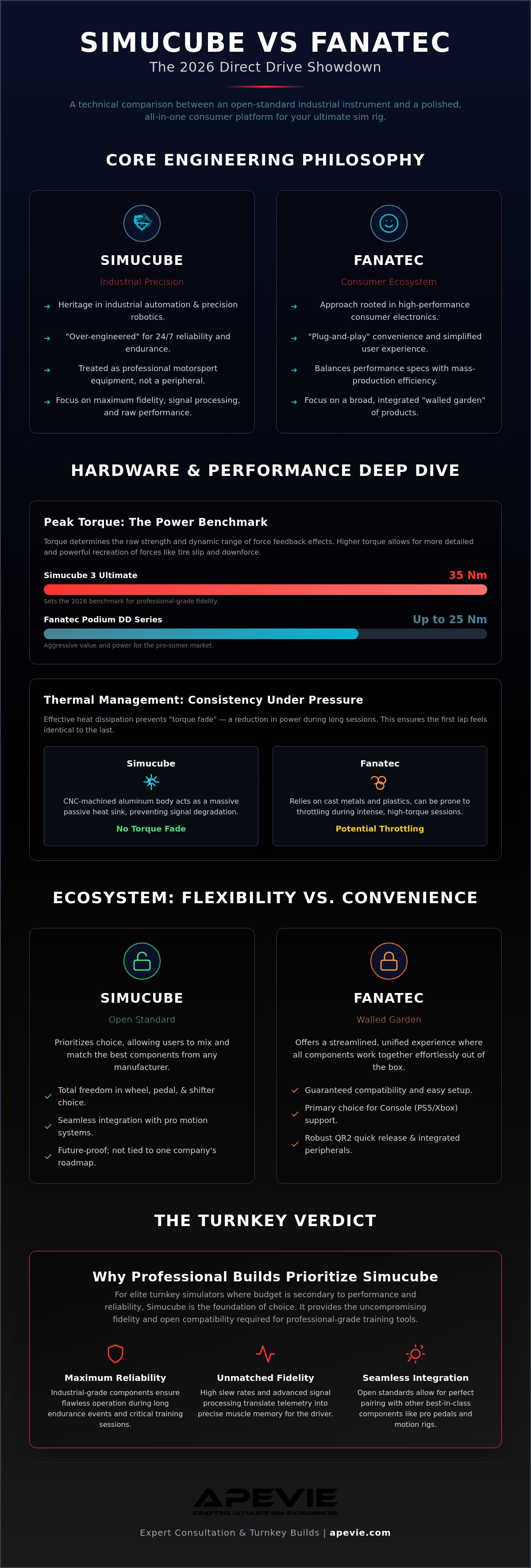
We understand the anxiety of investing in a foundation that might feel obsolete or restrictive in just a few years. This 2026 comparison clarifies which leader provides the fidelity and reliability required for professional-grade training. You'll discover how the Simucube 3 Ultimate's 35 Nm peak torque and Tuner 3.1 software compare to the aggressive value and console flexibility of the Fanatec Podium DD. We'll examine the nuances of force feedback detail, software stability, and long-term hardware flexibility to ensure your hardware foundation won't require an upgrade for years.
Key Takeaways
- Understand the fundamental difference between Simucube’s industrial-grade precision and Fanatec’s consumer-focused ecosystem to determine which aligns with your long-term racing goals.
- Compare the 2026 hardware landscape, specifically how the 35 Nm Simucube 3 Ultimate sets a new benchmark for professional fidelity against the Fanatec Podium DD series.
- Evaluate the "ecosystem lock-in" versus "open-standard" flexibility when deciding between a Simucube vs Fanatec direct drive setup for high-end wheel compatibility.
- Learn why signal latency and telemetry-based effects in Simucube Tuner 3.1 are critical for developing the precise muscle memory required for competitive motorsport.
- Gain insight into why professional turnkey builds prioritize Simucube for seamless integration with high-performance components like Sigma Integrale motion systems.
The 2026 Direct Drive Landscape: Simucube vs Fanatec
Choosing the right foundation for a simulator build determines whether your rig feels like a high-end peripheral or a professional training tool. The debate surrounding Simucube vs Fanatec direct drive systems has shifted significantly in 2026. While both brands utilize direct drive technology to eliminate the lag and dampening of belt or gear systems, their engineering philosophies have diverged more than ever. A direct drive motor connects the steering wheel directly to the motor shaft, providing unfiltered torque and granular detail that are essential for developing consistent muscle memory.
In the current market, the distinction is clear. Simucube has doubled down on industrial-grade performance with the Simucube 3 series, led by the 35 Nm Ultimate model. Fanatec, meanwhile, has refined its ecosystem approach, offering competitive pricing and seamless integration across its Podium and ClubSport DD+ lines. For a professional-grade simulator, the wheel base is the most critical decision. It dictates your choice of steering wheels, software experience, and the long-term reliability of your entire investment.
The Evolution of Direct Drive in 2026
We've reached a point where signal processing speeds have largely exceeded the limits of human perception. In 2026, the focus has moved from simple raw power to sustained cooling performance and fidelity. A standard direct drive base is no longer sufficient for professional rigs because it often suffers from thermal throttling during long endurance sessions. High-end units like the Simucube 3 Pro now maintain 25 Nm of torque without signal degradation, ensuring that the last lap of a race feels exactly like the first. This stability is what allows drivers to trust their instincts under pressure.
Fanatec: The Ecosystem Powerhouse
Fanatec remains the leader in accessibility and "plug-and-play" convenience. Their philosophy centers on a "walled garden" that simplifies the user experience. Key features of the Fanatec ecosystem in 2026 include:
- QR2 Quick Release: A robust, zero-flex mechanical connection that allows for rapid wheel swaps.
- Console Compatibility: The ClubSport DD+ remains the primary choice for those requiring PlayStation 5 or Xbox support alongside PC use.
- Proprietary Integration: Fanatec peripherals like the ClubSport V3 pedals and Shifter connect directly to the base, reducing cable clutter.
The typical Fanatec user values convenience and a broad range of official licensed wheels, such as their Formula Steering Wheel series. However, this convenience often comes at the cost of being locked into a single manufacturer's hardware standards. This contrast is central to the Simucube vs Fanatec direct drive decision for serious enthusiasts.
Engineering Philosophy: Industrial Precision vs. Consumer Ecosystem
The core of the Simucube vs Fanatec direct drive debate lies in their heritage. Simucube’s parent company, Granite Devices, built its reputation in industrial automation and precision robotics. This background is why their bases are famously "over-engineered." They treat a wheel base as a piece of heavy machinery designed for 24/7 operation. In contrast, Fanatec approaches the market through the lens of consumer electronics. They excel at balancing high-performance specs with the efficiencies of mass production. This is why their hardware often feels like a refined gaming product rather than a piece of motorsport equipment.
This difference in philosophy is most apparent during long endurance sessions. Thermal management is where Simucube truly shines. Because their housings are primarily CNC-machined aluminum, the entire body acts as a massive heat sink. This design prevents "torque fade," a phenomenon where the motor reduces power to protect itself from overheating. While Fanatec has made strides with the ClubSport DD+ and Podium lines, their reliance on cast metals and high-impact plastics in certain internal components can occasionally lead to thermal throttling during intense, multi-hour stints at high torque levels.
Motor Architecture and Slew Rate
The slew rate is essentially the "acceleration" of force feedback. It measures how quickly the motor can change its torque output in response to a signal from the sim engine. The Simucube 3 Ultimate, with its 35 Nm peak torque, currently leads the industry in signal fidelity. This high slew rate allows for micro-vibrations that signal tire-slip or subtle changes in road texture. If you're looking for professional advice on Which Direct Drive Wheel To Buy, consider that these high-frequency details are what build the muscle memory needed to catch a slide before it happens.
Software and Customization: True Drive vs. Fanalab
Software is the bridge between the motor and your hands. Fanatec’s Fanalab is highly intuitive and integrates perfectly with their full peripheral line. It allows you to sync LEDs and displays across your entire rig effortlessly. However, Simucube’s True Drive software offers a level of granular filtering that professional drivers prefer. With the 2026 update to Tuner 3.1, Simucube introduced "Simple Mode" for those who want instant performance. Simultaneously, the "Paddock" cloud-based platform lets you download specific profiles from real-world GT3 and Formula drivers to match your car class.
When we design a custom high-performance racing simulator at Apevie Simulators, we often recommend the Simucube platform for its industrial reliability and software depth. It’s a foundation that doesn't just work; it stays consistent lap after lap without compromise.
Force Feedback Fidelity: The Physics of Realistic Muscle Memory
Professional simulation isn't about which motor shakes the hardest. It's about the fidelity of information transmitted from the virtual tires to your palms. When evaluating a Simucube vs Fanatec direct drive setup, you're essentially choosing a signal processing philosophy. High-end motors must translate thousands of data points per second into physical intuition. This process is what allows a driver to develop the muscle memory required to catch a rear-end snap or feel the exact moment of tire graining. If the signal is muddy or delayed, your brain can't build the necessary neural pathways for consistent performance.
Consistency is the hallmark of professional training. You need to be certain that the 100th lap provides the identical physical cues as the first. This requires a motor that doesn't just produce power, but maintains it with surgical precision. Signal latency is the primary enemy here. Even a few milliseconds of delay between the sim engine and your hands can disrupt your timing. While both brands have pushed latency to the limits of human perception in 2026, the way they handle signal purity differs significantly.
Torque and Dynamic Range
Professional drivers rarely utilize 100% of a 35 Nm motor's power. Most GT3 or Formula cars require sustained forces between 8 and 15 Nm. However, torque "headroom" is vital to avoid clipping. When a lower-powered base reaches its limit, it flattens the signal, erasing the subtle details of curbs or ABS pulses. High torque allows for linear response without distorting micro-details. This ensures that even under heavy cornering loads, you can still feel the fine-grain texture of the track. Just as we explain in The Ultimate Guide to Sim Racing Pedals, holistic control depends on every component maintaining its resolution throughout the entire range of movement.
Filtering and Signal Purity
Simucube’s reputation is built on its reconstruction filters. These algorithms eliminate the "notchness" of digital signals without adding the artificial weight or lag found in cheaper systems. The result is a fluid, organic steering feel that mimics a real-world steering column. Fanatec’s 2026 response, FullForce technology, utilizes a dedicated high-frequency haptic channel. This allows the base to layer engine vibrations and road noise over the primary steering forces. While Fanatec offers a more "active" feel, Simucube’s approach remains the choice for those seeking the purest translation of physics. This signal purity helps professional drivers translate their sim time directly to real-world track performance with minimal adjustment.
Ecosystem and Compatibility: Steering Wheels and Peripherals
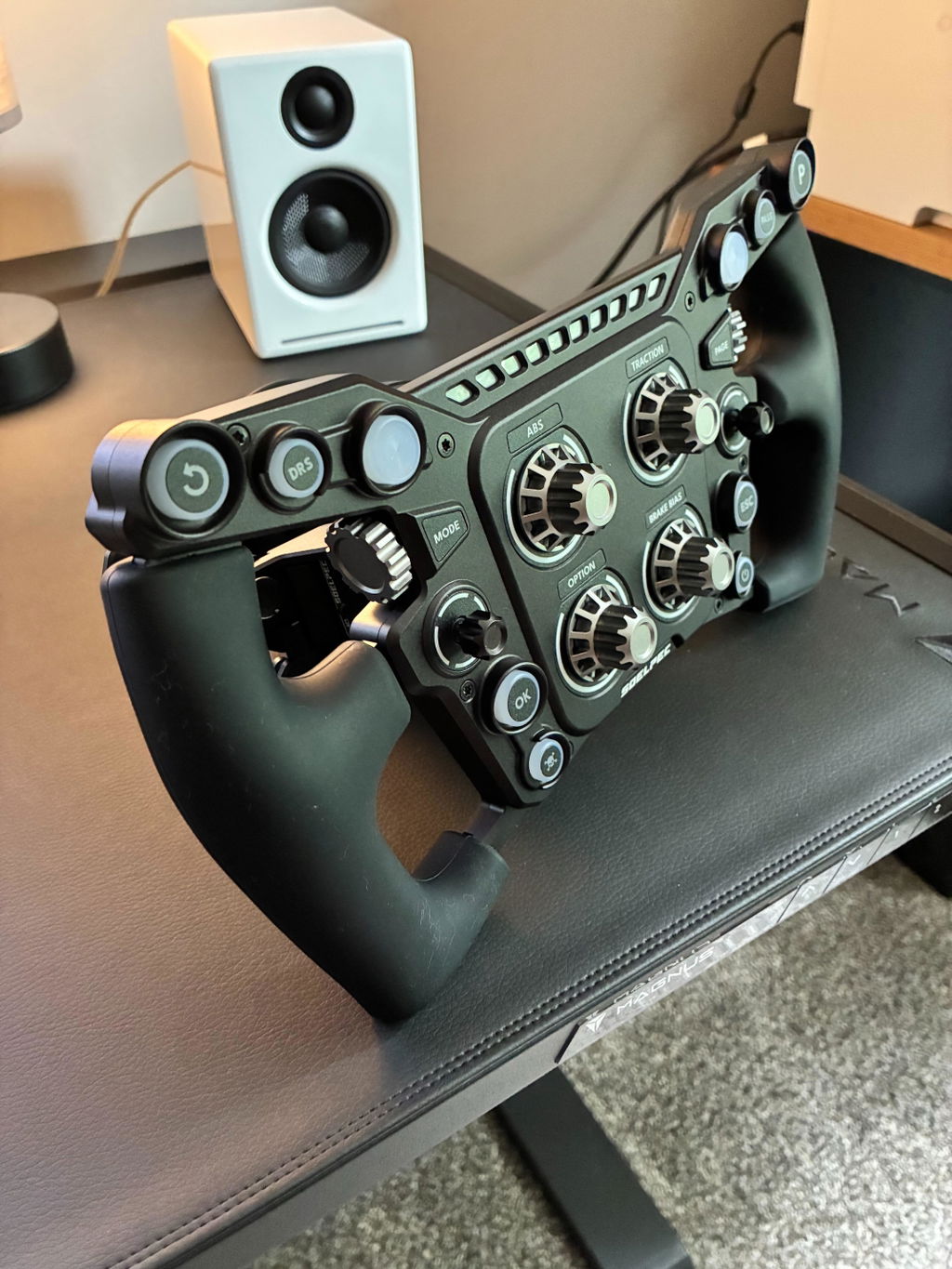
The choice between a Simucube vs Fanatec direct drive base often dictates your entire hardware trajectory for years. Fanatec operates as a "closed" ecosystem, much like a premium consumer electronics brand. To access the full functionality of their bases, you generally stay within their catalog of wheels, pedals, and shifters. Simucube takes the opposite approach. They provide an industrial-grade motor and an open standard that encourages you to curate your own build. This modular philosophy is why professional sim racers often prefer Simucube bases when they want to mount elite boutique hardware like the Gomez Sim Industries (GSI) Formula Pro Elite or the Cube Controls F-Core.
For those focused on single-seater competition, selecting the right interface is a critical part of the build process. You can find detailed recommendations on high-end options in our guide to The Best F1 Steering Wheels for Professional Sim Racing in 2026. While Fanatec offers the impressive BMW M4 GT3 Podium wheel, which is a direct replica of the real-world motorsport component, Simucube users aren't limited to a single manufacturer's vision. They can mix and match components from across the entire industry to create a bespoke cockpit.
The Freedom of the Simucube Quick Release
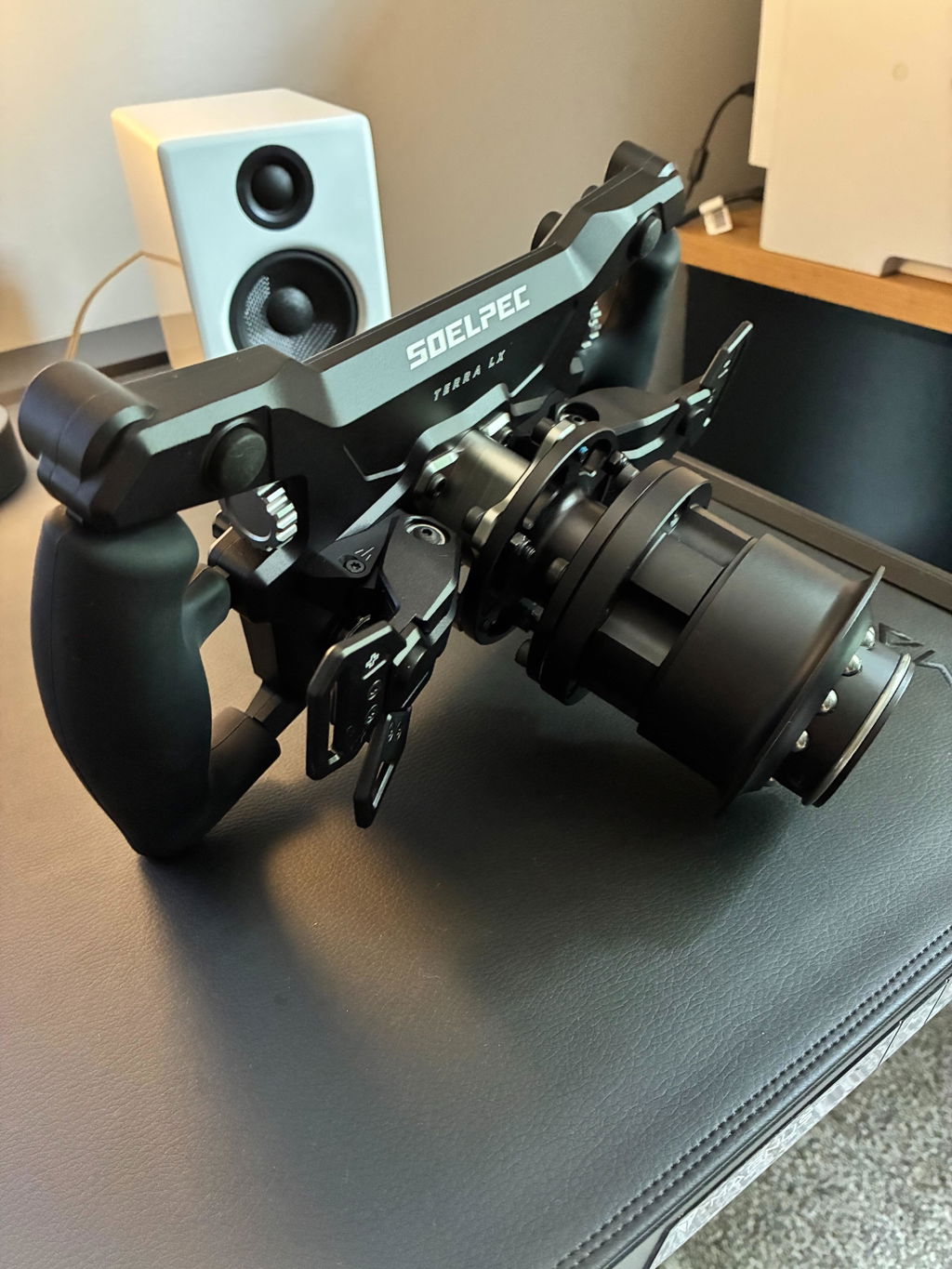
The Simucube SQR (Simucube Quick Release) system is a masterclass in mechanical engineering. It uses a tapered, wedge-shaped design that completely eliminates mechanical play, ensuring every bit of high-frequency detail is transmitted to your hands without dampening. Because Simucube uses a standard bolt pattern, you can easily integrate wheels from Precision Sim Engineering or other bespoke manufacturers. You can choose between the convenience of Simucube’s low-latency wireless wheel standard or a traditional USB connection for maximum reliability in a professional rig. This flexibility ensures your foundation remains relevant even as new wheel technologies emerge.
Fanatec Ecosystem Advantages
Fanatec’s greatest strength is its seamless plug-and-play simplicity. For a driver who prefers a single cable connection to the PC, Fanatec’s ability to daisy-chain pedals and shifters directly through the wheel base is unmatched. Console compatibility remains their primary differentiator in 2026. If your training requires PlayStation 5 or Xbox support alongside PC use, the ClubSport DD+ or Podium lines are the only high-end options that provide a consistent experience across platforms. However, as racers transition toward PC-only professional simulation, they often find the proprietary ecosystem restrictive. They eventually seek the ability to use specific high-end pedals or a custom wheel that Fanatec’s locked system doesn't support.
If you're ready to move beyond off-the-shelf setups and want a foundation that supports elite hardware, contact our team to discuss a custom turnkey simulator build.
The Turnkey Verdict: Why Professional Builds Prioritize Simucube
When designing a custom high-performance simulator, the wheel base serves as the central nervous system of the entire rig. At Apevie Simulators, our selection process is guided by a single metric: the ability to provide an unfiltered, industrial-grade connection to the virtual car. In the 2026 Simucube vs Fanatec direct drive landscape, we consistently prioritize Simucube for our professional turnkey builds. While Fanatec offers a polished consumer experience, Simucube provides the industrial integrity required for professional motorsport training where downtime isn't an option.
A significant factor in this decision is how the wheel base integrates with advanced haptic hardware. For instance, a Simucube 3 series base pairs exceptionally well with Sigma Integrale DK2 motion systems. Because the Simucube motor produces such a clean, high-frequency signal, it doesn't mask the vibrations coming from the motion actuators. In a professional rig, every component must talk to the others without interference. Simucube’s open-standard architecture allows us to fine-tune this communication, ensuring that the chassis movement and steering feedback work in perfect harmony rather than fighting for the driver's attention.
Holistic Rig Performance
The most effective simulators are built as a cohesive ecosystem rather than a collection of parts. We've found that the synergy between Simucube bases and Heusinkveld Sim Pedals Ultimate+ creates a level of consistency that consumer-grade ecosystems struggle to match. The wheel base is often the weakest link in the signal chain if it can't handle the complex telemetry data of modern sims. You can explore how these elements combine in our The Professional Guide to Haptic Systems. By using industrial motors, we ensure the steering signal remains pure even when the rest of the rig is generating intense G-forces and vibrations.
Final Decision Framework
Choosing the right foundation depends on your specific goals and how you intend to use the simulator. Use this framework to finalize your choice:
- Choose Fanatec if: You require native PlayStation 5 or Xbox compatibility; you prefer a single-brand plug-and-play setup; or you're working within a mid-range budget where value is the primary driver.
- Choose Simucube if: You're building a PC-only professional rig; you demand the highest possible signal fidelity; or you want the freedom to use elite boutique wheels like GSI or Cube Controls.
The Apevie Simulators promise is to eliminate the hardware headache of DIY builds. We provide white-glove installation and expert consultation to ensure your hardware is calibrated for your specific car class. Whether you're a professional driver or a serious enthusiast, we help you choose a foundation that won't require an upgrade for years. Contact us today for a consultation on a custom turnkey simulator build.
Securing Your Competitive Edge
Deciding on a Simucube vs Fanatec direct drive foundation is ultimately a choice between consumer convenience and industrial precision. Fanatec offers an accessible, all-in-one ecosystem that excels in multi-platform environments. However, for the serious racer who prioritizes signal purity and long-term hardware flexibility, the Simucube 3 series provides a level of fidelity that translates directly to real-world performance. A professional rig is only as strong as its weakest link; starting with an industrial-grade motor ensures your muscle memory is built on a consistent, unfiltered foundation.
At Apevie, we don't just sell components; we engineer professional training environments. As authorized dealers for Simucube and Sigma Integrale, we specialize in high-performance, PC-focused hardware. Our team provides expert white-glove installation nationwide, taking the complexity out of high-end simulation so you can focus on the track. If you're ready to invest in a system that won't require an upgrade for years, we're here to help you navigate the technical nuances of your build.
Build your dream simulator with an Apevie Custom Turnkey Solution and experience the difference that professional-grade calibration makes to your consistency on every lap.
Frequently Asked Questions
Is Simucube 3 much better than the Simucube 2 Pro?
The Simucube 3 series represents a significant leap in signal processing and thermal efficiency rather than just a torque increase. While the 25 Nm peak torque of the Simucube 3 Pro matches the older hardware, the updated Tuner 3.1 software and Telemetry-Based Effects (TBE) provide a much more nuanced road feel. The higher slew rate and improved cooling ensure that the feedback remains identical from the first lap to the end of a three-hour endurance stint.
Does Fanatec work with Gomez Sim Industries (GSI) steering wheels?
Fanatec bases don't natively support third-party USB wheels like the GSI Formula Pro Elite without additional hardware. To enable force feedback on a Fanatec base with a non-Fanatec wheel, you must use a Fanatec Podium Hub to bypass their proprietary lockout. This restriction is a key factor when comparing Simucube vs Fanatec direct drive systems, as Simucube’s open standard allows you to bolt on any professional wheel without workaround adapters.
What is slew rate and why does it matter for sim racing?
Slew rate measures how quickly the motor can change its torque output, expressed in Nm/ms. A high slew rate is essential because it allows the wheel to react instantly to sudden physics changes, such as a snap of oversteer or hitting a sharp curb. This speed creates "sharper" and more detailed feedback, which helps you catch slides earlier and builds the precise muscle memory needed for competitive motorsport training.
Is 25Nm of torque too much for a home simulator?
While you'll rarely race at a constant 25 Nm, having that much power provides vital "headroom" to prevent signal clipping. Clipping happens when the sim physics ask for more force than the motor can handle, resulting in a flat, detail-free sensation during heavy cornering. A 25 Nm base like the Simucube 3 Pro allows you to run at a realistic 10 to 12 Nm while keeping the micro-details of the track surface perfectly clear.
Do I need a special rig for a Simucube 3 Ultimate?
A heavy-duty aluminum extrusion rig is absolutely necessary for the Simucube 3 Ultimate. With a peak torque of 35 Nm, this motor will easily flex or damage standard desks and entry-level steel cockpits. To ensure the fidelity of the feedback isn't lost to rig flex, we recommend a professional-grade chassis. This foundation ensures that every bit of force is transmitted directly to your hands for maximum accuracy.
Can I use Fanatec pedals with a Simucube wheel base?
Yes, you can use Fanatec pedals with a Simucube base, provided you connect the pedals directly to your PC via USB. Most Fanatec ClubSport Pedals are compatible with this setup using a dedicated adapter. However, for a professional-grade build, we typically suggest pairing Simucube bases with Heusinkveld Sim Pedals Ultimate+. This combination offers a more consistent hydraulic-like feel that matches the high-fidelity feedback of an industrial wheel base.
Which direct drive base is best for iRacing in 2026?
The Simucube 3 series is widely considered the best choice for iRacing due to its sophisticated reconstruction filters. iRacing’s physics engine produces a high-frequency output that can feel "notchy" on lesser motors. Simucube’s software smooths this digital signal without introducing lag, allowing you to feel the exact moment of tire-slip. This clarity is why professional iRacers often choose Simucube to maintain their edge in highly competitive splits.
How does the Simucube wireless wheel system work?
The system uses a proprietary, low-latency 2.4 GHz radio link to connect wheel buttons and shifters directly to the base. This eliminates the need for a coiled USB cable, which can wear out or restrict your steering range during intense corrections. Many elite manufacturers, including Cube Controls, offer wheels with this technology built-in. It provides a clean, cable-free cockpit while maintaining the millisecond-perfect response times required for professional simulation.