
Professional Racing Simulators: 2026 Elite Buying Guide
If you're building a world-class simulator, the biggest mistake isn't choosing the wrong wheelbase; it's mistaking a high-end gaming setup for a professional training tool. You've likely felt the frustration of a rig that flexes during heavy trail braking or struggled to understand why your expensive direct drive motor feels "numb" despite its high torque ratings. Many enthusiasts find themselves overwhelmed by the technical compatibility of boutique brands or the fear of spending five figures on a setup that doesn't actually improve their lap times. High-performance racing simulators should function as precision instruments, not just entertainment centers.
We're going to help you navigate these complexities to build a system where every component works in harmony to translate virtual data into real-world muscle memory. You'll learn how to distinguish between mere immersion and actual physical fidelity. We'll explore the essential hardware for 2026, from zero-flex aluminum chassis to the nuanced haptic feedback of Sigma Integrale motion systems and Simucube wheel bases. This guide provides the decision framework you need to invest in a turnkey solution that mirrors the demands of the track.
Key Takeaways
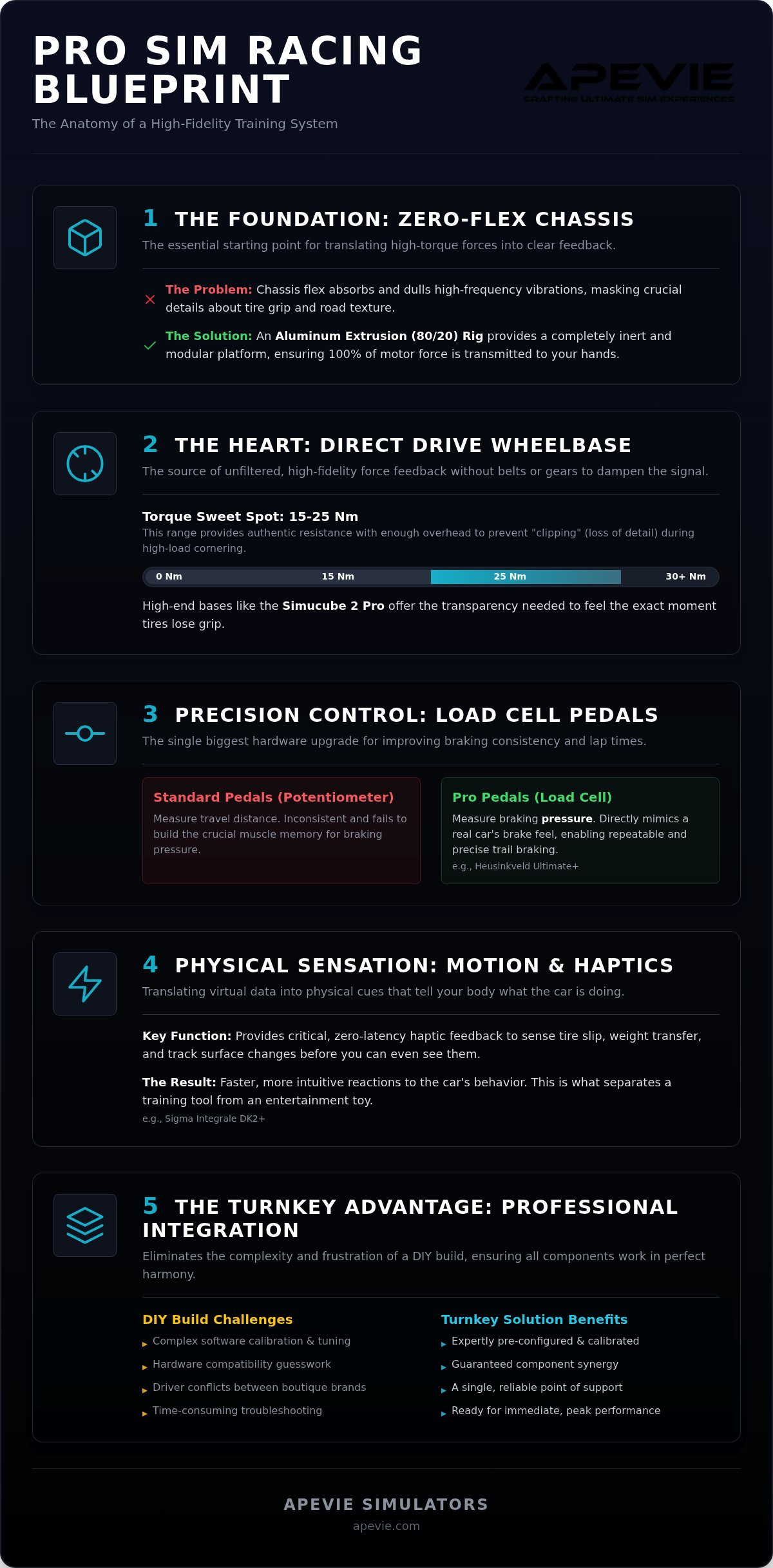
- Understand why a zero-flex aluminum extrusion chassis is the essential foundation for high-torque systems to prevent force feedback loss.
- Identify the 15Nm to 25Nm torque sweet spot for professional racing simulators to ensure you're getting authentic steering resistance without clipping.
- Learn why investing in load cell pedals, such as the Heusinkveld Ultimate+, will improve your trail braking consistency more than any other hardware upgrade.
- Discover how motion systems like the Sigma Integrale DK2+ provide the critical haptic feedback needed to sense tire slip and track limits.
- See how professional turnkey integration eliminates the complex software calibration issues often found when mixing boutique hardware brands.
Defining the Professional Racing Simulator Landscape
Professional racing simulators have moved far beyond the realm of consumer electronics. While arcade setups focus on accessibility and visual spectacle, elite systems prioritize the raw data transfer between the car's physics engine and your sensory receptors. This gap is most evident in the shift to Direct Drive technology. In a professional rig, the steering wheel is mounted directly to the motor's shaft. There are no belts or gears to dampen the signal. This provides a level of transparency that allows you to feel the exact moment the front tires lose grip or the subtle vibrations of a flat-spotted tire. It's the difference between playing a game and operating a vehicle.
Achieving this level of performance requires a PC-only ecosystem. While consoles offer convenience, they lack the bandwidth and driver support for independent high-end peripherals. A professional build often mixes a Simucube 3 wheel base with Heusinkveld Sim Pedals Ultimate+ and a Gomez Sim Industries wheel. Only a PC can handle these distinct USB inputs while maintaining the high refresh rates necessary for zero-latency feedback. At Apevie Simulators, we curate these components into turnkey systems. We ensure every piece of hardware communicates perfectly, removing the calibration headaches common in DIY builds.
The Core Elements of a Pro-Grade Build
A professional simulator isn't a single product but an ecosystem of high-fidelity components. Each part must be chosen for its ability to provide clear, actionable data to the driver.
- Direct Drive Wheel Bases: Units like the Simucube 2 Pro or the flagship Simucube 3 provide unfiltered road texture. They offer high torque overhead to prevent signal clipping during heavy cornering.
- Precision Pedals: Load cell or hydraulic systems, such as the Heusinkveld Sim Pedals Sprint, measure pressure rather than distance. This mimics a real racing brake's feel, allowing for consistent muscle memory.
- Visual Clarity: High-refresh-rate triple monitor setups or premium VR headsets are essential. They reduce input lag and ensure your visual cues match the physical feedback from the wheel.
Why Fidelity Trumps Immersion
In the world of professional simulation, fidelity is the priority. Immersion makes you feel like you're in a car, but fidelity ensures the information you receive is accurate. Fidelity is the purity of the signal from the software to your hands and feet. Professional drivers use these tools for track acclimatization because the physics are repeatable and precise. They aren't just playing; they're learning braking markers and weight transfer. Systems like the Sigma Integrale DK2+ Motion System add a layer of haptic feedback that tells your body what the chassis is doing before your eyes see it. This zero-latency communication separates a training tool from a toy.
The Foundation: High-Performance Chassis and Motion Systems
The performance of elite racing simulators is often limited by the structural integrity of the frame supporting them. When you operate a direct drive wheel base at high torque, any movement in the chassis acts as a filter, absorbing the high-frequency vibrations that represent tire grip and road texture. This phenomenon, known as chassis flex, doesn't just dull the experience; it actively degrades your ability to react to the car's physics. If your pedal tray flexes even a few millimeters under the heavy pressure required by a load cell brake, your brain cannot build the consistent muscle memory needed for perfect trail braking. A professional build requires a foundation that remains completely inert under extreme loads.
Choosing the Right Rig for Direct Drive
For enthusiasts using mid-range equipment, the Fanatec GT Cockpit offers a balanced entry into dedicated seating. However, as you move toward wheel bases capable of 25Nm or more, a custom Aluminum Extrusion Sim Rig becomes a necessity. These rigs use T-slot aluminum profiles, often referred to as 80/20, which provide a modular and incredibly rigid platform. Unlike pre-welded tubes, aluminum extrusion allows you to adjust every angle to your specific body geometry while providing a rock-solid mounting point for high-torque motors. This rigidity ensures that 100% of the motor's energy is transferred to your hands rather than being lost in the frame. You can explore the nuances of these structural choices in The Ultimate Sim Rig Guide.
Motion and Haptics: Sigma Integrale vs. Traditional Systems
True professional motion simulation has evolved beyond simple seat movers that tilt during cornering. Modern systems like the Sigma Integrale DK2+ Motion System are designed to replicate the car's actual telemetry through pitch, roll, and heave. The DK2+ uses high-speed, low-latency actuators that provide a sophisticated haptic layer. This allows you to feel the weight transfer of the car and the subtle "scrub" of the front tires during understeer. While traditional vibration-based transducers add immersion, a full-motion system provides the physical data cues that professional drivers use to find the limit of a circuit. This level of fidelity is what transforms a setup from a game into a legitimate training tool. For a detailed breakdown of these technologies, refer to The Professional Guide to Haptic Systems.
Apevie Simulators specializes in the complex engineering required to marry these high-torque components with the right motion hardware. If you are ready to eliminate the guesswork and technical hurdles of a DIY build, our team can design a custom high-performance racing simulator that delivers uncompromising stability and professional-grade feedback.
Direct Drive Systems and Elite Steering Wheels
Selecting the motor that drives your steering is the most critical decision for the tactile response of racing simulators. While belt-driven systems once dominated the market, they are now considered obsolete for professional training. The internal friction of a belt or gear system creates a "mask" between the software and your hands; this introduces latency and muffles the fine-grained textures of the road. Direct Drive (DD) technology eliminates these barriers by mounting the steering wheel directly to the motor shaft. This allows for a level of transparency where you can feel the exact moment of tire graining or the subtle weight shift of the car's aero platform. Torque matters. Without sufficient overhead, your motor will clip, losing the data you need to stay on the limit.
Wheel Base Performance Comparison
Simucube remains the industry benchmark for high-fidelity motors. At Apevie, we focus on Simucube hardware because of their uncompromising approach to signal purity. As an authorized dealer, we've seen how the evolution from the Simucube 2 series to the 2026 Simucube 3 flagship has redefined what drivers expect from high-bandwidth signal processing. While the Simucube 2 Pro (25Nm) is still a powerhouse, the newer architecture in the Simucube 3 provides a faster connection to the physics engine. This means the motor can react to smaller, faster changes in the simulation data. For most professional builds, 15Nm to 25Nm is the ideal torque sweet spot. It provides enough headroom to prevent "clipping," which occurs when the motor's force is maxed out and cannot convey additional detail during high-load cornering. Having that extra headroom ensures that the heavy steering of a GT3 car at 150 mph doesn't drown out the feeling of a curb strike.
Elite Steering Wheels: GSI and Cube Controls
Once you have a world-class motor, you need a wheel that can translate that torque without flexing. Gomez Sim Industries (GSI) has set a high bar with the Formula Pro Elite. It's constructed from 5mm carbon fiber and features an integrated telemetry display that mirrors the dash of a real-world formula car. If you prefer a more ergonomic, lightweight approach, the Cube Controls F-Core offers a professional-grade tactile experience with carbon-reinforced nylon and high-quality shifters. Choosing between a Formula-style and GT-style wheel depends on your primary discipline. Formula wheels are compact for quick inputs in high-downforce cars, while GT wheels offer a larger diameter for cars with more steering travel. For a deeper look at specific models, check out our guide on The Best F1 Steering Wheels for Professional Sim Racing. We ensure that every wheel we install is calibrated for the specific torque profile of your wheel base to prevent any loss in fidelity.
Precision Control: Choosing Sim Racing Pedals
If you want to find an extra half-second on your qualifying lap, stop looking at your steering wheel and start looking at your feet. In high-performance racing simulators, the brake pedal is your primary tool for managing weight transfer and hitting your marks. Entry-level hardware often uses potentiometers that measure how far the pedal travels. This is a fundamental flaw because real-world braking is about pressure, not distance. Professional pedal sets use load cell technology to measure the actual force you apply. This allows your brain to develop muscle memory based on pressure, which is significantly more consistent than trying to memorize a physical travel distance under duress.
Heusinkveld: The Professional Standard
Heusinkveld has essentially defined the elite pedal market for the last decade. The Heusinkveld Sim Pedals Sprint are an exceptional choice for home enthusiasts who require a stiff, reliable load cell setup without the complexity of hydraulics. However, for drivers seeking the highest level of fidelity, the Heusinkveld Sim Pedals Ultimate+ are the benchmark. These pedals feature a custom hydraulic damping system on the brake and clutch. This damping replicates the sensation of fluid moving through lines, providing that initial "bite" and a progressive resistance that feels identical to a GT3 or GTE race car. For a full technical breakdown of these systems, see The Ultimate Guide to Sim Racing Pedals.
Structural integrity is just as important as the sensors. If you're applying 100kg of force onto an Ultimate+ brake pedal, any flex in the pedal plate will ruin your precision. This is why we emphasize the zero-flex aluminum extrusion chassis in our builds. When the mounting surface is inert, every ounce of pressure you apply is captured by the sensor and translated into the simulation without loss or delay.
Calibration and Software Integration
The final layer of precision comes from software integration. Using Heusinkveld's SmartControl software, you can map custom output curves to match specific car types. Real race cars rarely have linear brake responses; there's usually a subtle take-up followed by a massive ramp in pressure. By calibrating a non-linear curve, you can prevent accidental lock-ups during trail braking while still having the confidence to stomp the pedal at the end of a long straight. At Apevie, we include professional pedal installation and calibration as part of our turnkey solutions. We set the physical stops and software curves to your exact preference, ensuring your racing simulators feel natural from the first lap.
The Turnkey Advantage: Professional Integration and Installation
The most significant hurdle in acquiring high-performance racing simulators isn't necessarily the cost; it's the technical complexity of the integration. When you source parts from multiple boutique manufacturers, you're essentially acting as a systems engineer. A Gomez Sim Industries wheel, a Simucube 3 base, and a Sigma Integrale motion system all have distinct software requirements. If these drivers don't sync perfectly, you'll experience micro-stuttering or signal loss at the very moment you're hitting an apex. This frustration is why professional drivers and serious enthusiasts increasingly turn to integrated solutions that remove the technical barrier to entry.
The Apevie Build Process
Our approach at Apevie Simulators is designed to bypass the technical headaches of DIY builds through a methodical, three-step process. We focus on creating a harmonious system where every component is optimized for your specific goals.
- Step 1: Consultation: We begin by defining your driver profile. Whether you're training for a specific motorsport season or building a dedicated GT3 rig, we ensure the hardware matches your physical requirements.
- Step 2: Component Curation: We select a balanced list of elite hardware, including Simucube wheel bases, GSI wheels, Heusinkveld pedals, and Sigma Integrale DK2+ motion actuators. We only use components we've verified for software stability.
- Step 3: Assembly and Optimization: Our team handles the professional assembly, including clean cable management and PC optimization. We tune the BIOS and operating system to prioritize simulation data, ensuring zero-latency feedback.
Why Choose a Turnkey Solution?
Choosing a turnkey solution eliminates the risk of hardware incompatibility. DIY builders often struggle with driver conflicts where one peripheral's software interferes with another's force feedback or haptic output. By providing a single point of contact for support and maintenance, we ensure that your training time isn't lost to troubleshooting Windows updates or firmware errors. We handle the complex telemetry routing and calibration as a unified package, so your focus remains entirely on the track. If you're ready to invest in a system that delivers professional-grade fidelity from day one, you can browse our curated collection of professional racing simulators. Our expert consultation ensures your investment translates directly into real-world performance.
Mastering the Track with Elite Simulation
Professional racing simulators in 2026 have evolved into precision instruments that require more than just high-end components; they demand a perfect synergy between structural rigidity and high-fidelity signal processing. We've explored how a zero-flex chassis preserves the nuanced feedback of a Simucube 3 wheel base and why hydraulic pedals like the Heusinkveld Ultimate+ are essential for building consistent muscle memory. These components are most effective when integrated by experts who understand the complex software landscape and telemetry routing required for a seamless experience.
As an authorized Simucube and Heusinkveld partner, Apevie Simulators specializes in bridging the gap between boutique hardware and a turnkey driving environment. Our team acts as Sigma Integrale motion integration specialists, providing expert white-glove installation nationwide to ensure your rig is calibrated for peak performance. You don't have to navigate the technical friction of DIY builds alone. Explore Professional Racing Simulators & Turnkey Builds to see how a curated system can transform your training. The right environment doesn't just simulate the track; it prepares you to dominate it.
Frequently Asked Questions
What is the difference between a gaming simulator and a professional racing simulator?
Professional racing simulators prioritize physical fidelity over visual entertainment. While gaming setups use belt-driven wheels and basic pedals, pro systems utilize direct drive motors and load cell or hydraulic pedals to replicate real-world forces. These systems require a dedicated PC ecosystem to handle the high-bandwidth data required for zero-latency feedback. This ensures that every vibration and weight shift is an accurate representation of the car's physics rather than a generic effect.
Do I need a motion system like Sigma Integrale for a realistic experience?
A motion system like the Sigma Integrale DK2+ is essential for drivers who need to feel the car's aero platform and tire slip. Traditional vibration transducers only provide surface-level immersion; however, the DK2+ replicates pitch, roll, and heave with extreme precision. This haptic data allows you to sense when the rear tires lose traction before your eyes see it on the screen. It's a critical tool for building real-world muscle memory and finding the limit.
Why is Simucube considered the gold standard for direct drive wheel bases?
Simucube is the industry benchmark because of its uncompromising signal purity and fast processing speeds. Their direct drive wheel bases, like the Simucube 3, eliminate the masking effect found in lesser motors. This provides an unfiltered connection to the simulation's physics engine. With torque ratings reaching 25Nm and beyond, these motors offer the overhead necessary to prevent signal clipping, ensuring that subtle road textures aren't lost during high-load cornering maneuvers.
Can I use high-end sim racing pedals like Heusinkveld on a console?
You cannot use high-end hardware like Heusinkveld Sim Pedals on a gaming console. These professional components are designed exclusively for the PC ecosystem, where they interface via dedicated USB controllers and specialized calibration software. Consoles lack the driver support and processing bandwidth required to handle boutique sim racing gear. Apevie Simulators focuses strictly on PC-based hardware to ensure every component delivers the maximum possible fidelity without the limitations of consumer consoles.
What are the benefits of a turnkey simulator build versus building it myself?
A turnkey racing simulator package eliminates the technical friction and software calibration headaches inherent in DIY builds. Mixing boutique brands often leads to driver conflicts and performance-sapping micro-stutters. By choosing a professional build, you receive a pre-configured system where the Simucube motor, Heusinkveld pedals, and Sigma Integrale motion work in perfect harmony. This saves dozens of hours in setup time and provides a single, reliable point of contact for ongoing support and maintenance.
Is a triple monitor setup better than VR for professional sim racing?
Triple monitor setups are the standard for professional endurance racers because they offer a wide field of view without the physical fatigue or heat of a VR headset. High-refresh-rate 1440p or 4K screens provide consistent spatial awareness of competitors. VR offers unmatched depth perception and a 1:1 scale of the cockpit, which is excellent for short sprints. However, for long-term consistency and reduced input lag, most pros still prefer the stability of a triple-screen configuration.
How much space is required for a full-motion racing simulator rig?
A full-motion racing simulators rig typically requires a footprint of approximately 6 feet in length and 4 feet in width. You must also account for a clearance zone around the actuators to allow for the pitch and roll movements of the Sigma Integrale system. If you're using a triple monitor setup, the total width can expand to 8 feet. It's best to dedicate a permanent space with a level floor to ensure the aluminum chassis remains perfectly stable.
Does Apevie offer support and maintenance for their turnkey simulator packages?
Apevie Simulators provides comprehensive support and maintenance for every turnkey package we install. Our white-glove simulator installation service includes nationwide delivery, physical assembly, and full software optimization. We don't just drop off boxes; we calibrate the entire system to your specific driving style. This commitment ensures your rig stays updated with the latest firmware and remains a reliable training tool throughout its lifecycle, backed by our expert consultation team.