
The 2026 Apevie Buyer’s Guide: Professional Sim Racing Hardware Explained
Why are you still fighting your equipment instead of the track? It's a common frustration to spend thousands on a setup only to realize your wheel base clips during heavy cornering or your brake pedal feels like a mushy sponge. You aren't alone in feeling overwhelmed by the technical requirements of motion systems and high-torque bases. At Apevie, we understand that the leap from consumer-grade gear to professional simulation is about more than just numbers; it's about the fidelity of the feedback.
This 2026 guide provides an expert breakdown of the elite hardware required for a truly professional rig. We'll show you how to choose between Simucube 3 wheel bases, Heusinkveld load cell pedals, and Sigma Integrale motion systems to ensure your custom build delivers maximum realism. You'll gain a clear understanding of why these brands are industry standards and how to select components that support professional-level muscle memory. We'll explore everything from the 35 Nm peak torque of the Simucube 3 Ultimate to the nuances of hydraulic braking, giving you the confidence to invest in a turnkey system that performs like a real GT or Formula car.
Key Takeaways
- Distinguish professional simulation from arcade gaming by focusing on PC-only hardware that provides high-fidelity, physics-based feedback.
- Understand the technical advantages of the Simucube 3 series and why high-torque direct drive bases are essential for zero-latency steering response.
- Identify why Heusinkveld load cell pedals are the most critical hardware upgrade for developing the muscle memory needed for consistent braking.
- Learn how Sigma Integrale haptic systems communicate real-time tire slip and road textures using pure telemetry rather than artificial effects.
- Discover the benefits of an apevie turnkey build, which eliminates technical setup confusion through professional assembly and white-glove installation.
The Apevie Philosophy: Professional Simulation vs. Arcade Gaming
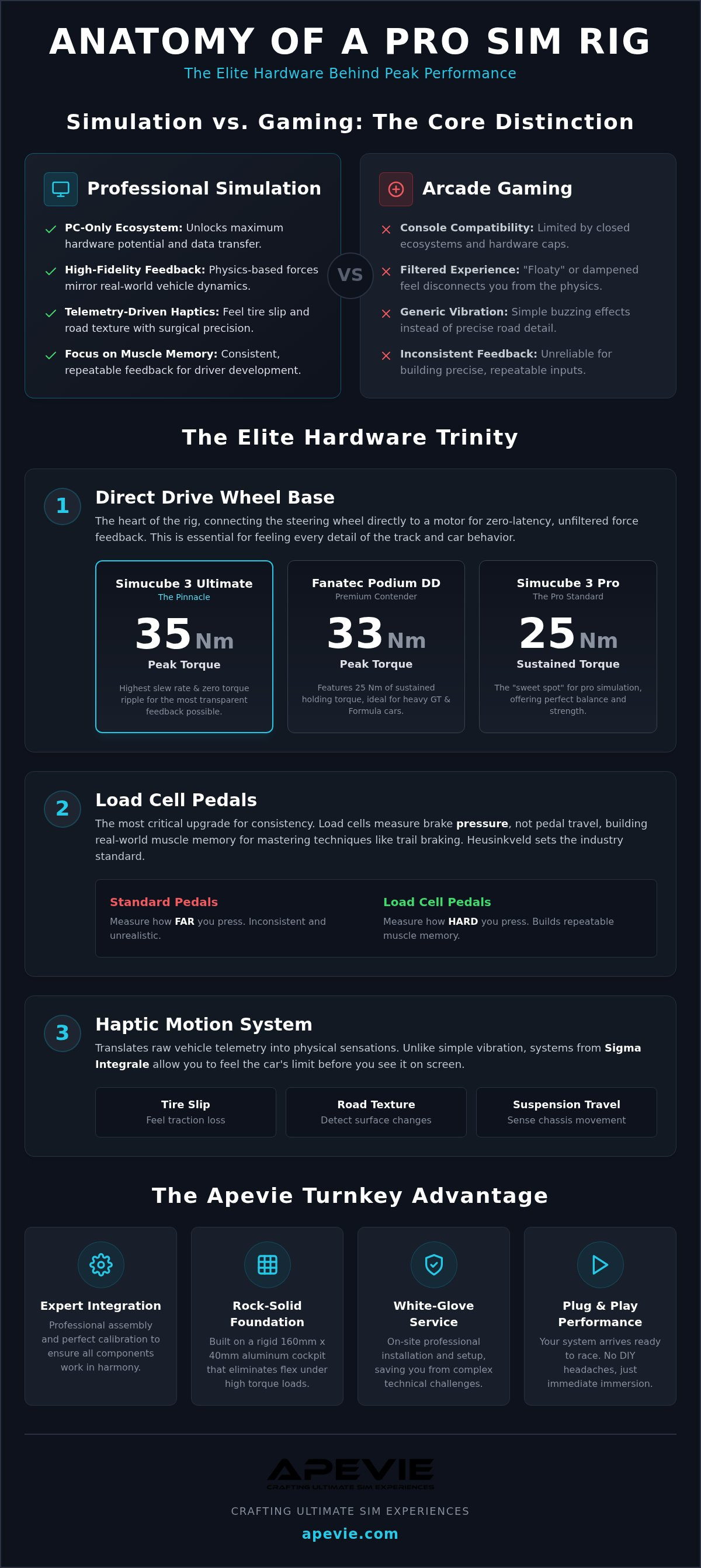
Professional sim racing is often mistaken for a high-end hobby, but for those aiming for real-world performance, it's a motorsport investment. The apevie philosophy centers on the belief that a simulator should be a transparent window into vehicle physics, not a filtered gaming experience. This distinction starts with hardware that eliminates the "floaty" feel of entry-level setups. We exclusively curate elite brands like Simucube, Heusinkveld, and Sigma Integrale because they provide the raw fidelity required for genuine driver development. When your goal is to shave tenths of a second off a lap time, you don't need a toy; you need a tool that mimics the exact steering torque and brake pressure of a GT3 or Formula car.
The PC-Only Advantage
The first step in achieving professional standards is moving away from consoles. While modern consoles are powerful, their compatibility requirements often limit the technical overhead of direct drive systems. A PC-based ecosystem allows for the uncompressed data transfer needed for 2026's high-performance hardware. For instance, leveraging Simucube True Drive software requires a direct connection that console firmware simply can't match. Professional rigs rely on RTX 50-series GPUs and high-refresh-rate monitors to maintain the low latency that keeps your eyes and hands in sync. To truly understand what sim racing is at the elite level, you must prioritize the raw data processing that only a dedicated PC build provides.
Why Hardware Consistency Matters
Muscle memory is built on consistency. If your brake pedal feels different every time you hit the threshold, you'll never master trail braking. This is why we focus on load cell and hydraulic systems from Heusinkveld. Unlike "vibration" effects found in cheap gear, which use simple offset motors to create a generic buzz, professional haptic systems use pure telemetry. Sigma Integrale motion systems communicate tire slip, road texture, and suspension travel with surgical precision. This feedback allows you to feel the car's limit before you see it on screen. Our white-glove service ensures these complex components are perfectly calibrated and integrated into a 160mm x 40mm aluminum cockpit, saving you the headaches of a DIY build that might flex or fail under the high torque of a 35 Nm wheel base.
Choosing Your Direct Drive Core: Simucube and Fanatec
The heart of any apevie custom rig is the direct drive motor. Unlike entry-level bases that use belts or gears, direct drive connects the steering wheel directly to the motor shaft. This eliminates friction and mechanical lag, providing the zero-latency feedback required for professional driver training. In 2026, direct drive is the industry standard for torque accuracy, allowing you to feel every ripple in the asphalt without the dampening effects of a traditional transmission. It's the only way to ensure the physics of the simulation are translated perfectly to your hands.
Choosing the right torque level is a balance of physics and physiology. While the enthusiast market is crowded with 15-25 Nm bases, professional GT3 and Formula simulation often finds its "sweet spot" at 25 Nm of sustained torque. This allows the motor to communicate heavy aerodynamic loads without clipping, which occurs when the software demands more force than the hardware can provide. If your base clips, you lose the subtle cues needed to catch a slide at the limit. For those seeking the flagship experience, the 2026 Fanatec Podium DD offers a holding torque of 25 Nm and a temporary peak of 33 Nm, positioning it as a powerful contender in the premium segment.
Simucube 3 Pro vs. Ultimate
The Simucube 3 series represents the pinnacle of Finnish engineering. The Simucube 3 Ultimate, released in June 2026, features a peak torque of 35 Nm. This headroom isn't just about raw power; it's about slew rate and torque ripple. A higher slew rate means the motor reacts faster to changes in the physics engine, providing sharper feedback. Torque ripple refers to small fluctuations in the motor's output; the Simucube 3 Ultimate virtually eliminates these, resulting in a smooth, organic feel. This model is designed for professional drivers who require the most transparent link possible between the car and the cockpit. For most racers, the Simucube 3 Pro offers a perfect balance of speed and strength without the extreme overhead of the Ultimate.
Elite Steering Wheels: GSI and Cube Controls
A high-performance wheel base requires a steering wheel that can handle the stress of high-torque maneuvers. The Gomez Sim Industries (GSI) Formula Pro Elite is a favorite for apevie builds due to its industrial-grade construction and integrated high-resolution screens. It feels like a piece of motorsport hardware because it's built with the same tolerances. If you prefer a more minimalist, ergonomic approach, the Cube Controls F-Core offers professional features with a lighter footprint. It's vital to ensure your wheel choice matches your base's mounting system, such as the Simucube Link wireless system, which eliminates physical USB cables for a cleaner setup. You can view our selection of professional steering wheels to see how these components integrate into a turnkey build.
Precision at the Pedals: Heusinkveld and Load Cell Technology
If the wheel base is the heart of your simulator, the pedals are the brain. Most drivers focus on steering torque, but consistency in braking is where the real lap time is found. At apevie, we prioritize load cell technology because it shifts the focus from how far you move your foot to how much pressure you apply. This mimics the physics of a real-world braking system, where muscle memory relies on pressure rather than travel distance. For professional driver training, this transition is non-negotiable. Potentiometers found in entry-level gear simply can't replicate the nuance of trail braking at the limit.
The science of a load cell sensor is straightforward but transformative. It measures the force of your leg, allowing you to develop a "feel" for the threshold of tire lock-up. When you're diving into a heavy braking zone, your brain remembers the tension in your calf muscle much better than the physical position of your foot. This reliability is why professional-grade pedals are the single most impactful upgrade you can make to your consistency on track.
Sprint vs. Ultimate+: Which Should You Buy?
Choosing between Heusinkveld models depends on your training goals and physical preference. The Heusinkveld Sim Pedals Sprint is the definitive benchmark for high-end home simulators. It utilizes a 120kg load cell that provides up to 65kg of actual force at the pedal face. It's more than enough for most GT racers. For those seeking the absolute limit of realism, the Heusinkveld Sim Pedals Ultimate+ utilizes a hydraulic damping system and a 200kg load cell, allowing for up to 140kg of braking force. This hydraulic element is crucial because it mimics the resistance of fluid being compressed, offering a smoother, more organic modulation. You can learn more about these differences in our Ultimate Guide to Sim Racing Pedals.
Mounting and Calibration
A common mistake is pairing these pedals with a standard desk setup or a lightweight frame. Applying 100kg of force will immediately flex a non-rigid chassis, resulting in lost signal and inconsistent braking. This is why apevie builds utilize 160mm x 40mm high-end aluminum cockpits that remain completely stationary under load. Once mounted, the Heusinkveld SmartControl software allows you to fine-tune your output curves. You can set a soft curve for road cars or a linear, heavy response for formula cars. Without a solid foundation, even the best pedals lose their precision, as the energy intended for the sensor is wasted on bending the metal of the rig.
The Haptic Revolution: Sigma Integrale Motion Systems
The final layer of a professional simulator isn't about what you see or hear; it's about what you feel through the chassis. While direct drive bases and load cell pedals provide the primary inputs, haptic systems like those from Sigma Integrale translate secondary physics into physical sensations. This "seat of the pants" feel allows a driver to sense the rear tires stepping out or the subtle vibrations of a flat-spotted tire. At apevie, we integrate these systems to move beyond simple motion and into high-fidelity haptic feedback. By feeling the car's limit through your body, you can react to oversteer milliseconds before your eyes even register the movement on screen.
Sigma Integrale DK2 vs. DK2+
Sigma Integrale has redefined the market by focusing on motion integrity. Their systems derive feedback directly from in-game physics telemetry rather than using artificial effects. The Sigma Integrale DK2 is a 2-actuator system that serves as a professional entry point, primarily focusing on the rear of the rig to communicate traction loss. If you require a full simulation of pitch, roll, and heave, the DK2+ expands the setup to 4 actuators. In June 2026, Sigma Integrale transitioned to using US-made motors for these systems, ensuring lower latency and higher reliability. These actuators are significantly faster than traditional "moving chair" platforms because they move the entire 160mm x 40mm aluminum cockpit. This preserves the geometric relationship between your seat, wheel, and pedals, which is vital for maintaining consistent inputs. You can explore the technical nuances in this Professional Guide to Haptic Systems.
Visual Immersion: Triple 32" vs. Ultrawide
Feedback is only as good as the context provided by your eyes. For the most accurate spatial awareness, a Triple 32" monitor setup remains the gold standard. This configuration allows for a full 180-degree field of view. It's essential for looking into the apex of tight hairpins or managing wheel-to-wheel racing. However, many apevie clients prefer the simplicity of an Ultrawide Curved monitor setup. These displays eliminate the bezels and simplify the hardware requirements while still providing a massive horizontal canvas. By 2026, VR headsets have also become a viable alternative for those who prioritize depth perception over physical screen space, though they require significant PC overhead to maintain the high refresh rates needed to avoid motion sickness. If you're ready to add "seat of the pants" feel to your setup, explore our Sigma Integrale motion packages.
The Apevie Turnkey Advantage: Plug-and-Play Excellence
Choosing elite components is only half the battle. The real challenge lies in the integration of high-torque motors, hydraulic pedals, and multi-actuator motion systems into a single, cohesive unit. This is where the apevie turnkey philosophy provides its greatest value. Instead of wrestling with driver conflicts or complex cable management, you receive a system that's track-ready from the moment it's powered on. Our RTR V2 chassis is built from 160mm x 40mm aluminum extrusion, providing a zero-flex foundation that's effectively future-proof. It's the last chassis you'll ever need to buy because its modular nature allows for infinite adjustments as your hardware and racing discipline evolve.
Inside the Apevie RTR V2 Package
The RTR V2 isn't just a frame; it's a curated ecosystem where every part is chosen for synergy. We integrate the latest RTX 50-series PCs directly into the chassis using a dedicated PC tray, which protects your sensitive hardware from the high-frequency vibrations of the Sigma Integrale motion system. Every build features an X1 Carbon Fiber Seat, designed to provide the lateral support needed for high-G cornering without the bulk of traditional fiberglass seats. We also include mini-keyboard mounts and optimized cable routing as standard. This attention to detail ensures your cockpit remains clean and professional, allowing you to focus entirely on your telemetry rather than a messy workspace.
Final Steps: Consultation and Installation
Our white-glove service is designed for those who value their time as much as their lap times. Once you've selected your hardware, our team handles the professional assembly and software optimization. This process includes calibrating your Simucube 3 base and Heusinkveld pedals to work in perfect harmony with your chosen simulation software. For customers across the US, our national installation service means we don't just ship boxes. We deliver a fully functional racing environment to your home or office. You'll receive a complete walk-through of the system's operation, ensuring you're comfortable with everything from the motion software to the steering wheel's screen integration before we leave. If you're ready to bypass the technical hurdles of a DIY build, you can Browse the Apevie Collection and Start Your Build today.
Master the Track with Professional Precision
Building a professional simulator is an investment in your growth as a driver. As we've explored, the transition from casual gaming to high-level simulation requires hardware that prioritizes raw physics over artificial filtered effects. By choosing Simucube 3 direct drive bases and Heusinkveld load cell pedals, you ensure that every steering input and braking maneuver is translated with surgical accuracy. However, even the most elite components require a stable foundation and expert calibration to reach their full potential. Without a zero-flex chassis and proper software integration, you're leaving performance on the table.
Apevie provides more than just high-end parts; we deliver a complete, engineered solution. As an authorized Simucube and Heusinkveld dealer, we specialize in custom turnkey packages featuring high-performance RTX 50-series PCs and 160mm x 40mm aluminum cockpits. Our white-glove national installation service removes the technical complexity of assembly and software optimization, allowing you to focus on your telemetry rather than troubleshooting. It's time to stop fighting your equipment and start mastering the apex.
Explore Professional Racing Gear at Apevie Simulator and begin your journey toward professional-grade performance today.
Frequently Asked Questions
What is the difference between a direct drive wheel and a standard racing wheel?
A direct drive wheel base connects the steering wheel directly to the motor shaft, whereas standard wheels rely on belts or gears to transmit force. This direct connection eliminates mechanical lag and internal friction, providing a more transparent link to the vehicle physics. It allows for higher torque levels and finer feedback details. In 2026, this technology is the industry standard for those seeking zero-latency response and professional-grade fidelity.
Do I need a special PC to run a motion simulator like the Sigma Integrale DK2?
Running a motion system like the Sigma Integrale DK2 requires a high-performance PC capable of processing real-time telemetry data with minimal latency. We recommend systems equipped with RTX 50-series GPUs to ensure frame rates stay high enough to match the physical movements of the actuators. A powerful processor is also vital for handling complex physics engines and motion software simultaneously so the haptic feedback remains perfectly synchronized.
Are Heusinkveld pedals compatible with Fanatec wheel bases?
Heusinkveld pedals are fully compatible with Fanatec wheel bases when used on a PC. Since apevie focuses exclusively on professional PC-based hardware, these components connect as separate USB devices. You don't need to plug the pedals into the wheel base itself. This modular approach allows you to mix and match the best hardware from different manufacturers while managing each device through its own dedicated calibration software.
Why should I choose an aluminum profile rig over a pre-fabricated tube frame?
Aluminum profile rigs, specifically 160mm x 40mm extrusions, offer superior rigidity and modularity compared to tube frames. High-torque direct drive bases and heavy load cell pedals can cause thinner tube frames to flex, which degrades the accuracy of your feedback. An aluminum rig is completely adjustable, allowing you to fine-tune the position of every component. It also serves as a future-proof foundation for adding new accessories or motion actuators.
Does Apevie offer national installation for turnkey sim racing packages?
Yes, apevie provides white-glove national installation for all turnkey racing simulator packages across the United States. Our professional team handles the entire process, from assembly and cable management to software optimization and calibration. We ensure your system is track-ready before we leave your home or office. This service is designed to eliminate technical hurdles, giving you a plug-and-play experience that meets professional motorsport standards from day one.
Can I use a professional sim rig for both racing and flight simulation?
Professional rigs are highly versatile and can be configured for both racing and flight simulation. The modular nature of aluminum extrusion allows you to mount flight sticks, throttles, and rudder pedals alongside your racing gear. We offer specific turnkey flight simulator packages that utilize the same high-fidelity motion systems and rigid foundations as our racing setups. This dual-purpose capability makes a high-end simulator a comprehensive training tool for multiple simulation disciplines.
What is the benefit of a load cell brake pedal for consistent lap times?
A load cell brake pedal measures the pressure you apply rather than the distance the pedal travels. This is critical for consistency because human muscle memory is far more accurate at repeating pressure levels than physical positions. It allows you to master trail braking and threshold braking with much higher precision. By mimicking the feel of a real hydraulic braking system, a load cell helps you hit your marks lap after lap.
How much space do I need for a triple monitor sim racing setup?
A triple monitor setup typically requires a footprint of approximately five to six feet in width, depending on the size and angle of the side displays. You should also plan for about four to five feet of depth to accommodate the cockpit and the monitor stand. While this configuration takes up more space than an ultrawide monitor, it provides a much wider field of view, which is essential for managing wheel-to-wheel racing scenarios.