
Fanatec Steering Wheel Hub Guide for Direct Drive
Why would a driver invest in a 25 Nm Podium DD base only to stifle its precision with a wheel that flexes under pressure? Choosing the right fanatec steering wheel is often a balancing act between aesthetic appeal and mechanical necessity. You've likely felt that nagging uncertainty about whether a CSL rim can truly handle the raw output of a high-torque motor or if you're losing vital road texture to unnecessary mass. It's frustrating when the sheer number of modular options turns a simple upgrade into a complex engineering puzzle, especially with the industry shift toward new connection standards.
We understand that achieving tactile clarity requires more than just high torque; it demands a perfect match between your base and your steering hub. This guide will help you master the Fanatec ecosystem so you can select a setup that translates every bit of force feedback into your fingertips without compromise. We'll examine the structural differences between CSL, ClubSport, and Podium tiers and clarify the mandatory transition to the QR2 standard. You'll learn how to balance wheel weight against your base's torque, from the 5 Nm CSL DD to the massive 25 Nm holding torque of the Podium DD, ensuring a future-proof rig that remains rigid during every high-speed corner.
Key Takeaways
- Navigate the structural differences between CSL, ClubSport, and Podium tiers to find the right balance of high-strength polymers and carbon fiber for your specific torque levels.
- Discover why matching a fanatec steering wheel's weight and diameter to your base is critical for preventing the "masking" of fine road textures and force feedback.
- Understand why the QR2 system has become the mandatory standard for 2026 and how its tapered fitment improves signal data while eliminating mechanical play.
- Identify the optimal rim for your driving style, comparing the rapid inputs of 270mm Formula wheels against the versatile leverage of 300mm GT hubs.
Navigating the Fanatec Hierarchy: CSL, ClubSport, and Podium Explained
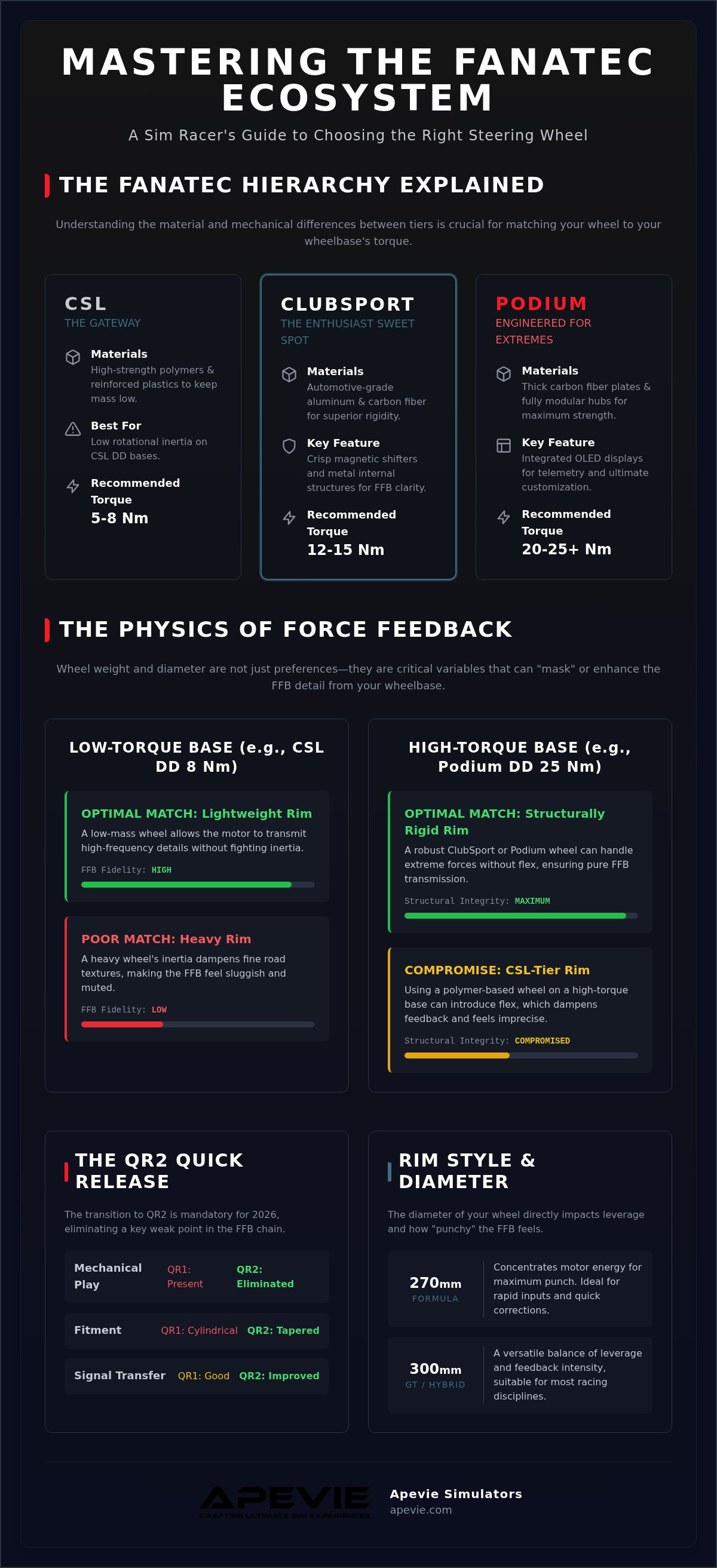
Understanding the hierarchy is the first step in building a cohesive rig. Fanatec's parent company, Endor AG, has structured their ecosystem into three distinct tiers: CSL, ClubSport, and Podium. This isn't just about price points; it's about the mechanical limits of the materials used. Choosing the wrong fanatec steering wheel for a high-torque base can lead to unwanted flex, which dampens the intricate vibrations sent from the motor to your hands.
The CSL Series serves as the gateway. These wheels use high-strength polymers and reinforced plastics to keep weight low. This is ideal for the CSL DD (5 Nm or 8 Nm) because a lighter wheel has less rotational inertia, allowing the motor to react faster to micro-adjustments in the physics engine. However, these materials have limits. Under sustained load, you might feel a slight "give" in the rim that isn't present in the higher tiers.
The ClubSport Series represents the "sweet spot" for most enthusiasts. Here, the construction shifts toward automotive-grade aluminum and carbon fiber. These wheels are designed to handle the 12 Nm to 15 Nm output of the ClubSport DD and DD+ bases without breaking a sweat. Selecting a fanatec steering wheel from this tier provides a premium tactile experience, often featuring Alcantara or genuine leather wraps that match the performance of a professional simulator.
CSL vs ClubSport: When to Make the Jump
The real difference lies under the skin. While CSL wheels often use plastic internal structures, ClubSport models utilize metal skeletons and carbon fiber faceplates. This rigidity is crucial for Force Feedback (FFB) clarity. Another major factor is the shift to magnetic shifters. Standard CSL paddles use a spring-based mechanism that can feel mushy over time. ClubSport shifters use magnets to provide a crisp, "clicky" engagement that ensures you never miss a gear during a tense qualifying lap.
Podium Series: Engineered for Extreme Torque
When you step up to a Podium DD base delivering 25 Nm of holding torque, the structural integrity of your wheel becomes a safety and performance priority. Podium wheels are the heavy hitters. They feature thicker carbon fiber plates and modular hubs that allow for complete customization. These hubs often integrate OLED displays for real-time telemetry, such as tire temperatures or fuel levels. Because the Podium line is modular, you can swap the rim while keeping the high-end button plate and electronics, making it the most versatile choice for long-term rig evolution.
The Physics of Force Feedback: Matching Wheel Weight to Base Torque
The physical interaction between your hands and the motor is governed by leverage and inertia. When you choose a fanatec steering wheel with a large 320mm diameter, you gain mechanical leverage over the motor. This makes the steering feel lighter but can dilute the perceived strength of the force feedback spikes. Conversely, a compact 270mm Formula-style rim concentrates that energy, making even a modest 8 Nm base feel remarkably punchy. This relationship is a cornerstone of research on force feedback in sim racing, which highlights how tactile clarity directly impacts driver performance and reaction times.
Moment of Inertia plays an equally vital role in your setup. Every gram of weight added to the rim increases the energy required to change its rotational direction. On lower-torque bases, a heavy wheel acts as a physical filter, unintentionally smoothing out the high-frequency vibrations that represent road surface changes or tire slip. FFB fidelity is the purity of tactile information transmitted from the motor to the driver, dictated by the inverse relationship between rim mass and structural rigidity.
Optimizing for CSL DD (5Nm - 8Nm)
To extract the most detail from an entry-level direct drive system, weight is your primary enemy. We recommend lightweight rims like the CSL Steering Wheel P1 V2 to maximize detail. Because this fanatec steering wheel is engineered with low-mass materials, the motor doesn't have to fight the wheel's own inertia before it can communicate with your hands. Using an oversized, heavy GT wheel on a 5 Nm base often results in a "sluggish" sensation, where the motor feels like it's struggling to keep up with rapid direction changes. If you're building a professional foundation, you can learn more about balancing these components in our guide at ProSimu.
Harnessing the ClubSport DD+ and Podium DD2 (15Nm - 25Nm)
High-torque bases demand a different strategy. When your motor is capable of 25 Nm holding torque, a lightweight plastic wheel becomes a liability. These professional-grade bases produce violent torque spikes that can cause lesser wheels to creak or flex, losing energy in the structure rather than delivering it to you. Metal hubs and carbon fiber faceplates are necessary to maintain a rigid connection during high-G cornering. If you experience oscillations, you can use Fanatec's software to add "Natural Friction" to tune out the inertia of a heavier rim. For those seeking a perfectly calibrated, high-performance setup, our team at Apevie Simulators provides expert consultation to ensure your wheel choice perfectly complements your motor's output.
Choosing Your Driving Style: Formula vs GT vs Rally Hubs
Your driving discipline dictates the physical architecture of your rim. A fanatec steering wheel designed for Formula racing, typically 270mm to 280mm in diameter, allows for the rapid, minute corrections required in high-downforce environments. In contrast, GT3 and GT4 cars often utilize a 300mm standard, which provides a more stable platform for endurance racing. Ergonomics are paramount here; button placement and rotary encoders must be within thumb-reach to ensure you don't lose focus during a long stint. While competitors often suggest Formula wheels are only for F1 titles, they're actually excellent for high-downforce GT3 cars in simulators like ACC where precision is king.
The Formula V3 and GT3 Comparison
The ClubSport Formula V3 remains a benchmark for those pursuing high-level competition. Its 5mm thick carbon fiber faceplate ensures zero flex, while the integrated dual-clutch paddles are essential for perfect standing starts. If you're looking for the absolute peak of open-wheel hardware, check out our guide on The Best F1 Steering Wheels for Professional Sim Racing in 2026. Comparing this to the CSL Steering Wheel GT3 reveals the trade-offs in materials. The GT3 wheel uses molded plastics and a larger diameter that suits the heavier steering feel of a GT car but lacks the surgical precision of the V3's carbon build. The tactile difference is immediate; the Formula V3 feels like a piece of motorsport equipment, while the GT3 prioritizes comfort and accessibility.
Specialized Rims: Rally Sweden and Vision GT
For rally and drifting, the design philosophy shifts toward the round profile. The CSL Elite Steering Wheel WRC is a prime example, featuring a 300mm round rim that allows the wheel to slide through your hands during a Scandinavian flick. While D-shape or yoke designs look modern, they're objectively inferior in rally where you frequently cross your arms or let the wheel spin. Structural integrity during these violent maneuvers is key. The connection between the hub and the rim must be robust, often mirroring the durability found in the SFI 42.1 quick release standard used in real-world racing. The CSL Elite Porsche Vision GT offers a unique middle ground, using a design language that balances futuristic aesthetics with functional ergonomics for multi-class drivers who switch between prototypes and GT cars. Choosing a specialized fanatec steering wheel ensures that your physical inputs match the intended physics of the vehicle, reducing the mental load of fighting a mismatched rim.
The 2026 Quick Release Standard: QR1 vs QR2 Transition
The sim racing landscape in 2026 has fully embraced the QR2 standard as the baseline for performance. If you're still running the older QR1 system on your fanatec steering wheel, you've likely noticed the "clunking" or subtle rattle that can occur under heavy torque loads. The QR2 isn't just a minor tweak; it's a fundamental mechanical overhaul. By moving away from the ball-bearing design to a tapered, wedge-shaped fitment, Fanatec has eliminated the mechanical play that often required a locking screw on older setups. This zero-play connection ensures that the high-frequency vibrations from your direct drive motor reach your hands without being dampened by loose tolerances or shifting parts.
Is the QR2 Pro Worth the Premium?
The hierarchy of the new standard includes three distinct versions tailored to different performance needs. The QR2 Lite uses high-strength polymers and is perfectly adequate for 5 Nm or 8 Nm bases. However, the standard aluminum QR2 is the workhorse of the lineup. It's CNC-machined to tight tolerances, providing the rigidity needed for consistent 15 Nm holding torque. The QR2 Pro takes this further with a gold-anodized finish and a design that meets FIA-certification standards for real-world motorsport. While the standard aluminum version is sufficient for most, the Pro version is built for those using the 25 Nm Podium DD who want the absolute peak of structural integrity. It eliminates the risk of creaking during violent weight transfers, which was a common pain point for professional simulator users in previous years.
Backward Compatibility and Conversion Kits
Upgrading your existing fanatec steering wheel collection to the 2026 standard is a straightforward process. Most rims released in the last few years feature a removable wheel-side shaft held in place by six bolts. Replacing this with a QR2 wheel-side adapter takes less than five minutes. It's important to identify which older CSL wheels are compatible with the QR2 Lite, as some entry-level rims have integrated shafts that cannot be swapped. For those who find the Fanatec ecosystem too restrictive and want to explore ultra-high-end bespoke hubs, we recommend looking at the offerings from Precision Sim Engineering.
If you're overwhelmed by the technical requirements of converting multiple wheels, our team at Apevie Simulators can handle the entire hardware transition for you. We provide white-glove installation services that ensure your base and wheel-side connectors are perfectly calibrated for zero-play performance.
Standout Fanatec Steering Wheels for Your 2026 Simulator Build
Selecting a fanatec steering wheel is the final, tactile touch in a high-performance simulator build. In 2026, the market has settled on a few clear winners that balance structural integrity with specialized ergonomics. For those focused on F1 or high-downforce GT3 racing, the ClubSport Formula V3 remains the industry benchmark. Its 5mm carbon fiber faceplate and magnetic shifters provide the rigidity needed to communicate every ounce of holding torque from a 15 Nm or 25 Nm base. Conversely, the CSL Elite Steering Wheel WRC serves the gravel and dirt specialists, offering a lightweight, round profile that's essential for rapid, hand-over-hand maneuvers in rally stages.
At Apevie Simulators, we curate our hardware selection based on long-term reliability and signal clarity. While the CSL Steering Wheel GT3 is often viewed as an entry-level champion, we frequently recommend it for endurance builds where durability and price-to-performance are the primary drivers. Our custom high-performance racing simulators often feature these components because they integrate seamlessly into a professional PC-based ecosystem. We don't just sell parts; we provide a white-glove installation service that ensures your QR2 connectors are perfectly seated and your firmware is calibrated for zero-play feedback.
The Apevie Selection: Top 3 Picks for 2026
Our technical team has identified three specific configurations that satisfy the demands of professional sim racers. First, the ClubSport Formula V3 is unmatched for open-wheel precision, especially when paired with its dual-clutch paddle system. Second, the CSL Elite WRC provides the best tactile response for rally enthusiasts who need a rim that won't flex during violent weight transfers. Third, for those seeking the ultimate elite setup, we often use Fanatec rims paired with third-party conversion hubs to run on Simucube 3 bases. This modularity allows drivers to keep the ergonomics they love while utilizing the raw power of the industry's most advanced motors. You can find these professional-grade options at ProSimu.
Final Decision Framework: Which Hub Wins?
Before finalizing your rig, use this checklist to ensure your fanatec steering wheel matches your motor's output. A common mistake is pairing a CSL-tier plastic QR with a 25 Nm Podium base; this creates a mechanical bottleneck that ruins FFB fidelity. Consider the following:
- Discipline: Do you need the 270mm precision of a Formula rim or the 300mm+ leverage of a GT wheel?
- Torque Handling: Ensure your wheel uses a metal QR2 if your base exceeds 8 Nm of peak torque.
- Standardization: Confirm all your rims are converted to the 2026 QR2 standard for easy swapping.
Whether you're building your first serious rig or upgrading a professional simulator, choosing the right interface is critical for immersion. Browse the complete Fanatec Steering Wheel collection at Apevie to find the perfect match for your direct drive system.
Mastering Your Interface for the 2026 Season
Achieving the perfect balance in your simulator rig requires a methodical approach to hardware selection. You now understand how the mass of your steering rim directly impacts the fidelity of your force feedback, especially when moving between the CSL and Podium tiers. By adopting the QR2 standard, you've ensured a zero-play connection that translates every nuance of the road surface into your hands without mechanical interference. Whether you're navigating tight rally stages or high-downforce F1 corners, the structural integrity of your hub is the foundation of your performance.
As an Authorized Fanatec Distributor, Apevie Simulators provides the expert technical support and custom turnkey rig integration necessary to build a professional-grade setup. We don't just sell parts; we engineer environments where hardware and software work in perfect harmony. We take the guesswork out of compatibility so you can focus on finding those extra tenths of a second on track. It's time to refine your interface and experience the true potential of your direct drive system.
Shop our curated Fanatec Steering Wheel collection for professional sim racing
Frequently Asked Questions
Are Fanatec steering wheels compatible with Simucube or other direct drive bases?
Fanatec wheels are natively designed for their own ecosystem, but you can use them on Simucube or other bases via third-party conversion kits. These adapters replace the quick release with a standard bolt pattern and use a USB cable or wireless chip to transmit data. At Apevie Simulators, we often perform these conversions for clients who want the specific ergonomics of a Fanatec rim on an elite Simucube 3 base.
What is the difference between the QR1 and QR2 quick release systems?
The primary difference lies in the mechanical fitment and the elimination of play. The older QR1 uses a ball-bearing system that can rattle or clunk under high torque. The QR2 uses a tapered wedge design that provides a zero-play connection, ensuring better signal clarity and structural rigidity. Since 2026, the QR2 has become the mandatory standard for all new Fanatec hardware, offering a more automotive-grade experience for direct drive users.
Do I need a specific steering wheel for Xbox or PlayStation compatibility?
Yes, platform compatibility depends on where the security chip is located. For Xbox, you must use an Xbox-licensed fanatec steering wheel to enable support on any Fanatec base. For PlayStation, the chip is inside the wheel base itself, such as the ClubSport DD+. Once you have a PlayStation-licensed base, almost any rim will work. We always recommend checking the specific licensing of each component before finalizing your PC or console rig.
Can I use a Formula-style wheel for GT3 racing in iRacing?
Absolutely, many professional drivers prefer Formula-style wheels for GT3 racing due to their compact 270mm to 280mm diameter. This smaller size allows for quicker steering inputs and provides a more direct feel of the car's front-end physics. While a round GT wheel offers more leverage, the precision of a Formula rim is often superior for high-downforce cars in titles like iRacing and Assetto Corsa Competizione.
Is the Podium Button Endurance Module compatible with all Fanatec wheels?
No, the Podium Button Endurance Module is not compatible with every rim. It's specifically designed to work with the Podium Hub or the ClubSport Universal Hub V2. It requires a specific six-hole bolt pattern and enough physical clearance to fit within the steering wheel's frame. We typically pair this module with the Porsche 911 GT3 R rim to create a professional-grade endurance setup for our custom high-performance racing simulators.
How does steering wheel weight affect the force feedback detail I feel?
Steering wheel weight creates rotational inertia, which acts as a physical dampener for force feedback. A heavier wheel requires more energy from the motor to change direction, which can mask subtle road textures on lower-torque bases like the CSL DD. For maximum detail, lightweight rims are best for 5 Nm to 8 Nm bases, while heavier, rigid wheels are necessary to handle the violent torque spikes of 25 Nm systems.
What is the best Fanatec wheel for a beginner on a budget in 2026?
The CSL Steering Wheel P1 V2 remains the best entry point for budget-conscious drivers in 2026. It's lightweight, versatile, and now ships with the QR2 Lite standard, making it compatible with the latest direct drive bases. This fanatec steering wheel provides all the essential features needed to start professional-grade simulation without the high cost of carbon fiber or Alcantara materials found in the ClubSport or Podium tiers.
How often should I update the firmware on my Fanatec steering wheel?
You should check for firmware updates whenever you install a new version of the Fanatec Control Panel or if you experience unusual FFB behavior. Regular updates ensure your wheel communicates correctly with the base and can even improve the tactile response of the magnetic shifters. Our white-glove installation service includes a full firmware calibration, ensuring your entire ecosystem is running the most stable and performant software versions available.