Professional Sim Racing Wheels: The 2026 Engineering & Buyer’s Guide
The moment you feel the structural flex in a mass-market plastic rim is the moment you realize you aren't driving a car; you're playing a game. You likely recognize that professional sim racing wheels must function as precision instruments, yet the technical jargon surrounding 70mm bolt patterns and proprietary quick releases often makes the upgrade path feel like a minefield. It's a common frustration to invest in a high-torque base only to worry if a third-party button box will lose connection or if the paddle shifters will feel like mush during a critical 24-hour endurance race.
We believe your equipment should be a final, one-time investment that requires zero future upgrades. This guide breaks down the engineering differences between consumer toys and motorsport-grade hardware, showing you how 5mm carbon fiber faceplates and magnetic hall-effect sensors provide authentic tactile feedback. We will explore the latest 2026 standards for the Direct Drive ecosystem to ensure your next steering solution is perfectly compatible with the professional turnkey builds we provide at Apevie Simulator.
Key Takeaways
- Learn the critical differences between mass-market peripherals and professional sim racing wheels crafted from authentic materials like 5mm carbon fiber and Alcantara.
- Understand how the engineering of magnetic paddle shifters and dual-clutch systems provides the tactile precision required for high-stakes motorsport competition.
- Discover why standardizing on the 70mm bolt pattern is essential for seamless integration and stability when using high-torque Direct Drive bases.
- Identify the ideal wheel geometry for your preferred discipline, from high-leverage Formula rims to ergonomically versatile GT steering solutions.
- Explore how Apevie’s turnkey assembly and professional calibration prevent hardware mismatches, ensuring your high-end ecosystem is race-ready from day one.
Defining Professional Sim Racing Wheels vs. Consumer Peripherals
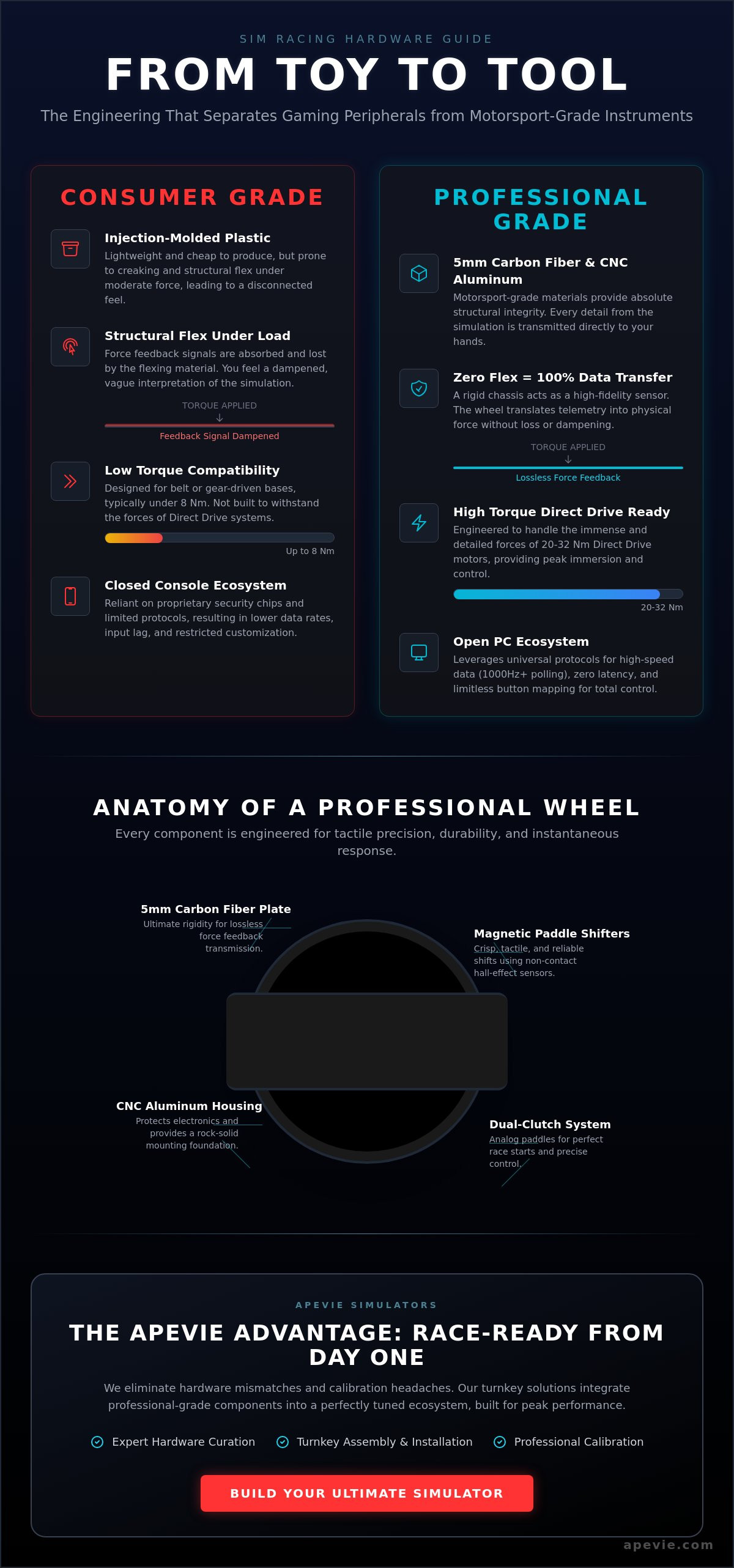
Transitioning from a hobbyist setup to a professional rig requires a fundamental shift in how you perceive your hardware. A consumer-grade sim racing wheel is typically designed for mass-market durability and broad console compatibility, but professional instruments serve as high-fidelity telemetry translators. These devices move away from injection-molded plastics and rubber grips. Instead, they utilize authentic motorsport materials like 5mm forged carbon fiber and hand-stitched Alcantara. This choice of material isn't merely for aesthetics; these components provide the structural integrity required to handle the 20Nm to 32Nm of torque generated by modern direct drive bases without deforming.
Professional sim racing wheels live almost exclusively within the PC ecosystem. This environment allows for high data polling rates, often exceeding 1000Hz, which consoles cannot process through standard controller protocols. When you use hardware from brands like Precision Sim Engineering, you're accessing a level of detail where every curb strike and tire slip is communicated without the "smoothing" filters found in consumer-grade software. The wheel becomes the primary tactile interface, turning digital data into physical resistance that a driver can feel and react to in real time.
The End of the Console Era in High-End Sim
High-end simulators have largely outgrown PlayStation and Xbox platforms because console manufacturers require proprietary security chips and specific wireless protocols. These requirements prioritize ease of use over raw data throughput, creating a significant bottleneck for professional gear. In titles like iRacing or Assetto Corsa Competizione, drivers require independent button box mapping for dozens of functions, including brake bias, traction control levels, and fuel maps. PC-based hardware utilizes universal USB protocols, ensuring every rotary encoder and toggle switch responds with zero latency and total customization.
Why Rigidity is the Foundation of Force Feedback
If a wheel rim flexes, the force feedback signal is lost before it ever reaches your palms. High-end rims eliminate this "noise" by using CNC-machined aluminum housings and reinforced faceplates. Torque delivery must be transparent; if the motor produces a 15Nm spike to simulate a high-speed corner, any bend in the wheel assembly acts as a mechanical dampener. Structural deflection is the unintended bending of a component under load, which directly obscures the fine tactile data required for consistent lap times. Without absolute rigidity, you're essentially driving with a muffled sensor. Professional setups from SimCraft and other elite builders prioritize this stiffness to ensure the driver receives 100% of the motor's output.
- Authentic Materials: Carbon fiber and aluminum replace plastic to handle high torque.
- Data Throughput: PC ecosystems support higher polling rates than closed console systems.
- Tactile Precision: Professional wheels act as scientific instruments rather than gaming controllers.
For those seeking a turnkey solution that integrates these professional standards, Apevie Simulator provides expert consultation and white-glove installation to ensure your hardware is calibrated for peak performance. Contact us today for a professional consultation or to explore our complete simulator builds.
The Engineering Anatomy of a Premium Steering Wheel
A professional rim isn't just a peripheral; it's a high-stress structural component. While entry-level gear relies on stamped steel or reinforced plastics, elite sim racing wheels utilize 5mm thick carbon fiber faceplates. This material choice isn't about aesthetics. When you're wrestling with a direct drive motor peaking at 25Nm of torque, structural flex translates to lost data. Carbon fiber provides the rigidity required to ensure every micro-vibration from the simulator reaches your hands without dampening. It's the difference between feeling the curb and simply hearing it.
The internal architecture is equally robust. Industrial-grade PCBs are designed to withstand the constant high-frequency vibrations produced by modern motion platforms. High-end units now feature zero-delay wireless technology, often operating on 2.4GHz proprietary protocols that offer sub-2ms latency. This eliminates the clutter of coiled cables without sacrificing the millisecond-perfect response times required in competitive eSports. These electronics are housed in CNC-machined aluminum enclosures that act as heat sinks, protecting the sensitive logic boards during endurance sessions lasting 12 hours or more.
Magnetic Shifters and Tactile Switches
The satisfying click of a professional gear change comes from neodymium magnets. Unlike spring-based mechanisms that lose tension over time, magnetic shifters provide a consistent, positive snap. This tactile certainty is vital when you're downshifting under heavy braking and high cockpit vibration. Most premium manufacturers integrate Omron industrial switches, which are rated for 10 million cycles to ensure longevity. You'll find advanced adjustment options for throw and tension in high-tier hardware from Gomez Sim Industries, allowing drivers to fine-tune the physical resistance of every shift to match their personal preference.
Telemetry and Visual Feedback Systems
Modern sim racing wheels serve as a secondary dashboard. Integrated VDUs (Visual Display Units) often feature high-refresh-rate LCDs that sync via SimHub to provide real-time telemetry. Instead of looking away from the apex, you can monitor brake bias, tire temperatures, and fuel delta directly on the wheel rim. Programmable RGB LEDs act as shift lights, helping you stay within the engine's optimal power band. These systems reduce cognitive load by placing critical data in your peripheral vision. If you're looking for a seamless way to integrate this technology into a complete setup, a professional simulator consultation can help identify the right telemetry ecosystem for your cockpit.
Direct Drive Compatibility: The Hub of the System
High-end sim racing wheels aren't just peripherals; they're the mechanical interface between your hands and a motor capable of producing enough force to cause physical injury. When you move into the professional tier, the connection between the wheel rim and the Direct Drive (DD) base becomes the most critical failure point in the entire cockpit. A flimsy mounting solution doesn't just dull the force feedback; it creates safety risks when handling peak torque loads exceeding 20Nm.
The industry has largely standardized on the 70mm bolt pattern for professional mounting. This six-hole configuration is identical to what you'll find in a Porsche 911 GT3 Cup car or a formula chassis. It allows racers to bypass plastic consumer adapters and bolt real-world racing hardware directly to the drive shaft. Managing these high-torque loads requires a zero-play Quick Release (QR) system. While Fanatec uses a proprietary splined shaft, many professionals prefer the Simucube SQR system. It utilizes a tapered pin design that physically cannot develop "slop" over time, ensuring that every micro-detail of the road surface reaches your fingertips without being absorbed by mechanical tolerances.
Simucube and the Professional Standard
The Simucube 3 Sport recently redefined what enthusiasts expect from signal reconstruction by proving that 15Nm of torque, when delivered with extreme precision, outperforms higher raw numbers with poor processing. This base relies on the SIFT protocol to manage the complex relationship between the motor and the rim. You can find a deep dive into how Simucube SIFT explained the process of mastering force feedback, but the takeaway for the driver is simple: the wheel must be rigid enough to handle high-frequency vibrations without rattling. If your wheel flexes, the SIFT protocol's work is wasted.
Universal Hubs and Button Boxes
For drivers who switch between disciplines, universal hubs are the superior choice. These units allow you to mount authentic rims from Momo or Sparco while retaining modern digital controls. This modularity is vital for rally and drifting, where a deep-dish round rim is preferable to a formula-style yoke. However, professional builds require specific attention to electrical grounding. High-torque direct drive environments generate significant electromagnetic interference (EMI). Without proper shielding and grounding within the button box, you'll experience "ghost inputs" or disconnected shifters mid-race. We often recommend components from Apex Sim Racing for their robust shielding and build quality in these high-stress environments.
- Durability: Professional hubs use machined aluminum rather than cast alloys to prevent cracking under 25Nm spikes.
- Connectivity: Choose coiled USB cables with aviation-grade connectors or low-latency wireless systems like the Simucube Wireless Wheel standard.
- Ergonomics: Modular boxes allow you to adjust the reach of your paddle shifters to match the diameter of your chosen rim.
If you're planning a high-end simulator build and want to ensure your steering system is perfectly calibrated for your driving style, contact Apevie Simulator for a professional consultation or a turnkey installation.
Selecting Your Discipline: Formula, GT, or Round Rims
Choosing the right sim racing wheels isn't just about aesthetics; it's a decision that directly impacts your physical endurance and car control. A wheel's shape determines how your muscles engage during high-torque feedback. If you're wrestling a 15Nm direct drive motor for two hours, the wrong ergonomic profile leads to forearm strain and missed apexes. Professional drivers select rims based on the rotation requirements of their specific car class to keep their hands in the optimal position for 95% of the lap. This alignment reduces the need for hand-over-hand movement, which is critical for maintaining a consistent steering ratio.
Formula and Prototype Racing Requirements
Open-wheel racing demands precision over large movements. These wheels typically feature a compact 270mm to 290mm diameter, allowing for rapid steering inputs without significant shoulder travel. The GSI Formula Pro Elite stands as a benchmark in this category, integrating high-resolution screens and dual-clutch paddles. These 'bite point' paddles are essential for standing starts, letting you release the first clutch to a pre-set friction zone for maximum traction. Thumb encoders are equally vital; they allow you to adjust brake bias or ERS deployment without shifting your grip during a 4G corner.
GT3 and Endurance Racing Ergonomics
For most drivers, a 300mm to 320mm D-shape or rectangular rim is the most versatile solution for sim racing wheels. This 'goldilocks' size provides enough leverage to manage heavy downforce cars while remaining comfortable for 12 or 24-hour stints. The Cube Controls F-Core is a standout entry-professional option that balances weight and rigidity. High-end GT rims prioritize grip materials; molded silicone often outperforms traditional suede in long sessions because it doesn't lose texture when it absorbs moisture. A slightly larger diameter also slows down the steering rack feel, which helps with smooth weight transfer in heavy GT3 machinery.
Round Rims for Specialized Disciplines
Round rims remain the only viable choice for disciplines requiring hand-over-hand techniques, such as stage rally or drifting. Attempting a Scandinavian flick with a Formula-style rim is a recipe for injury. A standard 330mm round rim allows the wheel to slide through your palms predictably. This is crucial for catching slides in street car simulations or navigating tight hairpins in rally stages. While they lack the button density of Formula rims, their 360-degree surface area is essential for any car with more than 540 degrees of rotation.
If you're looking to match your hardware to your favorite racing series, our team provides expert consultation on turnkey professional simulator builds tailored to your specific discipline.
The Apevie Advantage: Expert Curation and Turnkey Solutions
Investing in high-end sim racing wheels represents a major commitment to your performance, yet the most expensive hardware often fails to deliver if it isn't integrated correctly. Many enthusiasts face the "mismatched hardware" trap, where a Simucube base, a GSI rim, and a third-party quick release don't communicate perfectly out of the box. Apevie eliminates these configuration headaches by providing a curated ecosystem where every component is tested for synergy. We don't just sell parts; we engineer a cohesive environment where the force feedback feels exactly as the developers intended. This professional curation ensures that you aren't wasting hours troubleshooting driver conflicts or EMI interference when you should be on the track.
Beyond the Parts: Expert Consultation
A zero-compromise build starts with a deep understanding of your environment and intent. We analyze your available floor space and specific racing goals, whether you're training for real-world GT3 endurance or climbing the iRacing ranks, before suggesting a single piece of gear. This consultation extends to the professional calibration of Sim Racing Pedals, ensuring your brake pressure mapping matches your physical leg strength and muscle memory. We handle the technical synchronization of firmware across brands like Simucube and Cube Controls, so your 2026 setup remains stable through every software update.
Turnkey Installation Services
Our white-glove process moves from initial design to on-site delivery and final testing. We assemble your Aluminum Profile Rig with structural integrity in mind, which is critical for modern motion-capable systems that generate high G-forces. A professional build avoids the flex and creaks that plague DIY setups. Before any simulator reaches a client, it undergoes a 24-hour stress test to ensure thermal stability and signal purity. This meticulous approach is the only way to guarantee a "zero-compromise" experience from the first time you hit the power button.
- Hardware Synergy: Turnkey systems use pre-verified combinations of motors and rims; DIY often requires custom spacers or firmware workarounds.
- Cable Management: Professional builds include industrial-grade routing to prevent signal noise; DIY setups often suffer from "cable spaghetti" that risks port damage.
- Calibration: Apevie provides custom-tuned force feedback profiles for each car class; DIY requires the user to spend dozens of hours testing settings.
- Support: Specialized PC-based support beats generic retail because we understand telemetry data and USB controller priorities.
Generic retail support often treats a high-end direct drive base like a standard gaming peripheral. At Apevie, we provide specialized support that understands the intricacies of Windows power settings, BIOS configurations, and peripheral IDs. We lock down your system to prevent mid-race disconnects or sudden force feedback losses. This level of technical depth is what separates a simple gaming desk from a professional-grade simulator. If you're ready to skip the frustration of manual assembly and technical troubleshooting, book a consultation for your custom high-performance simulator build today.
Mastering the Path to Precision
Transitioning to professional-grade hardware represents a shift from playing a game to mastering a high-performance discipline. You've seen how the engineering behind premium sim racing wheels differs from mass-market peripherals through the use of 5mm carbon fiber faceplates and automotive-grade tactile switches. Whether you select a Gomez Sim Industries Formula rim or a Cube Controls GT wheel, your choice dictates the fidelity of the force feedback you receive. As an authorized Simucube dealer, we ensure these elite components integrate seamlessly with your direct drive system. We don't just ship hardware; we provide expert white-glove installation to calibrate your setup for immediate track performance. Investing in this level of equipment is about removing the mechanical barriers between your intent and the car's response. Our curation focuses on brands that withstand the rigors of 24-hour endurance races and professional driver training. You deserve a simulator that matches your dedication to the sport.
Explore our curated selection of professional sim racing wheels to begin your journey toward a more authentic driving experience today.
Frequently Asked Questions
Can I use professional sim racing wheels on a PlayStation or Xbox?
You can use professional sim racing wheels on consoles only if the wheel base contains a specific security chip licensed by Sony or Microsoft. While PC remains the standard for 95% of professional rigs, brands like Fanatec and Logitech offer high-end Direct Drive options compatible with PlayStation 5 or Xbox Series X. If you're building a turnkey system with Apevie Simulator, we ensure the hardware handshake matches your preferred platform perfectly.
What is the difference between a load cell and a magnetic shifter?
A load cell measures the physical pressure applied to a component, whereas a magnetic shifter uses neodymium magnets to create a crisp, tactile snap during gear changes. Magnetic paddles eliminate the mushy feel found in entry-level gear by using a 2-stage engagement process that feels identical to a real GT3 car. In high-end sim racing wheels, these magnets ensure the shift registers 100% of the time, even during 24-hour endurance races where mechanical fatigue might occur.
Do I need a specific Quick Release for my Simucube base?
You need the proprietary SQR (Simucube Quick Release) system to mount any wheel to a Simucube 2 Sport, Pro, or Ultimate base. This system uses a tapered aluminum rail and a 30mm or 70mm bolt pattern to ensure zero mechanical play during high-torque maneuvers. Unlike cheaper ball-bearing designs, the SQR system handles the 25Nm of torque produced by the Simucube 2 Ultimate without any flexing or rattling during high-frequency vibrations.
Why are professional wheels often wireless, and is there any lag?
Professional wheels often use wireless technology to eliminate cable snagging during high-rotation maneuvers, and modern systems like Simucube Wireless have less than 5ms of latency. This delay is imperceptible to the human nervous system and doesn't impact lap times. By removing the coiled USB cable, you prevent physical resistance that can interfere with the delicate force feedback signals delivered by high-end sim racing wheels.
How do I choose between a 280mm and a 320mm wheel rim?
Choose a 280mm rim for Formula or GT3 cars where quick, precise inputs are required to navigate tight corners at high speeds. If you prefer GT cars, rally, or drifting, a 320mm rim provides the necessary leverage and physical stability for smoother steering. The larger diameter increases the moment of inertia, which helps dampen the aggressive 15Nm torque peaks found in professional direct drive motors.
Are high-end sim wheels compatible with real-world racing rims?
High-end sim bases are compatible with real-world rims from manufacturers like MOMO, Sparco, or OMP using standard 70mm or 50.8mm bolt patterns. This allows you to bolt a genuine Porsche or Ferrari rim directly onto your button box for maximum immersion. Apevie Simulator often integrates these authentic components into custom builds to provide the exact tactile feel of a professional cockpit.
What is a dual-clutch system on a sim wheel used for?
A dual-clutch system on a sim wheel allows you to map a precise bite point for perfect standing starts in competitive multiplayer races. You hold both paddles, release one at the green light, and then slowly bleed off the second paddle to avoid wheelspin. This hardware-level adjustment gives you a consistent 0.2-second advantage off the line compared to using a single-clutch pedal setup.
How do I clean and maintain Alcantara or Suede wheel grips?
Clean Alcantara or suede grips by using a soft-bristled brush to lift the fibers followed by a slightly damp microfiber cloth. For stubborn oils, a dedicated Alcantara cleaner is effective when applied sparingly to a cloth first. Regular maintenance every 20 hours of use prevents the material from becoming matted or slick, which preserves the premium grip required for long-distance racing. If you're unsure about maintenance, Apevie Simulator provides professional consultation for gear longevity.