
Fanatec Plug and Play Sim: The Professional’s Guide to Turnkey Performance in 2026
Why do so many enthusiasts spend more time troubleshooting driver conflicts and cable routing than they do mastering the apex? It's a common frustration to feel overwhelmed by the intricate compatibility requirements between various wheels and bases, especially when you simply want a system that works the moment you sit down. You shouldn't have to sacrifice professional-grade torque for the sake of convenience, yet the fear of purchasing gear that lacks authentic feedback often keeps serious buyers stuck in the research phase.
Finding a high-performance Fanatec plug and play sim that delivers a consistent 15Nm or more of torque without the DIY headache is now more achievable than ever. This guide will show you how to navigate the 2026 Fanatec ecosystem to build or buy a turnkey setup that offers seamless integration between your hardware and PC software. We'll explore the latest advancements in the unified Fanatec App, compare the holding power of the ClubSport and Podium lines, and explain how a professionally calibrated system provides the clean, high-performance environment you need for serious training with zero downtime.
Key Takeaways
- Understand why the Fanatec ecosystem’s unified hardware recognition is the foundation for a reliable and responsive racing experience.
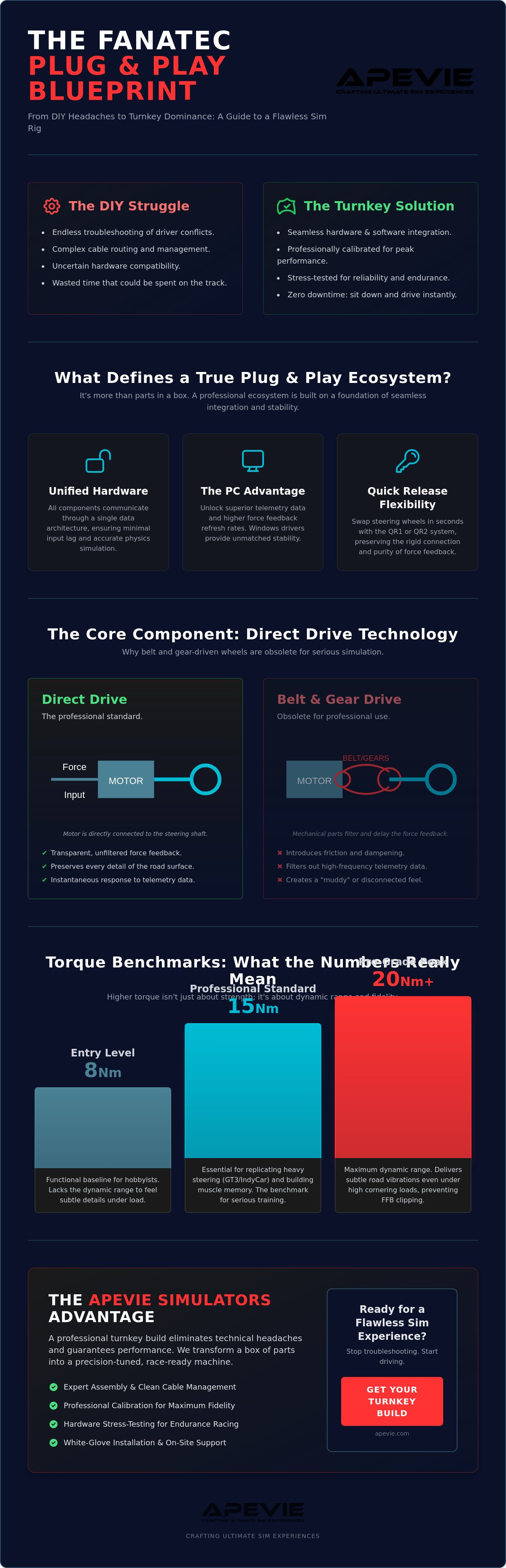
- Learn how to select the right Direct Drive wheel base by comparing torque benchmarks that range from entry-level 8Nm to professional 20Nm+ standards.
- Discover the necessity of structural rigidity and Load Cell technology to ensure your pedals and cockpit can handle professional-grade force feedback.
- Identify the software calibration steps that transform a standard Fanatec plug and play sim into a precision-tuned, race-ready machine.
- Explore how a professional turnkey build from Apevie Simulators eliminates technical headaches through expert assembly and white-glove installation.
What is a Fanatec Plug and Play Sim System?
A Fanatec plug and play sim represents a sophisticated shift from fragmented gaming peripherals to a cohesive racing ecosystem. At its core, this system is a unified collection of hardware, including Fanatec Direct Drive Wheel Bases, specialized steering wheels, and high-precision pedals like the Fanatec ClubSport Pedals. Unlike generic setups that require extensive manual configuration, these components are engineered to communicate through a single data architecture, ensuring that the software can accurately simulate auto racing physics with minimal input lag. This integrated approach removes the technical friction that often plagues high-end simulation, allowing racers to focus on their lap times rather than their driver settings.
There's a critical distinction between a standard consumer kit and a professional turnkey installation. While a consumer bundle provides the basic parts, it often leaves the user to manage complex mounting, cable routing, and software calibration. A professional turnkey solution, such as those provided by Apevie Simulator, delivers a fully realized racing environment. These builds ensure that high-torque components are mounted to a rigid Fanatec GT Cockpit, preventing the loss of fidelity caused by structural flex. By choosing a professional path, you're investing in a system that has been stress-tested and pre-calibrated for immediate, high-performance use.
The PC Advantage in Plug and Play Simulation
While Fanatec gear is known for its versatility, the true potential of a Fanatec plug and play sim is unlocked on the PC platform. PC-based systems provide superior telemetry data and significantly higher refresh rates for force feedback, which are essential for professional-grade realism. Windows-certified drivers facilitate immediate hardware detection, creating a stable foundation that supports advanced sim software. This stability is vital for racers who need their equipment to remain responsive during long endurance sessions without the risk of software conflicts or connection drops.
Ecosystem Flexibility: The Fanatec Quick Release System
The flexibility of the Fanatec ecosystem is best exemplified by its Quick Release (QR) technology. Whether you utilize the established QR1 or the precision-engineered QR2 system, you can swap steering wheels in seconds. This allows you to move from a Fanatec Formula Steering Wheel for open-wheel competition to a GT-style rim without needing to recalibrate your entire rig. This standardized connection isn't just a matter of convenience; it's a commitment to long-term reliability. It ensures that the mechanical bond between the wheel and the base remains rigid, preserving the purity of the force feedback even when the motor is delivering peak torque levels of 20Nm or more.
Selecting the Core: Fanatec Direct Drive Wheel Bases
The heart of any high-performance Fanatec plug and play sim is the direct drive motor. For years, belt-driven systems were the standard, but they've become obsolete for professional applications. Belts and gears introduce mechanical friction and dampening that filter out the high-frequency telemetry data you need to feel the limit of grip. Direct drive technology connects the steering shaft directly to the motor's rotor, providing a transparent link between the simulation and your hands that preserves every detail of the road surface.
Torque benchmarks are critical for developing muscle memory. While 8Nm serves as a functional baseline for hobbyists, professional standards start at 15Nm of holding torque, with peaks reaching 20Nm or higher. The Fanatec ClubSport DD+ provides a consistent 15Nm, which is essential for replicating the heavy steering racks of GT3 or IndyCar machinery. Higher torque isn't just about strength; it's about dynamic range. A base capable of 25Nm can deliver subtle road vibrations even while you're fighting high cornering forces, preventing the force feedback signal from clipping.
Consistent performance during 24-hour endurance simulations requires exceptional thermal stability. High-end Fanatec bases utilize advanced motor designs and passive cooling to maintain their torque output. Without this, you'll experience "torque fade," where the feedback weakens as the motor heats up over time. This consistency, paired with a high slew rate, allows you to detect car slides before they happen, giving you the split-second window needed to catch the rear end and maintain your pace.
The ClubSport vs. Podium Series Comparison
The Fanatec ClubSport Wheel Base line offers a refined balance of speed and power, ideal for most high-end home setups. However, the Fanatec Podium Wheel Base (DD1 and DD2) remains the professional choice for those requiring maximum fidelity and the highest torque ceilings. When choosing between them, you must consider your rig's structural rigidity. A high-torque base will expose every weakness in a chassis, turning intended feedback into unwanted structural flex.
Direct Drive Mounting and Vibration Isolation
How you mount your base is just as important as the motor itself. Side mounting is generally preferred over bottom mounting because it provides a more direct path for force feedback clarity and reduces unwanted leverage on the mounting plate. If your chassis isn't rigid enough, you'll lose significant detail through vibration absorption. For those Building a Professional Foundation in 2026, ensuring your cockpit can handle these forces is the first step toward a true turnkey experience. If you're unsure which base fits your racing goals, a professional consultation can help you match the right torque level to your specific cockpit requirements.
Essential Components for a Complete Turnkey Rig
Building a high-performance Fanatec plug and play sim requires more than just a powerful motor; it demands a structural foundation that can withstand extreme forces. The Fanatec GT Cockpit serves this purpose by providing a rigid, ergonomic platform designed specifically for high-torque direct drive bases. Without a stable chassis, the subtle vibrations and micro-details of the force feedback are lost to structural flex, which fundamentally compromises the realism of the simulation. A professional rig ensures that every Newton-meter of torque is transmitted directly to your hands rather than being absorbed by a shaky frame.
Consistency in sim racing is often won or lost in the braking zones. This is why the Fanatec ClubSport Pedals are a non-negotiable component for any serious build. By utilizing Load Cell technology, these pedals measure pressure rather than the distance the pedal travels. This mimics the hydraulic feel of a real race car, allowing your brain to develop muscle memory based on force. For those looking to expand their racing disciplines, integrating the Fanatec ClubSport Shifter and Handbrake adds the necessary tactile engagement for rally or vintage GT racing. A comprehensive Turnkey Racing Simulator Package from Apevie Simulator eliminates the risk of component mismatching, ensuring that every peripheral is compatible and calibrated before it arrives at your door. For enthusiasts wanting to expand their home entertainment beyond the cockpit, Arcade Fundi offers a range of professional-grade arcade equipment that perfectly complements a high-end sim racing room.
Steering Wheel Selection for Professional Realism
The steering wheel is your primary interface for car control and data management. A Fanatec Formula Steering Wheel is the preferred choice for open-wheel and high-downforce GT racing due to its compact diameter and high-speed responsiveness. Professional racers rely on precise button mapping and multi-position rotary encoders to manage brake bias, traction control, and ERS deployment on the fly. Selecting the right rim is about more than aesthetics; it's about ergonomic efficiency. You can explore The Best F1 Steering Wheels for Professional Sim Racing in 2026 to find a model that fits your specific ergonomic needs.
Pedal Calibration and Load Cell Sensitivity
Pressure-based braking is fundamentally superior to travel-based systems because it allows for much finer modulation at the limit of grip. While a standard pedal might feel spongy, the Fanatec ClubSport Pedals can be fine-tuned using the Fanatec Brake Performance Kit to achieve a rock-hard feel with minimal travel, just like a formula car. This level of customization ensures that your inputs remain consistent lap after lap, even under the stress of competition. For a deeper dive into the physics of braking, consult The Ultimate Guide to Sim Racing Pedals to understand how engineering consistency leads to precision on track.
Maximizing Performance: Calibration and Software Integration
The promise of a Fanatec plug and play sim is that it minimizes technical barriers, yet achieving professional-grade fidelity requires a methodical approach to software integration. Fanalab serves as the central nervous system for your hardware, allowing you to manage profiles that activate automatically based on the car and sim title you launch. By keeping your firmware updated through the unified Fanatec App, you ensure that the internal signal processing remains responsive and compatible with the latest physics engines. This stability is the difference between a system that merely functions and one that provides a reliable training platform.
Finding the "sweet spot" in force feedback involves balancing raw power with granular detail. If you set your gain too high, you'll encounter clipping, a state where the simulator's telemetry requests more torque than the motor can deliver. When this happens, the feedback signal flattens out, and you lose the ability to feel subtle tire vibrations or weight transfers at the limit. For a professional setup, the goal is to tune the base so that peak forces utilize the motor's full dynamic range without ever hitting that mechanical ceiling. This ensures that the 15Nm or 25Nm of torque available in your base is used to provide information, not just resistance.
Software Optimization for iRacing and ACC
In titles like iRacing, configuring linear force feedback is the professional standard. This ensures that the output from the wheel base is directly proportional to the forces calculated by the physics engine. You should also utilize the LED telemetry displays on your Fanatec steering wheel to provide immediate visual feedback for shift points and flags. Fine-tuning the "Natural Damper" and "Natural Friction" settings in Fanalab is equally essential; these parameters add a sense of mechanical weight to the steering, preventing it from feeling overly light or oscillating on long straights during high-speed sections.
Mechanical Fine-Tuning and Ergonomics
Software excellence is wasted if the driver's physical position leads to fatigue or inconsistent inputs. Adjusting the wheel height and angle is a precise process that must align with your natural seating position in the cockpit to prevent strain. We also emphasize the importance of cable strain relief. High-torque maneuvers can put significant stress on connectors, and a loose USB or power cable can end a race instantly. Our White Glove Simulator Installation Service takes a holistic approach to ergonomics, customizing the fit of the rig to the driver's specific biomechanics to ensure maximum comfort and control during grueling endurance sessions.
Why a Turnkey Build from Apevie Simulators is the Ultimate Choice
Buying the components for a Fanatec plug and play sim is only half the battle. While the ecosystem is designed for compatibility, achieving a professional-grade result requires a level of technical integration that most DIY builds lack. Many enthusiasts find themselves frustrated by suboptimal cable management, software calibration hurdles, and structural flex that saps the life out of high-end force feedback. A turnkey build from Apevie Simulator removes these obstacles, delivering a system that is engineered for stability and performance from day one.
Our approach centers on eliminating the technical friction that leads to downtime. We handle the complex assembly, ensuring that every bolt is torqued correctly and every cable is routed to prevent interference or physical strain. By utilizing modular aluminum profile rigs, we provide a foundation that is far more rigid than standard consumer cockpits. This structural integrity is vital when using high-torque bases like the Fanatec Podium series, as it ensures that every bit of telemetry data is transmitted to the driver rather than being lost to chassis vibration. We also pre-install and calibrate all necessary drivers, so you don't have to spend your first hours troubleshooting software updates.
The Apevie Difference: Professional Integration
We choose specific Fanatec components for our builds because they offer the best balance of reliability and professional fidelity. Every rig undergoes a rigorous quality assurance process where we stress-test the hardware and calibrate the pedals for consistent feel. While brands like Apex Sim Racing or CXC Simulations represent high-end comparative standards in the industry, our turnkey solutions focus on the unique strengths of the Fanatec ecosystem, providing a versatile yet rock-solid platform. This professional integration ensures that your equipment performs at its peak, whether you're practicing for a real-world race or competing in a high-stakes sim event.
Your Path to a Professional Setup
The journey toward a professional-grade simulator begins with an expert consultation. We work with you to define your specific racing goals, budget, and space requirements to ensure you get the right combination of Fanatec gear and cockpit ergonomics. Our White Glove installation service provides national-level support, bringing our expertise directly to your home or facility for final setup and driver fitting. We don't just leave you with a pile of boxes; we provide a race-ready tool. To start building your ideal racing environment, you can contact Apevie Simulators for a turnkey build consultation and discover how professional calibration changes the way you drive.
Mastering the Apex with a Professionally Tuned Rig
Success on the track depends on the harmony between your physical inputs and the digital feedback you receive. A Fanatec plug and play sim offers the necessary foundation, but the true professional standard is reached through meticulous calibration and structural rigidity. By balancing high-torque Direct Drive power with the precision of Load Cell braking, you create a training tool that responds exactly like a real-world race car. Eliminating technical friction allows you to focus entirely on your racing line and strategy rather than troubleshooting hardware conflicts.
As an authorized distributor of high-performance hardware, Apevie Simulator ensures your transition to a professional setup is seamless. We provide expert calibration for iRacing and ACC to prevent signal clipping and maximize telemetry detail. Our professional white-glove installation service means your rig is assembled, tuned, and fitted to your specific ergonomics before you ever turn a wheel. You don't have to settle for a generic setup when you can have a custom-engineered solution that's ready for competition.
Build Your Custom Turnkey Fanatec Simulator with Apevie and experience the difference that professional integration makes in your performance. The track is waiting for you to take control.
Frequently Asked Questions
Is Fanatec truly 'plug and play' on a Windows PC?
Yes, Fanatec hardware is recognized immediately by Windows once the certified drivers are installed. While the initial connection is seamless, a high-performance Fanatec plug and play sim still requires the Fanatec App or Fanalab to manage game-specific telemetry and LED profiles. This ensures your hardware communicates correctly with the simulation software, providing the stability required for professional competition without the need for manual port mapping.
What is the difference between Fanatec ClubSport and Podium wheel bases?
The primary differences lie in peak torque and internal signal processing. The Fanatec ClubSport Wheel Base DD+ delivers a consistent 15Nm of torque, which is ideal for serious hobbyists. In contrast, the Fanatec Podium Wheel Base series, including the DD1 and DD2, provides up to 25Nm. This higher ceiling allows for a greater dynamic range, ensuring subtle road details aren't lost when the car is under heavy aerodynamic load.
Can I use a Fanatec wheel base with third-party pedals and cockpits?
You can use Fanatec bases with third-party peripherals on a PC because each component typically connects via its own USB channel. While using Fanatec ClubSport Pedals within the ecosystem allows for a single-connection setup, many professional racers combine Fanatec bases with high-end pedals from other brands. Most aluminum extrusion rigs also feature universal mounting plates that accommodate the standard Fanatec hole patterns for easy integration.
How much torque do I actually need for a realistic professional sim experience?
Professional realism generally requires a minimum of 15Nm of holding torque to replicate the physical demands of GT3 or open-wheel steering racks. Having a base capable of 20Nm or more is beneficial because it prevents "clipping," where the motor reaches its limit and flattens out the force feedback signal. This extra headroom ensures that small vibrations, like hitting a curb, remain distinct even during high-speed cornering maneuvers.
Does Apevie Simulators provide installation for Fanatec hardware?
Apevie Simulator provides a comprehensive White Glove Simulator Installation Service for all Fanatec hardware. Our expert technicians handle the physical assembly, structural reinforcement, and software calibration at your location. This service ensures that your rig is professionally tuned for specific titles like iRacing or ACC, eliminating the trial-and-error process often associated with high-end simulation equipment.
What are the benefits of a turnkey sim rig over a DIY setup?
A turnkey rig eliminates the technical friction by providing a pre-calibrated, stress-tested environment. Professional assembly ensures that cable management is clean and structural bolts are torqued to prevent vibration loss. You gain immediate access to a high-performance system without spending weeks troubleshooting driver conflicts or ergonomic misalignments. It's a solution designed for those who value their time and demand elite-level performance.
Is the Fanatec GT Cockpit rigid enough for Direct Drive wheel bases?
The Fanatec GT Cockpit is engineered to provide a stable foundation for Direct Drive bases, but its performance depends on the torque levels used. It handles mid-range forces effectively; however, for those using the maximum 25Nm output of a Podium base, an aluminum extrusion sim rig offers superior rigidity. Structural flex can dampen the force feedback signal, so matching the cockpit's strength to the motor's peak output is essential for maintaining fidelity.
How do I update the firmware on my Fanatec plug and play system?
You update your firmware through the unified Fanatec App, which simplifies the process by identifying all connected components automatically. Once you connect your base via USB, the software checks for the latest versions of the motor, quick release, and steering wheel firmware. Keeping these components updated is vital for maintaining ecosystem stability and ensuring that new telemetry features function correctly across different racing titles.