


Simucube vs Fanatec: The Professional Buying Guide for 2026
Is the most expensive wheelbase actually the fastest, or are you simply paying for a closed ecosystem that might limit your future upgrades? Choosing between simucube vs fanatec in 2026 isn't just about comparing torque figures anymore. It's about deciding which engineering philosophy will anchor your cockpit for the next five years. You've likely felt the frustration of proprietary quick releases or the nagging fear of buying into a hardware path that could become a dead end as technology evolves. It's a common concern for serious racers who want their gear to feel like a surgical instrument rather than a gaming peripheral.
We'll help you navigate this choice by stripping away the marketing noise to reveal which direct drive titan truly dominates the 2026 landscape. This guide explores how the Simucube 3 series maintains its professional edge through open compatibility with boutique brands like Cube Controls and GSI, while Fanatec leverages its new Corsair integration to offer a streamlined, all-in-one ecosystem. At Apevie Simulators, we prioritize this level of technical clarity to ensure your professional racing goals are met with the right hardware. By the end, you'll have a definitive decision on which base to build your rig around, ensuring your force feedback "feel" is exactly where it needs to be for peak performance.
Key Takeaways
- Identify whether the convenience of Fanatec’s QR2 ecosystem or the industrial-grade reliability of Simucube’s all-metal construction better serves your long-term racing goals.
- Resolve the simucube vs fanatec dilemma by weighing the importance of multi-platform console support against the surgical force feedback precision required for elite PC simulation.
- Understand why technical specifications like slew rate and signal latency impact your driving performance more significantly than simple peak torque ratings.
- Learn how to successfully pair professional wheelbases with boutique steering wheels from brands like Gomez Sim Industries (GSI) and Cube Controls.
- Discover how to integrate your chosen wheelbase into a high-performance turnkey system featuring Sigma Integrale DK2 motion for ultimate immersion.
The Direct Drive Landscape: Simucube vs Fanatec in 2026
Direct drive technology has transitioned from an exotic luxury to the fundamental cornerstone of any serious racing simulator. In 2026, the market isn't defined by whether you should use a direct drive motor, but by which philosophy you choose to govern your tactile feedback. The debate between simucube vs fanatec has reached a fever pitch following Fanatec's integration with Corsair and Simucube's launch of the groundbreaking 3 Series. This choice dictates your entire hardware trajectory, from the steering wheels you can mount to the software you'll use to calibrate your car's behavior.
To understand the current Direct Drive Landscape, you have to look at how these motors have evolved. Early systems were often adapted industrial servos, but today’s units are purpose-built for high-frequency signal processing and instantaneous torque delivery.
Defining the Professional Standard in 2026
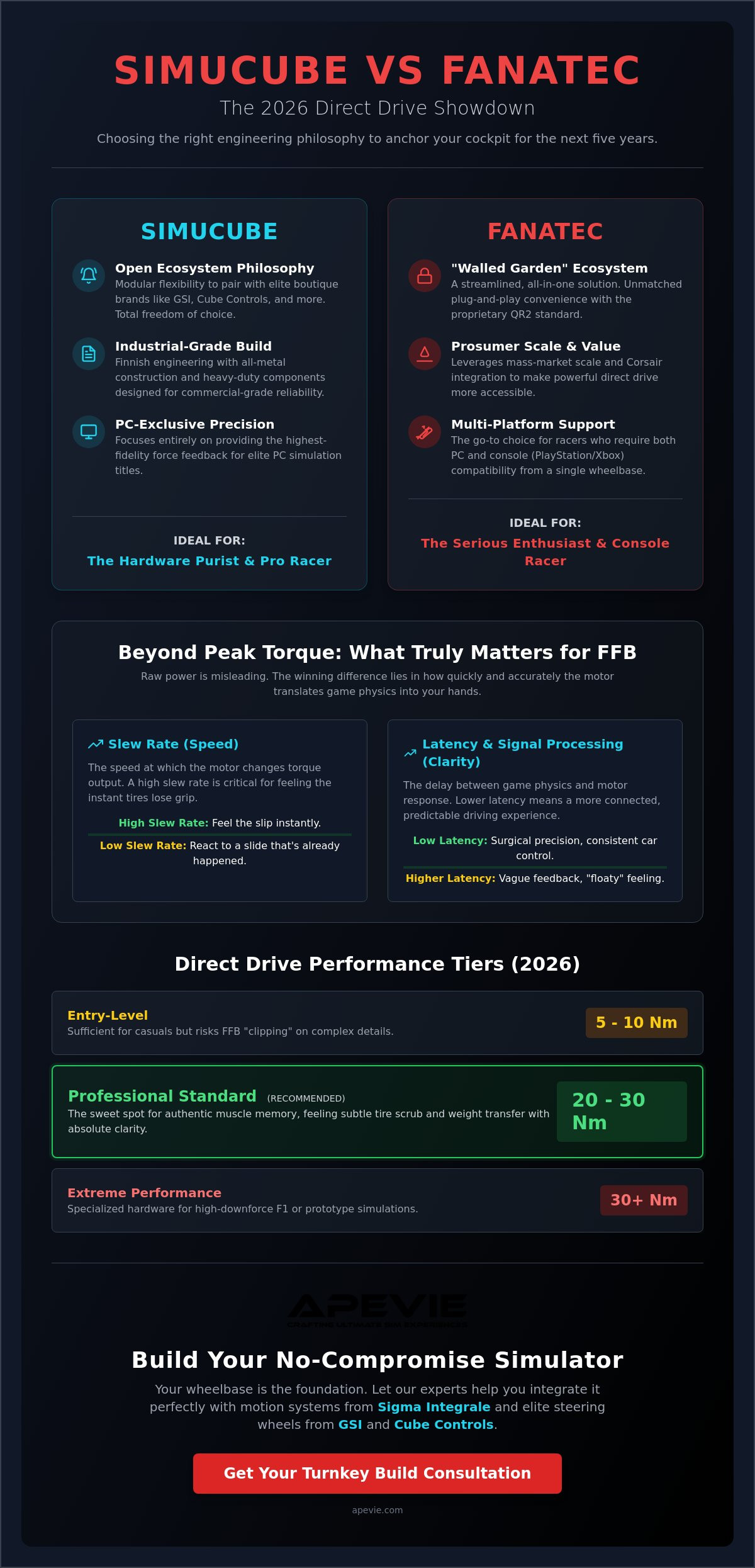
In 2026, the line between consumer gaming peripherals and professional training tools is clearer than ever. A professional wheelbase isn't just about raw power; it's about the speed of signal processing and the fidelity of the motor's communication. We've seen the industry settle into specific performance brackets that define the user experience:
- Entry-Level (5Nm–10Nm): Sufficient for casual racing but often lacks the headroom to communicate complex physics without clipping.
- Professional Standard (20Nm–30Nm): The recognized sweet spot for building authentic muscle memory. This range allows the motor to communicate subtle tire scrub and weight transfer with absolute clarity.
- Extreme Performance (30Nm+): Specialized hardware, like the Simucube 3 Ultimate, designed for high-downforce simulations where steering rack forces are immense.
This overhead in the 20Nm to 30Nm range is vital. It ensures that even during high-load cornering, the motor still has the "room" to vibrate or kick when you hit a curb, providing the tactile data you need for long-stint consistency.
Ecosystem vs. Modular Flexibility
Your decision also hinges on how you prefer to manage your hardware. Fanatec has doubled down on its "walled garden" approach. By utilizing the QR2 quick-release standard across its entire range, it offers unmatched convenience. You can swap between a Fanatec Formula Steering Wheel and a GT rim in seconds, but you're largely restricted to their proprietary ecosystem. This is an excellent path for those who value a plug-and-play experience without managing multiple USB cables or third-party drivers.
Conversely, Simucube champions an open-standard philosophy. Their wheelbases are designed to be paired with elite third-party manufacturers. This modularity allows you to mount a Gomez Sim Industries (GSI) Formula Pro Elite or a Cube Controls F-Core, giving you access to industrial-grade components that often surpass mass-market offerings in tactile quality. While this requires a more hands-on approach to setup, it ensures your rig is never limited by a single brand's design choices.
Simucube’s Finnish engineering emphasizes industrial-grade reliability, using all-metal construction and heavy-duty connectors that withstand the rigors of 24/7 commercial use. Fanatec, meanwhile, has used its mass-market scale to drive down prices, making direct drive accessible while maintaining a dominant presence in the prosumer space. Choosing between them is the most critical foundation for your rig.
Force Feedback Refinement: Slew Rate, Latency, and Software
Torque is often the first metric racers look at, but it's a misleading indicator of actual performance. In the simucube vs fanatec debate, the real winner is decided by how quickly a motor can translate game data into physical resistance. Slew rate is the speed at which the motor changes torque output. High slew rates allow you to feel the exact moment the front tires of a GT3 car lose grip in Assetto Corsa Competizione. If your motor is sluggish, you'll always be reacting to a slide that has already happened. This instantaneous response is what separates a professional training tool from a standard gaming peripheral.
Latency is the silent killer of consistency. Simucube 3 bases utilize advanced signal processing to minimize the delay between the simulation physics and your hands. Fanatec counters this with FullForce, a proprietary telemetry layer designed to bypass traditional force feedback bottlenecks. While FullForce provides a vibrant, high-frequency detail in titles like iRacing and Gran Turismo 7, Simucube’s approach feels more like a raw, mechanical connection to the steering rack. Catching a snap-oversteer moment requires this millisecond-level precision; without it, you're just guessing where the limit of adhesion lies.
Simucube Tuner vs. Fanatec App
By June 2026, both brands have unified their software suites to simplify the user experience. Simucube has transitioned to Simucube Tuner (v3.1.1), which offers a professional-grade interface for granular force feedback tuning. It's a surgical tool for those who want to tweak damping, friction, and inertia with mathematical precision. Fanatec has launched the Fanatec App (v1.5.2.3), focusing on user-friendly, profile-based management. This makes it easier to swap between different cars and sims without deep-diving into technical menus. Both platforms now utilize cloud-based tuning profiles, allowing you to download settings used by professional eSports drivers. Understanding this Decision Framework: Which System Fits Your Racing Goals? is essential before committing to a software ecosystem.
Motor Physics and Thermal Management
The physical construction of these motors determines how they perform during a grueling two-hour endurance stint. Simucube utilizes industrial-grade servos that rely on passive cooling. Their heavy metal housings act as a heat sink, ensuring that the force feedback doesn't fade as the motor gets warm. Fanatec systems often employ active cooling or sophisticated thermal throttling to manage temperatures. While Fanatec's 2026 lineup is remarkably smooth, Simucube’s motors are known for having virtually zero "cogging" or internal friction. This results in a steering feel that is as clear and transparent as a real-world steering column. If you're looking for a setup that maintains this level of fidelity through every lap, our team at Apevie Simulators can help you select the motor that matches your performance requirements.
- Wireless Telemetry: Simucube 3 now uses LightBridge technology for lag-free wireless wheel communication, while Fanatec relies on its robust QR2 physical connection.
- Signal Filtering: Simucube’s reconstruction filters can smooth out "grainy" physics signals from older titles without adding perceptible latency.
- Thermal Stability: Simucube’s industrial heritage means their motors are designed for 24/7 operation without performance degradation.
Build Quality and Hardware Ecosystem Comparison
The tactile sensation of a simulator begins exactly where your hands meet the rim. When evaluating simucube vs fanatec, the physical construction of the wheelbase and its surrounding ecosystem determines the longevity of your investment. Simucube wheelbases are renowned for their industrial-grade, all-metal housings. They lack the plastic shrouds or decorative trim found on many consumer-grade units, opting instead for a form-follows-function aesthetic that reflects their Finnish engineering roots. Fanatec, while utilizing high-quality materials in their Podium series, focuses on a more integrated, polished look that fits seamlessly into a home cockpit.
The choice of ecosystem is perhaps the most significant factor when selecting an f1 steering wheel. It's the difference between a closed system designed for convenience and an open platform designed for ultimate customization. Your decision here impacts every other peripheral you'll eventually add to your rig.
Steering Wheel Variety and Compatibility
Fanatec’s greatest strength lies in its massive catalog. From the officially licensed BMW M4 GT3 rim to the ubiquitous Formula V2.5, they offer a wheel for every discipline. Their QR2 system has finally addressed the mechanical play issues of the legacy QR1, providing a rock-solid connection. However, you're largely tethered to Fanatec's own designs unless you use a universal hub, which can add bulk to the steering column.
Simucube takes a different path. Their hardware is built to be a universal hub. This allows you to mount elite boutique hardware like the Cube Controls F-Core or Gomez Sim Industries (GSI) wheels. These manufacturers often use genuine motorsport components, such as Omron switches and carbon fiber plates, that offer a level of tactile feedback mass-produced wheels cannot match. While Fanatec provides variety, Simucube provides the modularity required for a truly bespoke simulator build.
Maintenance and Long-Term Support
Support structures differ vastly between these two titans. Fanatec, now integrated with Corsair, leverages a global logistics and service network. This scale makes getting replacement parts or firmware updates straightforward for the average user. Simucube operates through a boutique dealer network that prioritizes high-touch technical support and specialized knowledge.
Resale value reflects this difference in market positioning. Because Simucube bases are built with industrial-grade components designed for thousands of hours of use, they often hold up to 80% of their value even years after purchase. Fanatec gear holds its value well, but the frequent release cycles of consumer electronics mean older models can depreciate faster. For a professional rig, the longevity of Simucube’s all-metal construction offers a sense of permanence that is hard to ignore.
Decision Framework: Which System Fits Your Racing Goals?
Choosing between simucube vs fanatec comes down to where you plan to race and how much you value modularity over a unified interface. If your goals are strictly PC-based and you demand the most surgical force feedback available, the Simucube 3 Pro is often the non-negotiable choice for an elite rig. However, if you require native PlayStation or Xbox compatibility for titles like Gran Turismo 7 or Forza Motorsport, Fanatec remains the only high-performance direct drive option with official licensing. You shouldn't settle for a system that limits your platform access, but you also shouldn't compromise on fidelity if you never plan to leave the PC ecosystem.
Budgeting for these systems requires looking beyond the price of the motor itself. Simucube users must factor in the cost of a separate quick-release system and the higher entry price of boutique wheels. Fanatec offers a more predictable cost structure, but the "hidden" expense often comes later when you realize you're locked into their specific hardware path. Don't overlook your sim racing pedals when making this choice. A professional-grade load cell set like the Heusinkveld Sim Pedals Ultimate+ provides the precision that complements a Simucube base, whereas Fanatec users often prefer the plug-and-play simplicity of the ClubSport Pedals V3 within a single driver environment.
The Turnkey Enthusiast vs. The Modular Pro
The "buy twice, cry twice" trap is real in high-end simulation. If you prefer a cohesive, single-brand experience where every button on your wheel works perfectly the moment you plug it in, Fanatec is the logical path. It's a turnkey ecosystem that rewards loyalty with simplicity. Conversely, the modular pro chooses Simucube to maintain a "best-in-class" approach for every individual component. This allows you to pair a Simucube 3 Wheel Base with a Gomez Sim Industries rim and Heusinkveld pedals, ensuring every touchpoint of your simulator is the absolute peak of its category.
Matching the Base to Your Cockpit
Your foundation must be capable of handling the forces these motors generate. A professional sim rig made from heavy-duty aluminum extrusion is essential once you move beyond 15Nm of torque. Without a rigid frame, the subtle details of the force feedback are lost to chassis flex, defeating the purpose of a high-end motor. Consider the mounting style as well; Simucube bases often utilize front-mount brackets that provide superior legroom and adjustability, while Fanatec units typically use side-mounting or bottom-mounting points found on standard GT cockpits. If you're unsure which configuration fits your space, our experts at Apevie Simulators can provide a professional consultation to ensure your hardware and cockpit are perfectly aligned.
- Drift and Rally: Simucube’s ultra-low latency and raw motor speed make it superior for the rapid counter-steering required in these disciplines.
- Formula Racing: Both brands excel here, but the high-downforce loads of an F1 car benefit from the 25Nm to 35Nm ceiling found in the Simucube 3 Pro and Ultimate models.
- Endurance GT: Fanatec’s FullForce technology can provide a more "vibrant" feel that helps maintain focus during long, multi-hour stints.
Professional Integration: Building Your Elite Turnkey System
Deciding between simucube vs fanatec is a foundational step, but a world-class simulator requires more than just a high-performance motor. A professional wheelbase only reaches its full potential when it's integrated into a ecosystem of equally capable components. For elite drivers, this means moving beyond a simple desk-mounted setup and considering how the motor interacts with motion platforms, high-fidelity pedals, and complex software environments. The wheelbase is the heart of the rig, but the motion system and pedals act as the nervous system, providing the full-body feedback necessary for authentic training.
Pairing with Heusinkveld and Sigma Integrale
Professional Simucube users typically seek the highest possible mechanical transparency. This drive for purity leads many to pair their Simucube 3 Wheel Base with Heusinkveld Sim Pedals Ultimate+. These pedals offer the hydraulic-like resistance and high-load capacity necessary to match the intense torque output of a professional motor. When you add a Sigma Integrale DK2+ motion system, the simulation enters a new dimension. The DK2+ system provides the subtle pitch, roll, and heave cues that allow you to feel the car's weight transfer in perfect synchronization with the steering rack forces.
Managing these components requires technical expertise. A professional rig often runs multiple software suites simultaneously, such as Simucube Tuner for the wheel and specialized motion software for the actuators. Ensuring these systems communicate without signal interference is vital for maintaining low-latency performance. We've found that Simucube’s industrial-grade components offer the EMI shielding required to work flawlessly alongside powerful motion actuators, preventing the ghost inputs that can plague lesser hardware stacks.
The Apevie Advantage for Turnkey Builds
Navigating the simucube vs fanatec debate is significantly easier when you have an expert partner to curate your build. We specialize in creating custom high-performance racing simulators that eliminate the frustration of hardware incompatibility. Whether you want a bespoke rig featuring a Gomez Sim Industries (GSI) Formula Pro Elite wheel or a streamlined Fanatec setup for multi-platform versatility, we provide the expert consultation needed to make an informed choice. It's about finding the specific balance of hardware that aligns with your professional racing goals.
Our white-glove simulator installation service ensures your high-torque system is calibrated correctly from day one. High-end hardware requires precise mounting and meticulous cable management to prevent performance degradation. By choosing a turnkey solution, you gain direct access to premium hardware with compared pricing and a system that is ready to race the moment it's installed. We handle the technical complexities so you can focus on your lap times.
Ready to build your ultimate racing simulator? Contact Apevie Simulator today for a professional consultation or to explore our turnkey racing simulator packages and professional installation services.
Securing Your Sim Racing Legacy in 2026
Choosing between simucube vs fanatec is a decision that defines the tactile limits of your simulator for years to come. While Fanatec provides an unmatched, all-in-one ecosystem for those who value convenience and multi-platform compatibility, Simucube remains the surgical instrument of choice for the professional PC racer. The right foundation isn't just about raw torque. It's about the signal fidelity and modular flexibility that allow you to grow your rig with boutique hardware like GSI wheels or Sigma Integrale motion systems.
At Apevie Simulator, we specialize in bridging the gap between high-end hardware and peak performance. As an Authorized Simucube Dealer, we provide the expert white-glove installation and custom turnkey professional builds that ensure your equipment performs exactly as intended from the very first lap. You deserve a simulator that mirrors the physics of the real world with absolute transparency and reliability. Our team is dedicated to ensuring your investment aligns perfectly with your competitive goals.
Browse our curated collection of professional sim racing hardware to find the components that will anchor your cockpit. Your journey toward championship-level consistency begins with a foundation built on expertise and quality. We look forward to helping you reach the podium.
Frequently Asked Questions
Is Simucube really better than Fanatec for professional sim racing?
Simucube is generally considered the professional standard for PC-only simulation because of its industrial-grade servos and superior signal processing. When evaluating simucube vs fanatec, the Simucube 3 Series offers higher slew rates and a more transparent mechanical feel that elite drivers require for training. Fanatec is an excellent choice for those who need a unified ecosystem or console compatibility, but Simucube wins on raw fidelity and build longevity.
Can I use a Fanatec wheel on a Simucube 3 wheel base?
You cannot use a Fanatec wheel on a Simucube base natively because of the proprietary Fanatec quick-release and electronic connection. While third-party conversion kits exist to turn Fanatec rims into USB devices, most professionals prefer to use native wheels from brands like Gomez Sim Industries (GSI) or Cube Controls. These wheels connect directly to the Simucube ecosystem without the need for complex adapters or workarounds.
Does Fanatec work on PS5 and Xbox in 2026?
Fanatec remains the only premium direct drive manufacturer with official licensing for both PlayStation 5 and Xbox in 2026. The ClubSport DD+ offers native support for the PS5, while Xbox compatibility is handled by attaching an Xbox-branded steering wheel to the base. Simucube wheelbases are strictly PC-only and don't offer any native support for gaming consoles.
What is the best torque setting for a Simucube 2 Pro?
The most effective way to calibrate a Simucube 2 Pro is to set the hardware to its maximum 25Nm in Simucube Tuner and then adjust the force in-game to avoid clipping. This legacy wheelbase still performs at an elite level when given enough headroom to communicate high-frequency details. Most drivers find that an actual output of 12Nm to 15Nm provides the best balance of realism and physical endurance.
Do I need a special sim rig for a 25Nm wheel base?
A heavy-duty aluminum extrusion sim rig is essential for any motor capable of 25Nm or more. High-torque wheelbases generate immense rotational force that will flex or even damage standard office desks and entry-level tube frames. This flex acts as a dampener, absorbing the subtle vibrations and tire-scrub details that you need to feel to be competitive.
Which software is easier to use: Simucube Tuner or the Fanatec App?
The Fanatec App is more accessible for beginners because it uses a streamlined interface with many pre-configured cloud profiles. In the 2026 simucube vs fanatec software battle, Simucube Tuner is the more powerful tool for professionals who need granular control over every aspect of the motor's physics. It allows for surgical adjustments to damping and friction that the more consumer-oriented Fanatec software doesn't prioritize.
Are Simucube wheel bases compatible with Heusinkveld pedals?
Yes, Simucube wheelbases are perfectly compatible with Heusinkveld Sim Pedals Ultimate+ and other high-end pedals on PC. Since these components connect via separate USB cables, they don't need to be from the same manufacturer to work together. This modularity is a key advantage of professional rigs, allowing you to pair the best motor with the best pedal set available.
How much should I expect to spend on a full Simucube-based rig?
A professional-grade Simucube rig is a significant investment that reflects its industrial-grade components and high resale value. Costs vary depending on whether you include motion systems like the Sigma Integrale DK2+ or boutique steering wheels. For a system of this caliber, we recommend a professional consultation to ensure every component is correctly matched for a high-performance turnkey experience.