Simucube 2 Sport Review: Is 17Nm the Precision Sweet Spot in 2026?
Is the pursuit of higher torque numbers actually masking the very detail you need to find those final tenths on the track? Many racers feel pressured to chase 25Nm or 30Nm bases, fearing that anything less is merely a stepping stone they'll eventually outgrow. However, the simucube 2 sport challenges this assumption by focusing on the purity of the signal rather than raw, exhausting power. We understand the hesitation of investing in a premium setup only to wonder if you've left performance on the table or if your rig can handle the mechanical strain of a high-torque unit.
You'll discover why the 17Nm output of the Simucube 2 Sport remains a precision sweet spot for serious enthusiasts and professional drivers in 2026. This guide explores how the major software update on March 26, 2025, which introduced Simucube Tuner, has refined the user experience and added features like automatic profile switching. We also examine how this wheelbase integrates into a high-performance ecosystem, including compatibility with components like Heusinkveld Sim Pedals Sprint or a Gomez Sim Industries (GSI) Formula Pro Elite wheel. This ensures your cockpit becomes a balanced, professional-grade tool tailored for consistency and long-term growth by the experts at Apevie Simulators.
Key Takeaways
- Understand why 17Nm of torque on the simucube 2 sport provides the ideal balance of professional-grade resistance and signal clarity for modern GT and Formula disciplines.
- Learn how the 22-bit absolute encoder and dual-CPU architecture work in tandem to eliminate signal noise, allowing you to feel subtle tire slip and weight transfer.
- Discover the benefits of the Simucube Tuner software, including how automatic profile switching streamlines your transition between different racing titles.
- Compare the Sport against the Pro and Ultimate models to determine if a higher torque ceiling is a necessary investment for your specific simulator goals.
- Gain insights into proper rig integration, including why an aluminum extrusion foundation and expert calibration are essential for maximizing high-fidelity feedback.
Simucube 2 Sport: Redefining the Professional Direct Drive Entry Point
The simucube 2 sport is frequently mislabeled as an entry-level base simply because it sits at the start of the Finnish manufacturer's hierarchy. This classification is misleading. In reality, the Sport utilizes a high-end industrial motor specifically repurposed for the rigors of elite simulation. While consumer-grade gear often relies on mass-produced motors with plastic housings, this unit is built with the same uncompromising philosophy as the Pro and Ultimate models. When you first transition from a belt-driven or lower-tier direct drive system, the difference isn't just about strength; it's about the sudden absence of mush. Within the first hour, you'll likely find yourself catching slides you previously didn't even feel starting.
The Physics of 17Nm: Why Torque Peaks Matter
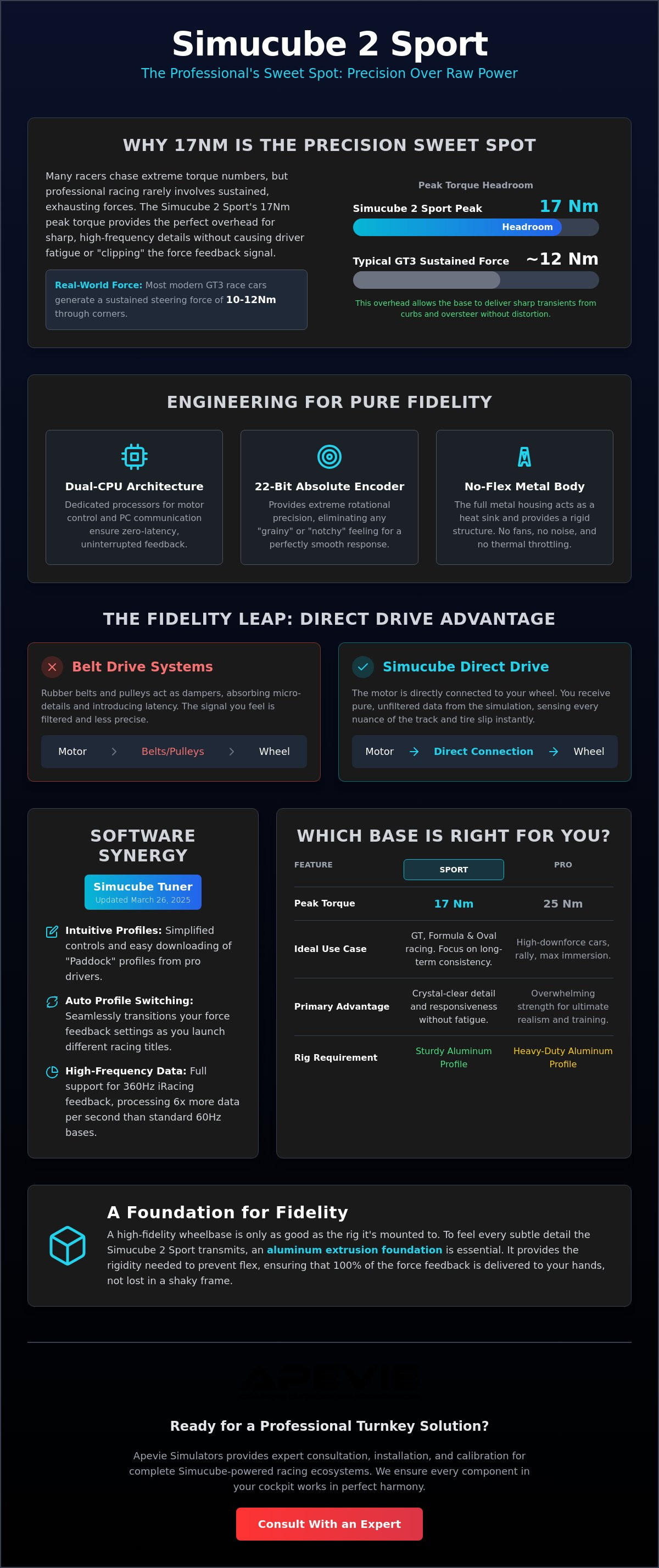
Understanding the distinction between holding torque and peak torque transients is vital for any serious buyer. Many racers assume they need 25Nm to feel real forces, but most modern GT3 cars rarely exceed 10 to 12Nm of sustained force through the steering column. The 17Nm provided by the simucube 2 sport offers a generous buffer. This overhead ensures that when you hit a curb or experience a sudden snap of oversteer, the base can deliver those sharp, high-frequency transients without clipping the signal. It mimics the mechanical response of a real-world steering rack with startling accuracy. It provides enough resistance to build muscle memory without causing the physical fatigue that often comes with higher-torque units.
Direct Drive vs. Belt Drive: The Fidelity Leap
The leap to direct drive technology removes the layers of mechanical interference found in traditional setups. In a belt-driven system, the rubber belts and pulleys act as dampers, soaking up the micro-details of the track surface. The Sport eliminates these friction points entirely. The motor shaft connects directly to your steering wheel, turning the wheelbase into a high-resolution sensor for your hands. You aren't just receiving force; you're receiving data. The Sport is a zero-latency feedback loop between the simulator and the driver. This transparency allows you to sense the exact moment the front tires begin to scrub in a high-speed corner, giving you the confidence to push closer to the limit.
Engineering Excellence: The Hardware and Software Synergy of 2026
The simucube 2 sport isn't just a powerful motor; it's a sophisticated computing device designed for high-fidelity simulation. At its core, the unit utilizes a dedicated dual-CPU architecture. This design splits the complex workload between motor control and PC communication. It ensures that the feedback loop remains uninterrupted even during high-load scenarios. This configuration transforms the base into a high-fidelity feedback actuator that responds with surgical precision to every digital ripple in the asphalt. You won't experience the micro-stutters or signal processing lag that can plague single-processor systems.
Much of this smoothness comes from the 22-bit absolute encoder. This component monitors the shaft position with extreme resolution, effectively eliminating the "grainy" or notched sensation found in consumer-grade hardware. You're left with a fluid, natural resistance that feels like a real steering column rather than a series of magnetic pulses. Because the unit relies on passive cooling, there are no internal fans to fail or create distracting noise. The entire metal housing acts as a heat sink, maintaining consistent performance through three-hour endurance stints without thermal throttling.
Simucube Tuner: The Power of Customization
The software experience underwent a significant transformation on March 26, 2025, with the introduction of Simucube Tuner. This unified ecosystem replaced the older True Drive software, bringing a more intuitive interface and automatic profile switching. For those racing in iRacing, the 2026 updates fully support 360Hz feedback frequencies. This means the simucube 2 sport can process significantly more data per second than standard 60Hz bases. You can easily download "Paddock" profiles created by professional drivers to get a perfect baseline for GT3 or Formula cars instantly. The software allows you to fine-tune damping, friction, and inertia to match the specific weight of the car you're driving.
Build Quality: Industrial Motors for Domestic Rigs
Reliability is a cornerstone of the Simucube philosophy. The Sport is rated for years of continuous operation, which is why it's a frequent choice for commercial simulation centers. Every connector is high-grade to prevent signal interference. The Simucube Quick Release (SQR) system provides a rock-solid connection between the base and the wheel. It uses a tapered pin design that ensures zero flex, even under high torque loads. If you are looking for a professional-grade setup, many enthusiasts choose premium steering wheels to complement this industrial-grade foundation.
Simucube 2 Sport vs. Pro: Which Base Should You Invest In?
The decision between the simucube 2 sport and its larger siblings often comes down to a misunderstanding of how torque translates to the driving experience. On paper, the hierarchy is clear: the Sport offers 17Nm, the Pro provides 25Nm, and the Ultimate reaches a massive 32Nm. Many community discussions suggest buying the Pro to future-proof your setup. However, this advice often ignores the physical reality of racing. Sustaining 17Nm through a long stint in a high-downforce car is a significant physical challenge that most sim racers rarely attempt. The Sport delivers 100% of the fidelity required for professional training without the overkill of higher torque models.
The simucube 2 sport provides more than enough dynamic range for nearly every modern racing discipline. If you primarily drive GT3 or Formula cars, you'll likely find that running the base at its full 17Nm capacity is actually counterproductive to lap times. It can lead to early fatigue and fighting the wheel rather than feeling the car's subtle weight shifts. From a price-to-performance perspective, the Sport is often the smarter investment. Saving on the wheelbase allows you to allocate more budget toward high-end pedals like the Heusinkveld Sim Pedals Ultimate+, which can have a more direct impact on your consistency than an extra 8Nm of unused torque.
When the Sport is the Right Choice
The Sport is the definitive choice for racers who prioritize precision and long-term comfort. It excels in Formula-style racing where the steering rack forces are high but require delicate inputs to find the limit of grip. Because the Sport uses a single power supply and has a smaller physical footprint, it's also easier to mount on a wider variety of rigs without requiring massive reinforcement. It's a perfect match for a Gomez Sim Industries Formula Pro Elite or a Cube Controls F-Core. These wheels are designed to translate high-frequency feedback, and the Sport delivers that signal with absolute clarity.
When to Upgrade to the Simucube 2 Pro
There are specific scenarios where the extra headroom of the Pro becomes beneficial. If your primary interest lies in vintage racing, such as 1960s Formula cars with no power steering and massive tires, you might appreciate the higher torque ceiling. It's also suitable for simulating high-downforce prototypes where the steering weight needs to feel exceptionally heavy to be authentic. Apevie Simulators carries both models to ensure every custom build is perfectly tailored to the driver's specific needs. Whether you need the surgical precision of the Sport or the raw power of the Pro, we help you integrate these units into a complete, professional-grade ecosystem.
Rig Integration: Building a Foundation for 17Nm of Force
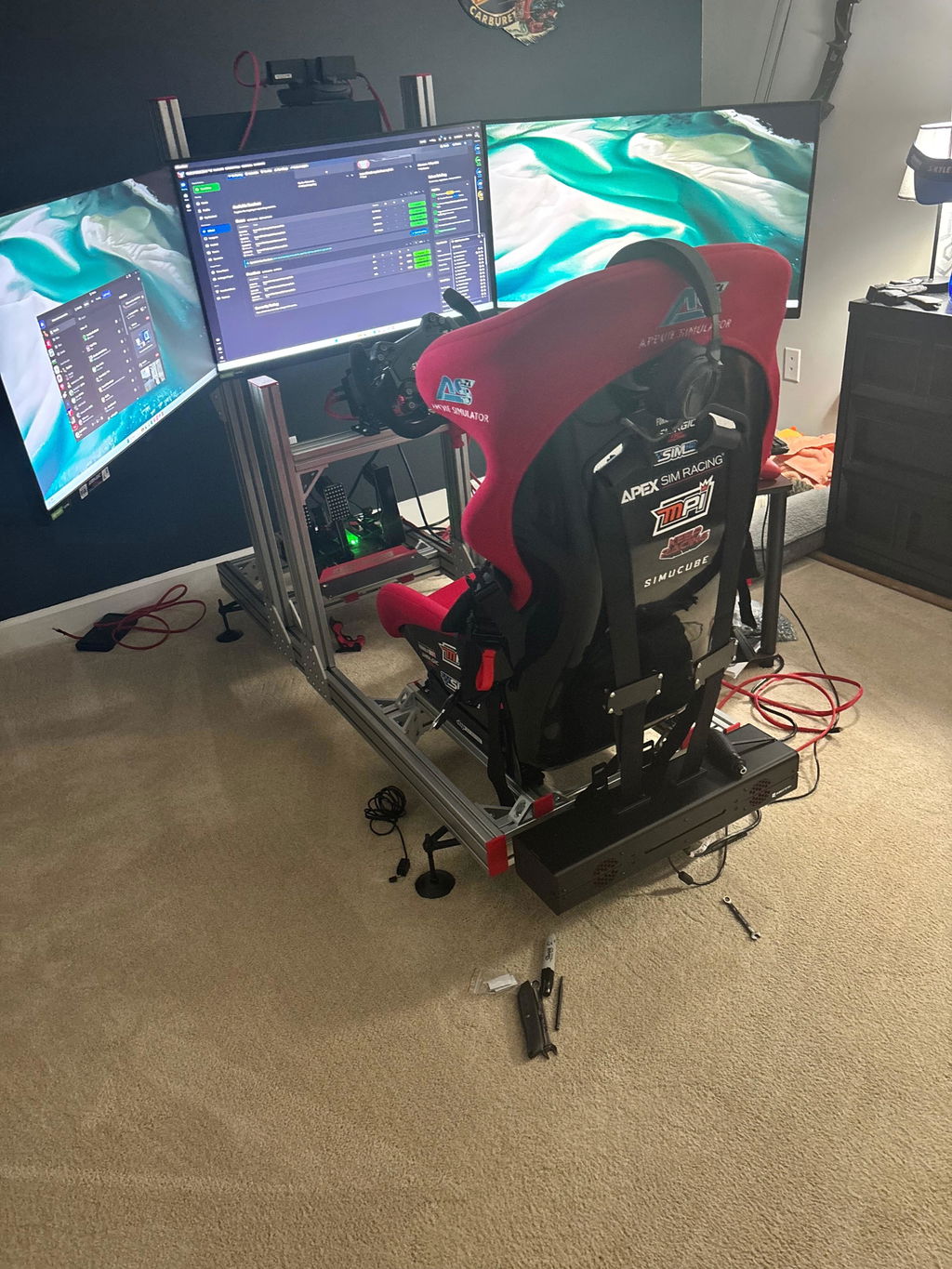
Investing in a simucube 2 sport is only half the battle. To actually feel the 17Nm of torque as the engineers intended, your physical foundation must be compromise-free. Many racers attempt to mount high-fidelity bases to thin steel wheel decks or wooden rigs, only to find the feedback feels muddy. This happens because the energy meant for your hands is being absorbed by the chassis. Flex is the ultimate enemy of detail. When your rig moves even a millimeter under load, you lose the high-frequency vibrations that signal tire scrub or a loss of traction. We recommend an aluminum extrusion foundation to ensure every bit of data reaches your fingertips.
Mounting geometry also plays a vital role in signal clarity. While bottom-mounting is common in consumer gear, the simucube 2 sport excels with front or side-mount brackets. These methods secure the motor housing more rigidly to the uprights, reducing the leverage that causes horizontal oscillation. You also need to consider electromagnetic interference (EMI). High-performance direct drive motors can occasionally interfere with unshielded peripherals. Using high-quality, shielded cables and ensuring your rig is properly grounded will prevent ghost inputs or signal dropouts during a race.
Selecting the Right Chassis
A professional-grade setup requires a chassis that can withstand sustained rotational forces without groaning. For a base of this caliber, we suggest a minimum of 80/40 aluminum profile, though 160/40 is preferred for the main uprights to eliminate all traces of movement. Your wheel deck or motor mount should be at least 10mm thick steel or 15mm aluminum. If you're unsure if your current setup can handle the strain, consult The Ultimate Sim Rig Guide for detailed extrusion rig recommendations tailored for 2026 hardware.
The Critical Secondary Upgrade: Pedals
Steering precision is useless if your braking is inconsistent. High-end bases must be paired with load-cell or hydraulic pedals to create a balanced simulator. While the simucube 2 sport tells you what the front tires are doing, a set of Heusinkveld Sim Pedals Sprint or Ultimate+ will provide the pressure-based feedback needed to stop the car on a dime. This synergy between steering fidelity and braking pressure is what allows professional drivers to find consistency lap after lap. If you want a perfectly calibrated cockpit without the assembly headaches, consider a Turnkey Racing Simulator Package that arrives ready for the track.
Professional Simulation with Apevie Simulators: Turnkey Simucube Solutions
While the simucube 2 sport provides the industrial foundation for elite performance, the true value of high-end hardware is only realized through meticulous calibration. Professional-grade equipment shouldn't be a source of frustration. At Apevie Simulators, we treat every simulator build as a cohesive ecosystem where the wheelbase, pedals, and motion system work in perfect harmony. We specialize in white-glove installation and expert consultation, ensuring you avoid the common pitfalls of mismatched gear. Our goal is to translate raw technical specs into a natural, intuitive driving experience.
Integrating a high-fidelity base like the Sport with advanced haptics requires a deep understanding of signal processing. We often pair this unit with a Sigma Integrale DK2 Motion System to provide a complete sensory experience. This combination allows the driver to feel the 17Nm of steering resistance while simultaneously receiving chassis pitch and roll data through the seat. It’s this layer of integration that separates a gaming setup from a professional training tool. You aren't just playing a game; you're developing muscle memory that translates directly to the real track.
The Turnkey Difference
Our turnkey approach removes the guesswork from the equation. We pre-configure Simucube Tuner profiles for your specific racing disciplines, whether you focus on endurance GT3 racing or sprint-format open-wheelers. By the time your simulator arrives, the feedback frequency and damping settings are already optimized for your specific wheel and pedal combination. We frequently utilize Cube Controls steering wheels in our builds. These components offer the tactile response and build quality that a simucube 2 sport deserves. Every system is a fully integrated solution designed for reliability and immersion.
Expert Support and Consultation
A professional simulator is a long-term investment. Our relationship with clients doesn't end at the point of sale. We provide ongoing support for software updates and rig adjustments as your driving style evolves. Apevie Simulators focuses exclusively on professional PC-based hardware because it offers the customizability and fidelity that serious drivers demand. We don't compromise on component quality or signal integrity. If you're ready to build a world-class cockpit, consult with an Apevie Simulators expert to design your Simucube-powered turnkey simulator. We'll help you select the right parts to ensure your rig remains at the cutting edge for years to come.
Refining Your Path to Professional Simulation
The choice to invest in the simucube 2 sport represents a shift from chasing raw power to prioritizing signal purity. You've seen how 17Nm provides the necessary headroom for sharp transients without the mechanical overkill that leads to driver fatigue. By pairing this industrial-grade motor with the intuitive Simucube Tuner software and a rigid aluminum foundation, you create a simulator that rewards precision rather than just strength. It's about feeling the tire slip at the exact millisecond it occurs, allowing for the consistent lap times that define professional-grade driving.
This dedication to precision and high-fidelity feedback isn't limited to the racing world; athletes who demand the same level of technical excellence in other sports can explore Raquetes de Tênis Performance to find professional-grade equipment that bridges the gap between technology and performance.
Navigating the complexities of high-performance hardware doesn't have to be a solitary challenge. As an Authorized Simucube Dealer, Apevie specializes in custom high-performance turnkey rigs that eliminate the guesswork of component matching. Our team provides expert white-glove installation to ensure every haptic signal and steering input is perfectly calibrated for your specific goals. If you're ready to move beyond standard setups, Build Your Professional Simucube Rig with Apevie Simulators today. We're here to help you design a cockpit that truly reflects your passion for the track.
Frequently Asked Questions
Is 17Nm of torque enough for a realistic sim racing experience?
Yes, 17Nm is more than sufficient for most GT3 and Formula car simulations. Most real-world steering forces in these categories fall between 8Nm and 12Nm during sustained cornering. Having a 17Nm ceiling on the simucube 2 sport allows the base to handle sharp peak transients without signal clipping. This provides a high-fidelity experience that captures every curb strike and tire scrub without the physical exhaustion often caused by higher-torque units.
Does the Simucube 2 Sport work with consoles like PlayStation or Xbox?
No, Simucube wheelbases are designed exclusively for PC-based simulation. They require a direct USB connection to a computer running Windows to utilize the Simucube Tuner software. If you're looking for console-compatible gear, you'll need to consider other brands. Simucube focuses entirely on the professional PC market to maintain the highest possible signal frequency and processing speed.
What is the difference between the Simucube 2 Sport and the Simucube 2 Pro?
The primary difference lies in the peak torque output and the power supply configuration. The simucube 2 sport offers 17Nm of torque and uses a single power supply unit. The Pro model delivers 25Nm and uses a different motor winding to achieve higher forces. Both share the same ultra-low latency processing and industrial build quality, but the Pro provides more headroom for simulating vintage cars or heavy prototypes that lack power steering.
Which steering wheels are compatible with the Simucube 2 Sport?
Any steering wheel that uses the Simucube Quick Release (SQR) or a standard 70mm bolt pattern is compatible. This includes premium rims from Gomez Sim Industries (GSI), Cube Controls, and other high-end manufacturers. Because it uses a universal connection standard, you can choose from a vast ecosystem of professional-grade wheels. You aren't locked into a single brand's ecosystem, allowing for a truly custom cockpit setup.
Do I need a special rig to mount the Simucube 2 Sport?
Yes, a rigid aluminum extrusion rig is highly recommended to handle the rotational forces without flex. Rigs made from thin steel or wood will often vibrate or bend under 17Nm of torque. This movement absorbs the fine details of the force feedback, making the car feel muddy. A solid foundation ensures that the motor's energy is transmitted directly to your hands rather than being lost through the chassis.
What is the Simucube Quick Release (SQR) system?
The SQR is a zero-play mechanical coupling system designed to connect the wheel to the motor shaft. It uses a tapered wedge design and a safety pin to eliminate any mechanical slop. This ensures that the high-frequency feedback generated by the motor is transmitted with absolute clarity. Unlike spring-loaded systems, the SQR won't develop play or rattling over time, even after years of heavy use.
Can I use third-party software with Simucube True Drive?
Most racers now use the updated Simucube Tuner software, which replaced the older True Drive interface in March 2025. While you can use third-party apps like SimHub for dash displays and haptic feedback, the core steering settings must be managed through Simucube's proprietary software. This ensures that the signal processing remains clean and that you can access the "Paddock" community for shared car profiles.
How does the Simucube 2 Sport handle force feedback clipping?
The Sport manages clipping through its 17Nm overhead and sophisticated internal signal processing. Clipping occurs when the sim requests more torque than the motor can provide, leading to a loss of detail. By setting your in-game gain correctly, you ensure that even the largest curb strikes remain within the motor's operating range. This preserves the high-frequency data you need to feel the car's limit at all times.