Simucube 2 Pro: The Professional Benchmark for Direct Drive in 2026
Why would a professional driver choose a wheelbase from a previous generation over the latest flagship model? While the market is flooded with high-torque options, the simucube 2 pro remains the definitive choice for those who prioritize fidelity over raw power. You've likely felt the frustration of force feedback clipping mid-corner in a high-downforce GT3 car or the distracting, notchy sensation found in lesser direct drive bases. It's a common hurdle that prevents you from developing the precise muscle memory needed for consistent podium finishes.
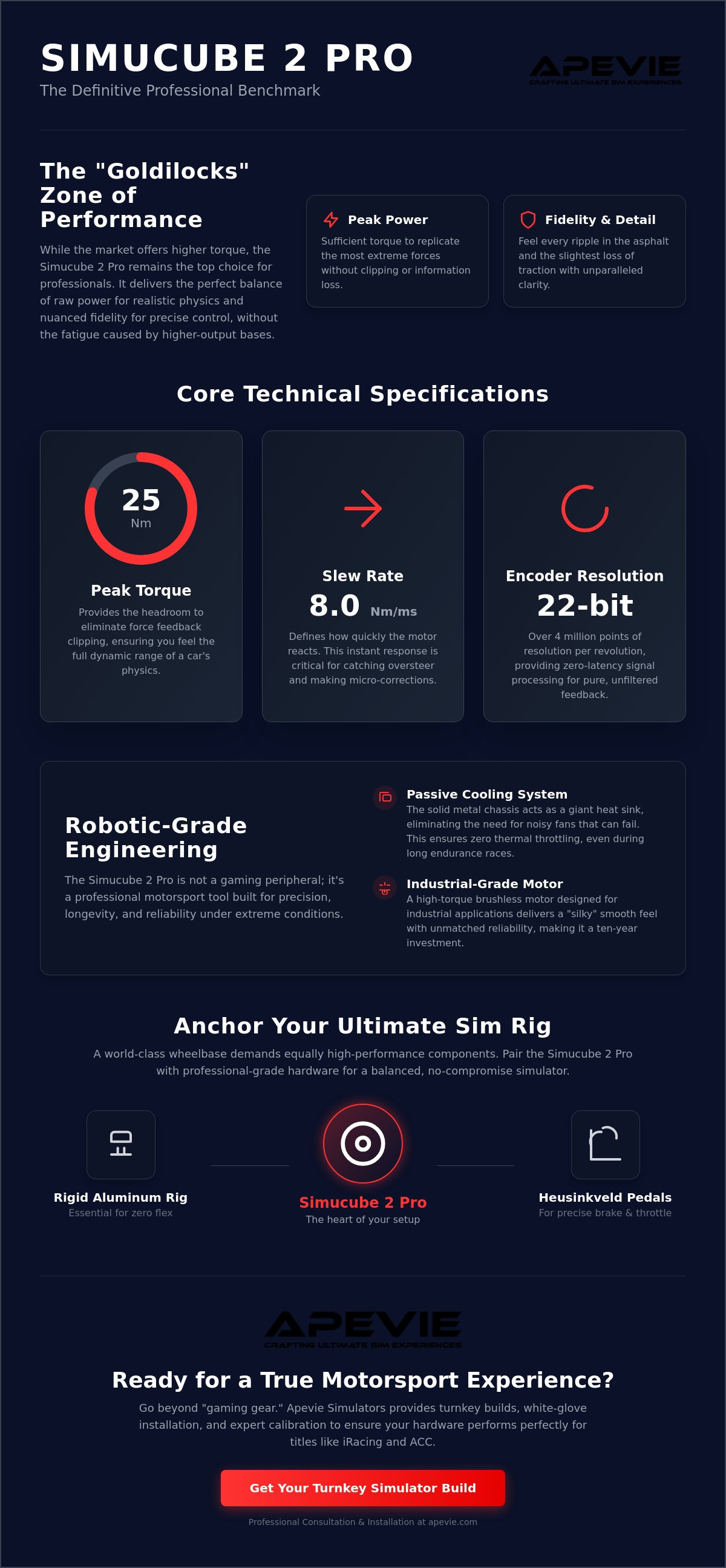
We understand that a simulator should feel like a precision tool, not a peripheral. In this guide, we'll explore why the 25 Nm peak torque and 8.0 Nm/ms slew rate of the Simucube 2 Pro still represent the "Goldilocks" zone for professional sim racing in 2026. We'll break down the transition to the unified Simucube Tuner software and explain how this base anchors a high-performance, turnkey simulator build. You'll discover how zero-latency response and industrial-grade reliability can transform your training from a gaming session into a genuine motorsport experience.
Key Takeaways
- Understand why 25Nm of peak torque makes the simucube 2 pro the ideal benchmark for professional physics without the fatigue of higher-output bases.
- Explore the technical impact of a high slew rate and how it provides the zero-latency response needed to catch oversteer instantly.
- Learn how to build a balanced ecosystem by pairing your wheel base with high-end components like Heusinkveld pedals and rigid aluminum rigs.
- Evaluate the performance gap between the Simucube 2 and the new Simucube 3 to determine which investment best suits your racing goals.
- Discover the benefits of white-glove installation and how expert calibration ensures your hardware is perfectly tuned for titles like iRacing and ACC.
What is the Simucube 2 Pro? Defining the Direct Drive Standard
At its core, the simucube 2 pro is an industrial-grade direct drive wheel base designed to eliminate the mechanical barrier between the driver and the simulation. Unlike entry-level gear that relies on belts or gears to amplify torque, this unit utilizes a high-torque brushless motor connected directly to the steering shaft. This architecture establishes the Direct Drive Standard for modern simulation, providing a path for zero-latency feedback that feels identical to a real-world steering rack. The result is a transparent connection where every ripple in the asphalt and every loss of traction is communicated instantly to your hands.
The "Pro" designation represents a specific performance tier where 25Nm of torque serves as the definitive sweet spot for professional sim racing physics. While some bases offer higher peak numbers, 25Nm allows for a complete, uncompressed representation of a car's physics. The internal architecture features a high-bandwidth signal processing system and the R2 dual-power supply, which ensures the motor receives clean, consistent energy even during high-load spikes. At Apevie Simulators, we frequently select the Pro model as the structural foundation for our custom high-performance racing simulators because it offers the perfect balance of raw power and nuanced detail.
The Physics of 25Nm Torque
When you're diving into a high-speed corner at Spa in a GT3 car, the steering rack experiences massive loading. If your hardware lacks sufficient headroom, you encounter force feedback clipping. This occurs when the simulation requests more force than the motor can provide, causing the feedback to "flatline" and hide vital information about tire grip. The 25Nm peak torque of the simucube 2 pro provides the necessary headroom to ensure that the highest momentary steering forces never exceed the motor's capabilities, preserving a full dynamic range of feedback. This allows you to translate real-world steering rack forces into your muscle memory without the artificial dampening found in weaker systems.
Industrial-Grade Engineering
The transition from consumer gaming peripherals to Simucube hardware is a shift toward robotic-grade engineering. These motors are designed for precision and longevity, featuring exceptional heat dissipation that prevents thermal throttling during grueling endurance races. There are no internal fans to fail or create distracting noise; instead, the solid metal chassis acts as a passive heat sink. This robust construction is why we consider the unit a ten-year investment. It's built to withstand the rigors of daily professional use while maintaining the same "silky" feel and mechanical integrity it had on day one. For the serious enthusiast, it represents a move away from "gaming gear" toward a professional motorsport tool.
Technical Superiority: Slew Rate, Latency, and Fidelity
The technical prowess of the simucube 2 pro isn't just a matter of marketing; it's a matter of physics. While many enthusiasts focus solely on the 25Nm torque ceiling, the true differentiator in 2026 remains the torque slew rate of 8.0 Nm/ms. This metric defines how quickly the motor can change its torque output. In a high-speed oversteer scenario, you don't need raw power as much as you need immediate communication. A high slew rate allows the wheel to snap into position, giving you the micro-seconds required to catch a slide before it ends your race. It's this level of responsiveness that has solidified the unit as The Professional Benchmark for serious sim racers who demand transparency from their hardware.
Zero-Latency Signal Processing
Precision starts with the 22-bit absolute encoder. This sensor tracks the wheel's position with incredible granularity, offering over 4 million distinct points of resolution per revolution. When paired with high-bandwidth signal processing, the system interprets telemetry data faster than the human nervous system can process a physical sensation. This eliminates the "mushy" feeling found in entry-level direct drive systems. Instead of a vague approximation of the road, you get a pure, unfiltered signal. This clarity is essential for developing the muscle memory required to consistently hit apexes in simulators like iRacing or Assetto Corsa Competizione. The signal purity ensures that the vibrations you feel are coming from the virtual track, not electronic noise within the motor.
Simucube Tuner vs. True Drive
The software experience saw a massive shift on March 26, 2025, with the release of Simucube Tuner. This unified platform replaced the older True Drive software, bringing a more intuitive interface and advanced features like the Torque Linearity Filter. One of the most significant upgrades is the automatic profile switching. The software detects whether you're launching iRacing, ACC, or a professional rFactor 2 build and applies your specific settings instantly. This removes the technical friction from your session. For those who prefer a seamless experience, we offer customized turnkey builds where we pre-configure these software profiles based on real-world telemetry and professional driver feedback.
Beyond the internal electronics, the simucube 2 pro excels in its ecosystem. The integrated wireless wheel support allows for a cable-free cockpit when using high-end rims like the Gomez Sim Industries (GSI) Formula Pro Elite or the Cube Controls F-Core. This isn't just about aesthetics; it prevents cable snagging during aggressive steering inputs. Additionally, the torque ripple minimization ensures the motor rotation is perfectly smooth. You won't feel any magnetic "notching" as you turn the wheel. This allows the subtle vibrations of the track surface and tire scrub to take center stage, providing a silky feel that remains consistent even after hours of endurance racing.
Simucube 2 Pro vs. Sport vs. Ultimate vs. Simucube 3
Choosing the right motor is about matching the hardware to the specific physics of your preferred racing discipline. While the Simucube ecosystem offers several tiers, the simucube 2 pro remains the most popular choice for professional sim rigs because it avoids the diminishing returns often found in higher-torque models. Moving from the 17Nm Sport to the 25Nm Pro provides a tangible leap in dynamic range, yet for most GT3 and Formula drivers, the jump to the 32Nm Ultimate or the newer Simucube 3 series is often more about prestige than a functional improvement in lap times.
Choosing Your Torque Ceiling
- 17Nm (Sport): This unit is ideal for rally and street car simulation where steering racks are naturally lighter. It provides plenty of detail without requiring the extreme physical effort of a formula rack during long sessions.
- 25Nm (Pro): This is the industry standard for GT3, GTE, and Formula racers. It offers enough headroom to replicate real-world steering forces without clipping, ensuring you never lose fidelity in high-compression corners.
- 32Nm+ (Ultimate/Simucube 3): These bases are for those demanding the absolute peak of industrial force. They're best suited for high-downforce prototypes or drivers who want the highest possible fidelity at the extreme ends of the torque spectrum.
Simucube 2 Pro vs. Simucube 3
The release of the Simucube 3 line in late 2025 introduced significant hardware advancements, including the Simucube Link Platform and the LightBridge quick release system. The Simucube 3 Pro, starting at $1,599, offers a new motor architecture and telemetry-based effects that create a more integrated ecosystem, especially when paired with Simucube ActivePedals. Despite these innovations, the simucube 2 pro continues to receive full support through the unified Simucube Tuner software, which ensures the older platform remains technically relevant for years to come.
For many buyers in 2026, the decision comes down to the ecosystem. If you don't plan to utilize the specific Link Platform features or the LightBridge system, the Simucube 2 Pro offers nearly identical steering fidelity for a more accessible investment. It remains a reliable, high-performance anchor that won't feel outdated. To understand how to properly mount these high-torque units and prevent chassis flex, you can learn more about the foundation of these systems in The Ultimate Sim Rig Guide.
Apevie Simulators selects the Pro model for our turnkey builds because it represents the most balanced price-to-performance ratio in the high-end market. It provides the industrial-grade reliability our clients expect without the unnecessary cost of ultra-high torque bases that few drivers can fully utilize for extended endurance sessions.
Building the Ecosystem: Pedals, Motion, and Wheels
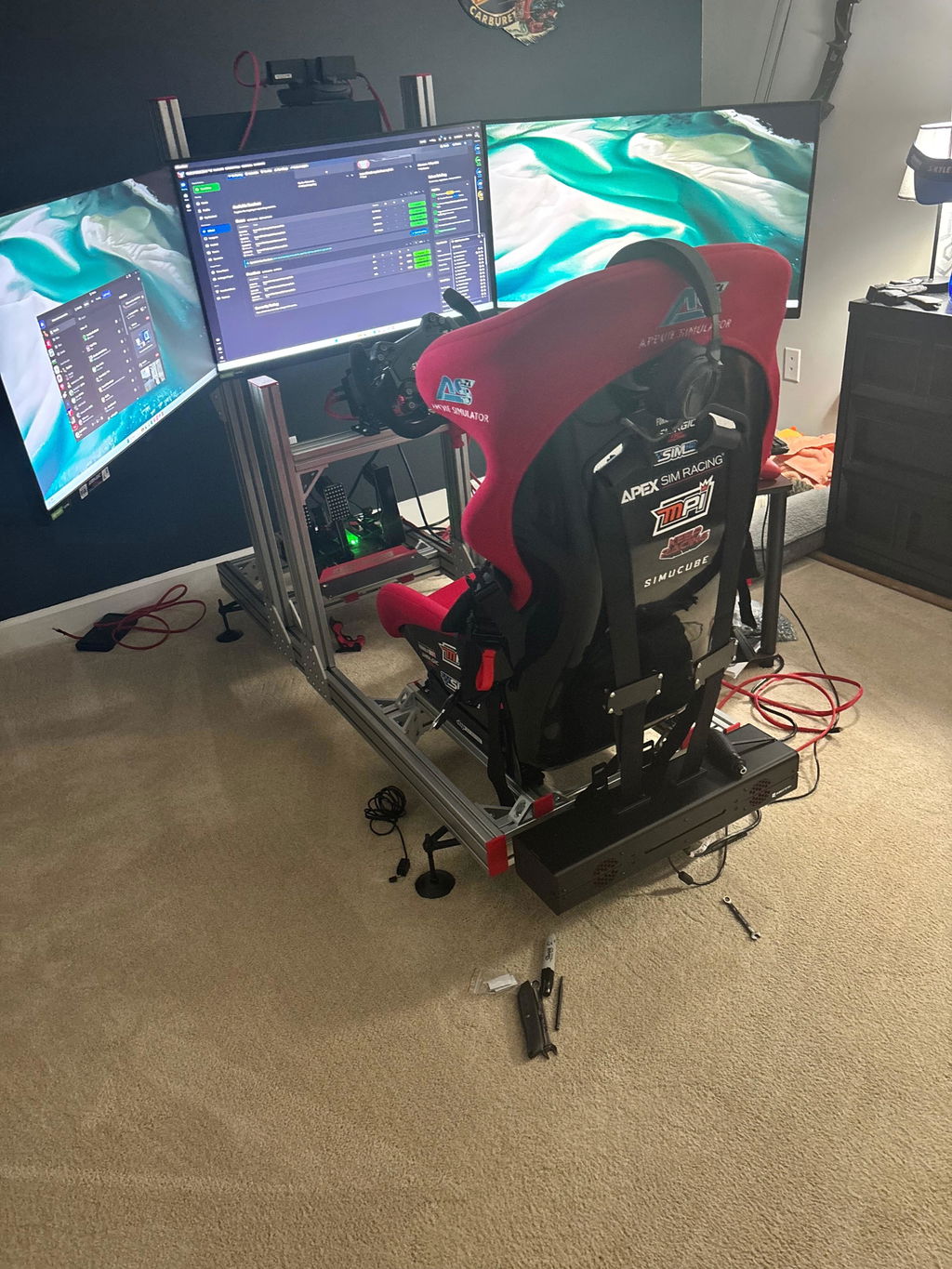
Owning a simucube 2 pro is only the first step toward a professional-grade simulator. To truly experience the fidelity this motor offers, you must mount it to a foundation that can handle the stress. A standard desk mount or a lightweight cockpit will fail under the 25Nm of peak torque. Without a rigid aluminum extrusion rig, that energy turns into chassis flex rather than steering feedback. This flex muddies the signal, making it harder to sense the subtle weight transfers that occur before a car loses grip. We always recommend a heavy-duty profile rig to ensure every bit of torque reaches your hands without compromise.
Steering wheels also play a critical role in this haptic loop. The simucube 2 pro ecosystem excels because it supports high-end wireless rims like the Gomez Sim Industries (GSI) Formula Pro Elite and the Cube Controls F-Core. These wheels offer the structural integrity required to translate high-torque forces without creaking or flexing. By eliminating cables through Simucube's wireless protocol, you remove the risk of snagging wires during aggressive corrections, maintaining a clean and professional cockpit environment.
Braking and Steering Synergy
Steering fidelity is useless if your braking performance is inconsistent. Your brain needs to balance the "weight" of the steering with the pressure of the brake pedal to build a complete picture of the car's balance. This is why we pair Simucube bases with professional-grade sim racing pedals, such as the Heusinkveld Sim Pedals Ultimate+. When you calibrate your motor to match the high force requirements of a load cell brake, you create a balanced haptic feedback loop. This synergy allows you to feel exactly how much trail braking you can apply before the front tires begin to scrub, a sensation that is often lost on lesser equipment.
Haptic and Motion Integration
Integrating motion adds another layer of complexity. The Simucube 2 Pro is fully compatible with advanced systems like the Sigma Integrale DK2 and D-BOX actuators. However, high-power motion rigs often generate significant Electromagnetic Interference (EMI), which can cause steering glitches or signal drops. Managing this requires professional cable shielding and grounding techniques. When we build a professional haptic system, we focus on isolating these signals so the vibrations from the motion platform don't interfere with the telemetry-driven feedback of the wheel base.
Achieving this level of integration is difficult for the average hobbyist. If you want to skip the technical frustration of EMI management and software calibration, consider our turnkey simulator solutions where we handle every detail from assembly to final tuning.
The Apevie Advantage: Turnkey Simucube 2 Pro Solutions
Investing in a simucube 2 pro represents a commitment to the highest levels of digital motorsport. However, hardware alone doesn't guarantee a podium finish. The real challenge lies in the integration of disparate components into a unified, high-performance ecosystem. At Apevie Simulators, we specialize in bridging the gap between a collection of premium parts and a professional-grade racing machine. Our turnkey solutions ensure that your wheel base, pedals, and motion system work in perfect harmony, eliminating the technical friction that often plagues high-end DIY setups.
A professional simulator should be a "get in and drive" experience. Our white-glove installation service removes the frustration of software bugs, firmware updates, and complex cable management. Whether you're integrating Heusinkveld pedals or a Sigma Integrale DK2 motion system, our team handles the heavy lifting. We provide national support across the United States, bringing professional PC-based hardware directly to your home or facility.
Why Order Through a Professional Builder?
The most common point of failure in a high-end simulator isn't the motor; it's the PC configuration. We don't just ship boxes; we provide pre-configured PC builds optimized specifically for the high-bandwidth requirements of Simucube hardware and high-refresh-rate triple monitor setups. This includes fine-tuning the operating system to prioritize simulation telemetry, which reduces input lag to the absolute minimum.
Our builds also focus on the ergonomic and structural requirements of 25Nm of torque. We design custom mounting solutions that ensure zero flex, allowing you to utilize the full dynamic range of the simucube 2 pro without compromising your seating position. This professional approach extends to your choice of steering wheel. We often integrate the GSI Formula Pro Elite into our builds, ensuring that the wireless handshake and button mapping are ready the moment you power on the rig.
Get Your Custom Simucube Build Started
If you're ready to move beyond consumer-grade gaming setups and invest in a genuine motorsport tool, it's time for a professional consultation. We don't deal in arcade gear or console compromises. Our focus is strictly on high-performance, industrial-grade hardware that delivers results. You can consult with Apevie Simulators for your custom Simucube 2 Pro build to begin designing a rig that matches your competitive ambitions and provides the reliability you need for years of daily training.
Elevating Your Performance on the Digital Circuit
The simucube 2 pro has secured its place as the definitive foundation for professional simulation in 2026. By balancing 25Nm of peak torque with an industry-leading slew rate, it provides the transparency needed to train your muscle memory without the artificial barriers found in consumer gear. You've seen how this hardware functions not just as a motor; it acts as a gateway to a complete ecosystem of GSI wheels, Heusinkveld pedals, and high-fidelity motion systems that define the modern sim racing standard.
Transitioning to this level of performance shouldn't be a technical burden. As an authorized Simucube and GSI dealer, Apevie Simulators specializes in professional PC-based simulation that eliminates the guesswork of DIY assembly. Our white-glove installation service is available nationwide, ensuring your custom rig is calibrated for peak performance the moment it arrives. We focus on the intricate details of EMI management and software optimization so you can focus on your lap times. Don't let software conflicts or cable management issues slow down your progression.
Build Your Turnkey Simucube 2 Pro Rig with Apevie Simulators and experience the difference that expert consultation and industrial-grade engineering make on every lap. Your journey toward consistent podium finishes starts with the right foundation.
Frequently Asked Questions
Is 25Nm of torque dangerous for home use?
Torque levels at this scale can be physically demanding and potentially cause injury if you don't follow proper safety protocols. The simucube 2 pro is an industrial-grade motor, so it's powerful enough to snap the wheel back during a crash. However, the Simucube Tuner software includes hands-off detection and an emergency stop button to mitigate these risks. We recommend starting with lower torque limits while you acclimate to the forces, especially if younger or less experienced drivers are using the rig.
Do I need a special power outlet for the Simucube 2 Pro R2?
You don't need a specialized high-voltage outlet for this hardware. The Simucube 2 Pro R2 operates perfectly on standard 110V or 230V household circuits. The R2 version utilizes a dual power supply system that efficiently manages energy draw even during peak torque spikes. It's always best to use a high-quality surge protector or a dedicated power strip to shield the sensitive internal electronics from fluctuations in your home's electrical grid.
Can I use the Simucube 2 Pro with a PlayStation or Xbox?
This wheel base is strictly a PC-only device designed for professional simulation software. It doesn't have native compatibility with PlayStation or Xbox consoles. While some third-party adapters exist on the market, they often compromise the signal fidelity and zero-latency response that make Simucube hardware valuable. For the best experience, we always pair these systems with a dedicated high-performance racing PC to ensure the telemetry signal remains unfiltered.
What is the best steering wheel for the Simucube 2 Pro?
The ideal wheel depends on your preferred racing discipline, but the Gomez Sim Industries (GSI) Formula Pro Elite and Cube Controls F-Core are the top-tier choices for this motor. These wheels support the Simucube wireless protocol, which eliminates distracting cables while maintaining an instantaneous connection. They're built with the structural integrity required to handle 25Nm of torque without flexing, ensuring that every bit of feedback is transmitted directly to your hands.
How does the Simucube 2 Pro compare to Fanatec Podium bases?
Simucube bases generally offer superior force feedback fidelity and lower latency compared to the older Fanatec Podium DD1 or DD2 units. While Fanatec provides a convenient ecosystem for console users, Simucube's industrial-grade motors and 22-bit encoders provide a much "cleaner" signal. The simucube 2 pro feels more mechanical and transparent, whereas the Podium series can sometimes feel dampened by internal processing filters that mask subtle road details.
Does the Simucube 2 Pro come with a quick release?
Every unit includes the Simucube Quick Release (SQR) system as standard. This is a zero-backlash, pin-based mechanism that ensures a rock-solid connection between the motor shaft and your steering wheel. It's specifically designed to withstand high torque loads without developing the "play" or wobbling often found in consumer-grade quick releases. You'll simply need an SQR wheel-side kit for each additional steering wheel you plan to use with the base.
What is the difference between the R1 and R2 versions of the Simucube 2 Pro?
The primary differences involve the power delivery system and internal hardware revisions. The R1 version utilized a single, large power brick, while the R2 version moved to a dual-power supply system for improved thermal efficiency and reliability. The R2 also features updated internal electronics for more refined signal processing. Both versions deliver the same 25Nm peak torque and are fully compatible with the latest Simucube Tuner software released in 2025.
How often does Simucube release firmware updates?
Simucube releases firmware updates several times a year to refine motor performance and add support for new simulation titles. Since the software was unified under Simucube Tuner on March 26, 2025, the update process has become more streamlined. These updates frequently include new filters, such as the Torque Linearity Filter, which further improves the "silky" feel of the feedback. We handle all initial firmware calibration as part of our white-glove installation to ensure your system is ready for the track.