Simucube vs Fanatec in 2026: The Ultimate Direct Drive Comparison for Professional Sim Racers
If you're building a professional-grade rig in 2026, the traditional Simucube vs Fanatec debate might actually be leading you toward a compromise you didn't see coming. You've likely spent hours weighing Simucube's clinical precision against Fanatec's massive ecosystem, feeling the weight of analysis paralysis as you try to avoid a closed system that limits your future wheel options. It's a common struggle for racers who demand more than just a gaming peripheral; they need a tool that mirrors the physics of a real cockpit.
We understand that at this level, you aren't just looking for raw torque. You're looking for the clarity of force feedback that translates into faster lap times and consistent muscle memory. This guide will break down the performance data of the Simucube 3 Pro and the updated Fanatec ClubSport DD+ to help you choose the right foundation. You'll also discover why Moza Racing has emerged as a definitive high-performance alternative and how Apevie Simulators provides the expert consultation needed to integrate these components into a reliable, turnkey solution.
Key Takeaways
- Understand the core philosophical divide between the industrial-grade precision of the Simucube 3 and the comprehensive, user-friendly ecosystem offered by Fanatec.
- Navigate the Simucube vs Fanatec choice with a professional framework that evaluates long-term compatibility with elite hardware like Gomez Sim Industries (GSI) wheels.
- Learn why high torque is essential for capturing granular force feedback details and how to use software like True Drive to refine your muscle memory training.
- Explore how Moza Racing has disrupted the mid-to-high tier market by offering a sophisticated software suite and performance that rivals traditional leaders.
- Discover the critical role of professional calibration and white-glove installation in transforming high-end hardware into a seamless turnkey simulator.
The Direct Drive Duel: Simucube vs Fanatec in 2026
The 2026 Simucube vs Fanatec rivalry isn't just a battle of torque numbers. It's a fundamental clash between two different ways of experiencing a race car's limit. While Fanatec has focused on making high-end racing accessible through integrated ecosystems, Simucube has doubled down on its reputation for laboratory-grade precision. Just as researchers in other scientific fields rely on Apex Pro to buy research peptides online with guaranteed purity, sim racers demand hardware that delivers absolute signal integrity. For the professional racer, the choice often comes down to whether you want a plug-and-play solution or a precision instrument that requires expert calibration to unlock its full potential.
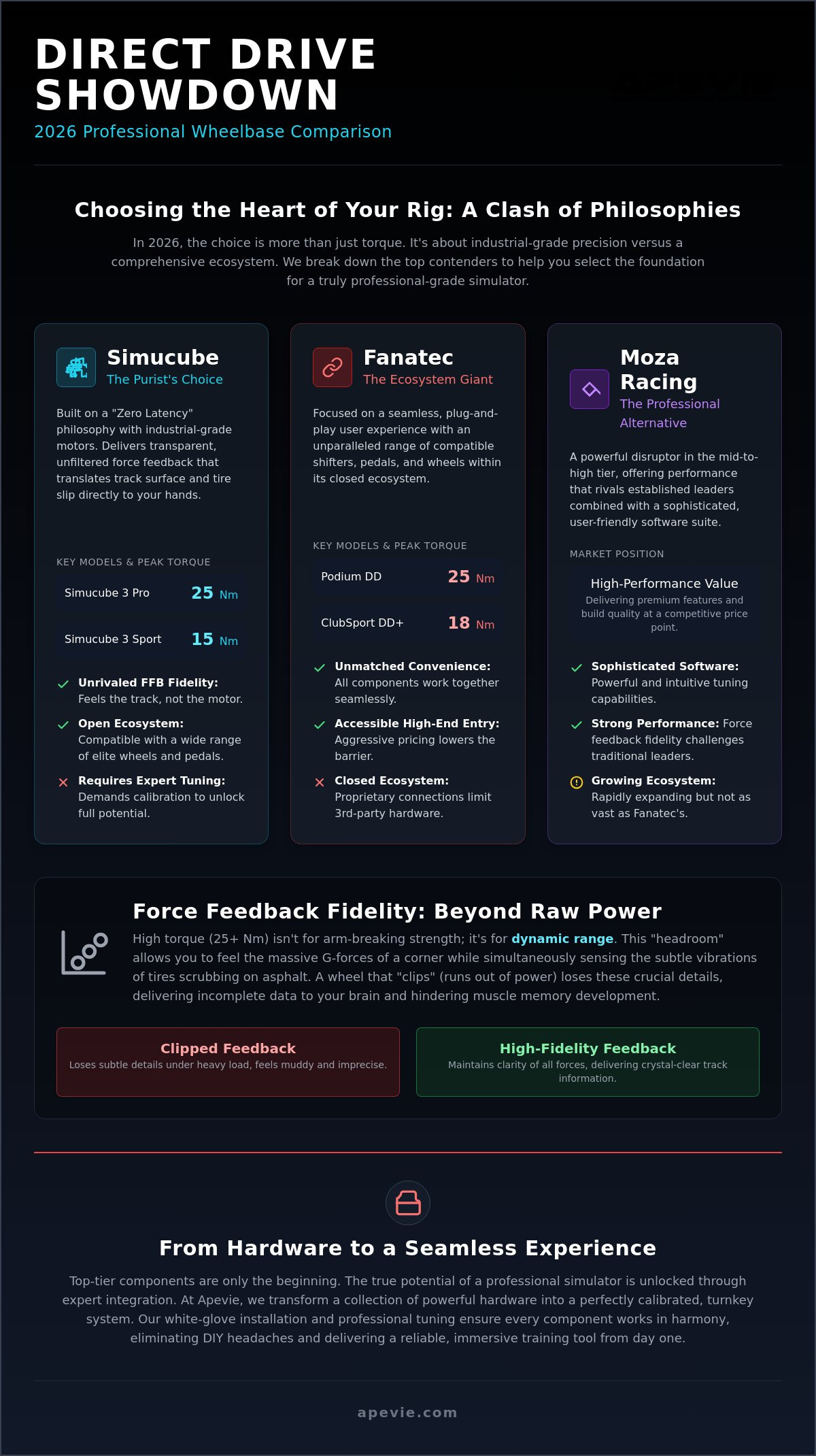
The landscape shifted significantly this year with the release of the Simucube 3 series. This new generation has moved the goalposts for what we expect from Direct Drive technology. It isn't just about the raw power of the motors; it's about the signal processing speed and the elimination of the "mechanical" feel often found in consumer-grade bases. Fanatec responded by pushing their ClubSport DD+ to 18 Nm through software optimization and lowering the entry price for their 25 Nm Podium DD to $1,199. This aggressive pricing makes Fanatec a tempting choice for those building their first high-end rig, but it hasn't quite closed the gap in pure fidelity.
Simucube: The Purist's Choice
Simucube's 2026 lineup is built on a "Zero Latency" philosophy that prioritizes the driver's connection to the front tires. The Simucube 3 Sport offers a refined 15 Nm of torque for €1,405, while the Simucube 3 Pro delivers 25 Nm at €1,656. For those who demand the absolute ceiling of performance, the upcoming Simucube 3 Ultimate is set to deliver a staggering 35 Nm. These units use industrial-grade motors designed for 24/7 operation, which is a far cry from the consumer electronics used in cheaper setups. Professional drivers choose Simucube because the feedback is transparent. You don't feel the motor; you feel the track surface and the tire's slip angle.
Fanatec: The Ecosystem Giant
The primary draw of a Fanatec Wheel Base remains its unparalleled convenience. It's a closed ecosystem that works seamlessly with their wide range of shifters, handbrakes, and pedals. The 2026 driver updates have breathed new life into the ClubSport DD line, providing more headroom for dynamic range. However, the trade-off for this mass-market approach is often found in the proprietary connections. While Fanatec is a "turnkey" brand for many, serious professionals sometimes find the plastic components and QR2 tolerances less inspiring than the heavy-duty machining of a Simucube. At Apevie Simulators, we find that Fanatec serves as an excellent entry point for those who want a cohesive, branded environment without the complexity of mixing hardware from different manufacturers.
Ultimately, professional-grade simulation requires PC-exclusive hardware. Consoles simply cannot process the high-frequency telemetry data required to make a 25 Nm base feel like anything more than a heavy steering wheel. By sticking to PC, you gain access to the granular tuning necessary to turn these powerful motors into genuine training tools.
Force Feedback Fidelity: Precision vs. Power
Many racers mistakenly believe that high torque is only about making the steering wheel harder to turn. In reality, the 25 Nm of peak torque found in the high-end models we've discussed is all about dynamic range. Think of it like a high-end audio system. You don't buy a powerful amplifier just to play music at a deafening volume; you buy it so the quiet, subtle notes remain crystal clear even during a thunderous crescendo. In the context of a Simucube vs Fanatec comparison, this "headroom" ensures that while you're fighting high G-forces in a long sweeper, you can still feel the tiny vibrations of the front tires beginning to scrub across the asphalt.
This clarity is vital for muscle memory training. If your wheel base "clips" because it lacks the power to represent both the cornering force and the track surface simultaneously, your brain receives incomplete data. Recent research on force feedback suggests that these haptic cues are essential for drivers to react instinctively to oversteer. Simucube's approach relies on raw signal processing, while Fanatec's FullForce technology uses a dedicated protocol to send high-frequency vibrations directly through the steering column. Both aim for realism, but they achieve it through different engineering philosophies.
Signal Clarity and Slew Rate
The defining characteristic of high-end hardware is the slew rate. This metric determines how fast the motor can change its torque output. Simucube's industrial-grade motors excel here, reacting almost instantly to a curb strike or a sudden loss of traction. This speed allows for a level of detail where you can distinguish between different types of tire scrub. Simply put; Force Feedback Fidelity is the ratio of signal detail to mechanical noise. Simucube typically offers a "cleaner" signal, whereas Fanatec provides a more dampened, user-friendly feel that some find more comfortable for long endurance stints.
Software Tuning and User Experience
Hardware is only half the battle. Simucube's True Drive software offers surgical control over every aspect of the feedback, which is a dream for those who enjoy fine-tuning for specific cars in iRacing or ACC. Fanatec's Fanalab is arguably more approachable, offering a "set and forget" experience for many. However, both ecosystems now support cloud-based profiles. This allows you to download settings from professional drivers, bypassing the need for a physics degree to get a decent feel. At Apevie Simulators, we take this a step further by pre-configuring these profiles for our professional simulator builds, ensuring your hardware is calibrated for maximum realism the moment you sit in the cockpit.
Ecosystem Compatibility: Rims, Pedals, and Rigs
Choosing between Simucube vs Fanatec often dictates your entire hardware roadmap for years. Fanatec operates a "walled garden" philosophy. It's convenient because everything from the handbrake to the steering wheel plugs directly into the base. This simplicity is great for those starting out, but it can feel restrictive for professionals who want to cherry-pick the best components from different manufacturers. Simucube takes the opposite approach. It's an open platform that treats the wheel base as a standalone component, allowing you to build a truly bespoke cockpit tailored to your specific needs.
On a PC, you don't have to stay within one brand's ecosystem. You can pair a Simucube 3 Wheel Base with Heusinkveld Sim Pedals Ultimate+ to get the best of both worlds. This modularity is a superpower for serious racers. It means you aren't stuck with a manufacturer's specific pedal design just because you like their motor. However, these high-performance parts generate immense forces. Mounting a 25 Nm motor to a desk or a flimsy stand is a recipe for disappointment. A professional sim rig made of heavy-duty aluminum extrusion is non-negotiable to handle the torque without flexing.
Steering Wheel Diversity
The connection between the wheel and the base is a critical failure point. Fanatec's QR2 system is a massive improvement over their older designs, but it still relies on a proprietary interface. If you want to use elite hardware like a Gomez Sim Industries (GSI) Formula Pro Elite or a Cube Controls F-Core, you'll need adapters or third-party conversion kits for Fanatec. Simucube's SQR (Simucube Quick Release) is built with industrial tolerances. It's designed to be rock-solid, which is why many of the F1 style steering wheels used by pro esports teams are built natively for the Simucube platform.
Peripheral Integration
Managing a high-end rig involves more than just plugging in a USB cable. As you add components like the Sigma Integrale DK2 motion system, cable management becomes a serious challenge. Professional builds require a methodical approach to routing and shielding to prevent electromagnetic interference. We often recommend mixing brands to achieve the best result. Using a Simucube base for steering and Heusinkveld for braking provides a level of fidelity that a single-brand setup rarely matches. It's about finding the right tool for each specific job in the cockpit.
The Professional Alternative: Why Moza Racing Dominates the 2026 Mid-to-High Tier
In the historical Simucube vs Fanatec rivalry, a vacuum once existed between industrial purity and mass-market convenience. Moza Racing has filled this space in 2026 by offering a sophisticated middle ground that refuses to compromise on build quality. While others were refining older architectures, Moza's rapid innovation cycle produced the R25 Ultra and the Vision GS wheel, components that challenge the status quo of professional simulation. Their approach integrates the user-friendly ecosystem of a consumer brand with the raw, unfiltered performance expected by elite drivers.
The secret weapon in the Moza Racing collection is the Pit House software. Unlike the technical complexity of Simucube's True Drive or the sometimes fragmented experience of Fanatec's Fanalab, Pit House offers a modern, intuitive suite for simulator management. It allows for one-click setup profiles that actually work, while still providing the deep telemetry hooks needed for professional-grade calibration. It's this balance of accessibility and depth that makes Moza a formidable contender for any high-end rig build.
Moza R21 and R25 Ultra: Direct Drive Contenders
The flagship Moza bases, particularly the R25 Ultra, now go toe-to-toe with the Simucube 3 Pro in terms of raw fidelity. With 25 Nm of torque, these bases provide the necessary headroom to avoid signal clipping during high-load cornering. The integration of the "Vision" dash ecosystem offers a cohesive cockpit experience that feels more like a modern GT3 car than a collection of separate parts. We've found that the latest Moza rims, featuring forged carbon fiber and high-tactile switches, rival the build quality of boutique manufacturers. This makes them an excellent choice for racers who want premium materials without the "closed system" headaches often found in the Simucube vs Fanatec debate.
Value Engineering without Compromise
Choosing Moza isn't about finding a budget shortcut; it's about maximizing the performance-to-integration ratio. A full Moza setup often provides a more seamless experience than trying to bridge hardware gaps with various third-party adapters. For those seeking an Apevie turnkey simulator, Moza offers a reliable foundation that simplifies the technical overhead without sacrificing the slew rate or signal clarity required for competitive racing. One common mistake is underestimating the torque requirements for muscle memory. We always recommend the R12 V2 or higher for serious training to ensure you have enough dynamic range to feel the tire's slip angle accurately.
If you're ready to step into a professional cockpit without the DIY integration headaches, explore our turnkey Moza-powered builds and see how we calibrate this hardware for peak performance.
Choosing Your Path: Turnkey Performance vs. DIY Headache
The Simucube vs Fanatec decision is a significant milestone for any racer, but it's only the beginning of the journey toward a truly professional setup. Owning a 25 Nm motor doesn't guarantee a realistic experience; in fact, high-end gear often highlights the flaws in a poorly configured rig. If your base isn't mounted to a rigid foundation or your software filters are working against the game's physics, you've essentially bought a very expensive gaming peripheral rather than a professional training tool. Realism lives in the details of integration, not just the brand on the box.
Apevie Simulator bridges this gap through expert consultation and white-glove installation. We don't just ship parts; we curate and calibrate ecosystems to ensure every component works in harmony. Whether we're integrating a Simucube 3 for a purist or a Fanatec Podium for someone who values the existing ecosystem, our goal is to eliminate the technical friction that keeps you out of the driver's seat. We handle the firmware updates, cable management, and electromagnetic shielding so you can focus entirely on your lap times.
The Importance of Expert Calibration
Standard "out of the box" settings are designed for the average user, not the professional driver. They often mask the very telemetry data you need to find those last few tenths of a second. We spend hours tuning the signal processing to ensure the wheel's rotation matches the car's steering rack perfectly. This precision extends to how we synchronize haptic systems with your wheel base output. When your seat vibrates in perfect time with a tire scrub felt through the rim, your brain stops seeing a screen and starts seeing a racetrack. This level of immersion is only possible through professional rig assembly and methodical testing.
Designing Your Custom Rig
Balancing a budget while chasing peak performance requires knowing where to invest. We often suggest spending more on a rock-solid aluminum extrusion frame and high-quality pedals like the Heusinkveld Sim Pedals Ultimate+ before chasing the highest possible torque numbers. For busy professionals and racing teams, a turnkey solution is the only way to ensure the simulator is a reliable asset rather than a constant maintenance project. After extensive testing of the 2026 hardware landscape, the Moza Racing collection has become our top recommendation for those seeking a balance of innovation, build quality, and software stability. It provides the high-performance foundation needed for a modern cockpit without the integration headaches of older platforms.
Building a world-class simulator shouldn't be a source of frustration. If you're ready to move beyond the DIY struggle and invest in a setup that provides genuine muscle memory training, contact Apevie Simulator today for a professional consultation or a complete turnkey build.
Mastering the Apex of Sim Racing Technology
Choosing between Simucube vs Fanatec is a decision that defines your experience in the cockpit for years to come. We've seen that while Simucube offers the peak of industrial precision, the 2026 market has shifted toward integrated solutions like Moza Racing that balance power with sophisticated software. The hardware you select is your foundation, but the true realism comes from how these components are calibrated to talk to each other. A 25 Nm motor is a powerful tool, but it requires a rigid, professionally assembled rig to translate that force into meaningful muscle memory.
At Apevie Simulator, we take the guesswork out of high-end builds. As an Authorized Simucube and Moza Dealer, we specialize in custom high-performance rigs and expert white-glove installation. We don't just sell parts; we provide the consultation needed to ensure your simulator is a precise instrument for driver development. Whether you're a professional racer or a dedicated enthusiast, our team is ready to help you engineer a solution that meets the highest standards of simulation fidelity.
Shop the 2026 Moza Racing Collection at Apevie Simulators and start designing your dream setup today. We look forward to helping you find your edge on the track.
Frequently Asked Questions
Is Simucube really better than Fanatec for professional drivers?
Simucube is generally preferred by professionals due to its industrial-grade motor and superior signal processing. While Fanatec offers a great ecosystem, the Simucube 3 provides a level of transparency and raw fidelity that is critical for high-level training. Professionals value the lack of mechanical dampening, allowing them to feel the car's limit with surgical precision. It's less about the brand name and more about the unfiltered connection to the track surface.
Can I use a Fanatec steering wheel on a Simucube base?
Yes, but it requires a third-party conversion kit and a USB connection. You'll need to install a Simucube Quick Release (SQR) adapter and a conversion chip to make the Fanatec buttons and shifters work on a PC. This process can be technical, which is why many racers prefer using native wheels from Gomez Sim Industries or Cube Controls on their Simucube bases. It's often easier to choose a wheel designed for an open platform.
What is the best direct drive wheel base for iRacing in 2026?
The Simucube 3 Pro is currently the gold standard for iRacing due to its high slew rate and True Drive software integration. It captures the high-frequency telemetry data of iRacing's physics engine without adding artificial smoothing. However, the Moza R25 Ultra has become a strong contender for those who want a more modern software experience through Pit House while maintaining professional-grade torque levels. Both options provide the clarity needed for competitive racing.
Does Moza Racing work with all sim racing cockpits?
Moza wheel bases use standard mounting patterns that are compatible with most aluminum extrusion sim rigs. However, high-torque models like the R21 or R25 require a very rigid frame to prevent flex. If you're using an older or lighter cockpit, you may need a reinforcement plate or a dedicated front-mount bracket to handle the dynamic forces generated during intense racing sessions. A stable foundation is essential for accurate feedback.
Is 25Nm of torque too much for a home sim rig?
25 Nm isn't about making the steering impossible to turn; it's about providing the dynamic range needed to avoid signal clipping. Having this much power ensures that even when the car is under high load, the motor can still deliver subtle feedback like tire scrub or track imperfections. It's essential for realistic training, provided you have a professional-grade rig to support the forces. Without that headroom, you lose the finer details of the physics.
How does the Simucube 3 compare to the older Simucube 2 Pro?
The Simucube 3 features a completely redesigned processing architecture that reduces latency even further than the Simucube 2 Pro. It offers a more refined force feedback signal and improved thermal management, which is vital for long endurance races. While the older Pro model remains a legendary piece of hardware, the newer series provides a noticeably cleaner connection to the virtual tires. It's a subtle but significant evolution for drivers chasing the final few tenths.
What is the benefit of buying a turnkey simulator from Apevie?
Buying a turnkey solution ensures that every component is professionally calibrated and integrated for maximum realism. We handle the complex task of tuning the Simucube vs Fanatec software filters to match your specific haptic and motion systems. This white-glove service eliminates the technical headaches of DIY builds, giving you a reliable, high-performance tool that is ready for competition the moment it's installed. We ensure your hardware investment reaches its full potential.
Which direct drive ecosystem has the best software in 2026?
Moza's Pit House is widely considered the most modern and user-friendly software suite in 2026. It offers an intuitive interface that makes complex tuning accessible to everyone. While Simucube's True Drive provides more granular control for power users, Pit House strikes a perfect balance between depth and ease of use. This allows racers to spend more time on the track and less time in menus, which is a major advantage for daily training.