Simucube vs Fanatec: The Professional Buying Guide for 2026
The most expensive wheelbase on the market isn't always the one that will shave tenths off your lap times. You might assume the choice in the simucube vs fanatec debate is a simple matter of budget, but the 2026 hardware shift has made the decision far more nuanced. It's frustrating to stand at the crossroads of a proprietary ecosystem and an open one, fearing you'll lock yourself into a hardware path that limits your future upgrades. You want more than just raw power; you're looking for a system that communicates every ripple in the asphalt through your GSI or Cube Controls wheel with absolute clarity.
We've spent years installing these systems for professional drivers and know that the best base is the one that disappears beneath your fingertips. In this guide, you'll discover which direct drive titan dominates the current landscape and which system aligns with your specific professional racing goals. We'll examine the 35 Nm peak torque of the new Simucube 3 Ultimate, the impact of Fanatec's recent 30% price reductions, and how the latest software updates like Simucube Tuner 3.1 are redefining force feedback fidelity. Whether you're building a turnkey GT rig or a dedicated formula simulator, this breakdown provides the clarity you need to choose your foundation.
Key Takeaways
- Learn how to navigate the choice between Fanatec’s integrated ecosystem and Simucube’s open platform for boutique wheel compatibility.
- Understand the technical differences in the simucube vs fanatec rivalry, focusing on how slew rates and software latency affect force feedback clarity.
- Compare the industrial-grade construction of the Simucube 3 Ultimate with the refined QR2 system and competitive 2026 pricing of the Fanatec Podium series.
- Identify which system aligns with your platform requirements, from PC-exclusive professional setups to multi-platform console flexibility.
- Discover how to integrate these high-performance wheelbases into a complete turnkey simulator with expert consultation and white-glove installation.
The Direct Drive Landscape: Simucube vs Fanatec in 2026
Direct drive technology didn't arrive in the sim racing world quietly. What began as a niche pursuit for engineers and professional racing teams has become the undisputed standard for anyone serious about replicating real-world steering feedback. The underlying principle, a servo motor coupled directly to the steering shaft with no gears or belts to absorb or distort the signal, is elegantly simple. What separates the contenders today is how intelligently each manufacturer has built upon that foundation. Understanding the direct drive technology at the core of both platforms gives you a far clearer picture of why the engineering choices each brand makes matter so profoundly at the wheel.
The simucube vs fanatec conversation in 2026 is no longer about whether direct drive is worth the investment. It's about which philosophy of direct drive serves your specific goals. These two brands have taken fundamentally different paths to market dominance, and neither path is wrong. They're just built for different drivers.
Defining the Professional Standard in 2026
A gaming wheel and a high-performance sim racing motor are separated by more than price. The distinction lies in signal fidelity, mechanical bandwidth, and the precision of the servo controller interpreting telemetry data. Consumer-grade belt-driven and gear-driven wheels introduce mechanical latency and harmonic distortion that masks the subtle tire-load information a driver needs to build genuine muscle memory. Professional direct drive systems eliminate that noise entirely.
Torque output has climbed steadily, and the 20 Nm to 30 Nm range has emerged as the practical sweet spot for professional training environments. Below that threshold, high-speed kerb strikes and aggressive understeer cues can feel compressed and ambiguous. Above it, sustained driving sessions become physically taxing without proportional gains in feedback resolution. The Simucube 3 Ultimate's 35 Nm peak sits at the ceiling of this range, offering headroom for the most demanding open-wheel and endurance training scenarios without making everyday driving uncomfortable.
Ecosystem vs. Modular Flexibility
Fanatec's integrated ecosystem is genuinely compelling. The QR2 quick-release system, the ClubSport peripheral range, and the unified Fanatec software stack create a cohesive experience that's difficult to fault for drivers who want a complete, plug-and-play solution. That coherence comes with a trade-off: peripheral choices are largely constrained to what Fanatec produces.
Simucube operates on an open-standard philosophy. Pairing a Simucube 3 base with a Gomez Sim Industries Formula Pro Elite wheel or Cube Controls F-Core is a straightforward process, and the hardware ecosystem around it, including Heusinkveld Sim Pedals Sprint or Ultimate+ load cell sets, connects without compromise. That modularity matters when your rig evolves over several years. Your wheelbase choice today directly shapes which pedal sets, shifters, and handbrakes you can integrate tomorrow without compatibility headaches or forced replacements.
For drivers building a turnkey professional simulator, this distinction is arguably the most consequential factor in the entire purchase decision.
Force Feedback Refinement: Slew Rate, Latency, and Software
High torque is a headline grabber, but it's the invisible numbers that define the winner in the simucube vs fanatec debate. When you're pushing a GT3 car through Eau Rouge in ACC, you aren't just feeling weight. You're feeling the millisecond-by-millisecond shifts in front-tire grip. Slew rate is the speed at which the motor changes torque output. A higher slew rate means the wheelbase can transition from 0 to 20 Nm almost instantly, providing the "snap" needed to catch a sudden oversteer slide before your brain even registers the visual cue. In the 2026 landscape, the Simucube 3 Ultimate utilizes its 35 Nm headroom to deliver these transients with a level of violence and precision that lower-spec motors simply can't match.
Simucube 3 wheelbases utilize ultra-fast signal filtering to eliminate the grainy sensation often found in consumer-grade motors. This allows for a surgical level of detail without artificial smoothing. Fanatec countered this with their FullForce technology, which introduces high-frequency vibrations to simulate engine RPM and road texture directly through the steering shaft. While FullForce adds a layer of immersion for the prosumer, Simucube's approach remains focused on raw telemetry accuracy. This difference in philosophy is central to understanding the current Simucube and Fanatec product lineups and how they translate into lap time consistency.
Simucube Tuner vs. Fanatec App
Software is where the hardware truly comes to life. Simucube has officially retired the True Drive interface in favor of Simucube Tuner 3.1, which integrates the Paddock cloud system directly into the software. It's a professional tool that allows for granular adjustments to damping, friction, and inertia. Fanatec has consolidated its ecosystem into the Fanatec App (v1.5.2.3), which offers a more streamlined, user-friendly experience. While Fanatec makes it easy to swap profiles between titles, Simucube Tuner provides the depth required by drivers who need to tune out specific frequencies for a perfect feel in iRacing. The ability to download a pro-driver's profile from the cloud has become a non-negotiable feature for both platforms in 2026.
Motor Physics and Thermal Management
Reliability under load is a hallmark of industrial-grade engineering. Simucube wheelbases use passive cooling through their thick, all-metal housings. This design ensures that force feedback doesn't fade during a grueling endurance stint, as there are no internal fans to fail or throttle. Fanatec wheelbases often employ active cooling or specific heat-sink geometries to manage the thermal output of their motors, which has improved significantly since the brand's integration with Corsair. Simucube's industrial roots also result in near-zero cogging, which is the slight magnetic resistance you feel when turning the shaft manually. This creates a liquid-smooth rotation that the Fanatec Podium series strives to match through complex firmware algorithms.
Choosing between these systems often comes down to how much control you want over the signal. If you prefer a system that works perfectly out of the box with minimal fuss, the Fanatec ecosystem is a strong contender. However, for those seeking the ultimate in signal purity and modularity, the Simucube path is hard to beat. If you're unsure which motor fits your specific cockpit dimensions, you can always consult with our expert team for a tailored recommendation on your foundation.
Build Quality and Hardware Ecosystem Comparison
The physical construction of a direct-drive simulator steering wheelbase tells you everything you need to know about its intended lifespan. When you hold a Simucube 3 base, the weight and finish reflect its industrial Finnish roots. It feels less like a piece of gaming hardware and more like a component pulled from a CNC machine or a high-end medical device. The all-metal housing serves as a massive heat sink, eliminating the need for internal fans that can fail or create noise. In the simucube vs fanatec comparison, Simucube consistently wins on raw material quality and the use of industrial-grade connectors that don't wiggle or degrade over thousands of hours of use.
Fanatec has made significant strides in this department, particularly with the introduction of the QR2 system. The legacy of the Podium series is built on a balance of high-performance internals and consumer-friendly aesthetics. While Fanatec uses more plastic in their peripheral ecosystem than Simucube, their wheelbases remain robust. The QR2 quick release finally addressed the mechanical play found in the older QR1, bringing the connection rigidity closer to what Simucube users have enjoyed for years. However, Fanatec remains a prosumer product at its core, designed for a global retail market rather than the boutique, "over-engineered" standard that Simucube maintains.
Steering Wheel Variety and Compatibility
Fanatec's greatest strength is its sheer variety. Their catalog is massive, offering everything from officially licensed BMW GT3 wheels to the popular Formula V2.5. It's a convenient, walled-garden approach. If you want a new wheel, you buy it, click it onto the base, and it works. The trade-off is that you're largely restricted to Fanatec's own hardware unless you use a universal hub, which can add bulk and cost.
Simucube takes the opposite path. By using an open standard, they've become the foundation for the world's most elite boutique wheel manufacturers. This modularity is why professional drivers often pair a Simucube base with a Cube Controls F-Core or a GSI Formula Pro Elite. Your choice of wheelbase will directly dictate your f1 steering wheel options; Simucube is the preferred choice for those who want to use authentic, high-end hardware that isn't tied to a single brand's ecosystem.
Maintenance and Long-Term Support
Support structures differ wildly between these two titans. Fanatec, now integrated with Corsair, leverages a global logistics and service network. This makes getting a replacement part or a repair relatively straightforward, though the sheer volume of their customer base can sometimes lead to longer wait times. Simucube operates through a network of specialized boutique dealers. This often results in a more personalized, expert-led support experience, which is vital when you're maintaining a professional-grade rig.
Resale value is perhaps the most telling metric of build quality. Simucube bases are famous for holding roughly 80% of their value even years after purchase. Sim racers recognize that these motors are built for a decade of service, whereas Fanatec gear, while durable, is often viewed as more "disposable" as new generations of the ecosystem are released. If you're building a rig to last the next five to ten years, the Finnish engineering in the Simucube 3 offers a level of security that's hard to ignore.
Decision Framework: Which System Fits Your Racing Goals?
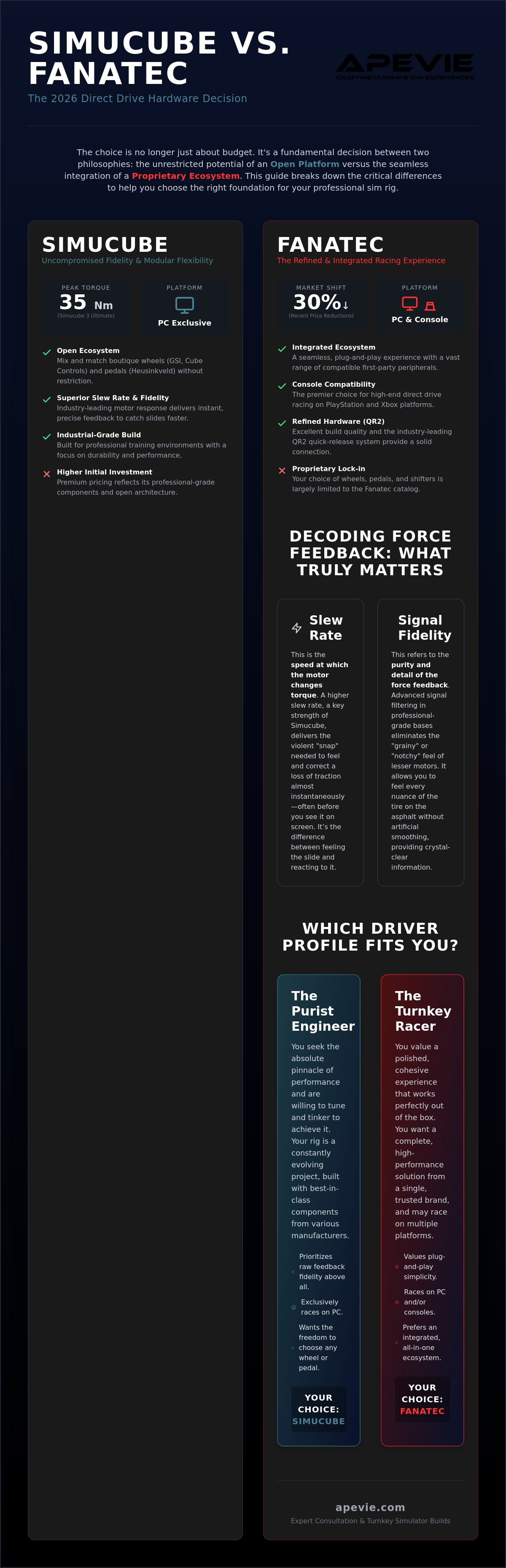
Choosing between simucube vs fanatec requires an honest assessment of your racing environment and long-term ambitions. While both brands offer high-torque direct drive motors, they cater to different philosophies of simulation. If your racing life includes a mix of PC competitive sessions and weekend stints on Gran Turismo 7 or Forza, the Fanatec ecosystem is the only professional-grade path that offers native console compatibility. However, for the driver whose rig is a dedicated PC cockpit, the modular freedom of a Simucube 3 provides a ceiling that consumer-focused ecosystems rarely reach.
To help you navigate this critical decision, we have developed a buyer framework based on the most common professional use cases we see at Apevie Simulators:
- The Multi-Platform Racer: Choose Fanatec if you require seamless compatibility with PlayStation 5 or Xbox. Their ClubSport DD+ and Gran Turismo DD Pro bases are the industry standard for cross-platform flexibility.
- The Boutique Enthusiast: Choose Simucube if you plan to use elite hardware like Gomez Sim Industries (GSI) or Cube Controls F-Core wheels. The Simucube 3’s open-standard wireless system is designed specifically for high-end modularity.
- The Competitive Specialist: Choose Simucube if you are focused strictly on PC titles like iRacing or ACC. The signal purity and ultra-fast slew rates are optimized for drivers who need every ounce of tire-scrub detail to find those final hundredths of a second.
- The Ecosystem Minimalist: Choose Fanatec if you prefer a single-brand experience where your wheelbase, sim racing pedals, and shifters all connect through a single hub with a unified software interface.
The Turnkey Enthusiast vs. The Modular Pro
The "buy twice, cry twice" trap is a real concern in high-end simulation. Many drivers start with a mid-range ecosystem only to realize they want the industrial-grade torque and slew rates of a 25Nm+ motor six months later. If you know your ultimate goal is a professional training tool, investing in a Simucube foundation from day one is more cost-effective than swapping an entire proprietary ecosystem later. This modular approach allows you to upgrade your components individually as new technology emerges in the 2026 landscape.
Matching the Base to Your Cockpit
The physical requirements of these wheelbases are often underestimated. A motor capable of 25 Nm to 35 Nm will expose any structural weakness in a cockpit. Your sim rig must be an aluminum extrusion or steel-reinforced frame to handle these forces without flexing. While Fanatec bases often offer bottom-mounting for wider compatibility, Simucube bases generally require heavy-duty front or side-mount brackets, which are essential for maintaining ergonomic alignment during high-G cornering maneuvers.
If you are struggling to decide which motor aligns with your existing hardware, book a professional consultation with our team to map out a balanced, high-performance upgrade path.
Professional Integration: Building Your Elite Turnkey System
A high-performance wheelbase is just one variable in a complex equation. When you're managing the extreme forces found in the simucube vs fanatec rivalry, the synergy between your motor and your motion platform determines the final level of immersion. A 35 Nm motor is a powerhouse, but without a chassis that can withstand those torsional loads, you'll experience frame flex that muddies the force feedback signal. Professional integration ensures that every component, from the steering shaft to the motion actuators, communicates with the same frequency to provide a coherent seat of the pants feel.
We specialize in harmonizing these high-end components at Apevie Simulators. We don't just bolt parts together; we calibrate the interaction between a Simucube 3 base and a Sigma Integrale DK2 motion system to ensure the haptic feedback from the road doesn't conflict with the steering telemetry. This level of technical oversight is what separates a high-end gaming setup from a professional training tool.
Pairing with Heusinkveld and Sigma Integrale
Drivers pursuing the Simucube path often choose Heusinkveld Sim Pedals Ultimate+ for their industrial-grade hydraulic feel. These pedals require a rock-solid mounting point, especially when paired with the Sigma Integrale DK2+ motion system. By using the Sigma Integrale software alongside Simucube Tuner 3.1, we can create a unified haptic profile where the pitch, roll, and heave of the car match the resistance in your steering rack. This eliminates the floaty sensation often found in less sophisticated setups and provides the physical cues necessary for consistent lap times.
The Apevie Simulators Advantage for Turnkey Builds
Navigating the hardware landscape is difficult, but our expert consultation helps you avoid the common pitfalls of mixing incompatible software suites. Whether you're interested in a formula-style rig with Gomez Sim Industries (GSI) hardware or a versatile GT setup, we handle the complex wiring, EMI shielding, and software optimization. You can explore our premium hardware with compared pricing to see how we curate the industry's best components into a single, high-performance package.
If you're ready to stop troubleshooting and start racing, contact Apevie Simulators today for a professional turnkey build consultation or white-glove installation service.
Choosing Your Foundation for the Future
The choice in the simucube vs fanatec landscape isn't about finding a single "best" motor; it's about deciding which ecosystem will support your racing goals for the next decade. If you require the seamless integration of a multi-platform setup, Fanatec provides a cohesive solution that's difficult to beat. However, for the driver who demands absolute signal purity and the freedom to pair their base with elite boutique hardware, Simucube remains the gold standard in professional simulation.
As an Authorized Simucube Dealer, we've seen firsthand how these systems perform in high-pressure environments. Apevie Simulators provides the white-glove installation and technical expertise needed to ensure your custom turnkey professional build is calibrated to your exact preferences. We don't just sell hardware; we provide the foundation for your competitive success.
Browse our curated collection of professional sim racing hardware to begin your journey with a system built to professional standards. We're ready to help you cross the finish line.
Frequently Asked Questions
Is Simucube really better than Fanatec for professional sim racing?
Simucube is widely considered the industry standard for PC-only professional training due to its industrial-grade servo motors and ultra-low latency signal processing. While Fanatec offers incredible convenience and a massive ecosystem, the simucube vs fanatec choice for elite drivers usually leans toward the Finnish brand for its raw fidelity and mechanical reliability during long endurance sessions.
Can I use a Fanatec wheel on a Simucube 3 wheel base?
You cannot use a Fanatec wheel on a Simucube 3 base natively because Fanatec utilizes a proprietary electronics interface. While third-party conversion kits can adapt these wheels to USB, most professional drivers prefer using native USB wheels from brands like Gomez Sim Industries (GSI) or Cube Controls. This ensures full functionality and signal integrity without the need for additional adapters.
Does Fanatec work on PS5 and Xbox in 2026?
Fanatec remains the primary choice for multi-platform racers because specific models like the ClubSport DD+ offer native PlayStation 5 compatibility. For Xbox use, you must pair a compatible Fanatec base with an Xbox-licensed steering wheel. Simucube wheelbases are designed strictly for the PC market and do not support consoles natively.
What is the best torque setting for a Simucube 2 Pro?
Most professional drivers set their Simucube 2 Pro to 100% torque (25 Nm) within the Simucube Tuner software to maximize the motor's dynamic range. They then adjust the "Max Force" setting within the simulation software, such as iRacing or ACC, to achieve a comfortable sustained torque of 8 to 12 Nm. This configuration prevents signal clipping and preserves fine details during high-load cornering.
Do I need a special sim rig for a 25Nm wheel base?
A rigid aluminum extrusion sim rig is essential for any wheelbase capable of 25 Nm or more. High-torque motors will cause significant flex and vibration in entry-level or mid-range cockpits, which effectively masks the subtle force feedback details you're looking for. A solid, professional foundation ensures that every bit of torque is transmitted directly to your hands rather than being absorbed by the frame.
Which software is easier to use: Simucube Tuner or the Fanatec App?
The Fanatec App is generally more intuitive for users who want a simplified, visual interface with quick-swap profiles. Simucube Tuner, which has replaced the older True Drive software, is a more granular, professional-grade tool. It offers advanced filters for damping, friction, and inertia, allowing for a surgical level of force feedback tuning that professional drivers require.
Are Simucube wheel bases compatible with Heusinkveld pedals?
Simucube wheelbases are fully compatible with Heusinkveld Sim Pedals Sprint or Ultimate+ sets. Since professional-grade pedals and wheelbases connect as independent USB devices on a PC, they don't need to belong to the same brand ecosystem. This modularity allows you to pair the best steering motor with the best pedal set without any compatibility issues.
How much should I expect to spend on a full Simucube-based rig?
A professional-grade, Simucube-based rig represents a premium investment that depends on your selection of boutique wheels, load cell pedals, and motion integration. Beyond the wheelbase itself, you must factor in the cost of a high-performance PC and a rigid chassis. Apevie Simulator provides expert consultation to help you navigate these choices and build a balanced, high-performance turnkey package tailored to your racing goals.