Simucube vs Fanatec: The Professional Guide to Choosing Your Direct Drive Base in 2026
The highest torque rating on the box is often the least important number in your decision-making process. You've likely spent hours comparing Newton-meters and peak force, yet that nagging feeling remains that a spec sheet can't describe how a car actually feels under load. It's a common frustration to invest deeply into a rig only to worry about software complexity or being locked into a proprietary ecosystem that might limit your hardware choices. When weighing Simucube vs Fanatec, the choice is less about power and more about the philosophy of your driving experience.
This guide provides a definitive comparison for 2026. We cut through the technical jargon to evaluate raw force feedback fidelity, long-term reliability, and the true value of ecosystem flexibility. You'll learn why the industrial precision of the Simucube 3 series remains the gold standard for professional-grade rigs, and how Fanatec's latest FullForce technology and 18 Nm ClubSport DD+ updates have shifted the mid-range landscape. We'll help you identify which base offers the authentic, detailed connection to the road you need for multi-hour sessions without the fear of your hardware becoming obsolete.
Key Takeaways
- Discover why raw torque figures are secondary to signal fidelity and thermal management when selecting a direct drive base for long-distance racing sessions.
- Compare the Simucube vs Fanatec philosophies to decide between an open-standard professional instrument or a convenient, haptic-rich integrated ecosystem.
- Evaluate the technical advantages of Simucube 3's industrial motors against the latest Fanatec FullForce technology and software-optimized torque delivery.
- Learn how to assess your simulator's chassis strength and platform requirements to avoid structural failure or hardware incompatibility.
- Understand how professional integration and white-glove installation can eliminate the frustration of complex firmware tuning and cable management.
Simucube vs Fanatec: Choosing Your Direct Drive Foundation
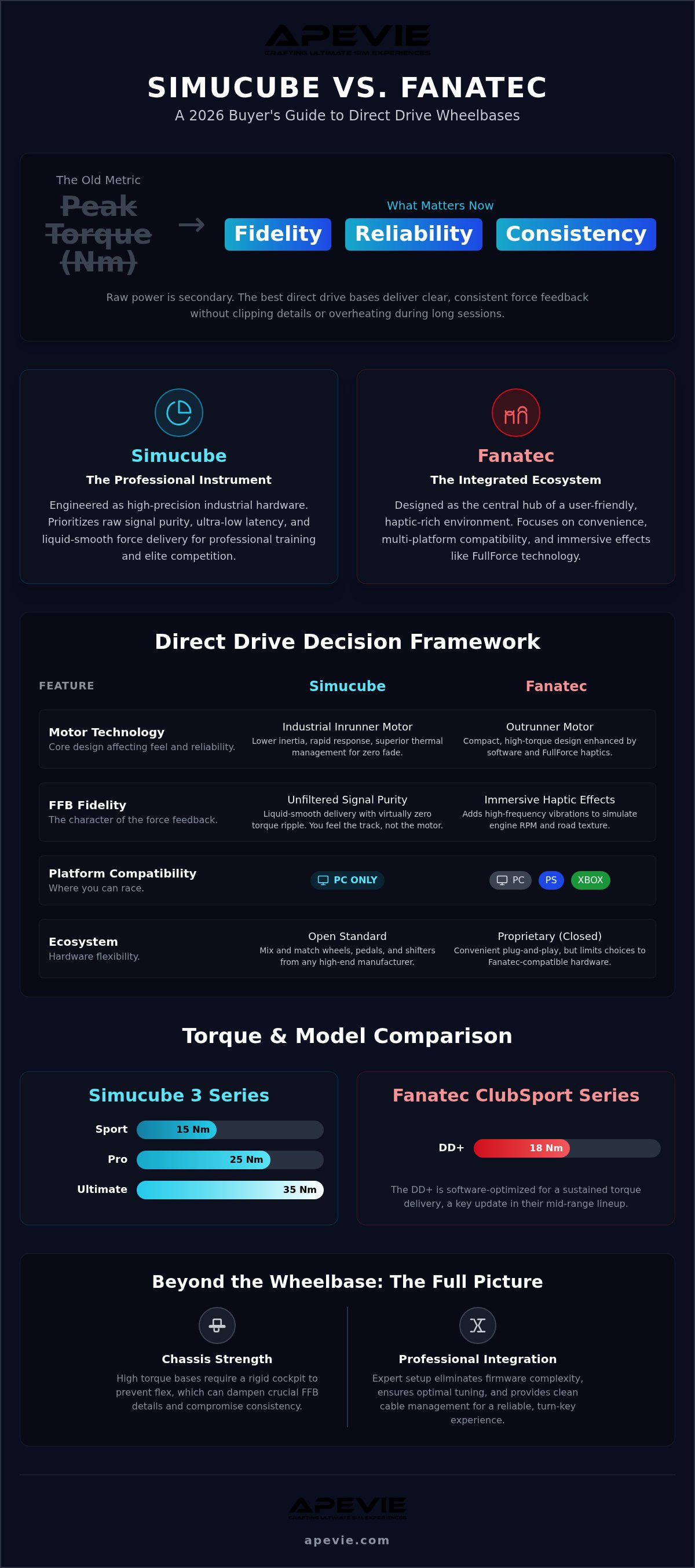
Selecting a wheel base is the most consequential decision you'll make for your sim rig. It's the primary interface between the simulation's physics engine and your sensory perception. While the marketing wars of the early 2020s focused almost exclusively on peak torque figures, the 2026 landscape is defined by fidelity and signal processing. When comparing Simucube vs Fanatec, you're choosing between two distinct engineering philosophies. One treats the wheel base as a professional-grade industrial instrument, while the other positions it as the central hub of a refined, user-friendly ecosystem.
Consistency is the foundation of speed. A high-quality direct drive base allows you to build precise muscle memory because it translates digital data into physical resistance without masking the details. If a motor introduces its own mechanical noise or "notchy" sensations, it obscures the subtle cues of tire slip or weight transfer. This is why the architecture of the motor itself has become a focal point for elite drivers who demand a setup that stays reliable over multi-hour sessions.
The Evolution of the Direct Drive Motor
The technical divide between these brands often starts with motor design. Simucube utilizes industrial-grade inrunner motors. These are designed for high-precision robotics, offering lower inertia and exceptional cooling. The Simucube 3 series has made significant strides in virtually eliminating torque ripple, which is the slight variation in force as the motor rotates. This results in a liquid-smooth feel that allows the smallest vibrations of the track surface to reach your fingertips. Fanatec has countered this with their FullForce technology, a haptic protocol that adds high-frequency vibrations directly into the steering column to simulate engine vibes and road texture.
- Inrunner Motors: Preferred for their rapid response times and ability to handle sustained high-torque loads without thermal throttling.
- Outrunner Motors: Often found in Fanatec's designs; these provide high torque in a compact form factor but require sophisticated software to match the smoothness of industrial units.
- Signal Purity: Simucube's focus on raw fidelity versus Fanatec's focus on immersive haptic effects.
Platform Compatibility: PC vs. Console
Your choice often depends on where you intend to race. Fanatec remains the undisputed leader for multi-platform versatility. Models like the Fanatec Gran Turismo DD Pro offer native PlayStation 5 and Xbox integration, making them the standard for those who want a plug-and-play experience across different systems. Simucube is a PC-only platform. This specialization allows them to focus on maximizing raw data rates for titles like iRacing and Assetto Corsa Competizione, providing a level of granular detail that console protocols cannot always replicate. For the serious PC racer, this often justifies the move toward a more specialized, open-standard setup.
Force Feedback Fidelity: Comparing the Simucube 3 and Fanatec DD Series
The debate of Simucube vs Fanatec often centers on raw numbers, but the real magic happens in how that power is managed. High torque isn't just about fighting the wheel; it's about headroom. When a base has a higher torque ceiling, it can deliver subtle details like tire scrub or suspension compression without clipping the signal. This clarity allows you to react to the car's behavior before a slide becomes unrecoverable.
The Simucube 3 Advantage
The Simucube 3 series represents the pinnacle of this philosophy. The upcoming Simucube 3 Ultimate is set to deliver a massive 35 Nm of torque, a figure specifically targeted at professional teams building ultra-realistic prototypes. While the Simucube 3 Sport (15 Nm) and Pro (25 Nm) cover the majority of high-end users, the architecture remains consistent across the line. These units rely on massive passive cooling fins rather than internal fans. This industrial build quality ensures that even during a 24-hour endurance race, the force feedback remains identical from the first lap to the last. Their proprietary wireless link system provides a clean, zero-latency connection for boutique steering wheels, removing the need for messy coiled cables.
Fanatec’s ClubSport DD+ Performance
Fanatec has made significant strides with the ClubSport DD and DD+ series. The ClubSport DD+ has been software-optimized to deliver a sustained 18 Nm of torque. This is a critical distinction; many bases can hit a peak number for a few seconds before thermal throttling kicks in and reduces the power. The DD+ maintains its 18 Nm consistently through advanced thermal management. To handle this force, the new QR2 quick-release system is an essential upgrade. It eliminates the mechanical flex found in older designs, ensuring that every bit of detail from the motor reaches your hands. For those starting their journey, the ClubSport DD (15 Nm) provides a compelling value proposition, offering high-end performance at a more accessible entry point.
Responsiveness, or slew rate, is where the two brands often diverge. Slew rate defines how fast the motor can change its torque output. Simucube bases are renowned for incredibly high slew rates, which translates to a "sharper" feel when hitting a curb or losing traction. This speed is what elite drivers use to make micro-corrections. In contrast, Fanatec's Podium DD2, delivering 25 Nm, offers a slightly more dampened feel. Some drivers find this more natural for GT3 cars where power steering would naturally filter some of those raw vibrations. Choosing the right torque ceiling depends on your physical strength and the type of cars you drive. If you're looking for a professional consultation to match these technical specs to your specific driving style, consider exploring a custom direct drive configuration.
Ecosystem Lock-in vs. Professional Open Standards
Choosing between Simucube vs Fanatec often comes down to how much you value convenience versus modularity. Fanatec's ecosystem is a "walled garden" where wheels, pedals, and shifters connect directly to the wheel base. This one-click compatibility is perfect if you want a cohesive setup without worrying about separate USB cables or driver conflicts. Simucube takes the opposite approach by championing open standards. This allows you to build a truly custom rig using the world’s best boutique peripherals, ensuring your setup isn't limited by a single manufacturer's catalog.
The connection between the wheel and the base is a critical point of failure for immersion. Fanatec's QR2 system has addressed many of the flex issues found in their older hardware, providing a much-needed mechanical upgrade for their DD line. However, the Simucube Quick Release (SQR) remains the benchmark for industrial rigidity. It's a zero-play system that feels like a solid extension of the motor shaft. This stability is essential when mounting high-end hardware like the Gomez Sim Industries (GSI) Formula Pro Elite, which delivers a level of tactile feedback that consumer-grade wheels simply can't replicate.
Steering Wheel Variety and Quality
Fanatec's Formula steering wheels offer excellent ergonomics and an approachable entry into open-wheel racing. They're well-built for the mass market, but they often rely on composite materials to keep costs down. For those seeking a motorsport-grade experience, the Simucube platform opens the door to elite manufacturers. Integrating a Cube Controls F-Core provides a level of carbon fiber rigidity and switchgear precision that feels authentic to a real cockpit. You can explore more options in our detailed guide on The Best F1 Steering Wheels for Professional Sim Racing in 2026.
Software and Tuning: True Drive vs. Fanalab
Software is the invisible hand that shapes your force feedback. Fanatec Fanalab is designed for ease of use, offering per-game profiles that automatically adjust your settings when you launch a sim. It's the ideal choice for the "plug-and-play" racer who wants to spend more time driving and less time tweaking. Simucube True Drive, updated in 2026 to Tuner 3.1, caters to the "purist" driver who demands absolute control. It offers professional-grade filtering and a cloud-based "Paddock" platform. This allows you to download precise profiles created by real-world professional drivers, ensuring your Simucube vs Fanatec comparison includes the most refined software experience available today.
Torque, Precision, and Reliability: A Buyer’s Decision Framework
Navigating the choice between Simucube vs Fanatec requires a methodical assessment of your racing goals and physical environment. High-performance sim racing is an investment in sensory accuracy. If your hardware cannot communicate the car's limits, your lap times will eventually plateau. To select the foundation that aligns with your ambitions, we recommend following this four-step decision framework.
- Identify your platform: Simucube is strictly for PC racers who prioritize raw data rates. Fanatec is the essential choice for those requiring PlayStation 5 or Xbox Series X compatibility.
- Assess your chassis: A wheel base is only as good as the frame it’s bolted to. High-torque systems require structural rigidity to prevent energy loss through mechanical flex.
- Select your torque range: While 5-10Nm is a transformative entry point, the 15-25Nm range is the enthusiast sweet spot for detail. Professional drivers building "forever rigs" often look toward the 30Nm+ category for maximum headroom.
- Balance your total budget: A premium base shouldn't come at the expense of your pedals or steering wheel. A balanced system outperforms an imbalanced one every time.
Matching the Base to the Rig
The physical demands of modern direct drive technology are often underestimated. A Simucube 3 Pro delivering 25Nm of sustained force will literally twist a basic steel tube cockpit or a desk mount. This mechanical flex absorbs the very detail you're paying for. To truly experience industrial-grade fidelity, you must use a heavy-duty aluminum extrusion cockpit. For a deeper dive into structural requirements, see The Ultimate Sim Rig Guide: Building a Professional Foundation in 2026. Conversely, entry-level bases like the Fanatec CSL DD are designed for versatility and can be safely used on high-quality desk clamps if space is a primary constraint.
Common Mistakes to Avoid
One of the most frequent errors is overbuying torque for a flexible cockpit. This leads to the "vibration over feedback" trap where the rig shakes violently, but the subtle cues of tire slip are lost in the noise. Another critical mistake is ignoring the importance of your feet. We strongly suggest pairing these high-end bases with load-cell units like the Heusinkveld Sim Pedals Sprint to match your steering precision with braking consistency. Safety is also paramount; never operate a high-torque base without a dedicated Emergency Stop button within easy reach. If you're unsure which components will complement your current setup, you can book a professional consultation to design your ideal turnkey system.
Beyond the Base: Why Professional Integration Matters
Owning the world's most advanced motor is only half the battle. High-end simulation hardware requires meticulous calibration to ensure the digital physics of the car translate accurately to your hands. Without precise tuning, even a flagship base can feel disconnected, overly aggressive, or muddy. This is where professional integration becomes the deciding factor in your driving experience. When you're investing in a Simucube vs Fanatec setup, the goal isn't just to own the gear, but to achieve a level of immersion that allows you to forget you're in a simulator.
Our white-glove installation service removes the technical friction that often accompanies high-performance systems. We handle everything from complex cable management to the latest firmware updates, ensuring your rig is race-ready the moment you sit down. Tuning a Simucube 3 Ultimate requires a deep understanding of how specific titles like iRacing or Assetto Corsa Competizione handle signal output. We create custom force feedback profiles that match the unique weight and resistance of the cars you drive most. For those seeking total immersion, we offer turnkey solutions that integrate these wheel bases with advanced haptics like the Sigma Integrale DK2 Motion System, creating a cohesive environment where every curb and gear shift is felt through the entire chassis.
Apevie’s Curated Hardware Bundles
We don't believe in a one-size-fits-all approach. To deliver the ultimate GT3 experience, we often pair Simucube bases with steering wheels from Precision Sim Engineering. This combination offers a level of tactile feedback and carbon fiber rigidity that is virtually indistinguishable from a real race car. For drivers who prefer a single-brand ecosystem, the Fanatec Podium DD2 Turnkey Package remains a formidable choice. It provides professional-grade performance with the seamless ease of Fanatec’s unified software. Our support doesn't end at installation; we provide pro-active maintenance and updates to ensure your simulator stays at peak performance as software standards evolve.
Final Verdict: Simucube or Fanatec?
Your final decision in the Simucube vs Fanatec debate should align with your long-term vision for your simulator. Simucube is the clear choice if you want the absolute pinnacle of build quality and the freedom to use boutique, professional-grade peripherals. It's the "forever rig" foundation for the purist. Fanatec is the superior option if you value a seamless, all-in-one ecosystem that offers native console support and a more approachable "set and forget" user experience. Both brands represent the elite tier of direct drive technology, and either will transform your ability to find the limit on track.
Browse our complete collection of professional Wheel Bases and start your build today
Refining Your Path to the Podium
The choice between Simucube vs Fanatec is ultimately a reflection of your driving philosophy. If you seek the absolute pinnacle of industrial fidelity and a modular foundation, the Simucube 3 series remains the professional gold standard. For those who prioritize a seamless, haptic-rich ecosystem with multi-platform versatility, Fanatec’s latest DD+ and Podium offerings provide an unmatched integrated experience. Regardless of your path, remember that even the finest motor is only as effective as its calibration and the structural rigidity of the chassis it powers.
Apevie Simulators is an authorized dealer for both brands, ensuring you receive authentic hardware backed by deep technical expertise. We bridge the gap between complex engineering and the pure joy of racing through our white-glove installation service and expert custom tuning. We handle the firmware complexities and cable management so you don't have to worry about the technical hurdles. Build your dream simulator with Apevie’s professional Wheel Bases and step into a setup designed for longevity and precision. Your journey toward unmatched realism starts with the right foundation.
Frequently Asked Questions
Is Simucube really better than Fanatec for pro sim racing?
Simucube is generally considered the professional standard due to its industrial inrunner motor design and superior signal processing. While Fanatec offers high-end performance in their Podium line, Simucube's focus on raw fidelity without haptic coloring appeals to purists. The choice between Simucube vs Fanatec often depends on whether you value a closed, convenient ecosystem or the ability to integrate boutique, motorsport-grade hardware into a permanent rig.
Can I use Fanatec wheels on a Simucube 3 wheel base?
You can't connect them natively because Fanatec uses a proprietary electronics interface. However, converted Fanatec wheels can work via third-party USB kits and a Simucube Quick Release adapter. This process bypasses the integrated pins and requires a separate cable, which may slightly impact the clean aesthetic of your rig. Most Simucube users prefer dedicated boutique wheels that offer native wireless or high-quality coiled cable connections for better reliability.
How much torque (Nm) do I actually need for realistic sim racing?
Realistic force feedback for a modern GT3 car typically peaks around 10 to 12 Nm at the steering column. However, we recommend a base capable of 20 Nm or more to provide headroom. This ensures the motor doesn't clip the signal during high-load corners or sudden impacts. Having extra power allows the base to deliver subtle road textures and tire scrub details simultaneously with heavy steering forces without any digital distortion.
Is the Simucube 3 Sport enough, or should I get the Pro?
The Simucube 3 Sport provides 15 Nm of torque, which is more than enough for the vast majority of GT and formula racing enthusiasts. If you frequently drive high-downforce prototypes or older IndyCars that lack power steering, the Simucube 3 Pro’s 25 Nm offers the necessary strength to replicate those heavy loads. The Pro model also provides a slightly higher slew rate, which translates to even sharper, more immediate feedback during rapid weight transfers.
Does Fanatec work better on PlayStation 5 than other brands?
Fanatec is the definitive leader for console integration, offering native, licensed support for PlayStation 5 through models like the ClubSport DD+. This allows for a seamless plug-and-play experience without the need for third-party adapters. Simucube remains a PC-only platform, focusing its engineering entirely on high-frequency data rates and professional simulator software. If your racing career includes titles like Gran Turismo 7, Fanatec is the logical foundation for your setup.
Do I need a special power outlet for a 32Nm Simucube 3 Ultimate?
A standard 110V or 230V household outlet provides sufficient power for even the 35 Nm Simucube 3 Ultimate. These bases are remarkably efficient and don't draw peak current continuously; they only spike during high-impact moments. We do recommend using a high-quality, medical-grade power strip or a dedicated surge protector to shield the sensitive internal electronics from voltage fluctuations. This ensures the longevity of the motor's sophisticated control board during long, intense sessions.
Is a direct drive wheel base dangerous for younger sim racers?
High-torque direct drive bases can be hazardous if they aren't managed with proper safety protocols. The rapid rotation of the motor can cause injury if a driver's hands are caught during a crash. We always recommend setting software torque limits for younger users and ensuring a physical Emergency Stop button is mounted within reach. When correctly configured with professional guidance, these systems provide a safe yet incredibly educational tool for developing real-world driving skills.