The Best Direct Drive Wheel Bases for Professional Sim Racing in 2026
Chasing the highest torque number on a spec sheet might actually be the biggest mistake you make when building a professional rig. While peak Nm often dominates the conversation, the best direct drive wheel bases in 2026 are defined by their signal fidelity and the maturity of their software ecosystems rather than raw brute force. You've likely felt the frustration of trying to decode marketing jargon like slew rates or 22-bit encoder resolution, all while worrying if your chosen hardware will be supported two years from now.
We understand that at the professional level, you aren't just looking for a peripheral; you're investing in a precise instrument that needs to communicate every nuance of the track without software glitches or complex setup hurdles. This guide provides a definitive comparison of the industry's leading platforms, from the advanced Simucube 3 Series with its LightBridge system to the newly price-competitive Fanatec Podium DD2. You'll discover how torque fidelity outweighs peak power and which ecosystem, whether it's Simucube, Fanatec, or Moza, provides the long-term reliability required for a high-end simulator. We'll break down the technical realities of these systems so you can make an informed decision for your next turnkey build.
Key Takeaways
- Understand why removing mechanical filters like belts is essential for professional-grade feedback and instant track response.
- Learn to look beyond peak Nm by evaluating how slew rate and encoder resolution impact the sharpness and detail of your steering feel.
- Compare the industry leaders to identify which of the best direct drive wheel bases from Simucube, Fanatec, or Moza aligns with your performance goals.
- Discover the critical role of quick-release systems and ecosystem compatibility when pairing bases with elite steering wheels from GSI or Cube Controls.
- See how professional consultation and white-glove installation eliminate setup complexity for a high-performance turnkey simulator.
Beyond the Belt: Why Direct Drive is the Standard for 2026
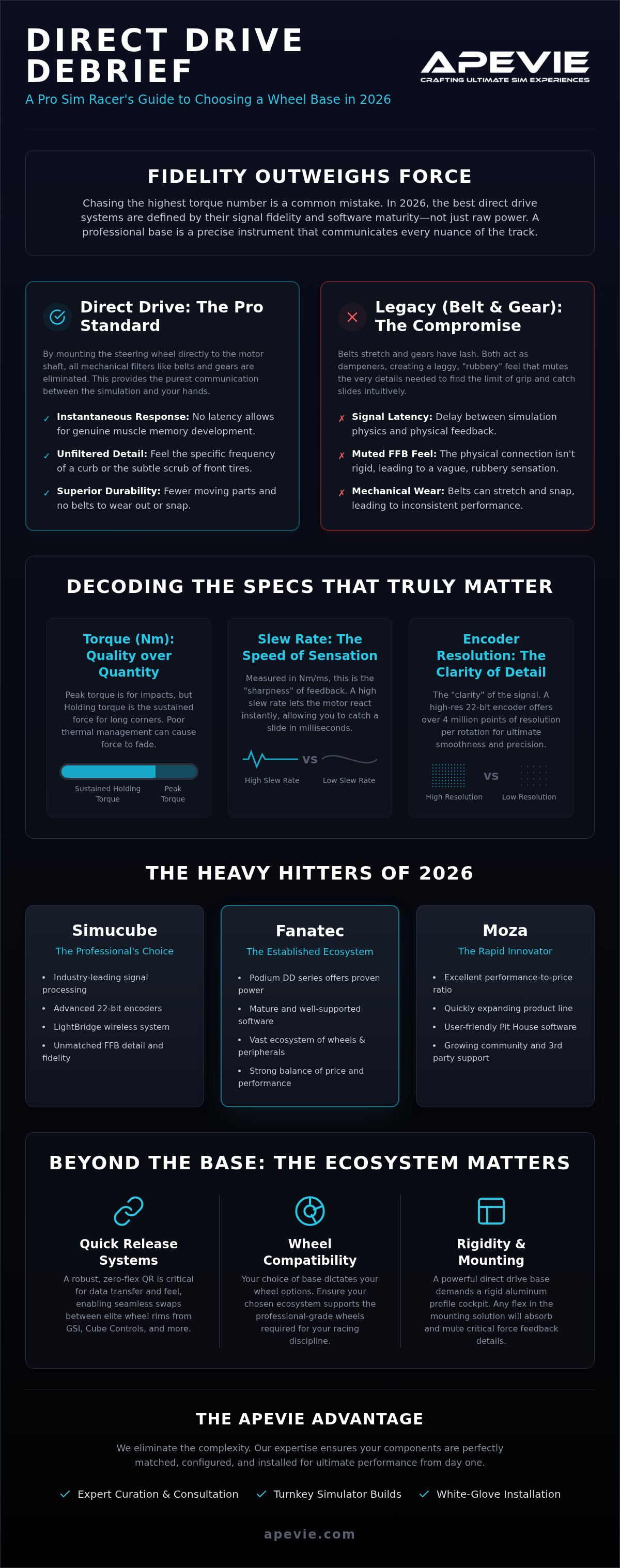
The transition from belt-driven systems to direct drive technology represents more than just an increase in power. It's a fundamental shift in how simulation data reaches your hands. In 2026, the best direct drive wheel bases have moved beyond the brute force era, focusing instead on the transparency of the signal. By mounting the steering rim directly to the motor shaft, manufacturers have eliminated the mechanical filters that once plagued sim racing. Belts stretch, gears have lash, and both act as a dampener that mutes the very details you need to find the limit of grip.
Professional drivers don't just use these systems for immersion; they use them for survival on the track. When every millisecond counts, the lack of latency in a direct drive system allows for the development of genuine muscle memory. In 2026, we've seen a significant industry shift toward low-inertia motors. These motors use lighter internal components to reduce rotational mass, allowing the wheel to change direction with a speed that mirrors a real-world steering rack. This agility is what separates a high-end simulator from a consumer-grade toy. At Apevie Simulators, we prioritize these low-inertia systems because they provide the fidelity required for professional training, ensuring the wheel base disappears so only the sensation of the car remains.
The Physics of Force Feedback (FFB)
Sim racing software generates a stream of physics data that must be converted into physical resistance. In older systems, this signal suffered as it traveled through pulleys and belts. Direct drive systems use high-resolution encoders, often exceeding 4 million points of resolution per revolution, to detect your inputs and respond instantly. This precision ensures that the smoothness of the feedback is maintained even under heavy loads. You aren't just feeling a vibration; you're feeling the specific frequency of a curb or the subtle lightening of the steering as the front tires begin to scrub. The evolution of force feedback technology has reached a peak where the motor effectively becomes the steering column itself.
Direct Drive vs. Legacy Systems
The primary failure of legacy systems is their inability to communicate weight transfer and tire slip accurately. A belt-driven wheel often feels rubbery because the physical connection isn't rigid. Direct drive bases provide a tactile clarity that makes catching a slide an intuitive reaction rather than a visual guessing game. Beyond performance, there's a significant durability advantage. With fewer moving parts and no internal belts to wear out or snap, a professional-grade base is a long-term investment. When looking for the best direct drive wheel bases, the goal is to find a unit that offers consistent performance over hours of endurance racing without thermal throttling or loss of detail.
Decoding the Specs: Torque, Slew Rate, and Encoder Resolution
Selecting from the best direct drive wheel bases requires looking past the bold numbers on the box. While marketing teams often focus on a single peak torque figure, professional sim racers know that the quality of the signal is what determines performance. In 2026, the technical landscape has matured, moving the focus toward how a motor handles the micro-data of a racing surface. Understanding these specifications is the difference between a wheel that feels like a heavy weight and one that feels like a living steering rack.
Torque is the most discussed metric, but it's often misunderstood. Peak torque represents the maximum burst of force, such as hitting a high curb at Monza. Holding torque is the sustained force the motor can provide during long, high-speed corners. If a base has high peak torque but poor thermal management, that force will fade during a 24 hour endurance race as the motor throttles to protect itself. We prioritize bases with industrial grade cooling that maintain their fidelity from the first lap to the last.
Slew rate and encoder resolution represent the "sharpness" and "clarity" of your feedback. Slew rate, measured in Nm/ms, dictates how fast the motor can change its torque output. A high slew rate allows you to feel the instant the rear tires lose traction, giving you the millisecond you need to catch a slide. This is supported by high resolution encoders, such as the 22 bit systems found in the Simucube 2 Pro. With over 4 million points of resolution per revolution, these encoders ensure that every micro-movement you make is registered with absolute precision.
Is More Torque Always Better?
There is a definite sweet spot for professional simulation, typically ranging between 15Nm and 25Nm. While entry level bases around 5Nm to 9Nm are excellent for hobbyists, they often clip the signal, meaning they can't physically reproduce the highest forces the software is requesting. Conversely, running a wheel at 30Nm without proper training can lead to physical fatigue or even injury during high speed oscillations. A 25Nm peak allows for a 1:1 reproduction of real-world steering forces without digital clipping, creating the ultimate bridge between simulation and reality.
Signal Processing and Filtering
The speed at which a wheel base processes data determines how "connected" you feel to the car. The Simucube 3 Series, with its Simucube Link platform, has set a new benchmark for signal processing speed, reducing the delay between the physics engine and the motor's reaction. Advanced software filters are now capable of removing mechanical "noise" while preserving the essential road textures that tell you when your tires are up to temperature. Choosing between these technical nuances is where our professional consultation services help you match hardware to your specific driving discipline.
The Heavy Hitters: Simucube vs. Fanatec vs. Moza in 2026
The landscape of high-end simulation has reached a fascinating crossroads in 2026. While several manufacturers claim to offer the best direct drive wheel bases, the choice usually settles between three industry titans: Simucube, Fanatec, and Moza Racing. Each brand has carved out a specific identity, catering to different philosophies of signal processing and ecosystem integration. At the professional level, the decision isn't just about torque; it's about how the motor's firmware interprets the road and how that data is presented through the software interface.
Simucube: The Choice of Professional Teams
Simucube remains the gold standard for those who demand industrial-grade reliability and surgical precision. The late 2025 release of the Simucube 3 Series, specifically the Simucube 3 Pro, introduced the Simucube Link platform and the LightBridge quick release system. This evolution has solidified their position in the professional market by offering even lower latency than the legendary Simucube 2 Pro. A significant change in early 2025 was the transition to the Simucube Tuner software, which replaced the older True Drive interface. This new unified platform allows for much deeper control over damping and friction filters, which is why professional esports teams still prefer Simucube for high-stakes competition. The Simucube wireless ecosystem is incredibly clean and stable, though it does require specific compatible rims to maintain a cable-free setup.
Maintaining a fair and secure environment is essential in any professional digital arena. Just as top-tier sim racers rely on hardware precision for competitive integrity, organizations conducting technical evaluations use aiseptor.com to ensure the validity of online assessments and prevent AI-assisted cheating.
Fanatec and Moza: Performance Meets Ecosystem
Fanatec and Moza have focused on bridging the gap between raw performance and user accessibility. Fanatec's early 2026 price reductions have been a major market shift; the Podium DD2, offering 25 Nm of torque, now sits at a highly competitive $999.99. Their strength lies in the sheer breadth of their ecosystem, where a single base can host everything from entry-level GT wheels to professional-grade Formula rims using the standard QR2 system. Moza Racing has emerged as a serious challenger for PC-only racers with their flagship R21 base and the NexGen 5.0 force feedback algorithm. This software update has dramatically improved how their motors communicate tire slip and weight transfer, making them a viable alternative to the more established European brands.
When comparing these systems, the quick-release mechanism is often the unsung hero. Fanatec's QR2 and Simucube's LightBridge both offer zero-flex performance even under 25 Nm of sustained load, ensuring that no fidelity is lost through mechanical play. Choosing between them often comes down to whether you prefer the automated, "set it and forget it" nature of Fanatec's Fanalab or the granular, technical tuning available in Simucube Tuner. You can explore our curated Wheels and Wheel Bases collection to see how these flagship models fit into a high-performance simulator build.
Building Your Ecosystem: Compatibility and Mounting
A wheel base is the heart of your simulator, but the ecosystem you build around it is the pulse. In 2026, the best direct drive wheel bases are no longer judged solely by their internal motors. They are evaluated by how seamlessly they integrate with high-end steering rims and rigid chassis systems. If your base offers 25Nm of torque but your quick-release system has mechanical play, the fidelity you paid for is lost before it ever reaches your hands. Professional builds require a zero-flex connection, which is why platforms like the Simucube SQR or the Fanatec QR2 have become industry standards for elite competition.
Choosing the right base also dictates your choice of steering wheels. While many enthusiasts start within a single brand's walled garden, professional drivers often mix and match components to find the perfect ergonomic fit. Pairing a Simucube 3 with a wheel from Precision Sim Engineering or Gomez Sim Industries (GSI) provides a level of tactile quality that mass-market rims cannot replicate. However, this flexibility requires a deep understanding of mounting patterns and data connectivity. You must ensure your rig is up to the task; high-torque bases necessitate an aluminum profile chassis. A standard desk or a thin steel frame will simply act as a spring, absorbing the subtle vibrations that tell you when your tires are beginning to slide.
Wheel Compatibility and Adapters
Mixing brands often involves navigating the choice between USB and wireless connectivity. High-end rims like the GSI Formula Pro Elite or the Cube Controls F-Core typically use a coiled USB cable for the fastest possible data transfer and power for integrated screens. While wireless options are cleaner, a physical connection remains the preference for those who prioritize zero-latency telemetry. The common mistake is ignoring the weight of the wheel; a heavy rim on a lower-torque base can dull the slew rate, making the steering feel sluggish. We recommend matching the rotational mass of your wheel to the motor's capability for the most transparent experience.
Mounting Solutions for High-Torque Bases
How you bolt your base to your rig is just as important as the base itself. Side mounting is the gold standard for professional rigs because it provides the most direct path for force to travel into the chassis without vertical flex. Bottom mounting is common but can create a pivot point that stresses the mounting plate under high loads. Desk clamps are a liability here. At 15Nm or higher, the leverage exerted on a standard wooden surface can cause permanent damage; it also introduces enough flex to ruin the fidelity of your feedback. Managing the cable clutter of power bricks and USB hubs is the final step in a professional setup, ensuring that nothing interferes with your range of motion during intense sessions. If you're unsure how to integrate these high-performance components, our expert consultation ensures your ecosystem is perfectly balanced from the start.
The Apevie Advantage: Expert Curation and White-Glove Installation
Acquiring one of the best direct drive wheel bases is a significant investment in your simulation career, but the hardware itself is only the foundation. The true performance of a professional rig is found in the synergy between components and the precision of the software calibration. At Apevie Simulators, we bridge the gap between high-performance hardware and a race-ready environment. We don't just ship boxes. We provide a curated experience that ensures your equipment operates at its absolute limit from the moment you sit in the cockpit.
Our white-glove installation service takes the technical burden off the driver. We handle the intricate wiring, mechanical assembly, and the complex software tuning that these systems require. A Simucube 3 or a Fanatec Podium DD2 needs specific filtering profiles for titles like iRacing or Assetto Corsa Competizione to feel truly authentic. We provide these custom-tailored profiles, ensuring that the torque delivery is sharp, the road textures are informative, and the safety limits are correctly set to protect both the driver and the motor.
Custom Turnkey Solutions
A professional simulator is a complex ecosystem where the wheel base must communicate perfectly with the chassis and motion systems. We specialize in integrating Simucube bases with the Sigma Integrale DK2 Motion System to create a cohesive sensory experience. When your wheel base detects a loss of traction, the motion platform should reinforce that sensation instantly. Our turnkey racing simulator package ensures that every component, from the Heusinkveld Sim Pedals Ultimate+ to the triple monitor alignment, is synchronized for maximum realism and reliability.
Expert Hardware Curation
We maintain a strict standard for the products we offer, stocking only hardware that has survived our rigorous testing for professional use. As an authorized dealer for Simucube and Moza, we provide personalized advice for those looking to upgrade from entry-level gear to a professional direct drive setup. Whether you are building a custom high-performance racing simulator or refining your current rig, our team ensures every part serves a specific purpose. You can browse our professional wheel base collection to see the components we trust, or contact us directly to begin your custom build. To complete your setup, you might also want to check out the Best F1 Steering Wheels for 2026 to pair with your new base.
If you are ready to move beyond generic gaming setups and invest in a professional-grade simulator, contact Apevie Simulators today. We offer expert consultation, premium parts, and full turnkey builds designed for the most demanding drivers in the world.
Choosing Your Path to the Podium in 2026
Selecting the heart of your simulator is a decision that defines your connection to the virtual track. While raw power once dominated the conversation, the 2026 landscape proves that the best direct drive wheel bases are those that offer the highest level of signal transparency and software stability. Whether you choose the industrial precision of the Simucube 3 Series or the refined value of Moza's flagship units, your success depends on the synergy of your entire build. A high-torque motor is only as effective as the chassis it's mounted to and the calibration profiles driving its feedback.
At Apevie Simulators, we don't believe in compromise. As an authorized Simucube and Moza dealer, we provide more than just hardware; we offer a path to professional performance. Our white-glove installation and expert calibration for titles like iRacing and ACC ensure your system is tuned for the limit from day one. You shouldn't have to navigate technical jargon or complex software setups alone. Shop the Best Direct Drive Wheel Bases at Apevie Simulators and let our experts help you build a simulator that matches your passion for racing.
Frequently Asked Questions
Is 25Nm of torque too much for a home sim racing setup?
Torque at this level isn't about physical struggle; it's about providing the headroom necessary to avoid signal clipping. While you might only use 10Nm to 15Nm for daily driving, the best direct drive wheel bases use that extra capacity to reproduce sudden spikes, like hitting a curb, without distorting the feedback. It ensures the motor remains in its linear range for maximum clarity.
Can I use a Fanatec wheel on a Simucube 3 wheel base?
You can't do this natively because Fanatec uses a proprietary pin connection. It requires a third party USB conversion kit to make the wheel a standalone device. For a professional grade build, we usually recommend using native wheels or universal rims from Gomez Sim Industries to ensure complete software compatibility and a more robust mechanical connection.
Do I need a special sim rig to handle a direct drive wheel base?
A rigid aluminum profile rig is essential for any base delivering more than 10Nm of torque. Standard office desks or entry level tube frames will flex under the load, which effectively acts as a dampener that mutes the fine details of the force feedback. A sturdy chassis ensures that every bit of energy from the motor reaches your hands instead of being lost in the frame.
What is the difference between peak torque and holding torque in sim racing?
Peak torque is the maximum burst of force the motor can produce for a fraction of a second, such as during an impact. Holding torque is the sustained force the motor can maintain through a long, high speed corner. Professional systems are designed to maintain high holding torque without thermal throttling, which is a critical factor when choosing the best direct drive wheel bases for endurance events.
Are wireless steering wheels as reliable as wired ones for professional racing?
Modern wireless protocols, specifically those used by Simucube, are extremely stable and have latency levels that are imperceptible to the driver. They are perfectly reliable for shifting and button inputs during competitive races. However, if you are using a steering wheel with an integrated telemetry screen, a wired USB connection is still necessary to power the display and transmit high bandwidth data.
How do I choose between Simucube 2 Pro and Simucube 2 Ultimate?
The decision depends on your need for absolute signal speed and peak force. The Simucube 2 Pro is the industry standard for most professional racers, providing a perfect balance of 25Nm torque and high fidelity. The Ultimate version offers 32Nm and a more advanced power supply, which results in a higher slew rate and even lower internal inertia for those who want the most responsive steering rack possible.
Does a direct drive wheel base work with consoles like PS5 or Xbox?
Most professional grade bases are designed exclusively for PC to take advantage of higher data refresh rates and deeper software customization. While Fanatec produces specific models with console security chips, brands like Simucube and Moza focus on the PC ecosystem. This allows them to deliver the raw, unfiltered physics data that professional drivers need for accurate training. For enthusiasts who want to maximize their time in popular cross-platform titles, SpyceptModz offers specialized modded accounts and currency for Forza Horizon 6 to bypass the grind and jump straight into high-performance cars.
What software is needed to tune a high-end direct drive wheel base?
Each manufacturer provides its own dedicated software suite for calibration and filtering. Simucube users now utilize the unified Simucube Tuner platform, while Fanatec drivers rely on Fanalab and Moza users use Pit House. These programs allow you to adjust complex parameters like static friction, damping, and inertia to match the specific handling characteristics of different cars and racing simulations.