The Ultimate Endurance Racing Simulator Setup: Engineering for Reliability and Stamina
Imagine entering the 18th hour of a virtual Le Mans stint only to find your steering has gone soft and your focus is splintering under the weight of a dull ache in your neck. Most drivers prioritize raw speed, but true victory in long-distance events is a matter of biological and mechanical endurance. Engineering a professional-grade endurance racing simulator setup requires a shift in perspective, moving away from short-term performance toward sustained, 100% fidelity. You understand that when the sun goes down in iRacing or Le Mans Ultimate, even the smallest hardware inconsistency can end a weekend of preparation in seconds.
We agree that nothing is more frustrating than a rig that fails you just as the track temperature begins to drop. This article will help you discover how to engineer a setup designed to eliminate fatigue and maintain peak performance through grueling 24-hour stints. We'll examine the specific hardware choices, such as Simucube wheelbases and Heusinkveld Ultimate+ pedals, that prevent force feedback fade. You'll also learn the ergonomic principles necessary to survive double stints without injury, ensuring your mental clarity remains as sharp as your lap times until the checkered flag.
Key Takeaways
- Learn why thermal stability in components is more critical than peak torque for maintaining consistent lap times throughout a 24-hour race.
- Understand how an aluminum extrusion sim rig eliminates micro-vibrations that cause physical fatigue and long-term discomfort during multi-hour stints.
- Discover the essential hardware for a professional endurance racing simulator setup that eliminates force feedback fade and hardware failure.
- Explore how haptic systems like the Sigma Integrale DK2+ reduce cognitive load by providing tactile feedback on tire grip and slip angles.
- See how expert calibration and white-glove installation ensure your rig remains reliable and consistent, removing the luck factor from endurance competition.
The Endurance Mandate: Why Reliability Trumps Raw Speed
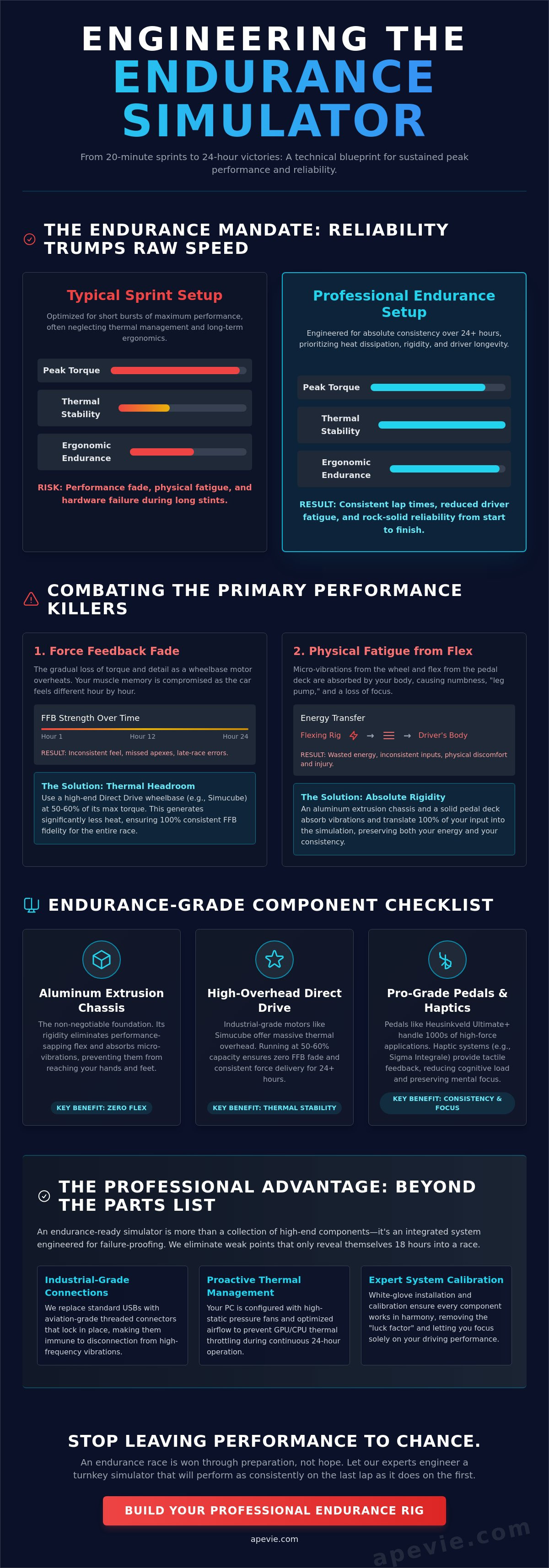
In a 24-hour race, the clock is your most relentless opponent, but heat is your most silent one. Most enthusiasts build rigs for 20-minute sprints where cooling and ergonomics are secondary to peak numbers. However, a professional endurance racing simulator setup is an exercise in engineering for thermal stability and human longevity. It's a system where every component is chosen not just for its performance at the start, but for its ability to deliver the exact same inputs at 4:00 AM after eighteen hours of continuous load. Success in endurance racing isn't about being the fastest for one lap; it's about having the mechanical and physical overhead to be fast when everyone else is fading.
Understanding Force Feedback Fade
Force feedback fade is the gradual loss of detail due to motor heat soak. As the internal motor of a wheelbase reaches high temperatures, internal resistance increases and torque output drops. This alters your muscle memory; the car feels lighter and less communicative in the final hours than it did in the first. This inconsistency leads to missed apexes and late-race errors. Utilizing Direct-drive technology with significant mechanical overhead is the only professional solution. Running a Simucube 3 Wheel Base at 50% of its capacity generates far less heat than pushing a smaller motor to its absolute limit, ensuring 100% fidelity throughout the entire event.
Reliability Beyond the Motor
Reliability extends to every physical connection and electronic component. Standard USB connectors can vibrate loose or fail over long periods of high-frequency vibration. At Apevie, we prioritize industrial-grade components and PC-based platforms because they offer the stability required for professional competition. A high-performance endurance racing simulator setup must account for the following technical requirements:
- Industrial Connectors: Aviation-grade threaded connectors lock into place, preventing the vibration from high-torque motors or motion systems from wiggling cables loose.
- PC Thermal Management: High-performance GPUs and CPUs require dedicated airflow solutions or high-static pressure fans to prevent thermal throttling during 24-hour continuous operation.
- Software Stability: We focus on PC-based hardware over console-compatible gear because it allows for the management of complex telemetry and haptic data without hardware-imposed limitations.
If your hardware throttles or a connector fails in the middle of the night, months of team preparation can vanish. By engineering for mechanical overhead and thermal stability, you minimize the luck factor and keep the focus entirely on your driving performance.
Ergonomics and Cockpit Stability: The Foundation of Long-Stint Performance
Speed is often the first casualty of discomfort. In a sprint race, you can drive through a slightly misaligned seat or a vibrating steering column, but in an endurance racing simulator setup, these minor annoyances transform into performance-ending injuries. True stability starts with the chassis. A high-grade aluminum extrusion sim rig acts as a heat sink for mechanical energy, absorbing the high-frequency micro-vibrations produced by direct drive motors. Without this rigid foundation, those vibrations travel directly into your hands and forearms, causing numbness and premature fatigue long before your stint is over.
Your choice of seating is equally critical for sustained focus. While deep side-bolsters are excellent for maintaining posture in motion-equipped rigs, they can trap body heat during a 24-hour event. We recommend professional-grade shells with breathable mesh inserts or integrated ventilation. This structural rigidity is mirrored in the pedal deck. When you're applying 80kg of force to a load cell brake for the thousandth time, any flex in the deck is stolen energy. This movement forces your muscles to constantly recalibrate their pressure points, leading to "leg pump" and inconsistent braking markers. A professional racing simulator analysis confirms that consistent driver inputs are directly tied to the stability of the cockpit environment.
The Ergonomic Checklist for 24-Hour Races
Perfecting the "Endurance Triangle"—the ratio between wheel height, pedal distance, and eye level—is a non-negotiable step in your build. We follow these specific metrics to ensure driver longevity:
- Monitor Height: Align the in-game horizon line exactly with your eye level. Looking up or down even five degrees will cause significant neck strain by the second hour.
- Pedal Angle: Set the brake face at a slight incline to allow for a natural ankle pivot. This prevents the "shin splint" sensation common in poorly configured setups.
- Wheel Reach: Adjust the column so your elbows maintain a 90-degree bend. If you're reaching too far, your shoulders will tighten, restricting the fine motor skills needed for micro-corrections.
Managing Driver Environment
The cockpit environment must be managed as carefully as the car's telemetry. Integrating active cooling fans into the rig isn't a luxury; it's a necessity for maintaining lower heart rates and core temperatures during night stints. Position your button boxes and secondary controls so they're reachable by touch alone. You shouldn't have to break eye contact with the apex to adjust your brake bias or fuel map. Finally, meticulous cable management ensures that frantic driver swaps or position adjustments don't result in a snagged headset or a disconnected shifter. If you're looking to eliminate these variables, exploring a turnkey endurance solution ensures every ergonomic detail is calibrated by experts before your first green flag.
Direct Drive and Pedal Engineering: Maintaining Consistency for 24 Hours
Consistency in a professional endurance racing simulator setup is not merely a product of the driver's skill, but a result of hardware that provides transparent, repeatable data. When tires are 40 laps old and the sun is just starting to peek over the horizon, your ability to execute perfect threshold braking determines whether you stay on the lead lap or end up in the gravel. This is where the engineering of your primary inputs, the wheel and the pedals, becomes the deciding factor in your team's success. You need gear that doesn't just work, but gear that speaks to you with clarity when your physical senses are beginning to dull.
Direct Drive: The Heart of the Endurance Rig
The Simucube 3 Wheel Base has established itself as the industry benchmark because it virtually eliminates torque ripple, those tiny mechanical inconsistencies that can mask the subtle "lightness" of a losing front-end grip. High-fidelity feedback allows a driver to feel tire wear and graining minutes before it becomes a critical issue on the telemetry. We often recommend a high-torque direct drive base because having 25Nm of torque is essential for realistic muscle memory training, allowing the system to replicate the heavy steering of a GT3 or LMP2 car without clipping or thermal degradation. By utilizing only a fraction of the motor's total capacity, the Simucube 3 Pro and Ultimate models maintain perfect signal clarity for the entire duration of a 24-hour race, ensuring the car feels identical from the green flag to the checkered.
Pedal Precision and Fatigue
While the wheelbase provides the information, your sim racing pedals are where you execute your most critical decisions. For long-stint performance, the debate between load cell and hydraulic systems usually lands on the side of load cells for their sheer reliability and lack of maintenance. The Heusinkveld Sim Pedals Ultimate+ is the professional standard for endurance durability, featuring custom-made dampers and a robust load cell that can handle the repetitive, high-pressure demands of a multi-driver event without drifting in calibration.
When comparing the Heusinkveld Sim Pedals Sprint and the Ultimate+, the choice often comes down to the intensity of the environment. The Sprint is a masterpiece of engineering for serious enthusiasts, but the Ultimate+ offers a more robust damping system that mimics the feel of a real racing brake more accurately over three-hour double stints. Adjusting pedal tension is a vital part of the setup process; a brake that is too stiff will cause knee fatigue and "leg pump" after 90 minutes, while one that is too soft makes it difficult to modulate pressure when tires are worn. Engineering this balance ensures that your last lap is as precise as your first, even under the heavy cognitive load of an endurance classic.
Haptics and Motion: Using Feedback to Combat Driver Fatigue
In the final hours of a 24-hour race, the brain begins to filter out visual information to conserve energy. This is where a professional endurance racing simulator setup leverages sensory layering to keep the driver engaged and precise. While many beginners view motion as a purely immersive addition, serious competitors use haptic systems to offload mental processing. By feeling the car's slip angle through the chassis rather than just seeing it on a screen, you reduce the cognitive load required to maintain your pace. This tactile feedback acts as a secondary nervous system, allowing you to react instinctively rather than analytically.
Integrating the Sigma Integrale DK2 Motion System provides the high-frequency chassis feedback needed to identify curbs, traction loss, and road texture with absolute clarity. This constant physical engagement is the most effective way to combat "highway hypnosis," a state of mental fog that occurs during long, repetitive stints in the dark. When your body is physically involved in the car's dynamics, your heart rate and focus remain more stable, preventing the performance drop-off that often ruins late-race consistency.
The Science of Tactile Intuition
The human brain processes tactile information approximately 20ms faster than visual data. In a high-speed corner at Spa or Sebring, those milliseconds are the difference between a minor correction and a race-ending spin. This speed advantage allows your body to sense the rear tires stepping out before your eyes register the change on the monitor. We differentiate between "immersion motion," which mimics g-forces, and "data-driven motion," which provides specific telemetry-based cues. For endurance, data-driven motion is superior because it focuses on information that saves the car and preserves the race while keeping your mental energy reserves intact.
Sigma Integrale DK2+ for Endurance
The Sigma Integrale DK2+ is the preferred choice for GT3 and Prototype racing due to its exceptional high-frequency response and industrial durability. Unlike slower, consumer-grade platforms, the DK2+ can replicate the sharp, rapid vibrations of a flat-spotted tire or the harshness of an aggressive curb without delay. Its actuator-based design is engineered for 24-hour continuous stress, maintaining its calibration and response speed even as the event enters its second day. This reliability ensures that the motion cues you rely on at the start of the race are exactly the same when you cross the finish line. If you're ready to add this level of sensory precision to your rig, you can consult with Apevie on a motion-integrated build to ensure your hardware is optimized for professional competition.
Engineering Your Professional Endurance Setup with Apevie
Building a professional endurance racing simulator setup is a complex engineering task that goes far beyond mounting a wheelbase to a frame. At Apevie, we understand that for serious competitors, the rig is a tool for professional development and competitive success. This is why we curate a specific selection of hardware from industry leaders like Simucube, Heusinkveld, Gomez Sim Industries (GSI), and Cube Controls. We don't stock entry-level gear because it lacks the thermal stability and structural integrity required for 24-hour stints. By choosing a custom-built solution, you bypass the trial-and-error phase and move straight to a platform that is calibrated for consistency and reliability.
Our turnkey racing simulator packages are designed to be plug-and-play, but the "play" part is backed by rigorous testing. White-glove installation means our experts handle the assembly, cable management, and software configuration at your location. This prevents the common mid-race technical failures, such as driver conflicts or thermal throttling, that often plague DIY builds. We ensure your rig is a stable, high-performance environment from day one, allowing you to focus on your racing line rather than your hardware settings.
The Apevie Advantage: Expert Consultation
Every driver has different requirements based on their primary platform, whether that is competing in iRacing Special Events or mastering Le Mans Ultimate. During our consultation process, we match hardware to your specific goals. We often recommend the Gomez Sim Industries Formula Pro Elite as a top-tier endurance wheel choice. Its robust construction and high-quality encoders ensure that every adjustment to your brake bias or traction control is precise, even in the middle of a frantic night stint. Our focus remains exclusively on professional PC-based hardware because it offers the necessary uptime and telemetry depth that console-compatible gear simply cannot match.
Next Steps: Booking Your Build
The transition from researching components to sitting in a professional-grade cockpit is a streamlined process with Apevie. Professional assembly is the ultimate insurance policy against the mechanical and electronic variables that can ruin an endurance weekend. We take care of the engineering so you can focus on the driving. If you are ready to invest in a system that maintains its fidelity from the green flag to the finish line, contact Apevie Simulators for a custom turnkey build today. Our team is ready to help you design a high-performance racing simulator that meets the uncompromising standards of professional endurance competition.
Dominating the Long Game with Professional Engineering
As an authorized Simucube and Heusinkveld dealer, Apevie specializes in high-torque and motion-capable turnkey systems that eliminate the guesswork of high-end builds. Our expert white-glove installation services ensure your equipment is perfectly aligned for your specific ergonomic needs before your first green flag. If you are ready to remove the technical variables from your competition strategy, you can build your professional endurance rig with Apevie Simulators today. Your next 24-hour victory begins with a rig that is as resilient as your passion for the sport.
Frequently Asked Questions
What is the most important piece of hardware for endurance sim racing?
The chassis is the most critical component because it provides the foundation for every other input. An aluminum extrusion sim rig eliminates the micro-vibrations that cause driver fatigue and ensures that your high-torque wheelbase doesn't lose fidelity through frame flex. While a Simucube 3 Wheel Base provides the data, the rig ensures that information is transmitted accurately to your hands without mechanical interference or energy loss.
How do I prevent my direct drive wheel from losing power during a long race?
You prevent force feedback fade by using a direct drive motor with significant mechanical overhead. Running a 25Nm Simucube 3 Pro at 40% to 50% capacity generates significantly less heat than pushing a 10Nm base to its absolute limit. This approach ensures that the motor remains within its optimal thermal range, maintaining consistent torque delivery and signal clarity from the green flag until the final lap.
Are motion systems actually helpful for endurance, or just a distraction?
Motion systems like the Sigma Integrale DK2+ are highly beneficial for endurance because they reduce cognitive load. By providing tactile cues for tire slip and chassis balance, the system allows your brain to process vehicle dynamics 20ms faster than visual cues alone. This physical engagement keeps you alert during monotonous night stints and helps prevent the mental fog that often leads to late-race errors.
Which pedals are best for preventing leg fatigue in 24-hour races?
The Heusinkveld Sim Pedals Ultimate+ are the professional standard for endurance due to their robust damping and load cell technology. Unlike hydraulic systems that can drift in feel as fluid temperatures change, these pedals provide a consistent, pressure-based response. Properly adjusting the elastomer tension allows you to maintain precise threshold braking without overstraining your knee or ankle during a demanding three-hour double stint.
Do I need a special PC for endurance sim racing?
You need a PC engineered for thermal stability rather than just peak benchmark scores. Continuous 24-hour operation under heavy load requires high-static pressure fans and a professional-grade GPU to prevent thermal throttling. At Apevie, we focus on PC-based hardware because it allows for superior management of the complex telemetry and haptic data streams required for a professional endurance racing simulator setup.
What is the best steering wheel for endurance racing (GT3 vs Prototype)?
The best choice depends on your primary vehicle class, but ergonomics and button accessibility are the universal priorities. For GT3 and Prototype racing, the Gomez Sim Industries Formula Pro Elite is a top-tier option due to its rigid construction and accessible encoders. You need a wheel that allows you to adjust brake bias and traction control by touch alone, ensuring you never break focus.
How can I make my sim racing seat more comfortable for 3-hour stints?
Long-stint comfort is achieved through breathability and proper lumbar alignment. While deep side-bolsters provide support in motion rigs, they can trap heat over many hours. We recommend professional racing shells with mesh inserts or integrated ventilation to manage body temperature. Additionally, ensure your seat is positioned to maintain a 90-degree elbow bend, which reduces the shoulder tension that accumulates during long-format races.
Is VR or triple monitors better for endurance racing stamina?
Triple monitor setups are generally superior for endurance stamina because they cause significantly less eye strain and physical fatigue than VR headsets. Wearing a VR headset for multiple hours can lead to heat buildup and sensory conflict, which compromises your mental clarity. Triple monitors provide the necessary peripheral vision for traffic management while allowing you to stay cool and comfortable in your endurance racing simulator setup.