Gomez Sim Industries Wheels: The Professional’s Guide to GSI Hardware (2026)
If you feel even a millimeter of flex in your steering wheel during a high-torque corner, you aren't driving a professional simulator; you're using a gaming peripheral. Serious racers understand that true immersion is fragile. It breaks the moment a rim creaks under load or the telemetry display lags behind the physics engine. When you're wrestling a GT3 car through a high-speed chicane, you need hardware that feels like a genuine motorsport component. This is exactly where Gomez Sim Industries wheels separate themselves from the rest of the market. These wheels are engineered as rigid, heavy-duty instruments designed to handle the violent forces of modern direct-drive systems without a hint of compromise.
We understand the frustration of complex software setups and ergonomics that fail during long endurance stints. You want a setup that works seamlessly from the moment you sit in the cockpit. At Apevie Simulators, we often integrate these components into our turnkey builds because they meet our strict standards for professional reliability. In this guide, you'll discover how GSI hardware achieves its legendary zero-flex status and which model fits your specific racing discipline. We'll examine the technical details of the 2026 lineup, including the modular Interlock system and the flagship Hyper P1. Whether you're looking for the screenless simplicity of the GXL V2 or the data-rich interface of the Formula Pro Elite V2, this overview provides the clarity you need to make an informed investment.
Key Takeaways
- Learn why Gomez Sim Industries wheels are considered the industry benchmark for zero-flex performance in high-torque racing environments.
- Understand the functional differences between the versatile Formula Pro Elite V2 and the telemetry-heavy Hyper P1 flagship to find the right fit for your rig.
- Discover how 6061 aluminum construction and motorsport-grade material science preserve force feedback detail while dampening unwanted oscillations.
- Explore the seamless integration possibilities between GSI hardware and the Simucube 3 wheel base using the new modular Interlock mounting system.
- Find out how professional white-glove installation ensures complex screen telemetry and integrated controls are perfectly calibrated for a turnkey racing experience.
Engineering Excellence: Why Gomez Sim Industries (GSI) Dominates High-End Sim Racing
The landscape of sim racing has shifted dramatically from a niche hobby into a disciplined professional environment. As direct drive wheelbases have pushed past the 25Nm torque threshold in 2026, the demand for hardware that can withstand these violent rotational forces has reached a peak. Gomez Sim Industries wheels have emerged as the dominant choice for those who view their simulator as a serious training tool. This dominance isn't accidental. It's the result of an "overbuilt" engineering philosophy that treats every steering wheel as a critical motorsport instrument rather than a gaming accessory.
Professional drivers require consistency above all else. If a wheel rim flexes even slightly during a high-G corner, the driver's muscle memory receives "noise" instead of clean data. GSI addresses this by utilizing industrial-grade materials that provide a rock-solid connection to the wheelbase. This rigid architecture ensures that every vibration, curb strike, and tire slip is transmitted directly to the driver's hands without being dampened by flexible materials. The transition from hobbyist gear to professional-grade controls is defined by this uncompromising approach to structural integrity.
The "Not a Plastic Toy" Philosophy
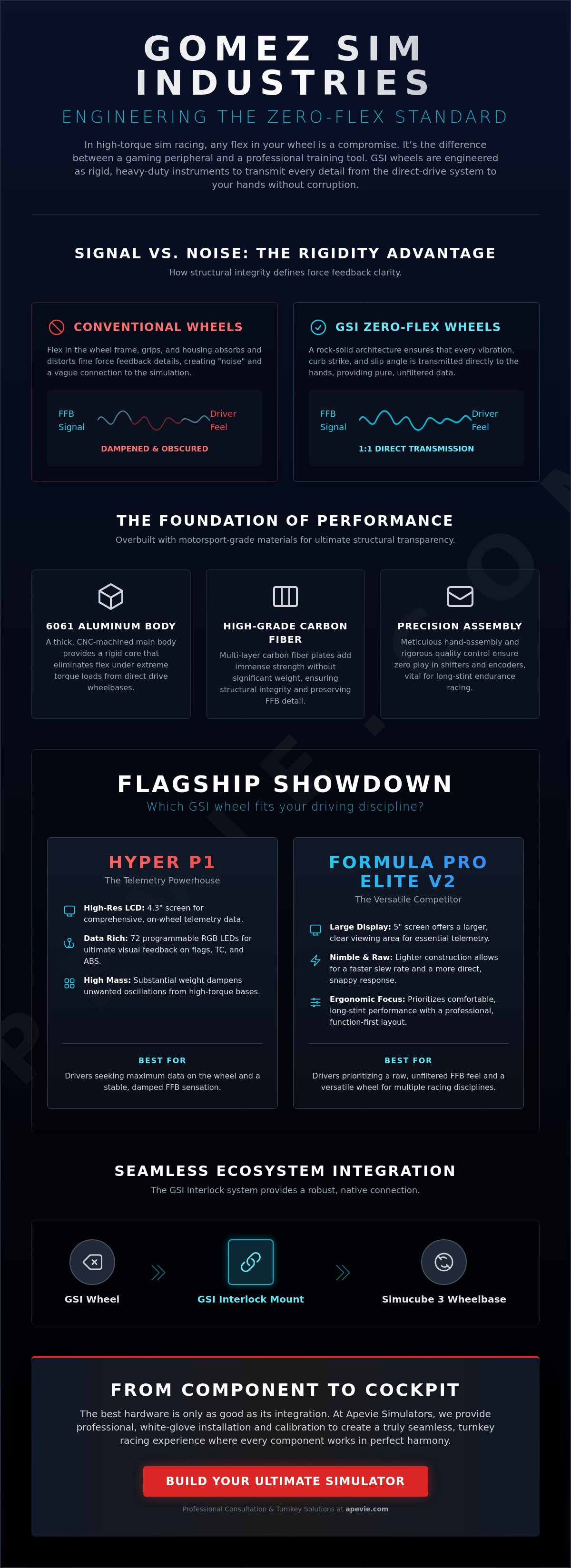
GSI builds their frames using thick 6061 aluminum and high-grade carbon fiber plates. This choice of materials isn't just about premium aesthetics; it's about structural transparency. When you use a high-torque base, a lesser wheel will actually absorb the fine details of the force feedback. By maintaining a zero-flex profile, Gomez Sim Industries wheels allow the driver to feel the exact moment the front tires lose grip. This clarity is essential for elite-level competition where thousandths of a second matter.
Manufacturing Standards in 2026
Precision in ergonomics is achieved through meticulous CNC machining and hand-assembly. Each component is cut to exacting tolerances to ensure there's no play in the shifters or encoders. In a 24-hour endurance race, a single missed shift or a failing button can ruin months of preparation. GSI’s assembly process involves rigorous quality control that mirrors professional motorsport standards. This focus on reliability is why serious racers prioritize GSI for long-stint performance. The tactile feedback from their custom-designed shifters provides the confident engagement required under intense pressure.
Comparing the GSI Lineup: From the Formula Pro Elite V2 to the Hyper P1
Selecting the right hardware requires a clear understanding of how different models interact with your specific racing goals. While all Gomez Sim Industries wheels share the same zero-flex DNA, their functional layouts vary to suit different cockpit environments. Choosing between them often comes down to how much data you need at your fingertips versus the physical feedback you want to prioritize in your steering rack.
Hyper P1 vs. FPE V2: Which Flagship is Yours?
The Hyper P1 is the definitive flagship of the 2026 lineup. It features a high-resolution 4.3 inch LCD screen and a staggering 72 programmable RGB LEDs. This is the primary choice for drivers who want every bit of telemetry, from tire temperatures to brake bias, visible on the wheel itself. In contrast, the Formula Pro Elite (FPE) V2 offers a slightly different interface with its 5 inch screen, serving as the versatile king of professional sim wheels for those who prefer a larger display area.
One critical difference lies in the physical mass and input density. The Hyper P1 is a substantial piece of hardware with more encoders and buttons than almost any other rim on the market. This added weight helps dampen unwanted oscillations in high-torque bases like the Simucube 2 Pro. However, it might slightly reduce the slew rate compared to the more nimble FPE V2. Drivers who prefer a raw and snappy feel often lean toward the FPE V2, while those seeking a stable, damped sensation usually choose the P1.
- Hyper P1: Best for maximum telemetry and complex mid-race adjustments in iRacing.
- FPE V2: Best for drivers who want a larger screen and a slightly more agile steering feel.
- Paddle Setup: Both support dual-clutch configurations, essential for perfect standing starts in Formula disciplines.
The X-29 and GXL V2: Performance Without the Screen
Not every professional needs an integrated display. Drivers who race exclusively in VR or have a dedicated dashboard mounted to their rig often prefer the GXL V2 or the X-29. These models provide the same 6061 aluminum construction and tactile shifting experience as the flagships but at a more focused price point. The GXL V2 is essentially a screenless version of the FPE, providing the same ergonomic excellence without the electronic complexity.
The X-29 serves as an excellent entry point into the ecosystem. It lacks the screen but retains the rigid profile that makes GSI famous. It’s a pragmatic choice for endurance racers who prioritize reliability and muscle memory over visual flair. Much like how students apply virtual engineering lessons to master real-world vehicle dynamics, choosing a screenless Gomez Sim Industries wheels setup requires a disciplined focus on pure tactile feedback and sound.
If you are looking for a professional recommendation on which rim fits your specific driving style, the team at Apevie Simulators can help you integrate these components into a fully calibrated turnkey system.
Beyond Aesthetics: The Performance Impact of Material Science
A common misconception among enthusiasts is that a lighter steering wheel is always superior for performance. While low inertia helps with rapid direction changes, a rim that lacks sufficient structural mass can suffer from violent high-frequency oscillations when paired with a 25Nm direct drive base. Gomez Sim Industries wheels are engineered with a specific weight profile that serves a functional purpose. This mass acts as a natural dampener for electrical noise and mechanical vibration, allowing the true force feedback signal to reach your hands with surgical clarity. It’s a deliberate application of materials science that ensures your hardware doesn't chatter or "hunt" for center during high-speed straights.
The choice of 6061 aluminum for the main chassis isn't merely for a premium feel. Under heavy mid-corner loads, lesser wheels made of plastic or thin composites can flex. This microscopic bending creates a "mushy" sensation that makes it difficult to sense the exact limit of traction. By utilizing a rigid aluminum skeleton, GSI eliminates this variable entirely. You get a direct, metal-to-metal connection from the motor shaft to your palms. This rigidity is complemented by custom injection-molded silicone grips. Unlike traditional Alcantara, these grips don't degrade or become slippery over time, providing consistent friction that reduces hand fatigue during grueling three-hour endurance stints.
Tactile Feedback and Button Feel
The "clack" of a GSI shifter is one of the most recognizable sounds in a professional cockpit. This positive engagement is achieved through industrial-grade switches that require a high actuation force. This prevents accidental upshifts when you're wrestling the car over aggressive curbing. For drivers who primarily race in VR, the tactile distinctiveness of the rotary encoders and button caps is vital. You can differentiate between a brake bias adjustment and a traction control tweak by touch alone, without ever taking your eyes off the apex. This level of physical intuition is a hallmark of elite The Best F1 Steering Wheels for Professional Sim Racing in 2026.
Thermal Management and Durability
Modern sim wheels are complex computers with high-brightness displays and dozens of LEDs that generate significant internal heat. The thick aluminum body of Gomez Sim Industries wheels acts as a massive heat sink, drawing warmth away from the internal PCBs. This thermal efficiency prevents processor throttling and ensures that your telemetry display remains responsive even after hours of continuous use. This industrial-grade construction also contributes to an impressively high resale value; these wheels are built to be heirloom pieces of hardware that can survive multiple wheelbase upgrades over a decade of racing.
Compatibility and Integration: Pairing GSI with Simucube 3
By 2026, the Simucube 3 has established itself as the industry standard for force feedback fidelity. When you pair this motor with Gomez Sim Industries wheels, you create a hardware ecosystem that translates digital physics into physical reality with zero loss in translation. However, achieving this level of performance requires more than just bolting parts together. It involves a systematic approach to mounting, power management, and software calibration to ensure the high-torque base and the feature-rich wheel work in perfect harmony.
The introduction of the GSI Interlock system has revolutionized how these components connect. This modular mounting ecosystem allows you to swap between different rim styles while maintaining a rock-solid mechanical link. For those using the Simucube 3, the Interlock Base Module provides a direct interface with the Simucube Quick Release (SQR) system. This metal-on-metal connection is vital because even the slightest play in a plastic quick release would be magnified by the 25Nm+ torque of a modern direct drive base.
The Simucube Connection
Mounting a GSI wheel to a Simucube Sport, Pro, or Ultimate base is a straightforward process thanks to the universal 70mm bolt pattern. While the Simucube wireless ecosystem offers convenience, professional racers often prioritize the wired reliability of GSI hardware to ensure zero-latency telemetry for their integrated displays. A secure physical connection is the foundation of any high-end rig, especially when you're also integrating complex haptic feedback. You can learn more about these advanced setups in our Professional Guide to Haptic Systems in High-Performance Simulation.
Software and Telemetry Configuration
The true power of the GSI Hyper P1 or FPE V2 is unlocked through SimHub. This software acts as the bridge between your racing title and the wheel's hardware. You can configure the 72 RGB LEDs to represent everything from spotter alerts to engine maps. It's essential to match your shift light patterns to the specific car class you're driving. A GT3 car requires a different visual cue than a high-revving Formula car to optimize your acceleration curves.
One technical detail often overlooked is power delivery. The high-brightness LCD screens and extensive LED arrays on Gomez Sim Industries wheels draw significant current. We recommend using a high-quality powered USB 3.0 hub to prevent connection drops or screen flickering. In high-EMI environments created by powerful direct drive motors, using shielded cables and proper grounding is non-negotiable for maintaining a stable data stream.
If you want to ensure your high-end components are perfectly synchronized, consider a professional simulator installation from the expert team at Apevie Simulators to handle the technical heavy lifting.
Custom Turnkey Integration: The Apevie Difference
Selecting premium hardware is only the first step in creating an elite racing environment. The true value of a professional simulator lies in how these components are synchronized to provide a transparent driving experience. At Apevie Simulators, we integrate Gomez Sim Industries wheels into our custom builds because they offer the mechanical reliability and software depth required for high-stakes competition. We don't just sell parts; we engineer complete ecosystems where every button press and telemetry flash serves a specific purpose.
A GSI Formula Pro Elite V2 reaches its full potential when paired with world-class peripherals that match its precision. We often combine these wheels with Heusinkveld Sim Pedals Ultimate+ for precise braking and a Sigma Integrale DK2+ Motion System for realistic chassis feedback. This combination ensures that the zero-flex performance of the wheel is matched by the rigidity and response of the entire platform. This synergy is what separates a professional training tool from a collection of expensive gaming gear.
Firmware management is another critical part of our white-glove service. As simulation titles receive updates, GSI hardware requires precise firmware tuning to maintain compatibility and optimize new telemetry features. Our team handles these technical complexities on your behalf. We ensure your rig stays updated and calibrated, so you can focus entirely on your lap times rather than troubleshooting driver conflicts.
Turnkey Simulators vs. DIY Component Hunting
The DIY route often leads to a phenomenon we call "software fatigue." This happens when a racer spends more time troubleshooting USB conflicts or SimHub layouts than actually training on track. By choosing a turnkey solution, you benefit from our professional calibration. We ensure that your GSI integrated display is perfectly mapped to your favorite titles. Our focus remains strictly on professional-grade, PC-based hardware. This commitment to quality is detailed in our guide on The Ultimate Sim Rig Guide: Building a Professional Foundation in 2026.
Get Started with a Professional Consultation
Commissioning a custom high-performance racing simulator is a significant investment in your racing career. We help you navigate the nuances between Gomez Sim Industries wheels, Cube Controls F-Core, and other elite options to find the ergonomic fit that suits your hands. Our consultation process ensures that your cockpit is built around your specific needs, from pedal spacing to monitor focal distance. We provide the expertise needed to build a rig that feels like a genuine GT3 or Formula cockpit.
Ready to experience the benchmark in professional simulation? Contact Apevie Simulators for a professional consultation or turnkey GSI build today.
Master the Apex with Professional-Grade Hardware
Investing in Gomez Sim Industries wheels is about more than just owning a premium steering rim; it's about securing a reliable, transparent link between your inputs and the simulator's physics engine. We have explored how the 6061 aluminum construction and industrial-grade components provide the zero-flex foundation necessary for the high-torque forces of modern direct drive bases. Whether you opt for the data-intensive Hyper P1 or the agile Formula Pro Elite V2, you're choosing hardware that's built to withstand the rigors of professional motorsport without compromise.
Apevie Simulators serves as an authorized Simucube and GSI integrator, specializing in expert consultation for professional motorsport drivers who demand perfection. Our white-glove simulator installation service removes the technical friction of firmware updates and complex software calibration, delivering a ready-to-race system tailored to your specific needs. If you're ready to move beyond consumer-grade setups and embrace a truly immersive racing environment, build your dream simulator with integrated GSI hardware today. True consistency on the track starts with hardware you can trust in every corner.
Frequently Asked Questions
Are Gomez Sim Industries wheels compatible with Fanatec or Moza bases?
Gomez Sim Industries wheels are designed as standalone USB devices, which makes them compatible with almost any direct drive base, including those from Fanatec or Moza. To mount them, you simply need a 70mm hub adapter or the specific quick release system for your particular base. Since the wheel communicates with your PC via its own dedicated USB cable rather than through the wheelbase pins, you retain full functionality regardless of the motor brand you use.
Do GSI wheels work on PS5 or Xbox consoles?
No, these wheels are strictly for PC-based simulators and don't support PS5 or Xbox consoles. The complex telemetry, high-resolution integrated screens, and extensive RGB LED mapping require Windows-based software to function correctly. At Apevie, we focus exclusively on professional-grade PC systems to ensure our clients have access to the full depth of high-performance racing simulations without the limitations of console hardware.
What is the difference between the GSI Hyper P1 and the Hyper SL?
The primary difference is the presence of an integrated display; the Hyper P1 features a 4.3 inch LCD screen, while the Hyper SL is the "Screenless" version of the same flagship design. Both models share the same 6061 aluminum chassis, tactile shifters, and high-quality silicone grips. The SL is often the preferred choice for VR racers or those with a dedicated dashboard who don't require a second screen in their peripheral vision.
Do I need a powered USB hub for a GSI wheel with an integrated screen?
Yes, a high-quality powered USB 3.0 hub is highly recommended for any Gomez Sim Industries wheels that feature integrated screens. The high-brightness displays and dozens of programmable LEDs can draw more power than a standard motherboard port can reliably provide. Using a powered hub ensures a stable data connection and prevents the screen from flickering or disconnecting during intense high-torque maneuvers.
How do I mount a GSI wheel to a Simucube 2 or 3 wheel base?
Mounting a GSI wheel to a Simucube base is done via the industry-standard 70mm bolt pattern located on the back of the wheel. You'll use the Simucube Quick Release (SQR) system, which bolts directly to the GSI hub or the newer Interlock module. This creates the rigid, metal-on-metal connection that's essential for transmitting fine force feedback details from the Simucube 3 motor to your hands without any mechanical loss.
Is the weight of a GSI wheel too much for a 10Nm wheel base?
A 10Nm wheelbase can certainly handle the weight of a GSI wheel, though you'll notice a slight increase in rotational inertia compared to lighter, plastic rims. This weight actually helps dampen the "grainy" feeling found in some mid-range bases, resulting in a smoother steering experience. However, to truly experience the zero-flex benefits of this hardware, we typically recommend pairing it with bases in the 20Nm to 25Nm range for optimal dynamic range.
What software is required to run the telemetry on a GSI Formula Pro Elite?
SimHub is the essential software required to run telemetry on the GSI Formula Pro Elite and other screen-equipped models. It's a versatile tool that allows you to customize dash layouts, map shift lights, and sync your wheel LEDs with in-game flags or spotter alerts. While the wheel works as a standard controller out of the box, SimHub is what unlocks the professional-grade data integration that serious racers expect from their equipment.
Can I customize the buttons and rotaries on GSI wheels for different sims?
You can fully customize every button, rotary encoder, and multi-switch on Gomez Sim Industries wheels to suit different racing titles like iRacing or ACC. These inputs are recognized as standard Windows game controller buttons, which means you can map them directly in the game's settings. For more advanced logic, such as changing LED colors based on your traction control levels, you can use SimHub to create specific profiles for every car in your garage.