2026 Turnkey Flight Simulator Guide for Serious Pilots
What if the most sophisticated piece of aviation technology you own didn't require a single line of code or a weekend of troubleshooting to operate? Many serious pilots find that building a high-end rig often leads to a software configuration nightmare, where fighting with MSFS 2024 updates or calibrating inconsistent force feedback takes precedence over actual flight time. You likely believe that a simulator should be a tool for precision and skill development, not a constant source of technical frustration. Investing in a professional-grade turnkey flight simulator changes that dynamic by providing a pre-configured, plug-and-play ecosystem where every component is optimized for absolute realism.
In this guide, you'll discover how to identify a system that mirrors real-world physics through elite hardware like the Sigma Integrale DK2+ motion system and the latest NVIDIA RTX 5090 GPUs. We'll examine the critical differences between gimmicky consumer setups and professional rigs that offer zero-maintenance reliability. You'll gain a clear understanding of the ROI for training versus entertainment, ensuring your setup provides the haptic feedback and high-torque control response required for serious flight mastery.
Key Takeaways
- Define the three essential pillars of a professional rig: structural rigidity, high-fidelity peripherals, and authentic haptic feedback.
- Learn how to match your specific flight goals, from VFR training to high-G combat, with the appropriate degree of freedom (DOF) in a motion system.
- Discover how a high-performance turnkey flight simulator utilizes Sigma Integrale DK2+ haptics to translate real-world physics like turbulence into precise tactile data.
- Evaluate specialized hardware like Restech carbon fiber seating and GT-style cockpits to create a stable, aircraft-specific foundation for your build.
- Understand the value of white-glove installation and virtual flight-testing to eliminate technical maintenance and software configuration hurdles.
What Defines a Professional Turnkey Flight Simulator in 2026?
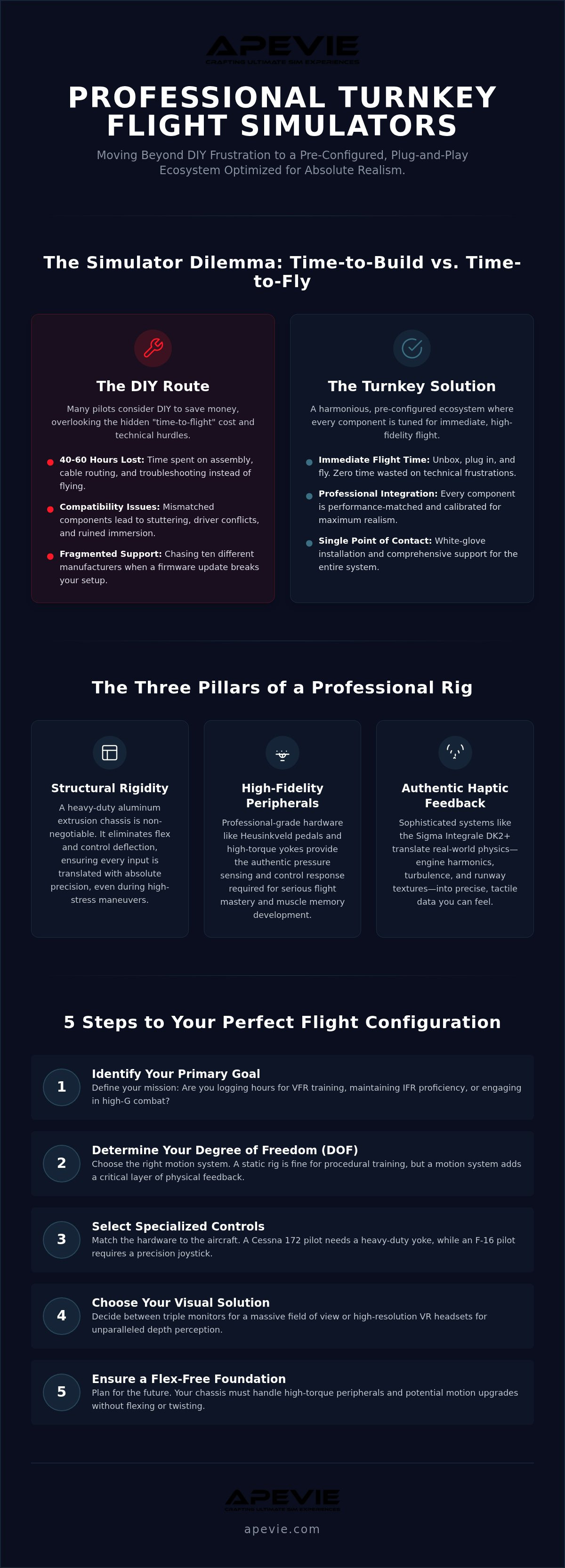
A professional turnkey flight simulator in 2026 is far more than a collection of high-end components bolted to a frame. It is a harmonious, pre-configured ecosystem where every piece of hardware and every line of code is tuned for immediate, high-fidelity flight. While a standard Flight simulator might focus on basic visuals, a professional-grade rig relies on three core pillars: structural rigidity, high-fidelity peripherals, and sophisticated haptic feedback. Without an aluminum extrusion chassis to eliminate flex, even the most expensive flight stick loses its precision during high-stress maneuvers.
The Apevie standard moves past the limitations of arcade-style setups. We focus on professional PC-based simulation that bridges the "tuning gap." This gap is where many enthusiasts struggle. They buy top-tier gear but find the experience disjointed because the software doesn't communicate correctly with the hardware. A true turnkey solution ensures that the resistance in your yoke and the vibration in your seat perfectly match the physics of the aircraft you're piloting. We prioritize these elements:
- Structural Rigidity: Heavy-duty aluminum extrusion prevents control deflection and rig twist.
- High-Fidelity Peripherals: Precision hardware like Heusinkveld pedals provide authentic pressure sensing.
- Haptic Feedback: Systems like the Sigma Integrale DK2+ translate engine harmonics and runway textures into tactile data.
Turnkey vs. DIY: The Hidden Costs of Building Yourself
Many pilots consider the DIY route to save money, but they often overlook the "time-to-flight" cost. Assembling a complex rig, routing cables, and troubleshooting driver conflicts can easily consume 40 to 60 hours of your life. It's a grueling process. Beyond time, system compatibility is a major hurdle. If you don't match your NVIDIA RTX 5090 with the right processor and high-speed RAM, you'll experience stuttering in VR that ruins immersion. Choosing a turnkey flight simulator means you have one point of contact for support instead of chasing ten different manufacturers when a firmware update breaks your configuration.
The Role of Professional Integration
Realism lives in the details of software calibration. Tuning Microsoft Flight Simulator 2024 for maximum realism involves more than just sliding graphics settings to "Ultra." It requires deep adjustments to control sensitivity curves and haptic output. Our integration process includes meticulous cable management and ergonomic adjustments that are essential for long-haul flight comfort. We don't just ship a box. Our white-glove installation service is the final, critical step. It ensures the system is physically and digitally optimized for your specific environment, providing a level of reliability that off-the-shelf gaming setups simply can't match.
Choosing the Right Flight Configuration: GA, Commercial, or Combat?
Choosing a configuration is the first step toward a system that actually serves your training or entertainment goals. A turnkey flight simulator shouldn't be a "one size fits all" purchase. Step one is identifying your primary goals: are you logging hours for VFR training, maintaining IFR proficiency, or engaging in high-stakes combat? Step two involves determining the degree of freedom (DOF) for your motion system. While a static rig works for basic procedural training, adding a Sigma Integrale DK2 Motion System later is a smart way to plan for future modularity.
Step three requires selecting specialized controls. A Cessna 172 pilot needs a heavy-duty yoke, while an Airbus or F-16 pilot requires a precision joystick. Step four is your visual solution. Triple monitors provide a massive field of view and cockpit familiarity, while high-resolution VR headsets offer unparalleled depth perception and spatial awareness. Finally, step five is planning for the "Apevie advantage" by ensuring your chassis can handle high-torque peripherals without flexing. If you're curious about how to lay the groundwork for these systems, see our Ultimate Sim Rig Guide for foundation tips.
General Aviation (GA) and Commercial Training
Precision is the priority here. In GA and commercial setups, you're looking for consistent, repeatable inputs. This is why load-cell pedals like the Heusinkveld Sim Pedals Ultimate+ are a standard in professional builds. They measure pressure rather than distance, mimicking the hydraulic feel of real aircraft rudders. When setting up a glass cockpit or a traditional "six-pack" layout, the goal is muscle memory. Professional rigs often aim to meet the rigorous standards discussed in the FAA's National Simulator Program, ensuring that the transition from sim to sky is seamless.
Combat and High-G Maneuvering
In the world of fighter jet simulation, spatial awareness is everything. A 3-DOF system might suffice for some, but a 6-DOF motion platform is necessary to truly replicate the complex forces of combat flight. You need to feel the buffet of an approaching stall and the sharp jolt of a missile release. Integration of a HOTAS (Hands On Throttle-And-Stick) system is non-negotiable for these builds. Managing G-force simulation through haptic feedback allows you to react instinctively rather than relying solely on visual cues. If you're ready to start your journey with a system tailored to your specific flight path, our team at Apevie specializes in custom turnkey builds that deliver this level of detail.
The Hardware Stack: Why Motion and Torque Matter
The hardware stack is the nervous system of your simulation experience. In a high-performance turnkey flight simulator, the synergy between the motor and the motion platform determines whether you feel like you're piloting an aircraft or playing a game. While many associate a Simucube 3 Wheel Base exclusively with sim racing, its direct drive technology is revolutionary for flight. It provides high-torque, granular feedback that gear-driven or belt-driven bases can't replicate. This precision allows you to feel the subtle weight shifts of the airframe, which is critical for the physics of muscle memory. When executing a landing flare, having consistent, predictable control pressure is the difference between a smooth touchdown and a bounced arrival.
Reducing latency is the invisible challenge of professional builds. There's a critical link between your PC's frame timing and the motion response of your actuators. If your system has even a slight delay, the disconnect between what your eyes see and what your inner ear feels causes motion sickness and breaks immersion. This is why we pair elite hardware with high-performance PCs to ensure the Sigma Integrale DK2+ translates engine vibration and turbulence in real-time. A lag-free connection ensures that the physical feedback is instantaneous, allowing your brain to process the flight environment naturally.
Force Feedback and Control Loading
Control loading is the technical term for how a simulator mimics air resistance on control surfaces. As your airspeed increases, the yoke or stick should become harder to move. A base capable of 25Nm+ torque isn't just about raw power; it's about having the headroom to simulate these heavy aerodynamic loads or sudden high-speed maneuvers without clipping. This prevents the controls from feeling light or disconnected at high velocities. For a deeper dive into these tactile sensations, read The Professional Guide to Haptic Systems.
Motion Platforms: DK2 vs. DK2+
Choosing the right "throw" for your actuators is a pivotal decision. The Sigma Integrale DK2 offers 2 inches of travel, which is excellent for General Aviation aircraft where movements are generally more subtle. However, the DK2+ provides 3 inches of travel. This extra inch significantly changes how the system simulates "heave" during a hard touchdown or the dramatic "pitch" during rotation. This increased range of motion reduces pilot fatigue by providing more natural cues, ultimately making your training sessions more effective. When you feel the airframe settle onto the runway with the precision of a 3-inch stroke, the simulation becomes a valid training tool rather than just a visual experience.
Top Components from the Restech Collection for 2026
The foundation of a high-performance turnkey flight simulator is often overlooked, yet the chassis and seating determine the long-term viability of your training. Within the Restech Collection, we've curated components that provide the necessary rigidity to handle high-torque wheel bases and 6-DOF motion systems. For pilots focusing on high-G combat simulations, the Restech Carbon Fiber Formula Seats are essential. These seats aren't just for aesthetics; their rigid construction ensures that motion forces are transferred directly to the pilot without being absorbed by foam or flexible plastic shells. This direct transfer is what allows you to feel the subtle buffet of a stall before it's visually apparent.
The Restech GT-Style Cockpit serves as the versatile foundation for many of our professional builds. It's particularly effective for users who require a hybrid setup where stability is the priority. When you're mounting heavy flight throttles or center-mounted joysticks, the structural integrity of the frame becomes paramount. We often recommend floor-mounted monitor stands over integrated versions for systems with significant motion travel. This separation prevents the vibrations from your flight maneuvers from causing screen wobble, which is a common distraction in lower-tier setups. Customizing your rig with dedicated shifter and throttle mounts allows for aircraft-specific layouts, ensuring every control is exactly where your muscle memory expects it to be.
Restech Cockpits: Stability Meets Comfort
Aluminum extrusion is the only professional choice for high-torque and motion setups. It allows for infinite adjustability, which is vital for maintaining proper ergonomics during long sessions. Whether you are adjusting the pedal plate for a shorter reach or moving the seat to accommodate a specific cockpit layout, the T-slot design makes it possible without drilling. Our professional frames start in the premium tier, reflecting the heavy-duty grade of aluminum and the thickness of the mounting plates. This stability ensures that your control inputs remain precise, even during the most turbulent weather scenarios.
The Hybrid Solution: Racing and Flight on One Rig
Building a dual-purpose rig is one of the most frequent requests we handle at Apevie. Using the Restech Collection, you can create a system that transitions from a GT racer to a cockpit in minutes. The key is using quick-release systems for your steering wheels and specialized mounts for your flight yokes. If you're interested in the racing side of this hybrid equation, check our Best F1 Steering Wheels guide. By planning for modularity, you ensure your investment serves both passions without compromise. To explore how we can customize these components for your specific needs, consult with our expert build team today.
The Apevie Advantage: Custom Builds and Professional Support
The real value of a turnkey flight simulator isn't found in the boxes delivered to your door; it's found in the expertise required to make those components talk to each other. At Apevie, our advantage begins with a deep consultation to understand your specific flight profile. We don't just sell hardware. We build a validated ecosystem. Every system undergoes rigorous virtual flight-testing before it leaves our facility. This ensures that the control loading curves and haptic responses are calibrated to provide the professional-grade realism we promise. You won't spend your first weekend troubleshooting software. You'll spend it in the cockpit.
Bespoke Simulator Design
Tailoring the hardware stack to your training needs is where our engineering team excels. If you're a private pilot practicing IFR procedures, your requirements for switchgear and cockpit layout differ significantly from a combat enthusiast. We integrate high-end audio and visual systems to ensure total immersion, removing the distractions of the outside world. A key differentiator in our process is the White Glove Simulator Installation Service. We handle the heavy lifting, physical assembly, and complex software routing at your location. This service transforms a room into a professional cockpit without you ever needing to pick up a wrench or troubleshoot a driver conflict.
Corporate and Professional Training Solutions
Professional environments demand a level of reliability that consumer-grade setups can't provide. Our turnkey simulators are built for high-traffic environments like flight schools and corporate event activations where downtime isn't an option. Beyond the initial setup, we provide remote tuning and software updates to keep your system at peak performance. This post-purchase support ensures your investment remains current as simulation software evolves. Whether you're training the next generation of pilots or hosting a premium activation, our systems deliver consistent results. Ready to begin your journey? Explore the Restech Collection for your turnkey build and discover the difference that professional integration makes.
Elevate Your Flight Training with Professional Precision
A professional turnkey flight simulator represents the intersection of high-fidelity engineering and specialized software integration. It's about precision. By prioritizing a rigid aluminum foundation from the Restech Collection and matching it with the granular feedback of a Simucube 3 base, you move beyond gaming into true aviation training. We've explored how the Sigma Integrale DK2+ system transforms turbulence into tactile data. This level of specificity is what builds real muscle memory for the landing flare.
As an authorized dealer for industry-leading brands, Apevie ensures your rig is built with components that meet the highest performance standards. Our team of enthusiasts provides expert consultation to tailor the hardware stack to your goals, whether you're chasing IFR proficiency or high-G combat maneuvers. With our white-glove installation service, the complexity of cable management and software calibration is handled by professionals. This leaves you with a system that's ready for departure the moment it's installed in your home or facility.
Build Your Ultimate Turnkey Flight Simulator – Shop the Restech Collection
The sky is no longer the limit when you have the right tools at your fingertips. We look forward to helping you reach your next milestone in the cockpit.
Frequently Asked Questions
What is included in a turnkey flight simulator package?
A standard turnkey flight simulator package from Apevie includes a fully integrated ecosystem: a heavy-duty aluminum extrusion rig, a high-performance PC, and all necessary peripherals. We include professional-grade hardware such as Heusinkveld Sim Pedals and high-torque direct drive bases, ensuring the entire system is pre-configured and cable-managed. This means your software, drivers, and haptic settings are tuned and tested before the rig ever reaches your door.
Can I use a turnkey flight simulator for both racing and flight?
Yes, you can use a hybrid configuration built on a versatile foundation like the Restech GT-Style Cockpit. By incorporating quick-release systems for your steering wheels and dedicated mounts for flight yokes or joysticks, you can transition between disciplines in minutes. This modular approach allows you to maximize the utility of your high-end motion actuators and direct drive base for both racing and aviation without owning two separate rigs.
How much space do I need for a full-motion flight simulator?
Most full-motion rigs require a dedicated footprint of approximately 6 feet by 6 feet to account for the physical "throw" of the actuators. If you're using a triple monitor setup or an ultrawide curved monitor, you'll need additional clearance to prevent the screens from contacting walls during aggressive maneuvers. We recommend a clear perimeter of at least 2 feet around the entire rig for safety and maintenance access.
Do I need a special PC to run high-end flight simulation software?
High-end flight simulation in 2026 demands a specialized PC, particularly if you're running MSFS 2024 at 4K or in VR. We equip our builds with the NVIDIA GeForce RTX 5090 and AMD Ryzen 9 9950X3D to handle complex physics and high-resolution textures without stuttering. Standard gaming PCs often lack the VRAM and cache capacity required to maintain smooth frame rates during heavy motion processing and dense scenery rendering.
Is a motion system necessary for realistic flight training?
While you can learn procedures on a static rig, a motion system like the Sigma Integrale DK2+ is vital for developing genuine spatial awareness. It provides the "seat-of-the-pants" feel necessary to detect an approaching stall or the subtle shift of touchdown. Without physical cues for heave and pitch, you're relying entirely on visual data, which can lead to slower reaction times in real-world cockpits where physical forces are constant.
What software is best for professional flight simulation in 2026?
Microsoft Flight Simulator 2024 is currently the gold standard for visual fidelity and General Aviation training due to its updated physics engine and global scenery. For pilots who prioritize flight dynamics and IFR precision, X-Plane continues to be a reliable choice for professional-grade procedural work. Combat enthusiasts typically lean toward DCS World, which offers the most detailed systems modeling for fighter jet simulation and high-G maneuvering.
How does Apevie handle shipping and installation for turnkey rigs?
We provide a comprehensive White Glove Simulator Installation Service that goes far beyond traditional shipping. Our technicians handle the physical delivery, assembly, and on-site software calibration to ensure your turnkey flight simulator is perfectly tuned for your specific environment. This professional support eliminates the technical hurdles of setting up complex 6-DOF motion platforms and ensures your rig is ready for flight immediately upon arrival.
Can I upgrade my turnkey flight simulator later?
Every system we build is designed for future modularity. Because we use aluminum extrusion rigs and industry-standard mounting plates, you can easily add new throttles, switch panels, or even upgrade your motion system as technology evolves. This flexibility ensures that your initial investment remains a viable training tool for years, allowing for component-level updates without the need to replace the entire foundation.