
4DOF Sim Motion Systems: The Professional Guide to Realistic Car Control (2026)
You can own the most advanced direct drive wheelbase and triple 4K monitors, but if your vestibular system isn't feeling the rear tires step out, you're still just simulating the idea of driving. Most serious racers rely on visual cues to catch a slide, yet by the time you see the horizon rotate on screen, the optimal window for correction has already passed. It's a common frustration to feel a "floaty" or disconnected sensation during high-speed cornering, particularly when your hardware doesn't communicate the subtle shift in traction that happens at the limit.
Integrating a professional 4dof sim platform transforms this experience from a purely visual exercise into a sophisticated physical training tool by introducing dedicated traction loss. This allows you to master oversteer through genuine muscle memory rather than reacting to visual lag. In this guide, we'll examine the engineering behind high-velocity actuators like the Sigma Integrale DK2+, discuss how to eliminate motion latency, and explain why a turnkey build from Apevie Simulators is the most reliable path to professional-grade car control. We'll break down the transition from simple weight transfer to true yaw movement, ensuring your simulator becomes a precise instrument for driver development.
Key Takeaways
- Learn why adding yaw movement to your setup creates a complete 4dof sim environment that accurately mirrors real-world car rotation.
- Understand how physical traction loss feedback engages your vestibular system to catch oversteer faster than visual cues alone.
- Discover why 4DOF represents the performance sweet spot for driver training; it offers the most critical feedback without the complexity of 6DOF systems.
- Identify why heavy-duty 160mm x 40mm aluminum extrusion is essential to handle the intense torsional stress generated by professional-grade actuators.
- Explore how a turnkey build from Apevie Simulator eliminates the technical hurdles of DIY motion integration through expert calibration and white-glove installation.
What is a 4DOF Sim? Understanding the Degrees of Freedom
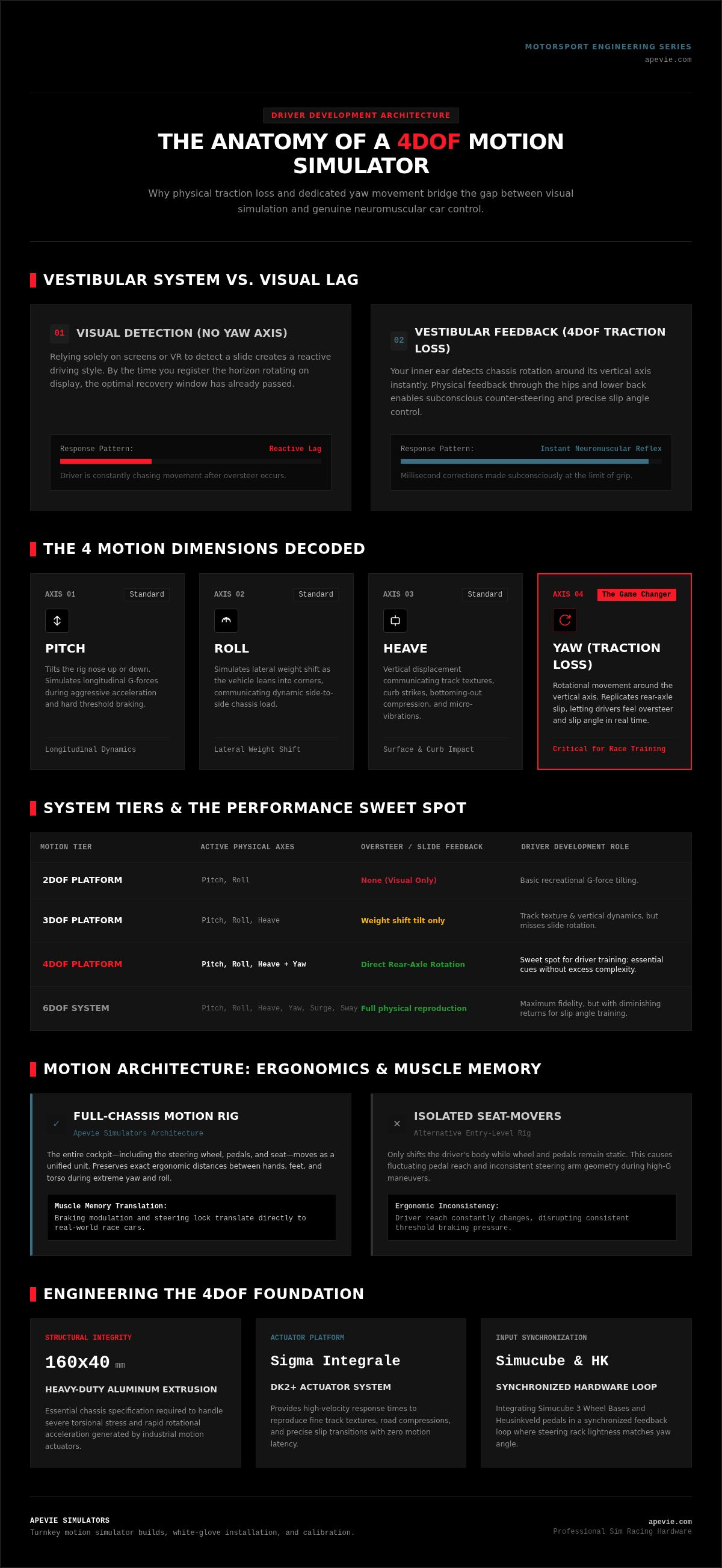
A 4dof sim is a dynamic platform that translates vehicle physics into physical cues across the longitudinal, lateral, and vertical axes, with a dedicated axis for rotational rear-axle slip. In professional motorsport simulation, this fourth dimension is what separates a recreational setup from a legitimate driver development tool. While basic simulators rely on visual and auditory feedback, a 4DOF system engages your vestibular system, providing the physical data needed to drive at the absolute limit of adhesion.
The technology has evolved rapidly from early 2DOF platforms, which only offered basic tilting to simulate G-forces. Professional 3DOF systems later introduced heave, allowing drivers to feel track textures and vertical weight shifts. However, the addition of the fourth degree; yaw; changed the landscape entirely. Unlike seat-movers that only shift the driver's body, Apevie Simulators focuses on full-chassis motion. In these builds, the entire cockpit, including the Simucube 3 Wheel Base and Heusinkveld pedals, moves as a single unit. This preserves the ergonomic relationship between your hands, feet, and seat, which is vital for developing authentic muscle memory that translates directly to a real race car.
The Standard 3 Degrees: Pitch, Roll, and Heave
Most high-end motion systems begin with these three fundamental axes. Pitch simulates the longitudinal forces of acceleration and braking, tilting the nose of the rig up or down. Roll mimics lateral weight transfer during cornering, providing the sensation of the car leaning into a turn. Heave is perhaps the most underrated, as it communicates the vertical displacement caused by track surface irregularities. When you're using a system like the Sigma Integrale DK2+, heave allows you to feel the distinct impact of curbs, the compression at the bottom of a hill, and the micro-vibrations of the asphalt.
The Critical 4th Degree: Yaw and Traction Loss
The defining feature of a 4dof sim is the introduction of Yaw. This is the rotational movement of the vehicle around its vertical axis. In a racing context, this manifests as traction loss. It's the sensation of the rear end stepping out during oversteer or the car rotating through a tight hairpin. Without this fourth degree, a driver must wait for visual confirmation that the car is sliding, which is often too late for a perfect recovery. Traction loss feedback bridges the gap between gaming and professional training by letting you feel the slide through your hips and lower back, allowing for instinctive, millisecond corrections that keep the car on the racing line.
Why Traction Loss is the Essential 4th Degree for Training
Your brain processes physical motion significantly faster than visual information. In a high-speed racing environment, your inner ear, or vestibular system, detects the car's rotation around its vertical axis long before your eyes register the horizon shifting on a monitor. Relying solely on a screen leads to a reactive driving style where you're constantly chasing the car's movements. A professional 4dof sim setup solves this by providing immediate physical feedback the moment the rear tires lose their grip. This allows you to develop instinctive counter-steering, turning a conscious correction into a subconscious reflex that feels natural and fluid.
To achieve this level of realism, the motion system must work in perfect harmony with your steering inputs. We ensure this by integrating Simucube 3 Wheel Bases into our builds, which provides a synchronized loop of force feedback. When the steering rack goes light and the chassis kicks laterally, your brain receives a unified signal. This sensory alignment is what allows drivers to find and hold the car at the absolute limit of grip, significantly improving lap time consistency across long stints.
Detecting Oversteer vs. Understeer
A 4DOF system is uniquely capable of distinguishing between front-end scrub and rear-end drift. While a 3DOF rig might tilt to show weight transfer, it can't physically communicate the yaw angle that defines a slide. For GT3 and Formula racers, physical traction loss is the primary tool for managing narrow slip angles where a single degree of over-rotation can end a qualifying lap. The haptic feedback within these systems also identifies different track surfaces, letting you feel the difference between a greasy track surface and the biting grip of fresh rubber. If you're looking to refine these instincts, our turnkey simulator builds from Apevie Simulators offer the most precise calibration available.
Sigma Integrale DK2+ and the Precision of Movement
When evaluating a 4dof sim, actuator speed and latency are far more important than the total distance of travel. A system that moves four inches but takes 50 milliseconds to react will always feel "floaty" or disconnected. The Sigma Integrale DK2+ system is engineered for high-velocity response, operating with latencies as low as 8 milliseconds and speeds reaching 900 mm/s. This high jerk rate allows the actuators to replicate high-frequency vibrations like engine rumble or ripple strips without muddying the primary motion signals. By using a dedicated geometry for traction loss rather than relying on software-heavy 6DOF washout filters, the DK2+ provides a pure, unadulterated sensation of what the rear axle is doing at all times.
3DOF vs. 4DOF vs. 6DOF: Finding the Diminishing Returns
Choosing the right motion tier is a balance between sensory immersion and technical practicality. While it's tempting to assume more actuators always lead to better performance, sim racing has a clear point where complexity starts to outweigh the benefits for driver training. A 4dof sim represents the ideal equilibrium, providing the most critical data for lap time improvement without the massive footprint or maintenance demands of industrial hexapod systems.
For most enthusiasts, the decision comes down to how much information your brain can actually process during a qualifying lap. A 3DOF system provides a solid foundation but lacks the rotational data needed for limit handling. Moving to 4DOF adds that missing yaw axis. Stepping up to 6DOF adds surge and sway, which are impressive for flight simulation but often introduce "noise" into a racing environment unless the motion profiles are perfectly tuned. A 4DOF rig remains the professional choice because it prioritizes the physics that actually help you drive faster.
The Limitations of 3DOF Systems
A 3DOF system handles pitch, roll, and heave effectively, but it's essentially "blind" during complex cornering sequences. Without the fourth axis, you can't physically feel the car's rotation. In competitive iRacing, this lack of "seat of the pants" feel forces you to rely on visual cues, which are always slightly delayed. If you're currently on a static or 3DOF setup and want to understand how to bridge this gap with tactile feedback, check out The Professional Guide to Haptic Systems for a deeper look at supplemental upgrades.
6DOF: The Ultimate, but at What Cost?
A 6DOF system utilizes six specialized linear actuators to include Surge (longitudinal movement) and Sway (lateral movement). While surge adds a layer of realism to braking and sway simulates the push of G-forces in a bend, the technical complexity increases exponentially. These systems often require a hexapod geometry, which demands a significantly larger footprint and specialized power solutions. A 4dof sim built on a 160mm x 40mm aluminum extrusion frame, like the Apevie RTR V2, fits within a standard sim racing room while providing 90% of the relevant racing feedback. For dedicated racing rigs, the simpler geometry of a 4DOF setup often leads to a more direct and less "floaty" sensation, making it the superior choice for serious driver development.
Engineering the Foundation: Chassis Requirements for 4DOF
When you transition to a 4dof sim, your cockpit is no longer just a seat; it becomes a dynamic structural component. The forces generated by high-velocity actuators like the Sigma Integrale DK2+ are immense, often hitting the frame with hundreds of kilograms of force in milliseconds. If your chassis isn't built to withstand these loads, the energy intended for your body is instead absorbed by the frame. This results in "chassis flex," which muddies the telemetry signals and can eventually lead to structural failure. For a professional-grade motion experience, a heavy-duty aluminum extrusion (80/20) frame is the only viable option. We specifically recommend profiles like the 160mm x 40mm used in the Apevie RTR V2 to ensure every bit of actuator travel translates into precise driver feedback. You can explore our detailed breakdown of structural standards in The Ultimate Sim Rig Guide.
Actuator Placement and Weight Balancing
The longevity and accuracy of your motion system depend heavily on calculating the center of gravity. If the weight of the driver, the Simucube 3 Wheel Base, and the heavy pedal assembly isn't balanced correctly, the actuators will wear unevenly. This imbalance also creates "phantom" motion cues where one corner of the rig struggles to lift as quickly as the others. The Sigma Integrale DK2+ requires specialized mounting brackets that allow for fine-tuned positioning along the longitudinal axis of the rig. Using a motion-ready cockpit from Apevie Simulators simplifies this process, as these frames are pre-engineered with reinforced mounting points that distribute the total operating payload, which can reach up to 460 kg, across the entire structure.
Peripheral Stress: Pedals and Wheels
Motion systems introduce unique stresses to your peripherals that static rigs never encounter. Your pedals must remain rock-solid even when the rig is pitching forward under heavy braking. We've found that high-end sets like Heusinkveld Sim Pedals perform best in these environments because their load-cell engineering isn't affected by the physical movement of the platform. However, the mounting plate must be reinforced to prevent the pedals from vibrating loose during high-frequency haptic events.
Cable management is another critical factor. On a moving platform, "cable whip" can lead to intermittent disconnects or port damage. Every USB and power lead must be secured with enough slack to accommodate the full range of motion without tension. Additionally, your monitor stand should always be a separate, floor-standing unit. Mounting screens directly to a 4dof sim chassis creates distracting visual vibrations and puts unnecessary strain on the monitor's internal components. If you're ready to bypass the technical headaches of DIY integration, consult with Apevie Simulators for a custom turnkey build that arrives pre-calibrated and motion-ready.
Turnkey 4DOF Solutions: The Apevie Professional Approach
Building a professional-grade 4dof sim involves more than just bolting actuators to a frame. It requires a deep understanding of how telemetry, software, and mechanical hardware interact to create a cohesive training environment. We've refined a process that takes the complexity out of the equation for the end user. Our approach begins with a comprehensive consultation to identify your specific training goals, whether you're a professional driver looking to maintain sharp reflexes or a serious enthusiast seeking the ultimate immersion. We handle the technical heavy lifting, from resolving electromagnetic interference (EMI) issues common with high-torque direct drive bases to fine-tuning the motion profiles for specific racing titles.
The software layer is where many DIY builds falter. A turnkey solution from Apevie Simulators ensures that your Sigma Integrale DK2+ actuators and Simucube 3 Wheel Base communicate without latency. We utilize advanced telemetry managers to implement side-slip damping and low-speed smoothing, ensuring the motion feels organic rather than robotic. Our national white-glove installation service means your system arrives fully commissioned, tested, and ready for your first stint on track. It's a plug-and-play experience designed to let you focus on your lap times rather than your cable management.
Custom Configurations for Professional Drivers
We don't believe in a one-size-fits-all setup. A driver competing in GT3 championships requires different motion cues than someone focused on open-wheel Formula racing. Our team optimizes the rig's geometry and software washout filters to match the specific physics of your real-world race car. This professional calibration extends to titles like iRacing, Assetto Corsa EVO, and rFactor 2, ensuring that the physical sensations you feel in the cockpit align perfectly with the telemetry data. We also provide ongoing support and hardware optimization to keep your system at peak performance as software versions evolve.
Why Choose Apevie Simulators for Your 4DOF Build?
Choosing Apevie Simulators means gaining access to an elite ecosystem of components, including Gomez Sim Industries (GSI) steering wheels and Cube Controls F-Core rims. We specialize in high-performance PC builds specifically designed to handle the massive processing requirements of triple-monitor setups or high-resolution VR headsets while managing motion-compensation algorithms. This holistic engineering approach ensures that your 4dof sim is a reliable, high-performance training tool rather than a constant troubleshooting project. If you're ready to invest in a system that prioritizes precision over gimmicks, schedule a professional consultation for your custom 4DOF build today.
Mastering the Limit with Professional Motion
A high-performance simulator is more than the sum of its components; it is a unified ecosystem designed to sharpen your racing instincts. By prioritizing the yaw axis, a 4dof sim provides the critical traction loss data that allows you to catch slides before they become race-ending incidents. We have explored why structural rigidity is non-negotiable and how professional calibration bridges the gap between digital physics and authentic car control.
As an authorized Sigma Integrale and Simucube dealer, Apevie Simulator specializes in creating these precision environments. Our process combines expert motorsport consultation with professional white-glove installation to ensure your hardware is optimized from the first lap. You don't have to navigate the complexities of EMI shielding or software washout filters alone. Whether you're refining your trail-braking or mastering oversteer, our turnkey systems provide the stability and response needed for world-class driver development.
Build Your Custom 4DOF Turnkey Simulator with Apevie and start training with the same precision as the professionals. The path to consistent lap times begins with feedback you can trust.
Frequently Asked Questions
What is the difference between 3DOF and 4DOF sim motion?
3DOF systems manage weight transfer via pitch, roll, and heave, but they're limited to vertical and tilting movements. A 4dof sim introduces a dedicated yaw axis, specifically for traction loss. This allows you to feel the rear end of the car rotating independently of your steering input. It's the most critical addition for driver training because it provides the physical sensation of oversteer before it's visually apparent on your monitors.
Can I add 4DOF motion to my existing aluminum profile rig?
Integration is possible if your chassis is constructed from heavy-duty aluminum extrusion, such as 160mm x 40mm profiles. Standard 80/20 rigs often require reinforcement to handle the torsional stress and weight of a professional motion setup. Apevie Simulators provides expert consultation to determine if your current cockpit, like an Apevie RTR V2, is motion-ready or if additional structural bracing is required to maintain rigidity under high-torque actuator loads.
Does 4DOF motion help you drive faster in iRacing?
Physical feedback significantly reduces your reaction time during oversteer events. In competitive iRacing, catching a slide milliseconds faster through your vestibular system rather than waiting for visual cues leads to better lap time consistency. By identifying the limit of grip through physical traction loss, you can push the car harder with confidence. This sensory data turns reactive driving into proactive car control, which is essential for maintaining pace in high-intensity sessions.
How much space do I need for a 4DOF motion simulator?
You don't need a massive dedicated room for a 4DOF setup. Most systems fit within a footprint of approximately 6 feet by 4 feet, which is only slightly larger than a static rig. You must account for the travel distance of the actuators and the lateral movement of the traction loss sled. It's best to leave a 12-inch buffer zone around the entire platform to ensure safety and prevent contact with walls or furniture.
Is 4DOF motion compatible with VR headsets?
Modern 4DOF systems are fully compatible with VR headsets like the Varjo or Pimax. However, you must use motion compensation software to sync your digital perspective with the physical movement of the rig. Without this, your view in the virtual cockpit would bounce independently of the car. When properly configured, VR enhances the immersion of a 4dof sim by aligning your visual horizon with the physical G-forces felt through the chassis.
What maintenance is required for a 4DOF motion system?
Professional-grade linear actuators, such as those in the Sigma Integrale DK2+ system, are designed for high-cycle industrial use and require minimal upkeep. You should periodically inspect the mounting bolts and pivot points to ensure they remain torqued to specification. Cable management is the most important maintenance task; checking for wear or tension in the leads prevents intermittent disconnects. Occasional lubrication of the internal lead screws may be necessary depending on your total hours of use.
What is the best motion software for 4DOF systems?
The best software often depends on your specific hardware configuration. Sigma Integrale systems utilize their own highly optimized software for low-latency response. For broader compatibility and haptic integration, Sim Racing Studio (SRS) and Motion Systems' ForceSeatPM are the industry leaders. These platforms offer deep customization for washout filters and side-slip damping, allowing you to tune the feedback for titles like Assetto Corsa EVO to match your personal preferences and car type.
How loud is a 4DOF sim motion platform during use?
High-end servo-driven platforms are remarkably quiet compared to older hydraulic or budget geared systems. You'll hear a subtle electrical whirring from the actuators during rapid movements, but it's rarely louder than the cooling fans on a high-performance gaming PC. The primary sound concern is the mechanical vibration transferred into the floor. Using specialized isolation feet or a dedicated motion platform mat can significantly dampen these vibrations, making the system suitable for home use.