
The Ultimate Guide to DOF Reality Accessories: Elevating Your Motion Simulator in 2026
Your high-torque Simucube wheel base is only as fast as the platform it sits on. If your mounting plate flexes every time you hit a curb, you aren't feeling the car; you're feeling the metal bend. It's a common frustration for serious racers who invest in premium hardware like Heusinkveld pedals only to find that standard setups can't quite handle the raw force. Choosing the right dof reality accessories isn't just about adding features. It is about creating a structural bridge that prevents high-performance gear from vibrating itself into inaccuracy.
We understand that a moving platform adds a layer of complexity, especially when it comes to cable management and securing non-standard professional pedals. In this guide, we'll show you how to transform your DOF Reality rig into a rock-solid, professional-grade simulator. You'll discover the specific mounting solutions required for high-torque bases, the secrets to clean haptic integration, and a buyer's framework for selecting upgrades that actually improve your lap times. From cable extension sets to rigid pedal plates, we're covering everything you need to build a flex-free, immersive cockpit that performs as well as it looks.
Key Takeaways
- Understand why standard mounting points often fail under the stress of 25Nm direct drive bases and how to bridge the motion-precision gap.
- Learn to eliminate pedal plate flex to ensure your Heusinkveld Sim Pedals Ultimate+ remain accurate even under 100kg of braking force.
- Discover the essential dof reality accessories in the Apevie collection that prioritize metal-fabricated durability over common 3D-printed parts.
- Master cable management for moving rigs by implementing service loops that protect your hardware during high-intensity pitch and roll maneuvers.
- Identify the best mounting brackets for tactile transducers to create a seamless integration between motion and haptic feedback.
The Role of Accessories in High-Performance Motion Simulation
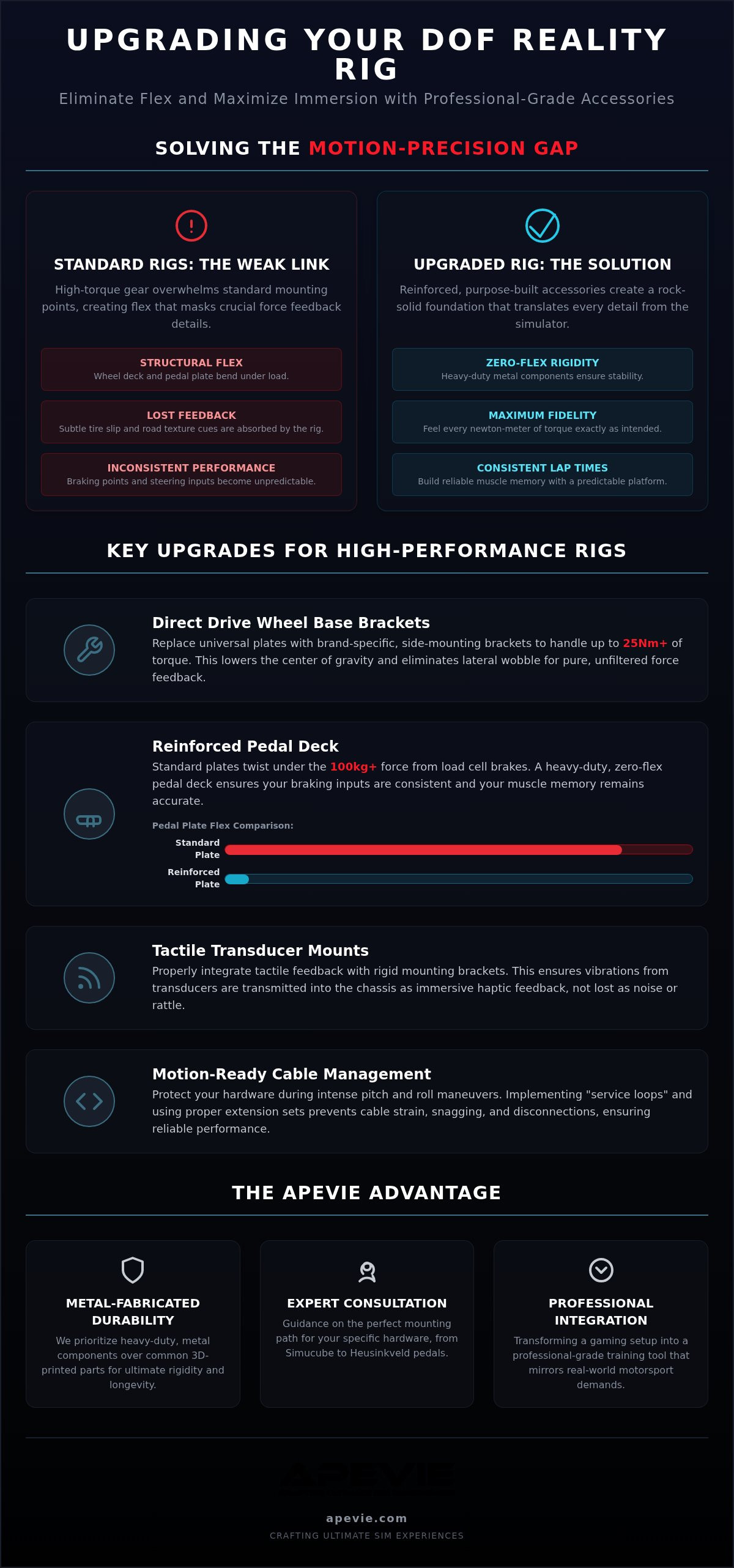
Standard mounting plates often act as the weakest link in a high-end sim racing setup. While a basic frame might feel stable on a static floor, the physics change completely when you integrate a motion simulator platform. High-torque direct drive bases, such as the Simucube 2 Pro or Fanatec Podium series, can generate up to 25Nm of force. Without the right dof reality accessories to reinforce the wheel deck, this energy isn't transferred to your hands; it's absorbed by the metal bending. This creates the "Motion-Precision Gap," where subtle vibrations and tire slip cues from the game engine are masked by structural flex. By choosing a curated accessory strategy, you aren't just improving feel; you're also protecting your investment. Rigid mounting reduces the erratic vibrations that put unnecessary strain on your motion motors, effectively extending their operational lifespan.
Structural Integrity and Signal Fidelity
Physics dictates that a moving platform experiences significantly higher stress than a stationary rig. When the platform pitches or rolls, the weight of your wheel base and steering wheel shifts, creating leverage that standard bolts weren't designed to handle. Preserving the detail in Simucube True Drive signals requires a level of rigidity that only professional-grade bracing can provide. If your mounting solution isn't as precise as your hardware, you're essentially listening to a high-end audio system through cheap speakers. Professional hardware like the Sigma Integrale DK2 system demands a foundation that doesn't compromise signal fidelity. We prioritize solutions that ensure every Newton-meter of torque is felt exactly as the software intended.
The Apevie Approach to Rig Customization
We believe that the out-of-the-box experience is just a starting point for competitive racers. To gain a true advantage, your rig must be tailored to the specific demands of elite gear like Heusinkveld Sim Pedals Ultimate+ or Gomez Sim Industries steering wheels. Our selection of dof reality accessories focuses on replacing vulnerable thin-gauge components with heavy-duty, metal-fabricated parts. This PC-focused, professional integration ensures that every ounce of haptic feedback and every millimeter of pedal travel is translated accurately. By reducing mechanical slop, you also help the platform's actuators perform more efficiently. This methodical approach to customization is what separates a basic gaming setup from a professional-grade training tool that mirrors the demands of real-world motorsport.
Essential Mounting Solutions for Direct Drive and Load Cell Pedals
Applying 100kg of force to a load cell brake pedal on a static rig is one thing. Doing it while your chassis is pitching forward under heavy deceleration is another. Standard mounting plates often fail when they face the combined stress of high-torque direct drive bases and professional pedals. If your pedal deck bows during a trail-braking maneuver, your muscle memory loses its reference point. You aren't just losing immersion; you're losing lap time consistency. High-performance dof reality accessories solve this by providing the structural rigidity needed to handle elite hardware like the Simucube 2 Pro or Fanatec Podium series without the dreaded "motion flex."
Wheel Base Brackets and Adapters
Universal mounting plates are often the first point of failure for serious racers. While they offer many holes for different brands, they lack the thickness to dampen high-frequency vibrations from a 25Nm motor. We recommend using brand-specific side-mounting brackets for the DOF Reality H3 or P6 platforms. Side-mounting provides a more direct connection to the frame, which lowers the center of gravity and reduces lateral wobble during aggressive steering inputs. By eliminating the "play" in the steering column, you ensure that every Simucube True Drive signal reaches your hands instantly. If you're unsure which bracket fits your specific motor, our team at Apevie can provide expert consultation on the best mounting path for your build.
Advanced Pedal Deck Customization
Mounting Heusinkveld Sim Pedals Ultimate+ on a moving chassis requires more than just a few bolts. The sheer force required to reach maximum braking pressure can cause standard thin-gauge plates to twist. This twist masks the subtle haptic cues provided by the platform's motion. Reinforcement kits and heavy-duty pedal decks are essential dof reality accessories because they create a zero-flex foundation. Don't overlook the importance of heel rest stability either. A rock-solid heel plate is the unsung hero of consistency, as it allows your foot to pivot without the baseplate shifting under load. For a deeper look at the physics of braking, see The Ultimate Guide to Sim Racing Pedals. When these components are properly integrated, the synergy between your physical inputs and the motion of the platform becomes seamless, allowing for the precise car control required in competitive esports.
Tactile Feedback and Haptic Integration Accessories
Motion platforms excel at simulating large-scale G-forces, but they typically operate at a lower frequency range than what is required to feel a flat-spotted tire or the vibration of a high-revving engine. This is the technical gap between motion and haptics. To bridge it, you need tactile transducers like the Buttkicker or specialized haptic motors. Integrating these systems with your rig requires specific dof reality accessories designed to isolate these high-frequency signals. Without proper mounting brackets, much of that tactile detail is lost as it dissipates through the metal frame and into the floor. For the Hero and Pro series frames, specialized brackets allow you to mount transducers directly under the seat or pedal tray, ensuring the road feel remains where you can actually sense it.
Isolating haptic signals is a technical challenge that many builders overlook. When you bolt a transducer directly to the frame, the vibration travels through the entire structure, which can lead to unwanted noise and a muddy sensation. Professional mounting solutions often include rubber isolators or dampening spacers. These components ensure that high-frequency cues stay concentrated in the seat or pedals. This precision is what allows you to distinguish between a curb strike on the front left tire and the subtle vibration of the transmission under your seat. It's a level of clarity that standard out-of-the-box setups rarely achieve without these targeted upgrades.
Beyond Simple Motion: The Layered Haptic Experience
A professional simulator doesn't just move; it communicates. By using haptic accessories to layer engine rumble and gear shift sensations over the platform's pitch and roll, you gain a more complete picture of the car's behavior. This layered approach is detailed further in The Professional Guide to Haptic Systems. These additions are often the final step in transitioning from a gaming setup to a high-performance training tool. When your motion platform handles the weight transfer and your haptics handle the surface texture, the immersion becomes total. This synergy is essential for drivers who rely on subtle cues to find the limit of grip in competitive esports.
Mounting Sigma Integrale Components
For racers seeking the ultimate in precision, combining a DOF Reality frame with the Sigma Integrale DK2 motion system offers a unique advantage. The DK2+ actuators provide surgical accuracy that complements the wider range of motion found in the P-series platforms. Achieving this requires custom dof reality accessories, particularly when integrating with aluminum extrusion components. This hybrid setup allows for 360-degree immersion, where the large-scale movements of the platform and the micro-vibrations of the actuators work in total harmony. By using custom brackets for actuator placement, you can fine-tune the feedback to match your specific seating position and hardware layout, ensuring that no signal is lost in the translation between software and physics.
Ergonomics and Cable Management on a Moving Rig
Static simulators allow for lazy cable management, but a moving platform is less forgiving. When your chassis pitches forward or rolls through a high-speed corner, every wire is subjected to tension and friction. If your cables are too tight, you risk ripping a USB port out of a $1,500 wheel base. If they are too loose, they can get caught in the actuator arms. Integrating professional-grade dof reality accessories for cable management is the only way to avoid mid-race disconnects and hardware damage. The goal is to create a system that moves with the platform rather than resisting it.
Service loops are the foundation of a reliable motion build. These are intentional slack points left at every pivot or axis of movement. By securing cables at both ends of a moving joint and leaving a generous loop in between, you ensure the wires never reach full tension. This approach is especially critical for VR headsets and high-end peripherals. Mounts for VR sensors and headsets should be rigid and positioned to account for the platform's full range of travel. Similarly, keyboard and mouse trays must be secured with locking mechanisms to prevent them from becoming projectiles during high-G maneuvers.
Professional Cable Routing for 6-Axis Platforms
Managing a 6-axis rig requires a methodical approach to routing. We recommend using flexible conduit or drag chains to house Simucube and Fanatec power cables. These chains guide the wires along a predetermined path, preventing them from bunching or fraying. It's also vital to address electromagnetic interference (EMI). High-torque direct drive bases generate significant electrical noise that can interfere with motion controllers. Using shielded cables and separating data lines from power lines within your dof reality accessories setup is essential for maintaining signal integrity. Don't forget to secure the "brain box" and power supplies; these components should be mounted to the stationary base or a dedicated shelf to minimize the vibration they experience.
Seating and Control Ergonomics
Ergonomics on a motion rig go beyond comfort; they are about safety and control. A high-performance seat, such as a carbon fiber shell, provides the lateral support needed to keep your body centered during aggressive motion. This stability allows you to maintain precise pedal pressure and steering inputs. Monitor positioning is another critical factor. As the rig moves, your field of view (FOV) can shift if the monitors aren't mounted correctly in relation to your seating position. For a complete breakdown of building a stable platform, explore The Ultimate Sim Rig Guide. If you need assistance designing a cockpit that balances motion and ergonomics, you can contact Apevie for a professional consultation today.
The Apevie Curated DOF Reality Accessory Collection
Choosing the right dof reality accessories requires a shift in mindset from gaming peripherals to industrial-grade components. Our shop features a curated selection of 16 professional-grade items designed to withstand the unique stresses of a motion-enabled cockpit. We've intentionally moved away from the 3D-printed mounts often found in enthusiast circles. While 3D printing is useful for simple cable clips, it lacks the material density required to dampen the high-frequency vibrations of a Simucube base or the sheer force of Heusinkveld Ultimate+ pedals. Our metal-fabricated parts offer the rigidity necessary to maintain alignment across the M2, H3, and P6 models, ensuring your platform doesn't become a source of mechanical noise.
Compatibility is a primary concern for any serious builder. Whether you're running a 2-axis M2 for flight simulation or a 6-axis P6 for competitive GT racing, each accessory in our collection is vetted for structural fit. We focus on parts that bridge the gap between the DOF Reality frame and elite PC-focused hardware. This methodical selection process ensures that your investment in high-end actuators and direct drive motors isn't wasted on a mounting plate that flexes under load. By treating your rig as a single integrated system, you achieve a level of fidelity that standard setups simply cannot match.
Top Picks for the Serious Sim Racer
The heavy-duty pedal plate is perhaps the most critical upgrade for those using load cell technology. It prevents the baseplate from bowing during 100kg braking events, which is essential for developing consistent muscle memory. Our direct drive mount is equally vital; it provides a zero-flex connection between your motor and the frame, allowing every Simucube True Drive signal to reach your hands without distortion. Selecting the right combination of parts can be daunting, which is why we provide expert guidance to help you navigate the technical requirements of your specific build. You can browse the full DOF Reality Accessories Collection to see the engineering specs for yourself.
The Turnkey Advantage
A professional installation ensures your dof reality accessories are mounted for peak performance from day one. Apevie’s white-glove service is designed for complex motion rig builds where every bolt torque and cable loop matters. We handle the technical integration of Sigma Integrale actuators and professional PC-based hardware so you can focus on the track. As you plan your 2026 rig upgrade, use this final checklist: prioritize metal-fabricated mounts, implement generous service loops for all moving cables, and use isolation brackets for your haptic transducers. These steps transform a moving platform into a precision racing tool that delivers a truly immersive training experience.
Solidifying Your Foundation on the Grid
Building a world-class simulator is a methodical process that goes beyond simply bolting actuators to a frame. You've seen how structural flex can mask the subtle cues from your Simucube wheel base and why rigid pedal decks are vital for Heusinkveld precision. By integrating high-performance dof reality accessories, you ensure that every signal from the game engine is translated into physical reality without distortion. This is the same expert-level engineering we apply to our professional turnkey builds, where every component is chosen for its ability to withstand the rigors of high-G maneuvers.
Whether you're refining a 6-axis platform or starting your first professional build, the right components make the difference between a gaming setup and a high-performance training tool. Don't settle for flex. Don't let thin-gauge mounting plates or messy cabling compromise your immersion. It's time to solidify your foundation and find the limit of grip with total confidence. We invite you to explore our curated selection of hardware designed for the most demanding sim racing environments.
Upgrade your motion rig today with professional DOF Reality Accessories.
Frequently Asked Questions
Are DOF Reality accessories compatible with all Hero and Pro models?
Most dof reality accessories are designed with a high degree of cross-platform compatibility, though specific items like floor mats and cable extension sets are tailored to the number of degrees of freedom. For instance, the protection cover fits H2, H3, P2, and P3 models, while lift supports are specifically engineered for the 6DOF platforms. It's essential to verify the specific mounting holes for your frame generation before purchase to ensure a seamless integration.
Do I need special mounts for a Simucube 2 Pro on a DOF Reality rig?
Standard universal plates included with most rigs often struggle to manage the 25Nm of torque produced by a Simucube 2 Pro. We recommend using heavy-duty, brand-specific side-mounting brackets. These dof reality accessories provide a more rigid connection to the chassis, which lowers the center of gravity and eliminates the lateral flex that can mask subtle force feedback cues. This ensures every signal from the Simucube True Drive software is felt accurately.
How do I prevent cable snapping during 6-axis motion?
Preventing cable fatigue on a 6-axis platform requires the implementation of "service loops" and flexible conduits. You must secure your cables at both ends of a moving joint while leaving enough slack to accommodate the platform's maximum pitch, roll, and heave. Using drag chains helps guide power and data lines along a predetermined path, preventing them from bunching or getting caught in the actuator arms during high-G maneuvers.
Can I mount Heusinkveld pedals directly to the standard DOF Reality plate?
While you can bolt Heusinkveld Sim Pedals Ultimate+ to the standard plate, the 100kg of braking force they generate will likely cause the metal to bow. To maintain consistency, we recommend a heavy-duty pedal deck reinforcement. This upgrade provides a zero-flex foundation, ensuring that your muscle memory isn't compromised by mechanical movement. A rock-solid heel rest is also a critical component for achieving professional-level lap time consistency on a moving rig.
What is the best haptic accessory for a DOF Reality H3 rig?
For the DOF Reality H3, the most effective tactile upgrade is a Buttkicker transducer paired with a specialized isolation mount. While the motion actuators handle low-frequency weight transfer, haptics provide high-frequency road texture and engine rumble. Using a dedicated mounting bracket under the seat ensures these vibrations stay concentrated in the cockpit rather than dissipating through the frame. This layered feedback is essential for drivers who need to feel the limit of grip.
Does adding accessories affect the weight limit of the motion motors?
Every accessory you add contributes to the "dead weight" the actuators must move, which can impact the platform's speed and motor longevity. It's vital to stay within the manufacturer's specified weight limits. For pilots over 300 lbs using 6DOF systems, specialized lift supports are available to assist the motors. Keeping your rig balanced and within its payload capacity ensures the motion remains crisp and responsive during intense racing sessions.
Why should I choose metal accessories over 3D-printed mounts?
Metal-fabricated accessories offer superior material density and structural integrity compared to 3D-printed alternatives. While 3D prints are suitable for non-structural items like cable clips, they often fail under the mechanical stress of a 25Nm direct drive motor or 100kg load cell pedals. Metal components dampen high-frequency vibrations more effectively and won't crack or warp over time. This durability is why we exclusively use professional-grade metal hardware in our turnkey builds.
Is there a specific mounting kit for Fanatec DD1/DD2 bases?
Yes, specific mounting kits are available for the Fanatec Podium DD1 and DD2 bases to replace the standard universal wheel deck. These brackets allow for a more direct connection to the rig's uprights, which is critical for managing the high torque of Fanatec Direct Drive systems. By using a dedicated mounting solution, you reduce the risk of vibration-induced hardware fatigue and ensure that the steering column remains perfectly aligned, even during aggressive counter-steering movements.