
Sim Racing Bundle Buying Guide: Choosing Professional-Grade Synergy in 2026
Buying the most expensive individual components for your rig often results in a frustratingly disjointed experience rather than a faster lap time. You likely understand that high-end racing is about more than just raw power; it's about how every piece of hardware communicates with the next. The technical friction of mismatched quick-release systems or software conflicts between manufacturers can disrupt the focus required for professional-grade training. This guide helps you select a performance-matched sim racing bundle that delivers professional-grade torque fidelity and genuine long-term value.
We'll break down the differences between peak and holding torque, compare elite ecosystems from Fanatec and Simucube, and explain why a curated bundle offers a superior return on investment compared to buying parts separately. By focusing on synergy over individual specs, you can secure a plug-and-play system that supports high-level skill development from day one. Whether you're eyeing a Fanatec Podium setup or a custom Simucube configuration paired with a Cube Controls F-Core wheel, understanding how these components work in unison is the key to a truly immersive simulator. We'll guide you through the technical background of these systems to ensure your investment provides a stable, professional platform for years to come.
Key Takeaways
- Learn why hardware synergy is the foundation of a professional sim racing bundle, ensuring that your wheel base and pedals communicate without software friction.
- Understand the critical role of torque headroom and why high-fidelity systems like the Fanatec Podium DD are necessary for realistic muscle memory training.
- Compare leading ecosystems, distinguishing between the industrial-grade precision of Simucube and the innovative, specialized hardware from Moza Racing.
- Identify the best hardware combinations for your specific discipline, whether you require the ergonomics of a Formula steering wheel or the versatility of a GT-style rim.
- Discover the financial and performance advantages of professional curation, where expert-selected packages offer significant savings over buying individual components.
The Strategy Behind Choosing a Professional Sim Racing Bundle
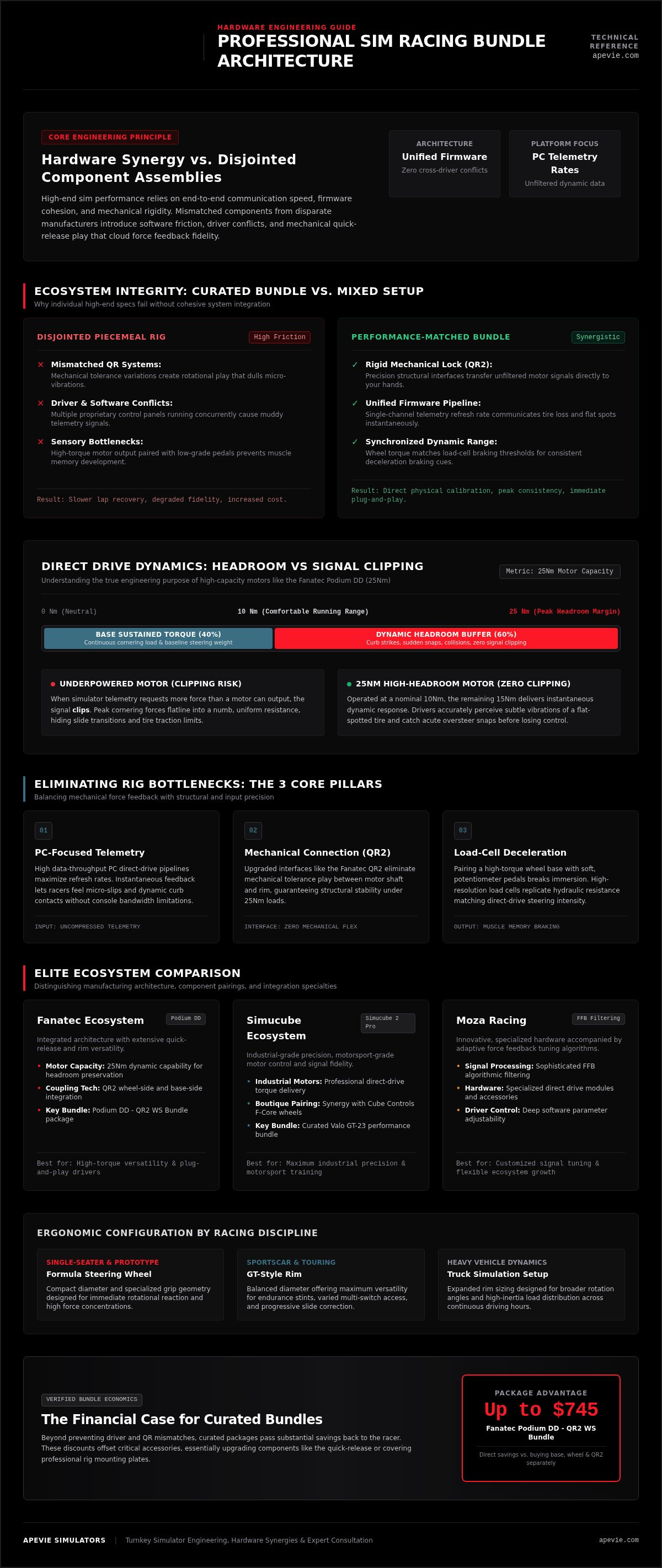
A professional sim racing bundle is more than a simple convenience for your equipment list; it's a performance-matched ecosystem designed for hardware synergy. In its most effective form, a bundle consists of a high-torque wheel base, a steering wheel, and often a high-resolution pedal set that are engineered to work in unison. This synergy is vital because it eliminates the software conflicts and "muddy" force feedback profiles that often occur when mixing components from different manufacturers. When your hardware shares a unified driver and firmware architecture, the communication between the sim's telemetry and your hands remains crisp and unfiltered.
While many entry-level setups focus on console compatibility, serious racers prioritize PC-focused hardware. This preference isn't about brand loyalty; it's about telemetry refresh rates. PC platforms allow for much higher data throughput, which is essential when utilizing modern direct-drive wheelbase technology. Higher refresh rates translate to more granular detail in the steering column, allowing you to feel the exact moment your tires lose grip or the subtle vibrations of a flat-spotted tire.
Eliminating Component Bottlenecks
One of the most common mistakes in sim racing is pairing a high-performance motor with a weak pedal set. If you invest in a 25Nm base but use entry-level pedals, your brain will struggle to reconcile the massive force in your hands with the lack of resistance under your feet. A balanced system ensures that your pedal resolution, particularly with load-cell technology, matches the intensity of your wheel's output. Rigidity also plays a role here; a professional bundle assumes you have a cockpit capable of handling these forces without flex. You also need to ensure Quick Release (QR) compatibility. For instance, the transition to the Fanatec QR2 system has significantly improved the mechanical connection between the base and the wheel, removing the tiny amounts of play that could ruin the fidelity of a high-end direct-drive system.
The Financial Case for Bundling
Beyond the technical benefits, the financial logic of a sim racing bundle is hard to ignore. Manufacturers often use these packages to incentivize staying within their ecosystem, passing on significant savings to the user. For example, the Fanatec Podium DD - QR2 WS Bundle has historically offered discounts as high as $745 compared to purchasing the wheel base, steering wheel, and QR2 wheel-side components separately. These savings essentially provide high-tier accessories, like the premium QR2, for "free." When you compare the cost of individual Simucube 2 Pro components against a curated Valo GT-23 Bundle, the price difference often covers the cost of a professional mounting solution. For a deeper look at how to match your stopping power to your steering torque, explore our Ultimate Guide to Sim Racing Pedals to ensure your entire rig operates with professional-grade precision.
Direct Drive Power: Torque and Fidelity in Premium Bundles
A common misconception in the community is that higher torque is simply about physical exertion. While a high-output motor can certainly provide a workout, its true value lies in the dynamic range and fidelity it offers. When you invest in a high-end sim racing bundle, you're buying the ability to replicate the complex forces of a real race car without the signal "clipping" that occurs in lower-powered units. Clipping happens when the simulator requests more force than the motor can physically provide, resulting in a flat, numb sensation during high-speed cornering. By having a motor capable of 25Nm, such as the Fanatec Podium DD, you can run the system at a comfortable 10Nm while leaving massive headroom for sudden jolts, like hitting a curb or a high-speed collision.
This technical capacity is supported by steering torque and force feedback research, which indicates that accurate torque delivery significantly reduces driver variance and improves the ability to recover from slides. Manufacturers like Moza Racing utilize sophisticated FFB filtering algorithms in their R12 and R9 bundles to handle signal noise, ensuring that the information reaching your hands is smooth and intentional. Similarly, professional-grade bundles often rely on industrial-grade aluminum housings for superior thermal management. This prevents "performance fade," where the motor loses strength as it heats up during a long endurance stint. If you're ready to experience this level of precision, you can explore our curated selection of performance bundles to find a system that matches your training goals.
High-Torque Performance: 15Nm to 25Nm
For those competing in Formula or GT3 categories, a 25Nm system is often considered the gold standard for professional training. The Fanatec Podium DD - GT3 Endurance Bundle is a 25Nm powerhouse that provides the necessary resistance to build authentic muscle memory. Other high-performance direct drive bundles offer ranges from 15Nm to 23Nm, allowing racers to choose the specific intensity they require for their rig. These systems are designed for enthusiasts who need the wheel to fight back, providing the tactile data needed to find those final tenths of a second on the track.
Mid-Range Precision: 9Nm to 12Nm
The Moza R12 Bundle (12Nm) has quickly become a sweet spot for home-based enthusiasts, offering enough torque to provide a convincing experience without requiring a full industrial-grade cockpit. For those transitioning from belt-driven systems, the Moza R9 Bundle (9Nm) remains a benchmark for price-to-performance. It's important to balance torque with wheel weight; a heavy steering wheel on a 9Nm base can feel sluggish because the motor lacks the rotational speed to move the mass quickly. Choosing a lightweight sim racing bundle with a carbon fiber rim ensures that even a mid-range motor remains responsive and snappy through fast chicanes.
Comparing Ecosystems: Simucube, Moza, and Fanatec Bundles
Selecting a sim racing bundle often means committing to a specific hardware ecosystem for the foreseeable future. Each major player in the industry offers a distinct philosophy regarding driver software, build materials, and peripheral expansion. Fanatec remains the established leader for deep integration, particularly with their GT3 Endurance Bundle. This specific package provides a concrete $94.75 saving over purchasing the individual parts, making it an attractive entry point for those who want a cohesive system from a single manufacturer. Meanwhile, Simagic is positioning itself as a premium alternative by focusing on high-end tactile feedback and exceptionally well-built steering wheels, such as the GTS and GT PRO series, which offer a level of finish that rivals custom boutique gear.
The Simucube Experience: Pro-Level Customization
Simucube is widely regarded as the gold standard for drivers who prioritize industrial-grade reliability and software precision. Their True Drive software allows for a level of granular tuning that is essential for those competing in FIA-sanctioned esports competitions. The Tahko GT-21 Black Edition x Simucube 2 Wheelbase Bundle is a popular choice for those wanting a professional starting point without the complexity of sourcing third-party wheels. For simulation centers or professional drivers who require the absolute maximum in signal clarity, the Simucube 2 Ultimate remains the pinnacle of the market. It's vital to ensure your chassis is up to the task of handling these extreme forces; you can refer to The Ultimate Sim Rig Guide to confirm your foundation is strong enough to prevent frame flex.
Moza's Rapid Innovation: From R3 to R21
Moza Racing has disrupted the landscape by utilizing aviation-grade aluminum and maintaining incredibly rapid product cycles. Their Moza Racing R5 3-in-1 Bundle is arguably the most accessible entry point into the world of direct drive, providing a complete sim racing bundle that includes pedals and a desk mount. For those needing flexibility across platforms, the Moza R3 Bundle offers rare compatibility for both PC and Xbox users. Moza isn't just for entry-level racers, though. Their KS and Vision GS wheels have challenged the mid-range market by offering high-end features, like integrated displays and carbon fiber composites, at a more accessible price point. They have even expanded into specialized hardware for truck simulation, proving that their ecosystem can adapt to almost any driving discipline.
Matching Your Discipline: Formula, GT, and Truck Simulation
Professional racing isn't a monolith. The ergonomic requirements for holding a tight line at Monaco are vastly different from navigating a heavy freighter across a digital continent. Choosing a sim racing bundle tailored to your specific discipline ensures that your physical inputs match the car's intended behavior. Open-wheel enthusiasts often gravitate toward the Fanatec Podium DD; Formula V2.5 Bundle because it replicates the compact, high-intensity cockpit of a formula car. This setup provides the immediate, twitchy response needed for high-downforce racing where every millimeter of steering input counts.
Innovation in this space has also reached specialized niches. The Moza Truck Bundle features the world's first 400mm truck steering wheel, specifically designed for the laid-back, high-leverage steering required in heavy vehicle simulation. On the other end of the spectrum, endurance specialists often look for dual-clutch systems like those found in the Simagic Alpha FX Pro variants. These allow for precise launch control and pit lane exits, which are critical in competitive leagues. Finding the right match for your discipline shouldn't be a guessing game. You can browse our discipline-specific bundles to find a setup that aligns with your professional training goals.
The F1 and Formula Specialist
Formula racing demands lightning-fast directional changes. This is why wheel diameter is a critical specification. Most professional formula wheels, like the Gomez Sim Industries (GSI) Formula Pro Elite, range between 280mm and 300mm. A smaller diameter reduces the physical distance your hands must travel to apply steering lock, which is vital for navigating high-speed chicanes. These bundles emphasize high button density and rotary encoders, allowing you to adjust brake bias and ERS deployment without taking your hands off the grips. You can explore a deeper analysis of these components in our guide to The Best F1 Steering Wheels.
GT and Endurance Excellence
GT3 and endurance racing require a balance of ergonomics and long-term comfort. The Simucube Valo GT-23 combo is a benchmark here, offering a versatile D-shaped rim that accommodates the wider steering ranges typical of GT cars. If you're looking for elite hardware, selecting a Cube Controls wheel and Simucube wheel base bundle can often result in a $300 saving compared to buying them as individual parts. These wheels usually sit in the 300mm to 320mm range. This extra size provides more leverage and comfort for multi-hour stints. For those pushing for maximum immersion, haptic feedback systems are becoming essential for feeling ABS activation; read more in The Professional Guide to Haptic Systems.
Why Professional Curation Matters for High-End Sim Bundles
Selecting a sim racing bundle is a major milestone in building a professional-grade simulator, but the hardware itself is only half of the equation. High-end Direct Drive ecosystems require precise calibration and mechanical integration that often goes beyond what a standard manual provides. Professional racers and serious enthusiasts choose curated packages because they offer a single point of technical support for complex setups. Instead of chasing three different manufacturers for a driver conflict, you have one expert partner who understands the entire signal chain. This curation also ensures future-proofing; a well-selected bundle provides a platform that can evolve with your rig, whether you're adding motion systems or upgrading to a triple-monitor configuration.
Our approach centers on turnkey solutions that eliminate the guesswork of assembly. While generic retailers focus on volume, we focus on performance-matched synergy. This means we've already tested how specific steering wheels interact with different wheelbase firmwares to ensure the force feedback remains unfiltered. This professional oversight is what separates a "gaming setup" from a genuine training tool used by real-world drivers to maintain their edge during the off-season. We ensure that every component is compatible from the moment you unbox it, allowing you to focus on your lap times rather than firmware updates.
The Apevie Difference: Curation Over Catalog
We don't believe in stocking every generic gaming peripheral on the market. Our focus remains strictly on professional, PC-focused hardware from industry leaders like Simucube, Heusinkveld, and Moza Racing. This specialization allows us to provide deep technical insights that general retailers simply can't match. When you order an in-stock sim racing bundle before 11 AM PST, we prioritize same-day shipping to ensure your training isn't delayed. For those seeking the ultimate in immersion, we specialize in integrating Sigma Integrale motion systems with our hardware bundles, creating a seamless bridge between digital telemetry and physical sensation. This "white-glove" philosophy extends to our consultation process, where we help you navigate the nuances of torque fidelity and pedal resistance before you spend a single dollar.
Your Next Steps to Professional Simulation
Before finalizing your purchase, it's essential to evaluate how a new Direct Drive system will interact with your current environment. A 25Nm motor requires a chassis with zero flex, and a high-end pedal set demands a stable, non-slip mounting surface. Use this final checklist to ensure your new hardware delivers its full potential:
- Wheelbase Torque: Does your rig support the peak and holding torque of a 15Nm+ motor?
- Pedal Capacity: Can your mounting plate handle the 80kg+ of force required by Heusinkveld Sim Pedals?
- Ergonomics: Is the steering wheel diameter appropriate for your primary racing discipline?
- Software: Does your PC meet the requirements for high-refresh-rate telemetry?
Ready to upgrade your training platform? Browse the full collection of performance-matched Sim Racing Bundles to find the system that fits your professional goals.
Securing Your Professional Foundation on the Track
Choosing a performance-matched sim racing bundle is a strategic investment in technical synergy and long-term performance. We've explored how 25Nm of torque provides the essential headroom for realistic fidelity and why discipline-specific ergonomics, from Formula to GT racing, are vital for authentic muscle memory. By selecting a curated ecosystem from manufacturers like Simucube or Fanatec, you eliminate the friction of mismatched components and software conflicts that often plague piecemeal builds.
As an authorized dealer for Simucube, Moza, and Fanatec, Apevie Simulators provides the expert PC-exclusive support needed to maintain a professional edge. You can save as much as $745 on Fanatec Podium DD bundles while ensuring your setup is ready for high-performance training from the moment it arrives. Shop Curated Sim Racing Bundles and Save Up to $745 to begin your journey toward a more precise and immersive simulation experience. Your path to the podium starts with hardware that works as hard as you do.
Frequently Asked Questions
Is a sim racing bundle actually cheaper than buying parts separately?
Yes, bundling typically offers a lower price point than piecemeal purchases. Manufacturers like Fanatec often provide significant discounts, such as the $745 saving on Podium DD packages, to encourage ecosystem loyalty. Beyond the direct financial saving, a sim racing bundle ensures that all components, including quick releases and cables, are compatible out of the box. This prevents the hidden costs of shipping separate parts or buying corrective adapters later.
What is the difference between Peak Torque and Holding Torque in a bundle?
Peak torque represents the maximum momentary force a motor can produce, usually during a curb strike or collision. Holding torque is the sustained force the motor maintains during long, high-G corners. Professional systems prioritize high holding torque to prevent the force from fading mid-turn. This distinction is vital for realistic training, as it ensures the steering remains communicative throughout the entire duration of a cornering sequence, allowing for more consistent lap times.
Can I use a Moza steering wheel with a Simucube wheel base?
Standard Moza wheels use a proprietary wireless connection and physical quick release that isn't natively compatible with Simucube bases. While third-party USB conversion kits exist for some rims, we generally recommend staying within a single ecosystem to maintain software synergy. Mixing brands often sacrifices the integrated telemetry features and "plug and play" convenience that make a high-end sim racing bundle a valuable asset for professional-grade simulation setups.
Do these bundles include pedals, or do I need to buy them separately?
Bundle contents vary significantly by manufacturer and price tier. Entry-level packages like the Moza R5 often include a two-pedal set, whereas professional-grade bundles from Simucube or Fanatec Podium series typically focus on the wheel base and steering wheel only. Serious racers often prefer to select high-end pedals, such as the Heusinkveld Sim Pedals Ultimate+, separately to ensure the braking resistance matches the high torque output of their direct-drive motor.
Is a 25Nm wheel base too strong for a beginner?
A 25Nm motor is never too strong because the software allows you to limit the output to any level you find comfortable. The benefit for a beginner is the massive headroom it provides; running a 25Nm motor at 8Nm ensures the signal remains perfectly linear and detailed without clipping. This allows the hardware to grow with your skill level, providing a stable platform for years of professional-grade training without needing an upgrade.
Do I need an aluminum profile rig for a Direct Drive bundle?
Yes, an aluminum extrusion sim rig is highly recommended for any bundle producing more than 10Nm of torque. High-torque motors generate significant leverage that can cause cheaper desk mounts or thin steel frames to flex or vibrate. This flex absorbs the subtle force feedback details you've paid for, effectively muddying the signal. A rigid aluminum foundation ensures that 100% of the motor's fidelity is transmitted directly to your hands for maximum precision.
Are these sim racing bundles compatible with PS5 or Xbox?
Most professional-grade bundles are designed exclusively for PC to take advantage of higher telemetry refresh rates. While certain Fanatec and Moza R3 models offer console compatibility, our focus at Apevie Simulators is on high-performance PC hardware. PC platforms provide the granular detail needed for professional motorsport training. If you require console support, you must verify that the specific wheel base contains the licensed security chip required by Sony or Microsoft for proper operation.
What is included in the Fanatec Podium DD QR2 bundle?
This specific package typically includes the Fanatec Podium Direct Drive wheel base, a compatible steering wheel like the Formula V2.5, and the upgraded QR2 Quick Release system. The inclusion of the QR2 is a significant upgrade over the older QR1, as it eliminates mechanical play and improves the force feedback transition between the base and the rim. It's a complete steering solution designed for racers who demand industrial-grade reliability and precision on the track.