
GSI Steering Wheel & Ecosystem Guide: Building a Professional Sim Rig in 2026
Investing thousands in a high-torque Simucube base only to pair it with a flexible, consumer-grade rim is the fastest way to mute the very tactile detail you paid to hear. It's a common frustration for serious racers who find their high-end hardware's potential throttled by inferior peripherals. You've likely spent hours analyzing torque ripples and slew rates, yet the physical bridge between the motor and your hands often remains the most overlooked component in a professional simulator build.
We understand that the transition to boutique hardware can feel overwhelming, especially when you're balancing technical specs with the fear of compatibility issues between different brands. This guide will help you master the nuances of choosing a gsi steering wheel that matches your drive system's fidelity. You'll learn how to complement these wheels with professional-grade Conspit accessories to create a seamless, high-performance racing experience. We'll examine the flagship GSI Formula Pro Elite, explore the mechanical advantages of hydraulic systems, and provide a clear blueprint for a turnkey setup from Apevie Simulators that requires minimal troubleshooting and delivers maximum immersion.
Key Takeaways
- Understand how Gomez Sim Industries applies motorsport engineering to eliminate flex and maintain torsional rigidity in high-torque Direct Drive environments.
- Compare the technical specifications of the gsi steering wheel lineup, specifically focusing on the ergonomic differences between the Formula Pro Elite and the Hyper P1.
- Identify how entry-level peripherals create ecosystem bottlenecks that can mute the high-fidelity feedback of your premium wheel base.
- Discover the mechanical precision of Conspit hydraulic accessories and how they provide the consistent tactile feel necessary for professional-level rally and drift performance.
- Learn why a professionally integrated turnkey build from Apevie Simulators outperforms a "parts bin" approach by ensuring seamless hardware and software compatibility.
The Professional Standard: What Sets GSI Steering Wheels Apart?
GSI wheels represent the pinnacle of sim racing hardware, bridging the gap between digital simulation and real-world motorsport engineering. When you're managing the high-torque output of a direct drive system, the rim becomes the primary sensor for your hands. If that sensor flexes, the feedback loop is compromised. This is why Gomez Sim Industries focuses on structural integrity as a foundational principle. In the custom builds we deliver at Apevie Simulators, these wheels are selected specifically for their ability to translate micro-vibrations without mechanical interference.
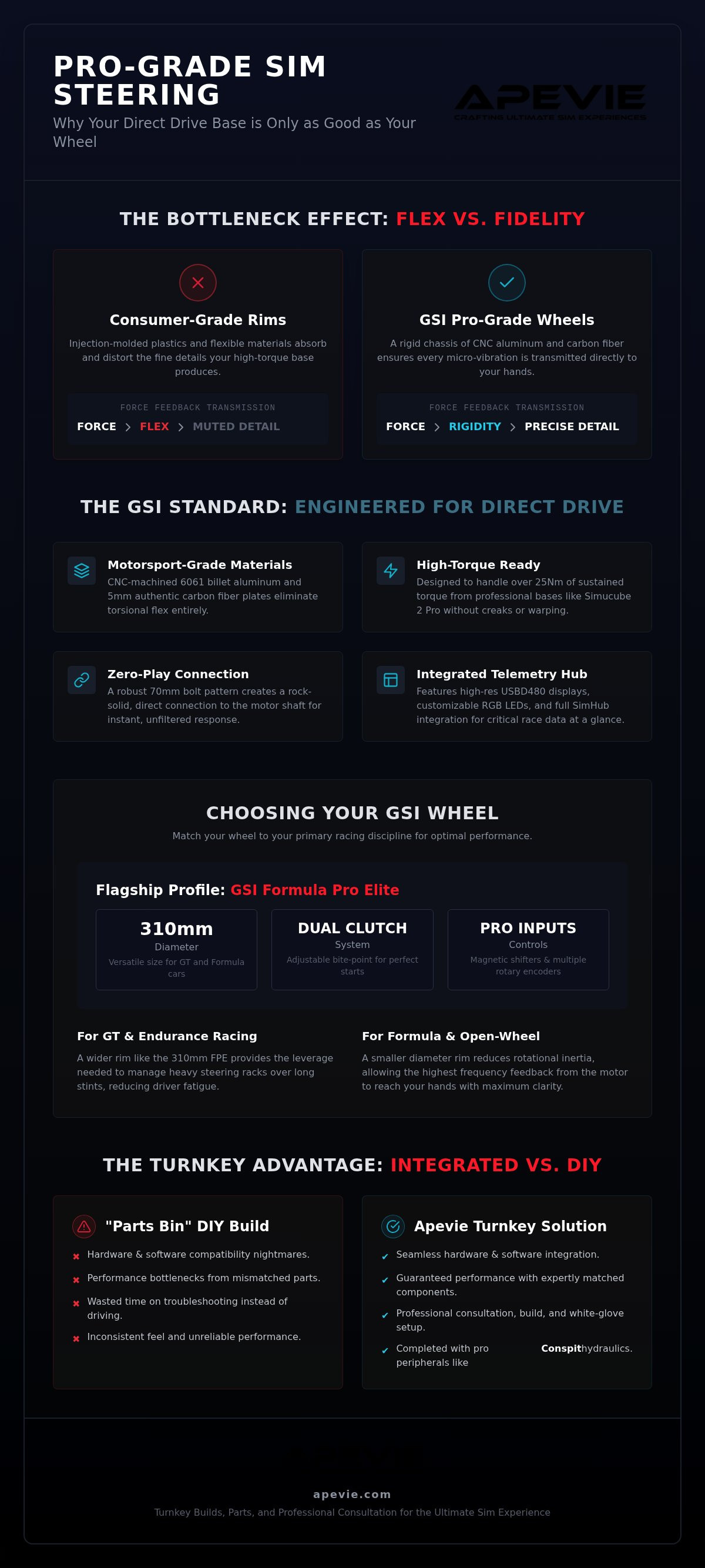
The secret lies in material selection. Instead of using injection-molded plastics, every gsi steering wheel is constructed from CNC-machined 6061 billet aluminum and 5mm thick authentic carbon fiber. This combination eliminates torsional flex entirely. When you hit a high-speed curb, the impact is transmitted directly to your palms rather than being absorbed by the wheel's chassis. This rigidity isn't just about durability; it's about the fidelity of the data being passed from the simulator to the driver.
Engineering for Direct Drive Bases
Modern direct drive motors, such as the Simucube 2 Pro, can generate upwards of 25Nm of torque. Standard consumer rims often struggle under these loads, leading to creaks or physical warping. GSI utilizes a robust 70mm bolt pattern that creates a zero-play connection to the motor shaft. By managing rotational inertia through precise weight distribution, GSI ensures that the wheel remains responsive. This allows the motor to react to telemetry changes instantly, providing a steering feel that is heavy yet incredibly communicative.
Telemetry and Visual Integration
Beyond its mechanical strength, a gsi steering wheel serves as a sophisticated telemetry hub. The integration of high-resolution USBD480 displays allows drivers to monitor critical car data like tire pressures and ERS deployment without breaking their line of sight. This visual feedback is essential for maintaining focus during competitive stints.
- Customizable RGB LED arrays for shift points and track-side flag warnings.
- Full SimHub integration to support real-time data across all major PC racing titles.
- Industrial-grade magnetic shifters that provide a crisp, tactile snap for reliable gear changes.
- Dual-clutch systems with adjustable bite points for consistent, professional race starts.
Comparing Elite GSI Models: From Formula Pro Elite to Hyper P1
Selecting the ideal gsi steering wheel requires a specific understanding of how ergonomics and input density affect your performance. While the previous section highlighted the structural integrity of these rims, the choice between models often comes down to the types of cars you drive most frequently. A 310mm diameter, for instance, provides the leverage necessary to manage the heavy steering racks found in GT3 endurance racing. Conversely, a smaller rim reduces rotational inertia, allowing the high-frequency feedback of a direct drive motor to reach your hands with greater clarity. You can see these distinctions in action within the professional environments curated by Apevie Simulators.
The decision framework for a professional rim should prioritize your primary sim categories. If you're alternating between iRacing's F3 sprints and long-stint GT3 races in ACC, versatility is your greatest asset. However, if you're a power user who constantly adjusts brake bias, traction control, and ERS maps mid-lap, button density becomes the deciding factor. Weight also remains a critical variable; a heavier wheel can smooth out torque spikes, while a lighter setup exposes the rawest telemetry data possible.
GSI Formula Pro Elite: The Versatile Flagship
The Formula Pro Elite remains the benchmark for professional sim rigs because it strikes a rare balance between formula-style ergonomics and GT versatility. Its 310mm diameter is wide enough to feel natural in a Porsche 911 GT3 R, yet it maintains the compact silhouette required for open-wheel cockpits. The dual-clutch system is particularly lauded for its tactile consistency, allowing for precise standing starts in competitive leagues. It's a rugged, dependable rim that serves as the centerpiece for many of our high-performance turnkey installations.
GSI Hyper P1: The Ultimate Competitor
The Hyper P1 is designed for the driver who demands total control without ever moving their hands from the grips. With an increased count of rotary encoders and tactile buttons, it allows for complex car adjustments on the fly. The debate between the screen-less and integrated screen versions usually depends on your primary display. VR users often prefer the screen-less version to save weight, whereas monitor users benefit from the high-resolution telemetry data provided by the integrated USBD480 display. If you find yourself navigating on-screen menus mid-race, the Hyper P1 is the upgrade that moves those critical functions to a physical, tactile interface.
Beyond the Rim: Why Peripherals Define the Professional Sim Experience
Many racers spend their entire budget on a high-end gsi steering wheel and a direct drive base, only to settle for entry-level pedals or a plastic shifter. This creates an "Ecosystem Bottleneck" where the premium fidelity of your wheel is undermined by the vague, mushy feedback of your other peripherals. If your steering wheel feels like a real GT3 component but your handbrake feels like a toy, your brain won't maintain the illusion of reality. At Apevie Simulator, we emphasize a professional sim rig foundation where every touchpoint shares the same level of mechanical intent.
Consistency is the bedrock of muscle memory. If the magnetic snap of your GSI paddles requires significant force, but your sequential shifter feels light and toy-like, you'll misjudge inputs during high-pressure sessions. We focus on matching the tactile "weight" of the entire cockpit. This approach reduces immersion breaks often caused by flex in low-quality mounting brackets. When every input provides industrial-grade resistance, you stop thinking about the hardware and focus purely on the apex.
Tactile Consistency and Muscle Memory
The psychological benefit of a cohesive hardware environment shouldn't be underestimated. When your shifter's throw matches the resistance of your wheel's paddles, your nervous system treats the rig as a single, unified machine. High-quality mounting solutions from Conspit ensure that none of your physical effort is lost to chassis flex. This rigidity allows for microscopic adjustments in braking and steering that are simply impossible on a less stable platform.
The Role of Dashboards and External Displays
While several models of the gsi steering wheel feature integrated screens, adding external displays can significantly improve your setup's ergonomics. Moving telemetry data from your primary monitor to a dedicated dashboard allows you to tighten your Field of View (FOV). This provides better spatial awareness on track. High-end Conspit displays integrate seamlessly with your wheel's telemetry via SimHub. They offer a secondary layer of information for car setting adjustments on the fly. This setup is vital for endurance racing where monitoring tire wear is as critical as the steering itself. By offloading these visuals, you keep your primary screen clear for the road ahead.
The Conspit Buying Guide: Premium Accessories to Complete Your GSI Rig
A world-class gsi steering wheel is only as effective as the peripherals that support it. While the wheel handles the primary communication of tire slip and steering rack forces, the rest of your rig's hardware must match that level of fidelity to maintain a professional simulation environment. Conspit has emerged as the essential partner for GSI users, primarily because their engineering philosophy focuses on mechanical precision and extreme durability. They don't build toys; they build hardware that mimics the hydraulic and mechanical resistance found in real-world motorsport cockpits.
When you're building a professional rig, you shouldn't overlook the stability of your secondary inputs. Touchscreen dashboards and external displays from Conspit allow for real-time car data management without cluttering your main visual field. This is particularly useful for endurance racers who need to track fuel maps and brake temperatures while keeping their eyes on the apex. For those looking to browse specific hardware options, the Conspit Accessories collection provides the necessary components to bridge the gap between a standard setup and a professional-grade simulator.
Conspit Hydraulic Handbrakes and Shifters
The choice between load cell and hydraulic handbrakes is often the deciding factor for serious rally and drift enthusiasts. While load cell systems measure pressure through an electronic sensor, Conspit's hydraulic systems use actual fluid pressure. This provides a progressive, organic feel that a spring-based system simply can't replicate. You'll find that the initial "bite" and the subsequent locking force feel remarkably authentic. This mechanical feedback is vital for muscle memory when you're initiating a drift or navigating a tight hairpin. It ensures that your physical inputs result in predictable car behavior every single time.
Mounting and Quick Release Systems
Zero-play connectivity is non-negotiable when you're using a high-torque direct drive base. Any microscopic movement in the quick release or mounting bracket will act as a filter, dampening the high-frequency feedback coming from your gsi steering wheel. Conspit's mounting brackets are precision-crafted to handle the 25Nm+ torque loads of a Simucube 2 Pro without developing flex over time. Their quick release systems are machined to tolerances that ensure a rock-solid connection. This rigidity is what allows for unmatched durability during long endurance sessions, where heat and constant vibration can cause lesser hardware to fail. If you're ready to eliminate flex from your setup, you can explore our turnkey build services to ensure perfect hardware integration.
Expert Consultation and Turnkey Integration with Apevie Simulators
Building a professional simulator isn't just about purchasing the most expensive components. It's about ensuring those parts communicate effectively. A "parts bin" approach often leads to weeks of troubleshooting driver conflicts and mounting issues. When you integrate a gsi steering wheel into a custom build, you're dealing with high-bandwidth data that needs to be perfectly synced with your wheel base and pedals. At Apevie Simulator, we specialize in eliminating the friction between hardware and software.
Calibration is where most DIY builds fall short. We ensure that your wheel, your Conspit hydraulic system, and your Simucube 2 Pro function as a single, cohesive unit. Rigidity is the goal. This synergy is what allows you to feel the difference between a cold tire and a worn one. We don't just bolt parts to a frame; we tune the telemetry output to match your specific driving style. This level of precision is why professional drivers choose turnkey solutions over home-built rigs.
The Apevie Turnkey Advantage
The most significant benefit of a turnkey build is the removal of the "troubleshooting phase." High-end sim racing gear is notorious for complex setup procedures. Our white-glove installation service handles everything from firmware updates to custom cable management. We optimize the ergonomics of your cockpit to prevent fatigue during long endurance stints. You aren't just buying a setup; you're gaining direct access to experts who race the same hardware they sell. We know how a gsi steering wheel should feel when it's dialed in, and we don't consider a build finished until it meets that professional standard.
Next Steps for Your Professional Build
Transitioning from enthusiast-grade gear to a professional simulator is a significant step. It requires a move away from "one-size-fits-all" solutions toward a setup tailored to your physical requirements and racing goals. Whether you're looking for a full GT3 cockpit or a dedicated formula rig, our team provides the expert consultation needed to make informed choices. You can browse the Conspit collection to start your upgrade or contact Apevie Simulator for a custom quote. We'll help you select the right GSI rim and Conspit peripherals to ensure your next build is your final build.
Elevating Your Simulation to Professional Standards
Transitioning from an enthusiast setup to a professional simulator is a journey that demands technical precision and hardware synergy. A gsi steering wheel acts as more than just a rim; it's a high-fidelity interface that requires a rigid, zero-flex ecosystem to communicate telemetry effectively. Synergy is everything. By pairing these wheels with Conspit hydraulic systems, you eliminate the common bottlenecks that often mute the feedback of high-torque direct drive bases.
As an authorized dealer of GSI and Simucube, Apevie Simulator provides the expert consultation and white-glove installation necessary to bridge the gap between individual parts and a unified racing machine. We focus exclusively on high-performance, PC-grade hardware to ensure every build meets the demands of serious competition. If you're ready to move beyond the troubleshooting phase and focus purely on your lap times, we're here to help you calibrate your dream setup. Upgrade your simulator with the Conspit Accessories Collection and experience the difference that professional integration makes in your racing career.
Frequently Asked Questions
Is the GSI steering wheel compatible with all wheel bases?
Most high-end direct drive bases like Simucube and Fanatec are compatible with GSI wheels because they use a standard 70mm bolt pattern. However, these wheels are designed exclusively for PC use and aren't compatible with consoles. They require a direct USB connection to your computer to power the displays and buttons. For proprietary bases, you'll need a specific adapter to ensure a secure, zero-flex connection between the motor and the rim.
What is the difference between GSI and Cube Controls wheels?
GSI wheels are known for their industrial, overbuilt feel and heavy use of 6061 billet aluminum and thick carbon fiber. Cube Controls focuses on a more sleek, lightweight Italian design. While both are elite choices, a gsi steering wheel often feels more substantial in the hands. Many drivers prefer this for high-torque direct drive systems to help dampen raw motor vibrations. It provides a more grounded, mechanical connection.
Do I need a specific hub or adapter to mount a GSI wheel to a Simucube base?
You'll typically need a Simucube Quick Release (SQR) adapter to mount the wheel. Since GSI wheels feature a universal 70mm pitch circle diameter bolt pattern, they bolt directly to the SQR system. This creates a rock-solid connection that's vital for high-torque environments. We provide these adapters as part of our turnkey build services. This ensures your hardware is ready to race immediately upon installation without any compatibility guesswork.
Are Conspit accessories compatible with non-Conspit cockpits?
Conspit accessories are designed with universal mounting standards in mind. Their handbrakes and displays can be mounted to most aluminum extrusion sim rigs or GT-style cockpits using standard T-nuts and brackets. We often integrate Conspit hardware into custom rigs because of this versatility. The key is ensuring your mounting surface is rigid enough to handle the high forces of their hydraulic systems. This prevents the flex that ruins immersion during heavy braking.
Why should I choose a hydraulic handbrake over a load cell version?
Hydraulic handbrakes offer a progressive, organic resistance that load cells can't fully replicate. A load cell measures electronic pressure, while a hydraulic system uses actual fluid displacement. This creates a realistic "bite" point and a firmer feel as you pull harder. For rally and drift enthusiasts, this mechanical feedback is essential. It helps you develop the muscle memory required for consistent car control. It's a more authentic representation of real-world motorsport hardware.
Does the GSI Formula Pro Elite display work with all racing sims?
The USBD480 display on the Formula Pro Elite is compatible with almost all major PC racing titles through SimHub. This includes iRacing, Assetto Corsa Competizione, and DiRT Rally 2.0. It doesn't work on consoles because those platforms don't support external USB displays. Our experts help calibrate these screens so they show the exact telemetry data you need for your specific car class. This ensures you never miss a shift point or a critical warning.
What kind of PC specs are required for a GSI and Conspit setup?
You don't need a supercomputer just for the peripherals, but you do need enough USB bandwidth. High-end wheels with integrated screens and multiple accessories can saturate a single USB controller. We recommend a modern PC with a dedicated USB 3.0 hub. Since we focus on high-performance PC hardware, we ensure your computer's motherboard can handle the data throughput from your gsi steering wheel and hydraulic sensors. This prevents input lag during competitive sessions.
Can Apevie help with the software calibration of my new GSI wheel?
Calibration is a core part of our white-glove installation service. We don't just ship boxes; we set up the software environment to ensure your GSI wheel, Conspit pedals, and Simucube base work in harmony. This includes mapping buttons, setting up shift lights, and configuring your USBD480 screen. We eliminate the frustrating troubleshooting phase so you can move straight to the track. Our goal is to provide a turnkey solution that's ready for professional competition.