Best Simucube Steering Wheels 2026: Professional Guide
Most sim racers spend months obsessing over peak torque figures. However, they often ignore the one component that actually translates those forces to their hands: the steering wheel's rotational inertia. If your rim is too heavy or lacks structural rigidity, you're essentially putting a filter between yourself and the motor's high-fidelity feedback. Finding the best steering wheels for simucube isn't just about counting buttons; it's about finding a chassis that can handle the raw power of a Simucube 3 or Pro base without a hint of flex.
We understand the frustration of compatibility anxiety and the fear of wireless lag during a competitive stint. You want a setup that feels like a real GT3 or Formula car, not a collection of vibrating parts. In this professional guide, we'll show you how to achieve a rigid, automotive-grade steering experience through elite options like the Gomez Sim Industries Formula Pro Elite and the Cube Controls F-Core. We'll also break down how these boutique rims integrate with the latest Simucube Tuner software to ensure your tactile feedback remains crisp, clear, and perfectly synchronized with every kerb and slide.
Key Takeaways
- Understand how the Simucube Wireless Wheel protocol eliminates cable clutter without sacrificing response times for a cleaner, more reliable cockpit setup.
- Learn why CNC-machined aluminum and carbon fiber are essential for maintaining structural rigidity and force feedback clarity under high torque loads.
- Discover the best steering wheels for simucube from elite manufacturers like Gomez Sim Industries and Cube Controls, tailored for professional-grade performance.
- Identify the specific rim characteristics needed for different racing disciplines, whether you require the high-speed response of Formula racing or the button density of GT3 endurance.
- Explore how professional integration and white-glove installation ensure your high-end hardware is perfectly calibrated within a turnkey simulator system.
Understanding the Simucube Steering Wheel Ecosystem
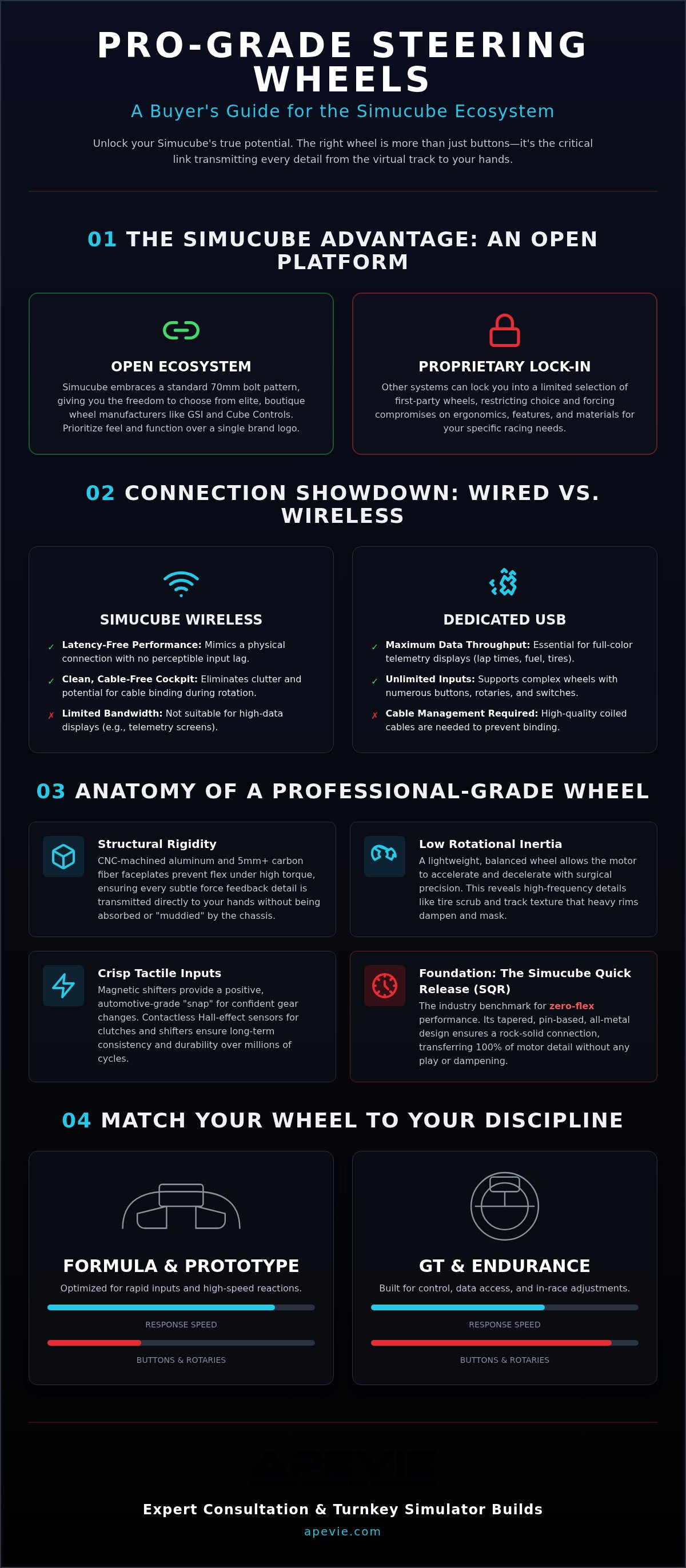
The Simucube ecosystem stands apart because it doesn't force you into a proprietary hardware loop. Unlike some manufacturers that lock you into a single brand of rims, Simucube embraces an open platform. This flexibility is exactly why finding the best steering wheels for simucube often leads you to boutique manufacturers like Gomez Sim Industries or Cube Controls. By using a standard 70mm bolt pattern and a robust software backend, Simucube allows you to prioritize the tactile feel of the rim rather than the logo on the base. We often guide our clients through this selection process to ensure that the chosen hardware integrates seamlessly with the Simucube Tuner software for a professional, plug-and-play experience.
Wired vs. Wireless: Choosing Your Connection
Choosing your connection method is the first major decision in building your cockpit. The Simucube Wireless Wheel protocol is a marvel of engineering. It provides a latency-free experience that mimics a physical connection, making it perfect for racers who value a clean, cable-free environment. However, wireless technology has physical constraints. Most wireless modules are limited in the number of rotary encoders and buttons they can support. If you require a full-color telemetry display, like the one found on the GSI Hyper P1, a USB-wired connection is mandatory. High-bandwidth data for live lap deltas and tire temperatures simply requires more throughput than current wireless protocols offer. When running a wired setup on a high-torque base like the Simucube 3, we recommend using high-quality coiled cables with sufficient slack to prevent binding during aggressive counter-steering.
The Importance of the Simucube Quick Release (SQR)
Structural integrity starts at the mounting point. The Simucube Quick Release, often referred to as the SQR, is widely considered the industry benchmark for zero-flex performance. While other systems rely on friction fits or plastic locking rings that can develop "play" over time, the SQR uses a tapered, pin-based design. This ensures a metal-on-metal connection that remains rigid even under the extreme forces delivered by a Simucube Ultimate base. The system's simplicity is its strength; there are no complex electronics inside the hub to fail. For those moving to the latest Simucube 3 wheel bases, the updated SQR versions maintain this commitment to a "Xero-Play" experience while ensuring compatibility with the newest generation of professional rims. It's this rigid foundation that allows the motor's subtle vibrations to reach your fingertips without being dampened by mechanical tolerances.
Key Features of a Professional Grade Sim Wheel
Selecting the best steering wheels for simucube requires looking past the surface level aesthetics and evaluating the engineering beneath the carbon fiber. When you're dealing with the high torque of a Simucube 3 or Ultimate base, structural rigidity is non-negotiable. Rims constructed from 5mm carbon fiber faceplates and CNC-machined aluminum housings ensure that every ounce of force feedback is transmitted directly to your hands rather than being absorbed by mechanical flex. A rigid chassis prevents the "muddy" feeling that often plagues lower-end hardware during high-load cornering.
One critical factor often missed in standard reviews is rotational inertia. A steering wheel's weight and how that weight is distributed affects the motor's ability to communicate micro-details like tire scrub or subtle weight transfers. A heavy rim acts like a flywheel, dampening high-frequency signals. For the most responsive experience, you want a wheel that balances features with low mass. This allows the Simucube motor to accelerate and decelerate the steering column with surgical precision, revealing the textures of the track surface that a heavier wheel might mask. Finding this balance is key to achieving the clarity Simucube users expect.
Tactility extends to your shifting performance as well. Professional-grade wheels utilize magnetic shifters to provide a crisp, automotive-grade snap that prevents accidental double-shifts. While traditional microswitches can wear out over time, Hall-effect sensors offer a contactless solution that maintains consistency over years of endurance racing. For those who prioritize real-time data, integrating a high-resolution LCD screen with SimHub allows you to monitor tire temperatures and fuel levels without looking away from the apex. If you need help configuring these advanced telemetry displays, our experts at Apevie Simulators can assist in matching the right hardware to your specific simulator build.
Ergonomics and Grip Materials
The choice between silicone and Alcantara grips often depends on your preference for gloves. Silicone grips offer incredible durability and can be used with bare hands without degrading. Alcantara provides a more traditional racing feel but requires gloves to prevent oils from ruining the texture over time. Diameter also plays a vital role; a 280mm to 300mm rim is ideal for the rapid rack movements of Formula cars, while a 320mm rim provides the leverage needed for GT3 or Rally. The ideal grip is one that minimizes hand fatigue while maximizing feedback, allowing for consistent lap times during long stints.
Advanced Inputs: Dual Clutches and Funky Switches
Modern sim racing demands more than just basic buttons. Dual-clutch paddles are a game-changer for standing starts in iRacing, allowing you to find the bite point and launch with zero wheel spin. Navigating complex in-car menus while driving at high speeds requires 7-way "funky" switches that combine directional input with a rotary encoder and a push button. These inputs, along with dedicated thumb encoders for on-the-fly brake bias and traction control adjustments, ensure you never have to take your hands off the wheel to optimize your car's performance during a race.
Top Recommendations: GSI, Cube Controls, and Moza Racing
Choosing the best steering wheels for simucube involves balancing your budget against the specific tactile demands of your preferred racing discipline. While the Simucube motor provides the raw data, these three brands represent the pinnacle of how that data is translated into physical sensation. We've spent countless hours testing these rims on Simucube 2 Pro and Ultimate bases to identify which ones maintain their composure under high-torque scenarios. Each brand offers a distinct philosophy, from the industrial "no-compromise" build of GSI to the refined Italian ergonomics of Cube Controls.
The Elite Tier: GSI Formula Pro Elite
The Gomez Sim Industries (GSI) Formula Pro Elite remains a benchmark for professional-grade hardware. Its 5mm carbon fiber faceplate ensures zero flex even when the Simucube motor is outputting its full torque range. This rigidity is vital because it prevents the mechanical dampening of fine force feedback details. The integrated 4.3-inch full-color LCD screen works flawlessly with SimHub, providing a high-density telemetry display that keeps your eyes on the track. If you're looking for a deeper dive into open-wheel hardware, you can explore our guide on The Best F1 Steering Wheels for Professional Sim Racing in 2026. The magnetic shifters on this rim provide a heavy, tactile snap that feels more like a piece of industrial machinery than a gaming peripheral.
Performance Value: Cube Controls F-Core
For racers who prioritize low rotational inertia, the Cube Controls F-Core is an exceptional choice. It's significantly lighter than the GSI rims, allowing the Simucube motor to react with slightly more agility to micro-corrections. Despite its lower price point, it doesn't sacrifice input quality, featuring proprietary carbon fiber composites and high-grade tactile buttons. The F-Core is particularly appealing because it supports both USB and Simucube wireless connections, giving you the freedom to choose between a clutter-free cockpit or high-bandwidth telemetry. It's the ideal entry point for serious buyers who want professional-level inputs without the four-figure price tag of the "Elite" tier rims.
Ecosystem Versatility: Moza Racing Accessories
While Moza is often viewed as a mid-range ecosystem, their hardware has become increasingly popular for Simucube users thanks to the Moza Universal Hub. This adapter allows you to mount Moza wheels to non-Moza bases, providing a high-value path for those who want specific features like the 5.4-inch flexible OLED display found on the Moza Porsche Mission R wheel. You can Discover Moza Racing Accessories to see how these components can be integrated into a high-end build. Using Moza's high-definition dashboards alongside a Simucube base offers a unique blend of ecosystem flexibility and top-tier motor performance that was previously difficult to achieve.
When comparing the F-Core and the Formula Pro Elite for a Simucube 2 Pro setup, the decision often comes down to the display. If you already have a dedicated dash on your rig, the F-Core's lighter weight and lower cost make it a logical choice. However, if you want the most rigid, immersive "all-in-one" solution, the GSI's integrated screen and industrial construction are worth the investment. Both wheels integrate seamlessly with Simucube's software, ensuring that your calibration settings remain consistent across every session.
Choosing Your Wheel Based on Racing Discipline
A Simucube motor is essentially a blank canvas for high-fidelity force feedback; however, the physical dimensions of your rim will fundamentally change how that power is perceived. When searching for the best steering wheels for simucube, you must consider how the diameter and shape align with your primary racing discipline. A Formula 1 driver requires lightning-fast rack response and high-frequency feedback, while a GT3 endurance racer needs leverage and comfort for multi-hour stints. The motor might be the same, but the rim dictates the resolution of the data reaching your fingertips.
The Formula One Setup
In the world of open-wheel racing, speed and precision are everything. We recommend pairing a high-torque base like the Simucube Ultimate, which delivers 25Nm of peak torque, with a compact 280mm Formula rim. The smaller diameter reduces the distance between the steering axis and your hands, effectively increasing the perceived detail of the motor's feedback. This setup allows you to feel the front tires losing grip a fraction of a second earlier. For those seeking a bespoke, professional-grade cockpit, the integration of Precision Sim Engineering rims provides a level of craftsmanship that matches the Simucube's industrial performance. These wheels are designed to withstand aggressive counter-steering without the slightest hint of mechanical flex, ensuring that no fidelity is lost in the steering column.
GT and Prototype Racing
GT3 and Prototype racing demand a different ergonomic approach. A 300mm to 320mm D-shaped rim is the standard here, providing the necessary leverage to manage heavy downforce cars through long, sweeping corners. This larger diameter slows down the steering ratio slightly, making the car feel more stable and less "twitchy" than a Formula setup. Because endurance racing requires managing complex systems on the fly, many drivers integrate external button boxes from Apex Sim Racing to expand their mapping options for fuel maps and engine braking. This allows the steering wheel to remain focused on primary driving inputs while secondary controls are within easy reach on the rig chassis.
For rally and drift enthusiasts, a round 320mm or 330mm rim is essential. The Simucube Quick Release (SQR) is particularly valuable here; its pin-based connection handles the violent, rapid rotations of a drifting car without developing the play found in friction-fit systems. If your rig serves multiple disciplines, we suggest a two-wheel collection: one dedicated Formula rim and one versatile round or D-shaped rim. This allows you to swap profiles in Simucube True Drive and match your hardware to the car's real-world geometry. If you're unsure which combination suits your driving style, you can consult with our team at Apevie Simulators to design a custom wheel collection for your turnkey build.
Integrating Your Steering Wheel into a Turnkey Simucube Build
Selecting the best steering wheels for simucube is the definitive act of personalizing your simulator. While earlier sections detailed the technical nuances of GSI and Cube Controls hardware, the integration phase is where Apevie Simulators adds the most value. We ensure your choice of rim isn't just aesthetically pleasing but is mechanically matched to your specific wheel base tier. A Simucube Ultimate or Simucube 3 base requires a rim with unyielding structural integrity to handle high torque loads without dampening the high-fidelity feedback that defines the platform.
Our consultation process focuses on the synergy between your driving style and the hardware's physical properties. We know that a Simucube Sport user might prefer the lower rotational inertia of a Cube Controls F-Core to maximize the motor's agility. Conversely, those pushing the limits of a 25Nm system need the industrial-grade construction of Gomez Sim Industries to prevent resonance and flex. By matching the appropriate rim strength to your base, we guarantee that no detail is lost between the virtual track and your fingertips.
The Professional Installation Process
Professional calibration transforms a collection of high-end parts into a cohesive racing instrument. Our white-glove service includes fine-tuning the Simucube Tuner software to account for the specific mass and diameter of your chosen rim. We also implement sophisticated cable management for USB-wired wheels, ensuring that telemetry-heavy setups remain reliable during aggressive steering maneuvers. This level of detail extends to the mounting phase, where we guarantee a zero-flex foundation on our aluminum profile sim rigs.
Ready to Race? Your Next Steps
If you're moving beyond basic gaming setups, a tailored consultation is your most effective path forward. We provide turnkey racing simulator packages that include expert hardware selection, professional assembly, and long-term support. You can also upgrade your setup with Moza Racing Accessories to enhance your current rig with high-definition displays and universal hub solutions. Contact Apevie Simulators today to start designing your custom high-performance racing simulator.
Mastering Your Connection to the Track
Finding the best steering wheels for simucube is about more than just aesthetics; it's about ensuring your hardware can translate the motor's high-fidelity signals without dampening the experience through mechanical flex. Whether you choose the industrial strength of a GSI Formula Pro Elite or the agile ergonomics of a Cube Controls rim, the right choice ensures your inputs are surgical and your feedback is crystal clear. The bridge between you and the virtual asphalt is only as strong as its weakest component.
As an authorized Simucube and GSI dealer, we specialize in professional turnkey simulator builds that prioritize structural integrity and long-term reliability. Our expert white-glove installation handles everything from hardware mounting to software tuning, so you can focus entirely on your lap times. We don't just sell parts; we curate high-performance environments designed for enthusiasts who refuse to compromise on quality.
Ready to refine your cockpit? You can Shop Moza Racing Accessories for Your Simucube Setup or visit Apevie Simulator to start your custom high-performance journey. We're here to help you build a simulator that feels as authentic as the real thing. See you on the grid.
Frequently Asked Questions
Can I use a Moza steering wheel on a Simucube 2 Pro base?
Yes, you can use Moza steering wheels on a Simucube 2 Pro base by utilizing the Moza Universal Hub. This adapter bridges the gap between Moza's proprietary connection and Simucube's open ecosystem. It's a popular choice for racers who want the unique features of the Moza Vision GS or the Porsche Mission R rim while maintaining the superior force feedback of a Simucube motor.
What is the best steering wheel for iRacing on a Simucube base?
The Gomez Sim Industries Formula Pro Elite is often considered one of the best steering wheels for simucube when racing in iRacing's competitive Formula and GT3 series. Its high button density and dual-clutch paddles are perfect for managing complex in-car settings and standing starts. For those focusing on endurance, the tactile feedback of GSI's magnetic shifters ensures consistent performance during long stints.
Do I need a wireless steering wheel for my Simucube setup?
A wireless steering wheel isn't strictly necessary, but it offers a much cleaner cockpit by removing the coiled USB cable. Simucube's proprietary wireless protocol provides a latency-free experience that professional racers trust. However, if you require a high-resolution LCD screen for live telemetry, a wired USB connection is currently the only way to provide enough bandwidth for those displays.
Are Gomez Sim Industries (GSI) wheels worth the premium price?
Gomez Sim Industries wheels are worth the premium because they offer industrial-grade rigidity that cheaper alternatives can't match. When you're running a Simucube Ultimate at 25Nm of torque, lesser rims can flex or creak under load. GSI uses 5mm carbon fiber and CNC-machined aluminum to ensure that 100% of the motor's feedback reaches your hands without any mechanical dampening.
How do I mount a third-party wheel to the Simucube Quick Release?
Mounting a third-party wheel requires attaching the Simucube Quick Release (SQR) to the back of your rim using a standard 70mm bolt pattern. Most professional wheels from brands like GSI and Cube Controls are designed with this pattern in mind. Once the SQR is bolted on, you simply slide the wheel onto the base and insert the locking pin for a zero-flex connection.
What is the difference between Simucube 2 and Simucube 3 wheel compatibility?
Most steering wheels compatible with Simucube 2 will also work with the Simucube 3, provided you have the correct SQR adapter. The core communication protocols for wireless wheels remain consistent across the lineup. However, the Simucube 3 features an updated quick-release system designed to handle even higher forces, so it's essential to verify that your specific rim and hub combination meet the latest structural requirements.
Do I need a separate dashboard if my steering wheel has an LCD screen?
You don't necessarily need a separate dashboard if your steering wheel features an integrated LCD screen, as it can display all your vital telemetry via SimHub. However, some racers still prefer a fixed dash mounted to the wheel base. This ensures that the data remains in a consistent position even when the wheel is turned, which can be helpful during tight cornering or recovery maneuvers.
Which steering wheel diameter is best for GT3 racing?
A diameter between 300mm and 320mm is ideal for GT3 racing because it provides the right balance of leverage and precision. Rims in this size range, like the Cube Controls GT series, allow for smoother inputs during long endurance sessions. A smaller 280mm rim might feel too twitchy for GT cars, while a larger 330mm rim can feel sluggish during rapid transitions.