
Cube Control Accessories Buying Guide: Optimizing Your Professional Sim Rig
What if the most expensive direct drive motor on the market is only as good as the small piece of aluminum connecting it to your steering wheel? Many enthusiasts spend months researching peak torque figures and slew rates, only to settle for a mounting solution that introduces subtle flex during high-load cornering. Choosing the right cube control accessories isn't just about aesthetics; it's about preserving the high-fidelity force feedback you've already invested in for your professional rig.
You likely understand that in a high-end simulator, every millimeter of unintended movement counts. We agree that nothing breaks immersion faster than a loose quick release or a tangled coiled cable that limits your steering rack's rotation. This guide promises to help you master the technical nuances of the Cube Controls ecosystem, ensuring perfect compatibility between your wheel and bases like the Simucube 2 or Fanatec Podium. We'll explore how specific spacers, quick releases, and power solutions create a rock-solid connection. You'll gain a clear framework for optimizing your ergonomics and cable management, transforming a collection of premium parts into a seamless, high-performance racing machine.
Key Takeaways
- Learn how to select the correct quick release systems and hub adapters to ensure a flex-free connection between your wheel and base.
- Understand the technical requirements for integrating cube control accessories into existing Simucube or Fanatec ecosystems without compromising signal integrity.
- Discover the mechanical advantages of the SP01 pedal system, focusing on how load cell precision and adjustable travel distances impact your consistency on track.
- Identify the critical differences between wired USB and wireless connectivity to determine the best power management strategy for your specific simulator cockpit.
- Gain insight into why authorized dealer support is vital for maintaining genuine firmware and long-term hardware reliability for high-torque direct drive setups.
The Engineering Value of Cube Control Accessories
High-torque direct drive bases like the Simucube 2 Pro or Fanatec Podium DD2 generate forces that can easily overwhelm standard mounting hardware. If your connection point isn't rigid, the nuanced vibrations that tell you about tire slip or kerb strikes get lost in the mechanical noise. This is where the engineering of cube control accessories becomes a necessity rather than an optional upgrade. The ecosystem includes everything from the flagship Cube Controls F-Core wheel to the precision-engineered SP01 pedals; all connected by robust hub adapters and spacers designed to withstand sustained lateral loads.
We've seen a clear shift in the industry away from plastic-heavy gaming peripherals toward motorsport-spec components. When you use CNC-machined aluminum spacers or carbon fiber faceplates, you aren't just buying durability. You're ensuring that every bit of telemetry data sent from the simulator reaches your hands without being dampened by flex. This mechanical integrity is the foundation of a professional rig.
Beyond the Steering Wheel: Completing Your Rig
A professional simulator is a modular environment where the interface between components is just as vital as the components themselves. You wouldn't put budget tires on a supercar; similarly, mounting a high-end wheel to a flimsy quick release creates a bottleneck in performance. At Apevie Simulators, we select cube control accessories based on their ability to provide consistent tactile feedback. This modularity allows us to fine-tune the distance between the wheel and the motor using specific spacers, ensuring your ergonomics are perfect for long endurance stints. The goal is a seamless path for force feedback to travel from the motor to your fingertips.
The PC-Only Advantage: Precision over Compatibility
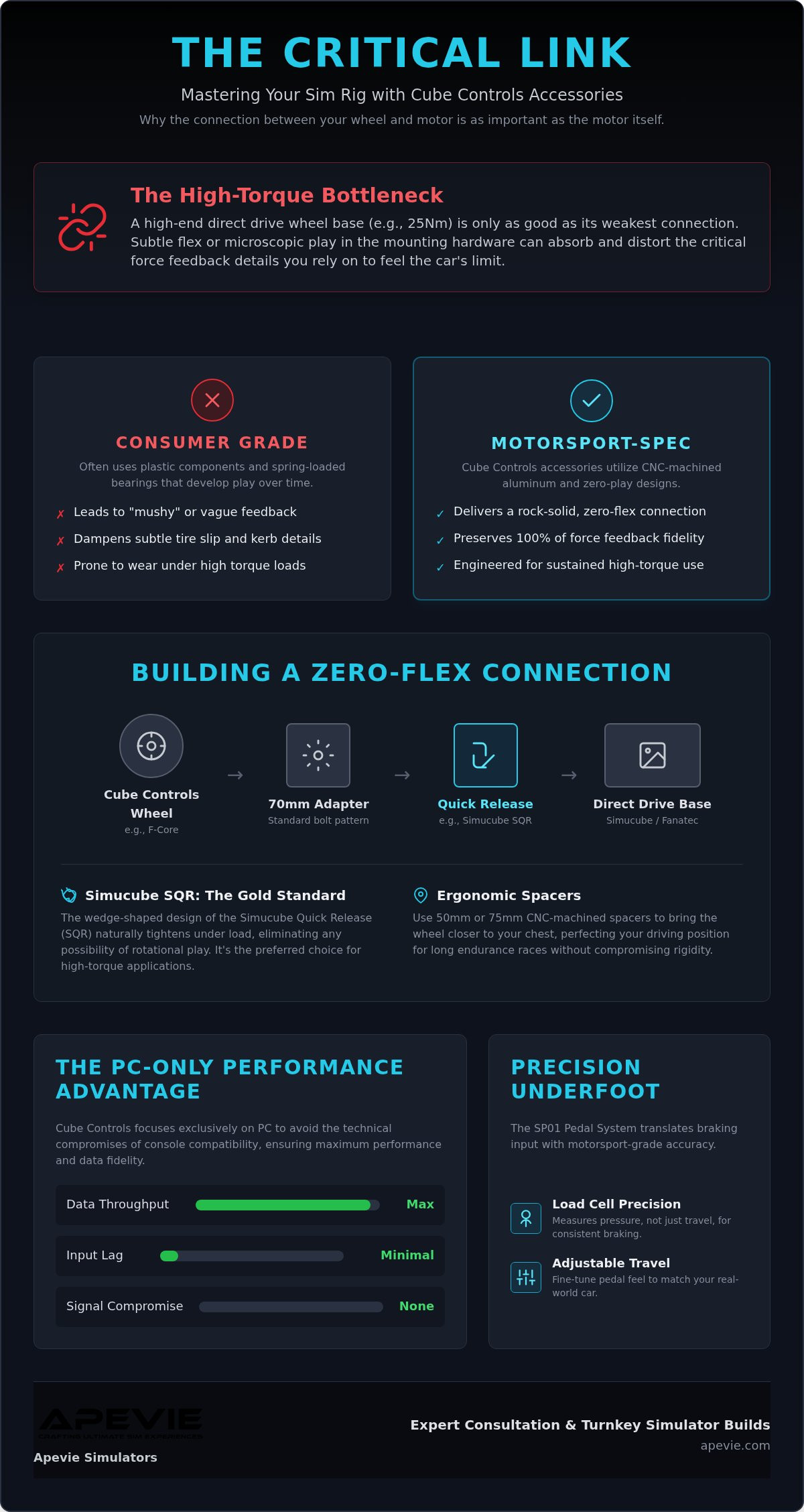
Cube Controls focuses exclusively on the PC platform to avoid the technical compromises inherent in console-compatible systems. Consoles often require proprietary chips and all-in-one designs that limit data throughput and force users into closed ecosystems. By prioritizing high-bandwidth USB connections, these components offer significantly lower input lag and higher resolution for pedal inputs. This focus on raw performance ensures that when you press the brake on a set of SP01 pedals, the signal is processed with the speed and accuracy required for competitive sim racing. You avoid the "dead zones" and signal smoothing often found in hardware designed for broader, less demanding audiences.
The Critical Link: Quick Release Systems and Hub Adapters
The mechanical interface between your motor and your steering wheel is where sim racing immersion either thrives or dies. When you're wrestling with 25Nm of torque through a tight hair-pin, any microscopic movement in the quick release translates to "mushy" feedback. High-performance cube control accessories are engineered to solve this by replacing standard consumer-grade plastic mounts with CNC-machined aluminum hubs. These components ensure that the raw data from your wheel base isn't lost to mechanical play.
The engineering difference between a consumer 'snap-on' release and a professional bolt-on hub is significant. Many entry-level systems use spring-loaded ball bearings that eventually develop play over time. In contrast, professional hubs use tapered interfaces or solid bolt patterns to ensure a zero-flex connection. This rigidity is essential for maintaining the fidelity of the force feedback signal, especially when using high-torque direct drive systems.
Simucube 2 and 3 Integration Strategies
Mounting a Cube Controls F-Core to a Simucube 2 Pro requires a specific logic to maintain that "locked-in" feeling. The Simucube Quick Release (SQR) is often considered the gold standard because its wedge-shaped design naturally tightens under load. To bridge the gap between the SQR and the wheel, you'll typically use a 70mm adapter plate. This setup ensures that the rotational forces are distributed evenly across the entire surface of the hub. For those just starting their journey, understanding these mechanical foundations is covered in detail in The Ultimate Sim Rig Guide.
Universal Hubs and Spacer Requirements
Ergonomics often dictate the need for spacers. If your monitors are mounted close to the wheel base, you might need a 50mm or 75mm spacer to bring the wheel closer to your chest while maintaining screen clearance. However, adding length to the steering column increases leverage, which can amplify flex if the components aren't high-grade aluminum. When selecting these cube control accessories, consider these critical factors:
- Material Density: Stick to 6061-grade aluminum to prevent warping under high lateral loads.
- Bolt Grade: Use high-tensile steel fasteners to avoid shearing during violent oscillations.
- Cable Management: Choose hollow spacers if you intend to route USB cables internally for a cleaner look.
A common mistake is using low-grade stainless steel bolts that can't handle the stress of a professional rig. We always recommend ensuring that USB cables are properly strain-relieved to prevent port damage during high-speed rotations. If you're unsure which spacing solution fits your cockpit, our team at Apevie Simulator can provide a tailored consultation for your specific build.
Cube Controls SP01 Pedals and Performance Add-ons
The steering wheel provides the direction, but the pedals dictate the pace. Expanding your rig with cube control accessories means moving beyond the dash to the floor of your cockpit. The SP01 pedal system represents a significant departure from entry-level hardware by focusing on pressure-based telemetry rather than simple distance travel. In a professional environment, this distinction is what allows a driver to find the absolute limit of the braking zone without locking the tires.
Most consumer pedals rely on a potentiometer or a basic hall effect sensor that measures how far you've pushed the lever. The SP01 system uses a high-precision load cell that measures the actual force applied. It's a technical shift that mirrors a real motorsport master cylinder. Because your brain is better at remembering pressure than distance, this hardware helps you develop a more consistent "feel" for the car's deceleration. This level of precision is why we prioritize these components for our custom turnkey builds at Apevie Simulator.
SP01 Pedals: Engineering Consistent Braking Zones
Muscle memory is the most valuable asset for a sim racer. The SP01's design allows for minute adjustments to the pedal face geometry, which is critical for drivers who switch between formula-style left-foot braking and traditional heel-and-toe techniques. By fine-tuning the resistance of the elastomers, you can simulate the rock-solid feel of an LMP3 brake pedal or the slightly more progressive travel of a GT3 car. For a deeper dive into how these mechanics translate to lap times, see The Ultimate Guide to Sim Racing Pedals.
Tactile Upgrades: Shifter Paddles and Knobs
Tactile feedback shouldn't stop at the steering rack. Magnetic shifters are one of the most impactful cube control accessories you can add to a rig. Unlike spring-loaded switches that can feel "mushy" over time, magnets provide a crisp, snap-action engagement that remains consistent even under the heavy vibrations of a motion platform. This ensures you never miss a gear during a violent downshift. Furthermore, the tension in the rotary encoders allows for precise, click-by-click adjustments to your brake bias or traction control settings. You can find more about high-performance steering interfaces in our guide on The Best F1 Steering Wheels.
Maintaining this performance requires proper infrastructure. High-quality coiled USB cables are essential because they provide the necessary slack for high-rotation steering while protecting the internal wiring from fatigue. If you're using wheels with integrated displays and high-brightness LEDs, power management becomes a priority. These displays draw more current than a standard rim, so using a powered USB hub is a non-negotiable requirement to prevent signal dropouts or flickering during a race.
The Buyer’s Decision Framework: Mapping Your Requirements
Selecting the right cube control accessories requires a methodical approach that goes beyond just picking the most expensive components. You need to consider how each piece of hardware interacts with your existing base and cockpit. A professional rig is an exercise in balancing mechanical rigidity with electrical reliability. Your first decision point is the wheel base. Simucube users often prefer the dedicated wireless modules for a clean aesthetic, but if you're using a Fanatec Podium base or a VRS DirectForce Pro, you'll need a specific hub adapter to bridge the ecosystem gap effectively.
Connectivity is the next critical factor. While wireless wheels offer convenience, wired USB connections remain the standard for rims with integrated telemetry displays or high-brightness LEDs. These features draw more power than a standard wireless battery can safely provide over long endurance sessions. You also need to account for the 'invisible' essentials. High-tensile bolts, precision-milled spacers, and shielded cables might not be the most exciting purchases, but they're the components that prevent your rig from feeling like a toy.
Compatibility Checklist for Professional Rigs
Before you finalize your order, verify the bolt pattern of your current quick release. While the 70mm pattern is the industry standard for cube control accessories, some specialized hubs use a 50.8mm pattern. You should also check the power draw of your entire setup. If you're running a high-end wheel, pedals, and a shifter through a single USB hub, you might experience signal dropouts. Ensure your sim rig's wheel deck is rated for the added weight and leverage of professional adapters to prevent long-term fatigue in the aluminum extrusion.
Cable Management and Rig Safety
Cable management isn't just about making the rig look professional; it's a safety requirement. High-torque direct drive motors can snap a USB cable instantly during a violent 'wheel spin' event if there isn't enough slack. We recommend using coiled cables with industrial-grade strain relief to allow for full steering rotation. This is especially vital if your rig includes a motion platform, where the entire cockpit is subjected to rapid G-force changes. For those integrating advanced vibration feedback, our The Professional Guide to Haptic Systems provides further insight into managing complex electronic interference.
If you're feeling overwhelmed by the technical specifications of different hub patterns and power requirements, our expert team can help you design a perfectly compatible setup. Explore our collection of Cube Control hardware to find the exact components needed for your specific wheel base.
Sourcing Cube Control Gear from Apevie Simulators
Investing in a professional-grade simulator is a commitment to precision and immersion. When you source your cube control accessories through an authorized dealer like Apevie Simulators, you're securing more than just hardware. You're gaining access to a support structure that understands the technical nuances of high-performance PC-based systems. We ensure that every component, from the F-Core steering wheel to the SP01 pedals, arrives with the latest genuine firmware and the full protection of manufacturer warranties. This eliminates the risks associated with gray-market imports or unverified resellers.
A professional rig is a complex synergy of mechanical and electronic systems. Buying from an expert consultant means your hardware is vetted for compatibility with other elite brands like Simucube and Heusinkveld. We don't just ship boxes; we provide a foundation for competitive success. Our role as an authorized partner allows us to offer direct technical insights that generic retailers simply can't provide, ensuring your setup remains stable under the most demanding racing conditions.
White-Glove Support and Consultation
Calibration is the bridge between a collection of premium parts and a true racing machine. Apevie Simulators specializes in the white-glove installation of complex rigs, assisting you with the fine-tuning of force feedback profiles and pedal sensitivity curves. If you're working with a non-standard cockpit configuration, we provide custom mounting solutions to ensure your ergonomics are perfect. This hands-on approach removes the retail guesswork, allowing you to focus on your lap times rather than troubleshooting driver conflicts or mechanical flex.
Explore the Collection
Ready to optimize your professional rig? Our curated selection features foundational ecosystem components designed for the most demanding drivers. Whether you're looking for the versatile Cube Controls F-Core or the high-fidelity SP01 pedals, we have the stock and the expertise to help you build a world-class simulator. These cube control accessories are chosen for their ability to deliver consistent performance under the stresses of high-torque direct drive bases.
Shop the Cube Control Accessories Collection at Apevie Simulators
If your project requires a custom configuration or a complete turnkey build, our team is available for professional consultation. We specialize in integrating these high-end components into seamless, PC-only environments that meet the standards of professional racing drivers and serious enthusiasts alike. Reach out to us to discuss how we can tailor a high-performance solution to your specific requirements.
Refining Your Path to Peak Performance
A professional simulator is only as strong as its weakest connection. You now understand how the right hub adapters and quick releases preserve the fidelity of your force feedback while load-cell pedals build the muscle memory required for elite competition. By focusing on a modular, PC-only hardware ecosystem, you eliminate the compromises found in consumer-grade gear and ensure your rig can handle the extreme torque of modern direct drive bases.
Apevie Simulator stands as an authorized dealer and expert turnkey rig builder, providing the technical knowledge needed to navigate complex hardware integrations. Selecting your cube control accessories is the final step in creating a rock-solid, immersive racing environment that responds to your every input with absolute precision. If you're ready to upgrade your simulator with components vetted by experts, Shop Cube Control Accessories for Professional Sim Racing today. We look forward to helping you achieve a setup that feels as authentic as the real thing.
Frequently Asked Questions
Are Cube Controls wheels compatible with Simucube 2 Pro bases?
Yes, Cube Controls wheels are fully compatible with Simucube 2 Pro bases. Most models utilize a standard 70mm bolt pattern that aligns perfectly with the Simucube Quick Release (SQR) system. It's a staple in high-end rigs because it provides a zero-play connection capable of handling high torque levels. You just need to ensure you have the correct adapter plate to bridge the wheel to the SQR hub for a secure, professional fit.
What is the difference between a wired and wireless Cube Controls wheel?
The primary difference lies in power requirements and cockpit aesthetics. Wireless models use a proprietary module to connect directly to Simucube bases, offering a cable-free experience. However, wired USB connections are necessary for wheels featuring integrated displays or high-brightness LEDs. These components draw more current than a battery can provide reliably. Choosing cube control accessories like shielded USB cables ensures these power-hungry features operate without signal dropouts during long endurance races.
Do I need a specific hub to mount Cube Controls hardware to my rig?
You will typically need a hub adapter to mount the wheel to your specific direct drive motor. While Cube Controls uses the industry-standard 70mm bolt pattern, the motor side varies between brands like Fanatec or Simucube. For example, adapting to a Fanatec Podium base requires a Podium Hub or a third-party conversion kit. Selecting the right aluminum hub is critical to eliminate steering column flex and maintain the fidelity of the force feedback signal.
Can I use Cube Controls pedals with other brands of steering wheels?
Yes, you can use Cube Controls pedals with any brand of steering wheel because they function as independent USB devices on the PC platform. Unlike entry-level console gear that requires all components to plug into a single base, professional hardware allows for a modular setup. This means you can pair the SP01 pedal system with a Simucube base or a Gomez Sim Industries wheel without any compatibility issues or the need for specialized conversion software.
Why should I choose magnetic shifters over standard mechanical ones?
Magnetic shifters offer a superior tactile response compared to traditional spring-based mechanical switches. The use of magnets creates a snap-action engagement that feels crisp and consistent every time you pull the paddle. This design is also more durable because it has fewer moving parts that can wear out or become mushy over time. It ensures that you get a positive gear change even when the rig is vibrating heavily from a professional motion system.
What is the benefit of a coiled USB cable for sim racing?
A coiled USB cable provides the necessary slack for high-rotation steering while preventing the wire from becoming tangled or caught in the rig. In a high-torque environment, a straight cable can easily be ripped out of its port during a violent spin or a full turn. These specialized cube control accessories are designed with industrial-grade shielding and strain relief to protect your hardware's internal electronics from the fatigue caused by constant mechanical movement.
Does Apevie Simulators offer installation for Cube Control components?
Apevie Simulators provides comprehensive white-glove installation services for all Cube Control components. We specialize in custom turnkey builds, which include mounting, wiring, and calibrating your hardware for peak performance. Our team handles the technical nuances of rig integration, from ensuring proper grounding of USB connections to fine-tuning force feedback profiles. This professional service ensures that your high-end equipment isn't configured incorrectly from the moment you first sit in the cockpit of your rig.