Cube Controls Buying Guide: Choosing the Ultimate Sim Racing Steering Wheel in 2026
Is your steering wheel truly translating the road, or is it acting as a filter between you and your direct drive base? Many enthusiasts find themselves paralyzed by the technical complexity of modern hardware, fearing that a wrong choice in button layouts or encoder types will hinder their performance rather than help it. We understand that the jump to professional-grade gear like cube controls involves more than just a financial investment; it's about finding a tool that feels like a natural extension of your hands. At Apevie Simulators, we see this uncertainty often when consulting on custom high-performance builds.
This guide will help you discover which cube controls wheel matches your racing style, whether you're chasing millisecond precision in Formula rims or seeking the authentic weight of GT replicas. You'll gain a clear understanding of the current hierarchy, from the accessible F-Core to the innovative new Phoenix wheel featuring its 1000 Hz polling rate. We'll examine the ergonomic differences and compatibility nuances that ensure your new hardware integrates seamlessly into your existing rig, ultimately leading to better immersion and more consistent lap times.
Key Takeaways
- Understand the ergonomic nuances between Formula and GT layouts to choose a rim diameter and grip shape that aligns with your primary racing discipline.
- Compare the technical specifications of the current cube controls lineup, from the entry-professional F-Core to the telemetry-rich CSX-3 flagship.
- Learn the critical role of high-quality Quick Release systems in maintaining a zero-play connection between your wheel and a direct drive base.
- Discover how Italian engineering, using CNC-machined aluminum and carbon fiber, provides the tactile feedback necessary for improved lap time consistency.
- Explore how expert consultation and turnkey builds from Apevie Simulator ensure your high-end hardware is professionally configured for peak performance.
Engineering Motorsport Reality: Why Cube Controls Dominates the High-End Market
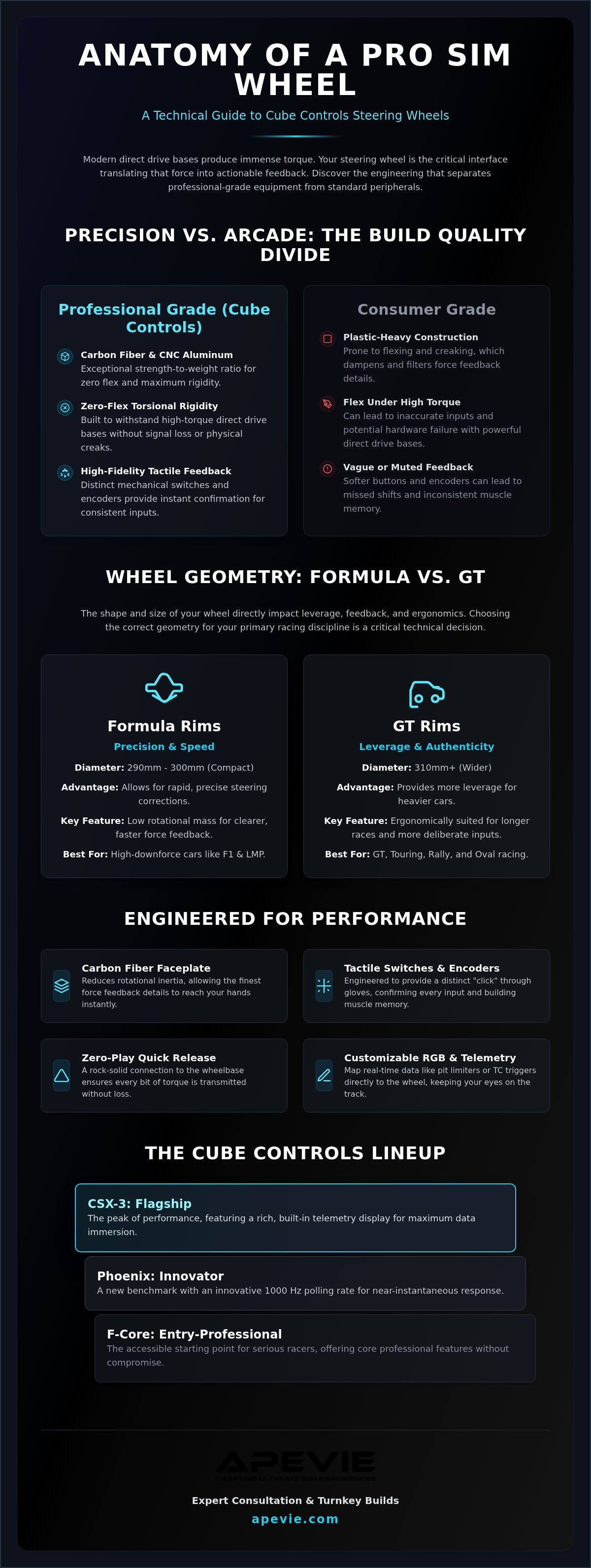
Cube Controls is an Italian boutique manufacturer that has redefined the boundary between virtual racing and motorsport reality. While the industry once relied on plastic-heavy peripherals, this Sardinian studio shifted the standard toward CNC-machined aluminum and genuine carbon fiber. This evolution isn't merely about aesthetics. It's a response to the massive torque generated by modern direct drive systems. In professional PC-based simulation, your steering wheel is the primary data interface. If that interface flexes or dampens signal, your lap times will suffer.
Tactile feedback is the foundation of consistency. When you're hurtling toward a corner at high speeds, your brain relies on sensory confirmation. High-quality switches provide a distinct mechanical "snap" that confirms a gear change or a brake bias adjustment instantly. This sensory loop builds the muscle memory required for elite-level competition. At Apevie Simulators, we integrate these components into our custom high-performance racing simulators because they provide the reliable communication a driver needs to find the limit of the car.
The Anatomy of a Professional Sim Wheel
The use of carbon fiber faceplates is a deliberate engineering choice. Carbon fiber offers an exceptional strength-to-weight ratio, which reduces rotational inertia. Lower inertia allows the motor's force feedback to reach your hands with more clarity and speed. You'll feel the subtle loss of traction or the ripple of a curb much sooner than you would with a heavier, less rigid rim.
Tactile switches and bespoke rotary encoders further distinguish these wheels. Every "click" is engineered to be felt through racing gloves, providing a physical handshake between driver and machine. Beyond the mechanical, integrated telemetry and customizable RGB lighting allow for real-time data visualization. You can map lighting states to traction control triggers or pit limiters, turning the wheel into a comprehensive dashboard that keeps your eyes on the track.
Precision vs. Arcade: The Build Quality Standard
Consumer-grade wheels often struggle in high-torque environments, leading to creaks, groans, or eventual hardware failure. Cube Controls products are built to withstand the rigors of professional-grade wheel bases without a hint of movement. This zero-flex construction is vital for maintaining the fidelity of the simulation. Torsional rigidity is the measure of a steering wheel's ability to resist twisting under high torque loads, ensuring that every nuance of force feedback is transmitted directly to the driver without being absorbed by structural flex.
The Technical Blueprint: Comparing Formula vs. GT Steering Wheels
Selecting the right geometry for your steering wheel is a decision that dictates your physical relationship with the car. It's not merely an aesthetic choice. It's a matter of leverage, rotational inertia, and accessible ergonomics. While a generic wheel might suffice for casual play, the professional-grade offerings from cube controls are engineered for specific racing disciplines. Your choice between a compact Formula rim and a wider GT rim will directly impact how you interpret the car's limit. The distance from your palms to the center of the wheel changes the torque you feel; this makes the selection of diameter a critical technical step.
The Formula Advantage: Precision and Speed
The Formula Collection is defined by its compact 290mm to 300mm diameter. This smaller size allows for the rapid, minute steering corrections required in high-downforce environments like F1 or LMP classes. Because these wheels are lighter, they minimize rotational mass. This allows the motor in a Simucube 2 Pro or similar high-end base to transmit fine details with greater clarity. Scientific research into haptic feedback technology confirms that the fidelity of these vibrations is crucial for a driver's spatial awareness and reaction time. When the wheel is smaller, you're closer to the source of the force, allowing for a more intimate connection to the front axle.
Button layouts in this collection are optimized for high-frequency inputs. You'll find that ERS and DRS management feels more intuitive when the encoders are within immediate thumb reach. In a title like F1 24, where you're constantly adjusting settings mid-lap, this ergonomic efficiency can be the difference between a podium and a mistake.
The GT Experience: Comfort and Realism
GT3 and endurance racing require a different approach. The GT Collection typically features larger diameters, often around 320mm. This provides the leverage needed to manage high-torque corners over several hours without excessive fatigue. Whether you prefer a D-shape for extra leg clearance or a classic round rim for rally and drifting, the focus remains on long-term comfort. The grips are often thicker and designed to be held for multi-hour stints, mirroring the cockpit of a real Porsche or Mercedes-AMG GT3 car.
Your primary sim title should be the compass for your hardware selection. In Assetto Corsa Competizione, the slower steering rack of a GT3 car feels more natural on a larger rim. Conversely, the twitchy nature of iRacing's open-wheelers demands the speed of a Formula wheel. If you're unsure which geometry suits your cockpit layout, our team at Apevie Simulators can provide a professional consultation to ensure your ergonomics are perfected before the first turn.
Standout Performers: A Review of the Cube Controls 2026 Collection
The 2026 collection from cube controls represents a refined balance between raw performance and sophisticated electronics. Each rim in the lineup serves a distinct purpose, ensuring that whether you're an entry-level professional or an endurance veteran, there's a specialized tool for your cockpit. We often recommend these wheels to Apevie Simulator clients because they bridge the gap between virtual racing and the physical sensations of a real race car. Choosing the right model requires an understanding of how you manage data and car settings mid-race.
Cube Controls F-Core: Pro Features, Accessible Value
The F-Core has established itself as the "sweet spot" for serious racers transitioning into professional-grade hardware. It utilizes a carbon-reinforced polymer shroud, which maintains structural integrity while keeping the weight low. This material choice ensures that the wheel remains stiff enough for high-torque bases without the premium cost of a full CNC-machined enclosure. You'll find high-quality magnetic shifters that provide the crisp, reliable engagement required for rapid downshifts. To truly capitalize on this precision, many of our clients find that this wheel pairs exceptionally well with Heusinkveld Sim Pedals Sprint, creating a balanced ecosystem of tactile feedback across all primary controls.
CSX-3 and Flagship Technology
For those who demand a comprehensive digital interface, the CSX-3 remains the definitive flagship. Its integrated 4-inch touch display eliminates the need for a separate dashboard, placing vital telemetry like tyre temperatures and fuel delta directly in your line of sight. The 12-button layout is fully customizable, allowing you to manage complex hybrid systems or multi-stage traction control without taking your hands off the wheel. The CSX-3 shifters provide a short-throw, heavy mechanical resistance that mimics the visceral sensation of a real sequential gearbox.
Realism reaches its peak with the Mercedes-AMG GT Edition. This officially licensed wheel isn't just a replica; it's a piece of motorsport history adapted for the simulator, featuring the exact button feel and ergonomics found in the GT3 car. For competitive sprint racing where every gram matters, the F-Pro and GT-X2 offer high-performance alternatives. The F-Pro focuses on maximum rigidity for high-torque bases, while the GT-X2 provides a wider, more versatile grip shape for drivers who frequently switch between GT and prototype classes. Choosing between them depends on your preference for telemetry integration versus raw, tactile simplicity.
Compatibility and Customization: Integrating Cube Controls into Your Rig
A premium steering wheel is only as effective as the interface connecting it to your motor. If there's even a millimeter of flex in your mounting system, the high-frequency vibrations from your direct drive base will be lost. Ensuring your cube controls wheel is properly integrated requires attention to both mechanical mounting and data transmission. Whether you're running a Simucube 3 or a Fanatec Podium base, the goal is a zero-play connection that preserves the fidelity of the simulation. The tactile brilliance of a Sardinian-engineered wheel deserves a foundation that won't compromise its signal.
Connection methods are a primary consideration for any setup. USB connections remain the gold standard for telemetry-heavy wheels like the CSX-3. They provide the bandwidth necessary for real-time data on the integrated display. For wheels like the F-Core, wireless options offer a cleaner aesthetic without the risk of cable snagging. Before you mount your new rim, it's vital to ensure your sim rig is rigid enough to handle the forces involved. A high-end wheel on a flexible platform is a wasted investment that muddies the feedback you've paid to receive.
Mounting and Connection Hardware
Most professional wheels utilize standard 50.8mm or 70mm bolt patterns. This allows for a wide range of compatibility through the Cube Controls Universal Hub or specific Quick Release (QR) adapters. If you're using a high-torque base capable of 25Nm or more, cable management becomes a safety priority. We recommend using coiled USB cables with enough slack to accommodate full rotation without tension. A high-quality aluminum QR system is non-negotiable for maintaining a professional feel; plastic alternatives will eventually fail under the stress of high-performance driving.
Software and Calibration
The hardware is managed through proprietary software that handles button mapping, rotary encoder behavior, and RGB lighting profiles. For those who want deeper immersion, integration with SimHub allows you to synchronize your wheel's LEDs with in-game telemetry. You can set specific colors for spotter alerts or flag status, keeping your focus on the apex. Once the software is configured, you'll need to recalibrate your wheel base's force feedback. A new, lighter rim might require a slight reduction in damping or friction settings to prevent the signal from feeling overly clinical.
If you're looking for a seamless integration of these high-end components into a professional environment, our team can design a custom turnkey simulator tailored to your specific performance goals.
Expert Consultation and Turnkey Builds: The Apevie Difference
Investing in a flagship wheel like those from cube controls is a significant milestone for any driver, yet it's only the first step in creating a truly high-performance environment. A professional-grade rim requires a foundation that matches its technical sophistication. Many enthusiasts discover too late that even the most advanced hardware can't compensate for a poorly calibrated motion system or a cockpit with structural flex. At Apevie Simulator, we bridge this gap through expert consultation, ensuring that every component in your custom high-performance racing simulator works in perfect harmony. We believe that professional hardware should be supported by professional expertise.
Our role is to curate the best hardware from industry leaders like Gomez Sim Industries (GSI) and Cube Controls to meet your specific racing goals. Mismatches often occur when drivers pair high-torque motors with wheels that lack the necessary torsional rigidity, leading to dampened signals or mechanical failure. Our consultation process identifies these potential bottlenecks before you make a purchase. We analyze your cockpit dimensions, your primary racing titles, and your force feedback preferences to recommend a cohesive hardware stack that translates into consistent results on the track. This personalized approach prevents expensive hardware mismatches and ensures your rig is built for your unique physiological needs.
The Turnkey Advantage
Apevie specializes in turnkey racing simulator packages that arrive at your door fully assembled, calibrated, and ready for the first lap. Our white-glove simulator installation service handles the technical heavy lifting, from mounting the wheel to fine-tuning the force feedback profiles for your specific wheel base. We don't just ship boxes; we deliver a refined racing instrument that has been stress-tested for reliability. You can explore our curated f1 steering wheel selection to see how we integrate these elite rims into our professional builds. With a typical delivery timeline of three to four weeks from deposit, your transition to the elite tier of sim racing is both swift and seamless.
Start Your Build Today
Moving from the research phase to your first green light is a journey we're ready to support. With over 33 specialized products in our collection, we have the hardware and the expertise to build a rig that exceeds professional standards. Whether you're looking for a single component or a complete turnkey flight or racing simulator, our team is here to ensure your investment translates into faster lap times and deeper immersion. We provide ongoing support and calibration services to ensure your system remains at peak performance as software and standards evolve. Browse the full Cube Controls collection at Apevie Simulators and let's begin designing your ultimate racing environment today.
Engineering Your Competitive Edge in 2026
The journey toward professional-grade simulation is defined by the quality of your primary interface. We've examined how Italian craftsmanship translates into torsional rigidity and why the ergonomic choice between a 290mm Formula rim and a 320mm GT rim dictates your car control. Every element of this hardware is designed to reduce the distance between your intent and the car's response. At Apevie Simulator, we serve as an Authorized Boutique Dealer to ensure these premium tools are integrated into a perfectly calibrated environment. Our expertise in Simucube integration and custom turnkey solutions means you won't have to worry about software conflicts or mounting play. You can focus entirely on the apex. Your rig is the foundation of your performance, and it's time to build it without compromise. Upgrade your rig with a professional cube controls wheel today. We're ready to help you find the limit.
Frequently Asked Questions
Are Cube Controls wheels compatible with Fanatec wheel bases?
Yes, you can use these wheels with Fanatec hardware by using a Fanatec Podium Hub or ClubSport Universal Hub. These adapters provide the necessary physical connection and the electronic handshake the base requires to enable force feedback. Since cube controls rims connect via their own USB or wireless signals, the Fanatec hub acts primarily as a mechanical bridge for the motor connection.
What is the difference between the Cube Controls F-Core and F-Pro?
The primary difference lies in the chassis material and the shifter mechanism. The F-Core uses a carbon-reinforced polymer shroud to offer professional performance at a more accessible price point. The F-Pro features a full CNC-machined aluminum body and upgraded magnetic shifters with a more visceral tactile snap. Both wheels share high-quality electronics, but the F-Pro is designed for drivers who prioritize maximum structural rigidity for high-torque environments.
Do I need a specific adapter to mount a Cube Controls wheel to a Simucube 2?
You'll need a standard 50.8mm or 70mm bolt pattern adapter, which is often included with the Simucube Quick Release (SQR) system. Most cube controls wheels are natively compatible with these industry-standard patterns. If you're building a system through Apevie Simulator, we handle this integration to ensure the wheel is perfectly centered and the connection is entirely free of mechanical play.
Can Cube Controls wheels be used on PlayStation or Xbox consoles?
No, these wheels are designed exclusively for professional PC-based simulation. Consoles lack the driver support and USB bandwidth required for the complex telemetry and button mapping these rims offer. To experience the full capability of the integrated displays and customizable RGB lighting, you'll need a high-performance PC setup running titles like iRacing or Assetto Corsa Competizione.
Are the shifters on Cube Controls wheels adjustable for different hand sizes?
Yes, the paddle shifters feature adjustable reach and position to accommodate different grip styles and hand sizes. You can move the paddles closer to the rim or further away to ensure your fingers rest naturally on the triggers. This adjustability is crucial for preventing hand fatigue during long endurance sessions or rapid-fire gear changes in Formula racing where every millisecond counts.
What software is required to manage the buttons and LEDs on a Cube Controls wheel?
You'll use the proprietary Cube Controls software for basic button mapping and hardware calibration. For advanced telemetry integration, such as mapping your LEDs to traction control or RPM data, SimHub is the industry-standard choice. We often pre-configure these profiles for our turnkey clients to ensure the wheel is race-ready the moment it's powered on at your facility.
Is the integrated screen on the CSX-3 worth the extra cost over the F-Pro?
The CSX-3 is ideal for drivers who don't use a separate dashboard display or VR headset. Having a 4-inch touch screen directly on the wheel puts tire pressures, fuel levels, and lap deltas in your immediate line of sight. If your rig already has a dedicated dashboard mounted to the wheel base, the F-Pro provides the same elite build quality without the redundant display.
How do I clean and maintain the suede or rubber grips on my Cube Controls wheel?
For suede or Alcantara grips, use a soft-bristled brush and a specialized Alcantara cleaner to prevent the fibers from matting over time. Rubber or elastomer grips are more durable and only require a damp, lint-free cloth to remove oils and dust. We always recommend wearing high-quality racing gloves to protect the materials from the natural acidity of your skin and to maintain the grip's tactile texture.