Cube Controls Steering Wheel Buyer Guide: Elite Sim Hardware Tested (2026)
Your direct drive wheelbase is only as good as the rim bolted to it; if the chassis flexes under load, you lose vital force feedback detail before it ever reaches your hands. Investing in a Cube Controls steering wheel eliminates that mechanical dampening, but picking the right model isn't always straightforward. Between deciphering proprietary magnetic Q-CONN cables versus wireless Bluetooth connections, verifying 6x70mm hub bolt patterns against direct drive shafts, and avoiding a rim too specialized for multi-class racing, it's easy to feel overwhelmed by technical nuances.
You deserve hardware that translates every kerb strike and tire slip angle into transparent physical data without setup headaches. This guide breaks down the engineering, paddle architecture, and direct drive compatibility across the Italian manufacturer's lineup, including benchmarks for the F-Core, F-PRO, and flagship CSX-3. We'll evaluate real-world rigidity on high-torque wheelbases, walk through dual-clutch bite-point calibration in Cubeset and SimHub, and ensure you select the exact rim architecture suited to your ergonomic preferences and racing discipline.
Key Takeaways
- Discover how solid carbon fiber faceplates and CNC-machined aluminum backplates eliminate chassis flex, preserving delicate force feedback on high-torque direct drive bases.
- Master universal 50.8mm and 70mm bolt patterns to ensure rock-solid mounting across leading direct drive systems without mechanical slop.
- Learn the calibration steps for Hall-effect dual-clutch paddles in Cubeset to achieve consistent, repeatable standing starts in competitive software.
- Compare grip profiles, diameter choices, and rotary layouts to identify the ideal Cube Controls steering wheel for your preferred car class.
- Understand the functional trade-offs between proprietary magnetic Q-CONN wired links and low-latency Bluetooth wireless connections.
What Defines a Cube Controls Steering Wheel in Professional Simulation?
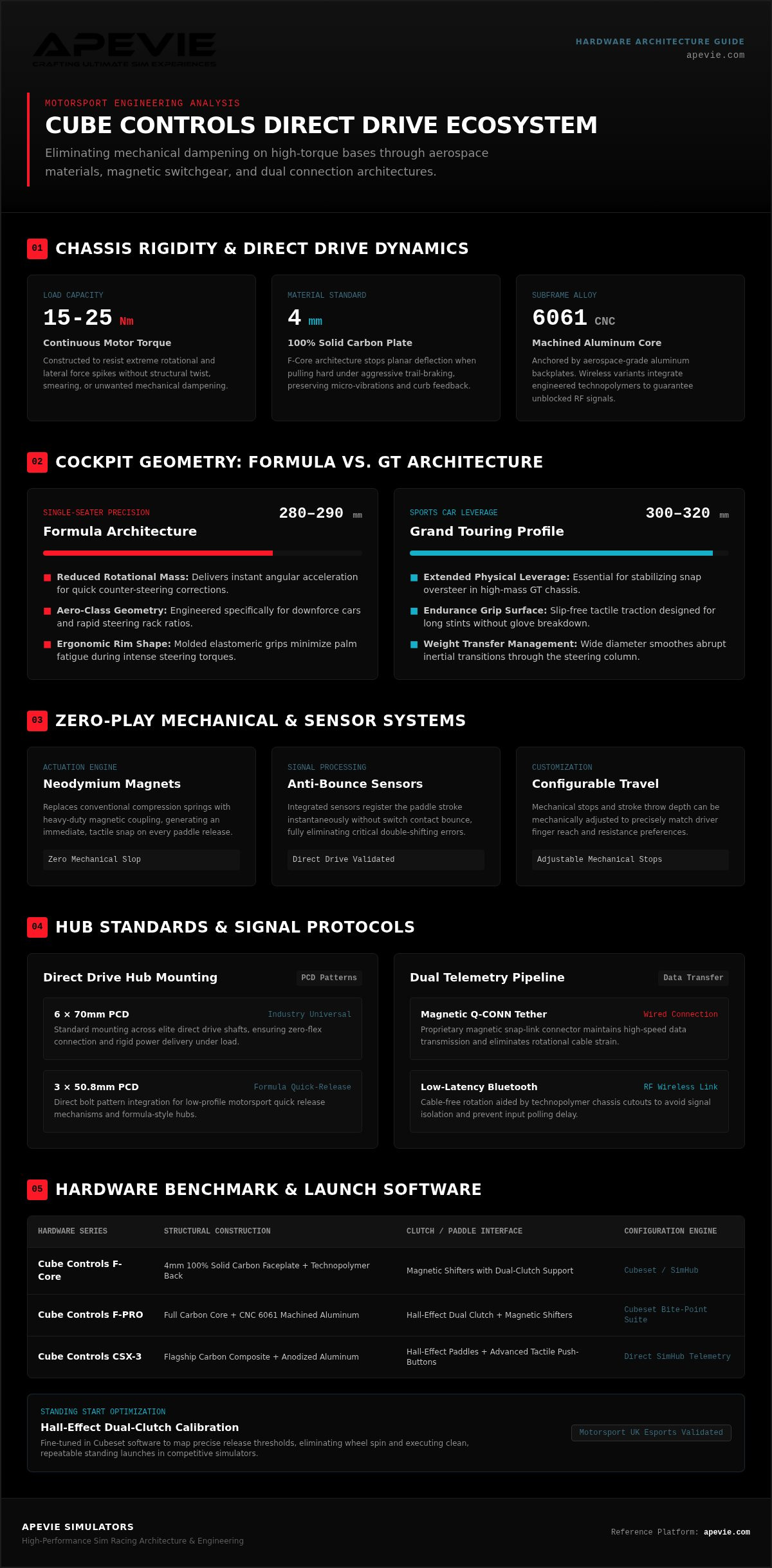
Italian motorsport heritage sits at the center of the brand's design philosophy. A Cube Controls steering wheel isn't constructed like standard consumer sim peripherals; it's engineered to withstand industrial-grade rotational forces. The structural foundation relies on a rigid sandwich design, pairing solid carbon fiber front plates with CNC-machined aluminum rear housings. When intense force feedback spikes pass through the column, inferior plastic or stamped metal frames flex and act as mechanical dampers, absorbing micro-vibrations before they reach your hands. This stiff carbon-aluminum union preserves raw telemetry, allowing you to react faster to sudden loss of grip.
Tactile control layout receives the same structural focus. Custom push-buttons feature measured actuation resistance to prevent accidental thumb triggers during violent curb strikes. To transfer switch telemetry to your PC, the hardware employs dual connectivity paths. Drivers can run a secure wired tether via the proprietary magnetic Q-CONN cable or utilize low-latency wireless Bluetooth. This flexibility ensures stable input polling whether you are pairing the rim with cutting-edge Direct Drive technology or integrating it into an existing modular chassis.
Formula Architecture Versus Grand Touring Ergonomics
Cockpit geometry and car class dictate wheel diameter. Formula-style models feature a compact 280mm to 290mm span, minimizing rotational mass to maximize quick steering corrections in high-downforce single-seaters. Conversely, GT-style profiles expand to 300mm or 320mm outer diameters, providing the physical leverage required to manage weight transfers and catch snap oversteer in heavier sports cars. Both variations utilize hand-molded elastomeric grips designed to reduce palm fatigue and maintain slip-free tactile traction over long endurance stints, even without racing gloves.
The Mechanics of Zero-Play Magnetic Shifters
Missed shifts ruin races, so paddle action must be immediate and definitive. Cube Controls builds its paddle assemblies around heavy-duty neodymium magnets rather than conventional mechanical compression springs. This magnetic coupling delivers a clean, tactile snap upon release, giving the driver undeniable feedback on every gear engagement. Integrated sensors register the stroke without switch bounce, avoiding double-shifting errors. Drivers can also tune stroke depth and mechanical stops to match their finger reach and preferred resistance level.
Evaluating Build Quality: Materials, Rigidity, and Direct Drive Torque
Subjecting a sim wheel to modern direct drive motors that deliver 15Nm to 25Nm of continuous torque instantly exposes any structural weaknesses. If a chassis twists under heavy lateral loading, that torsional deflection acts as an unwanted mechanical damper, smearing peak telemetry forces before they reach your hands. A Cube Controls steering wheel manages these extreme loads by sandwiching high-tensile materials into an unyielding core, an engineering standard validated through real-world competitive benchmarks like the Motorsport UK Esports partnership. You need a setup where every micro-detail transfers cleanly; if you want to understand how baseline frame rigidity complements wheel stiffness, explore complementary engineering standards in our sim rig guide.
Carbon Fiber Weaves Versus Molded Engineering Plastics
Layered carbon fiber construction serves a distinct mechanical purpose beyond aesthetics. For instance, the Cube Controls F-Core employs a 4mm thick 100% carbon fiber front plate that prevents planar deflection when pulling hard against high-torque wheelbases during emergency trail braking. CNC-machined 6061 aluminum backplates anchor the core structure, while targeted technopolymer rear enclosures are utilized on wireless variants to let Bluetooth radio frequencies transmit clearly without metal interference. When matching your rig with high-end controls, you can explore the steering wheel selection to verify which materials balance rigidity and connection styles best for your hub.
Rotary Encoders and Backlit Tactile Switches
Every interface on the faceplate must operate reliably during turbulent force spikes. Front-facing rotary encoders feature heavy mechanical detents that stop accidental value changes when bouncing across aggressive kerbs. Thumb encoders sit alongside the hand grips, letting you fine-tune brake bias and traction control settings mid-corner without lifting your palms. Integrated addressable RGB LEDs provide real-time telemetry alerts, flashing bright visual warnings for ABS engagement, engine RPM thresholds, and yellow flags.
Total Wheel Mass and Rotational Inertia
Excessive mass on the steering shaft dulls motor slew rate, muting sharp road feedback. Cube Controls engineers its rims to minimize unnecessary bulk:
- Sub-1500g Weight Target: Keeps rotational inertia low, ensuring the direct drive motor accelerates and decelerates without resistance from the rim itself.
- Symmetric Mass Distribution: Balances weight across the horizontal axis, preventing the motor from hunting around dead center during high-speed straights.
- Direct Telemetry Transmission: Rigid coupling transfers high-frequency micro-vibrations, giving you immediate notice of understeer.
Ecosystem Compatibility: Direct Drive Mounting and Connection Protocols
Mechanical rigidity means nothing if the interface connecting your wheel to the motor shaft introduces slop or communication lag. Every Cube Controls steering wheel uses standardized mounting patterns, giving drivers the freedom to pair Italian hardware with top-tier industrial direct drive motors. Rather than locking users into a closed ecosystem, the hub design accepts standard 50.8mm three-hole and 70mm six-hole Pitch Circle Diameter (PCD) bolt geometries. Once you match that solid foundation with ultra-precise load cell pedals like those reviewed in our sim pedal guide, your control inputs match the baseline mechanical resolution of a real race car.
Standard 50.8mm vs 70mm PCD Quick Release Systems
Direct drive forces demand quick-release mechanisms that eliminate both axial play and rotational backlash. Simucube SQR hubs attach directly to 50.8mm patterns, while systems from brands like Asetek or universal NRG-style adapters generally require the broader 70mm spread. Bolt depth management is critical here. Using M5 bolts that exceed the specified internal thread depth can bottom out against the wheel's internal electronics casing, risking permanent circuit board damage. Always measure thread engagement before torquing fasteners down. For open-wheel single-seater builds, you can cross-reference specific shaft clearance tips detailed in our F1 steering wheel guide.
USB Coiled Cable Management and Grounding Solutions
Powering complex RGB arrays and transmitting high-frequency input data requires reliable throughput. While Bluetooth handles basic switch data well, demanding setups rely on a coiled USB link anchored by magnetic, self-releasing Q-CONN plugs or industrial aviation-style threaded connectors. These secure couplings prevent catastrophic port failure if the wheel spins freely during a heavy crash. To maintain an uninterrupted data stream across multi-hour endurance sessions, apply these best practices:
- Isolate High-Power Draw: Route your Cube Controls steering wheel into an externally powered USB 3.0 hub rather than unpowered motherboard headers to prevent LED dimming and disconnect loops.
- Ground the Chassis Rig: Tie your aluminum profile frame directly to earth ground to dissipate static buildup from belt drivers, motion actuators, or synthetic carpet.
- Manage Cable Pre-load: Position the coiled cable anchor point centrally above the wheelbase shaft to prevent tension snagging at full steering lock.
Dual-Clutch Systems: Launch Control Calibration and In-Game Setup
Standing starts in competitive multiplayer grids leave zero margin for driver error. A properly dialed Cube Controls steering wheel removes launch inconsistency by taking advantage of frictionless Hall-effect magnetic sensors. Traditional potentiometers degrade over time due to contact wear and dust ingress, causing signal jitter that ruins clutch modulation. Hall sensors read positional data magnetically across a continuous analog sweep, ensuring the physical paddle throw maps identically to the in-game clutch pack every single time.
Master and slave paddle architecture splits clutch engagement into two distinct physical phases. The primary paddle controls the full stroke from complete disengagement to zero, while the slave paddle travel is mechanically or electronically limited to a predefined bite point. When the starting lights go out, dumping the master paddle drops engine revs straight into peak torque without spinning the rear tires or bogging the motor down.
Step-by-Step Dual-Clutch Bite Point Calibration
Dialing in launch mechanics inside titles like iRacing or Assetto Corsa Competizione requires synchronizing hardware calibration with simulator inputs. Follow this routine to establish a baseline bite point:
- Configure Hardware Travel in Cubeset: Open the official configuration tool to ensure both paddle axes register full throw from 0% to 100%.
- Map Combined Axis Mode: Set paddle output to combined single-axis rather than separate independent axes, preventing Windows Game Controllers from registering conflicting analog signals.
- Tune Bite Percentage: Use the dedicated faceplate rotary knob to set your target slip threshold, typically between 45% and 55% depending on tire compound and standing track grip.
- Test Standing Starts: Hold both paddles pinned in gear with full throttle. Release the primary paddle instantly on green, then modulate and feed out the secondary slave paddle smoothly as vehicle speed builds.
If you're upgrading your cockpit controls, you can browse high-performance steering wheels to match your rig with hardware engineered for precision starts.
Alternative Mappings: Handbrake and Throttle Assist Modes
Dual analog paddles aren't limited to standing starts. Through the manufacturer configuration utility, you can decouple the paddles into separate independent axes. Rallycross and drift racers frequently remap the lower left paddle to act as a progressive handbrake axis, giving precise slip-angle modulation without mounting a separate hydraulic handbrake assembly. For drivers with lower-body mobility considerations, assigning the analog paddles to primary throttle and brake control provides immediate, highly granular track inputs without requiring traditional pedal floor boxes.
Selecting Your Ideal Rim: Buying Decision Framework and Elite Alternatives
Selecting a Cube Controls steering wheel requires evaluating how wheel geometry matches the vehicles you drive most often. A lightweight, compact formula rim behaves entirely differently than a 320mm GT rim when fighting aggressive curb oscillation. Rotational diameter directly impacts your physical leverage and the rotational velocity required to catch sudden slides. To balance ergonomic comfort with pure input fidelity, browse our curated hardware lineup and explore performance steering wheels designed for modern direct drive cockpits.
Matching Wheel Geometry to Your Primary Racing Class
Every motorsport class imposes unique mechanical demands on the driver. Matching the chassis shape to your preferred discipline ensures you won't fight fatigue during multi-stint endurance events:
- Formula and Prototypes (280mm to 290mm): Compact butterfly rims minimize rotational mass, delivering instantaneous direction changes and immediate tactile feedback. Thumb encoders and rotary dials sit within immediate finger reach, letting you trim differential and brake bias maps without shifting hand placement.
- GT3 and Touring Cars (300mm to 320mm): Larger D-shaped or flat-bottom rims offer additional counter-steer leverage. This extra diameter dampens violent chassis snap over kerbs, providing smoother steering traces in heavier, front-engine race cars.
- Hybrid Ergonomics: If you split time equally between GT3 and formula grids, a 300mm open-wheel rim provides a balanced compromise between rapid turn-in speed and steady mechanical leverage.
Turnkey Integration and Rig Compatibility with Apevie Simulators
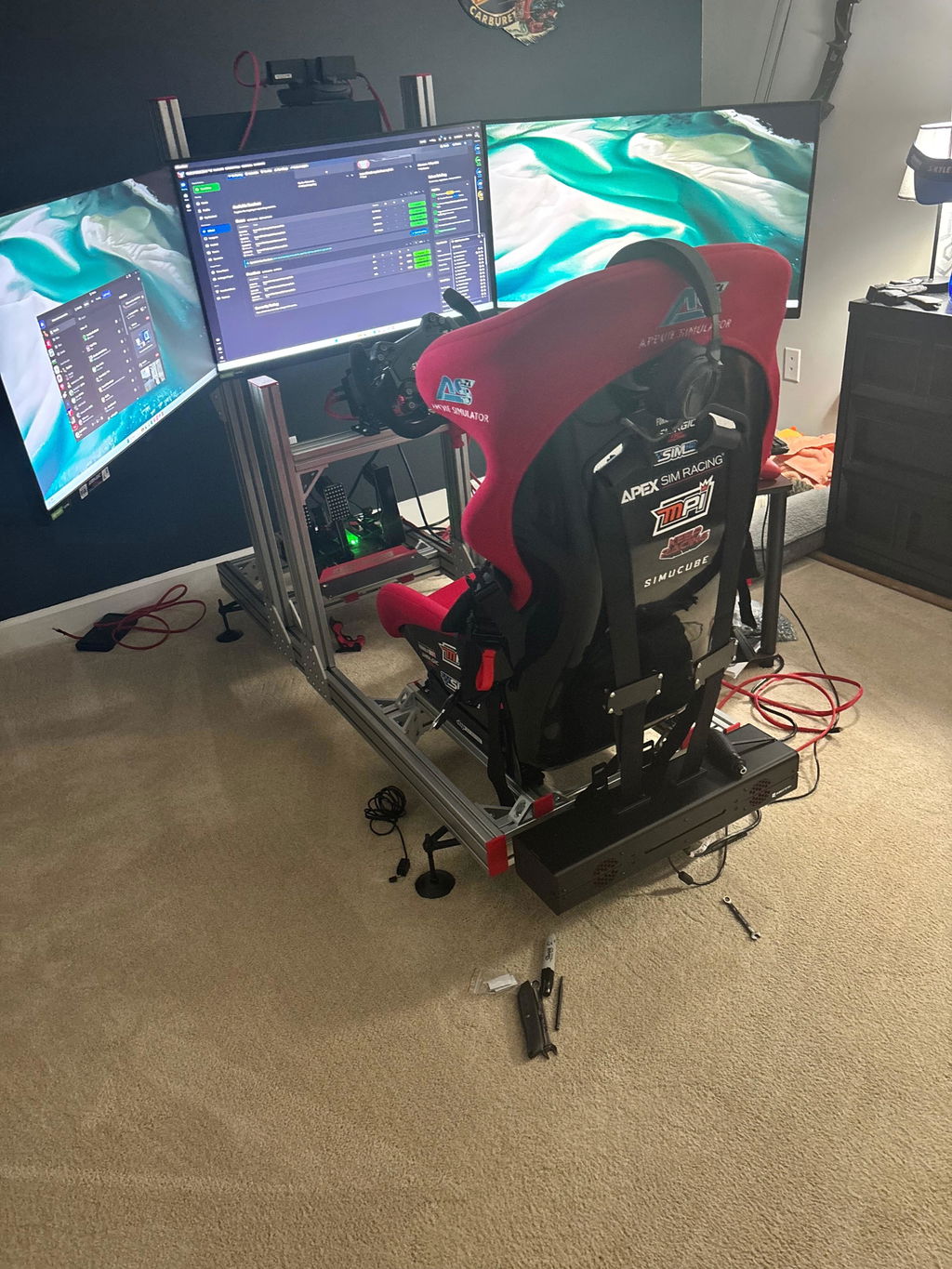
Even the finest sim hardware falls short if bolted to an unstable cockpit or coupled with poorly matched quick releases. Apevie Simulators engineers custom high-performance turnkey simulators nationwide, ensuring high-torque direct drive bases deliver maximum fidelity without structural chassis flex. Integrating a Cube Controls steering wheel or alternatives like the Gomez Sim Industries (GSI) Formula Pro Elite onto direct drive shafts requires tight manufacturing tolerances, robust quick-release pairings, and meticulous driver configuration.
Our specialists take the guesswork out of simulator architecture. We calibrate telemetry mappings, validate USB grounding paths, and tune dual-clutch bite profiles for repeatable performance on day one. Whether you are assembling a ground-up rig or refining your direct drive wheelbase, connect with specialists to upgrade your simulator steering setup with white-glove precision.
Dial In Your Direct Drive Setup for Peak Performance
Selecting the right rim transforms your driving precision. By matching wheel diameter to your primary motorsport class, configuring Hall-effect dual clutches for repeatable race starts, and relying on rigid carbon-aluminum plates, you prevent high-torque motor feedback from getting lost in chassis flex. A properly mounted Cube Controls steering wheel delivers unfiltered telemetry directly to your palms, giving you the tactile resolution needed to push deeper into braking zones.
Achieving that mechanical synergy requires seamless pairing between your rim, quick release, and cockpit foundation. Apevie Simulators eliminates setup friction through professional hardware testing across industry-leading direct drive bases, nationwide hardware delivery, and custom turnkey simulator builds engineered with zero structural flex. Whether you're refining quick-release tolerances or planning a ground-up pro cockpit build, upgrade your racing cockpit with premium steering wheels at Apevie Simulators and take the track with complete confidence.
Frequently Asked Questions
Can I use a Cube Controls steering wheel on any direct drive wheelbase?
Yes, as long as your wheelbase or quick-release hub accommodates standard 50.8mm three-hole or 70mm six-hole PCD bolt patterns. Systems from Simucube, Asetek, and VRS mount directly or via simple hub adapters. For wheelbases with proprietary shaft designs, you'll need a compatible conversion hub to bridge the mechanical bolt pattern and pass the USB data connection to your PC.
Do Cube Controls wheels work on PlayStation or Xbox consoles?
No, Cube Controls hardware is engineered strictly for PC simulation platforms. Console ecosystems require proprietary security chips built into the hardware architecture. Because the brand focuses purely on competitive PC simulation titles like iRacing and rFactor 2, its firmware communicates through standard Windows USB and Bluetooth HID interfaces rather than closed console protocols.
What is the main advantage of magnetic paddle shifters over standard mechanical switches?
Magnetic assemblies replace traditional coil compression springs with paired neodymium magnets to eliminate mechanical slop and mushy actuation. Instead of a gradual spring ramp, the magnetic force holds until the paddle reaches its sudden breakaway point. This design delivers a crisp, tactile snap and rapid return action, which prevents double-shifting and missed gears during aggressive downshifts.
How does the dual-clutch bite point system improve standing race starts?
Dual-clutch architecture splits clutch release into two manageable physical actions, eliminating initial wheelspin and engine bogging off the line. Releasing the primary launch paddle dumps the clutch to your pre-calibrated friction threshold instantly. From there, you feed out the secondary slave paddle gradually as the tires hook up, ensuring repeatable, rapid standing starts across changing track temperatures.
Is a wireless steering wheel as reliable as a coiled USB connection during competition?
Modern Bluetooth connectivity provides stable polling for standard push-buttons and rotary encoders, but wired links remain superior for maximum data bandwidth. High-intensity telemetry backlights and LCD display screens require consistent power that batteries can't sustain over long sessions. A magnetic USB connection also eliminates the risk of local radio frequency interference during critical endurance stints.
How do I choose between a 280mm formula wheel and a 320mm GT wheel?
Base your decision on the steering ratio, vehicle weight, and steering rack speed of your primary car class. A 280mm rim minimizes rotational mass, allowing the lightning-fast directional changes required in high-downforce single-seaters. A 320mm rim provides the extra physical leverage needed to smooth out kerb strikes and catch snap oversteer in heavier GT3 and touring cars.
What maintenance is required to preserve elastomer and suede wheel grips?
Maintenance depends directly on your grip material. For the molded elastomer grips found on a Cube Controls steering wheel, wipe the contact surfaces with a microfiber cloth lightly dampened with warm water. For suede or Alcantara finishes, always race with gloves to prevent natural hand oils from matting the fibers, and gently brush the pile regularly using a dry suede brush.