Custom Racing Simulator Guide: Engineering the Ultimate Professional Rig in 2026
Why does a premium sim setup often feel like a sophisticated toy rather than a precision motorsport tool when you finally sit in the cockpit? You've likely experienced the frustration of a brake pedal that flexes just enough to ruin your muscle memory, or force feedback that muddies the fine details during a critical qualifying lap in iRacing 2026 Season 2. These inconsistencies break the immersion and separate a generic gaming setup from a true professional-grade system. If you're building a custom racing simulator, you aren't just buying parts; you're engineering an ecosystem where every connection must be as rigid as the chassis itself.
We understand that your goal is a turnkey solution that works perfectly from the moment you power it on. In this guide, we'll show you how to architect a bespoke, high-performance racing ecosystem that transcends consumer-grade bundles for true motorsport fidelity. We'll examine the technical synergy between components like Simucube 3 wheel bases and Heusinkveld Sim Pedals Ultimate+ to ensure zero-flex stability and detailed haptic feedback. If you prefer a professional touch, Apevie Simulator offers white-glove installation to ensure these high-end components are calibrated for peak performance. We'll provide a clear framework for selecting the right direct drive technology and motion systems, such as the Sigma Integrale DK2+, to create a rig that matches the physics of Assetto Corsa EVO.
Key Takeaways
- Identify the technical benchmarks for torque fidelity and why moving beyond consumer-grade wheelbases to the Simucube 3 series is essential for professional simulation.
- Learn to evaluate chassis structural resonance and why high-grade aluminum extrusion is the only viable foundation for a high-performance custom racing simulator with integrated motion.
- Compare modern display strategies, including the visual advantages of triple 4K monitors versus the simplified footprint of 2026 ultrawide curved OLEDs.
- Discover why the final "10 percent" of software tuning and driver-specific calibration often determines whether a rig feels like a tool or a toy.
- Explore the benefits of a turnkey solution, including professional floor reinforcement and expert hardware integration provided by white-glove installation services.
Defining the Custom Racing Simulator Ecosystem
Professional simulation in 2026 has moved far beyond the era of simple gaming peripherals. When we discuss a custom racing simulator, we're describing a unified engineering project where every component is selected for its specific mechanical properties and data fidelity. Unlike consumer setups that prioritize retail convenience and low shipping costs, a bespoke rig focuses on the purity of the feedback loop between the car's physics and the driver's nervous system. This ecosystem approach ensures your hardware doesn't just look the part but actually functions as a cohesive tool for performance. It's about creating a space where the digital and physical worlds meet without the lag or flex that plagues entry-level gear.
The modern sim racing landscape requires an open ecosystem. Closed platforms often lock you into a single brand's ecosystem, which can be disastrous when a superior pedal set or steering wheel enters the market. A truly professional build allows you to mix a Simucube 3 wheel base with Heusinkveld pedals and a Gomez Sim Industries (GSI) steering wheel. This modularity isn't just about preference; it's about future-proofing your investment against the rapid technological shifts we're seeing in 2026.
Bespoke vs. Off-the-Shelf Bundles
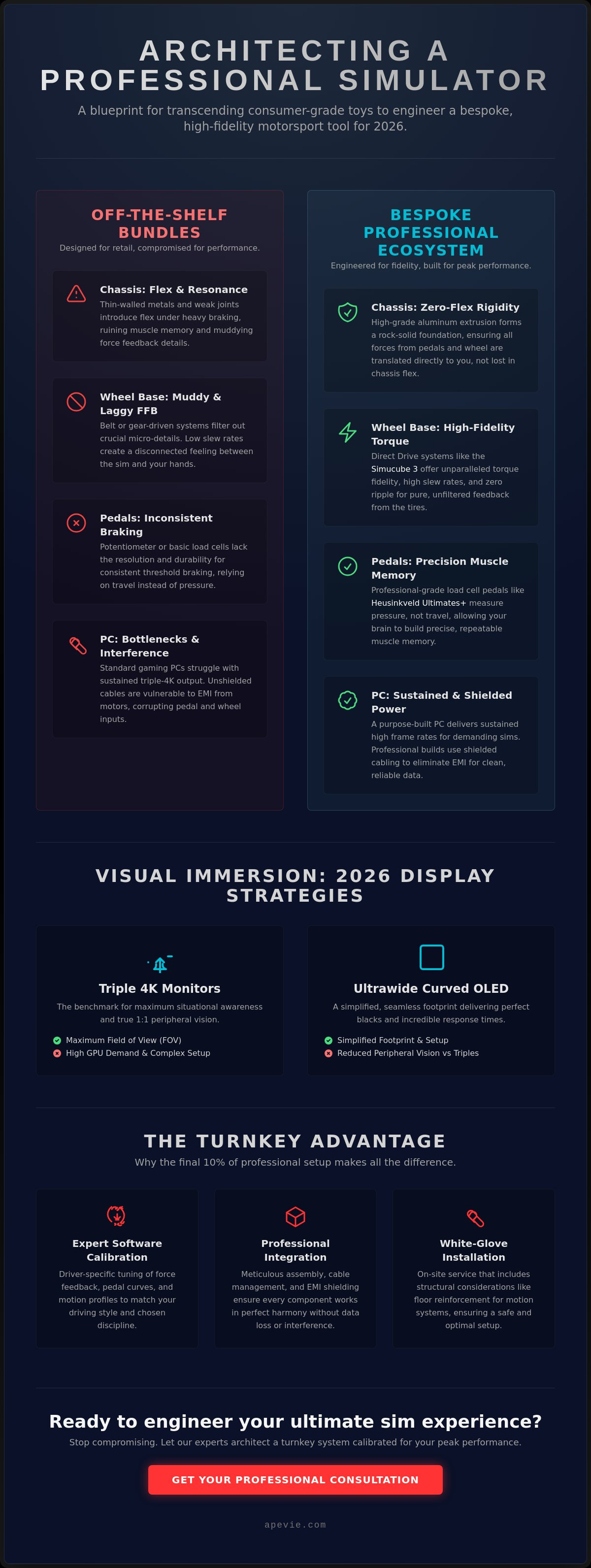
Most off-the-shelf bundles compromise on the components that matter most to a serious driver. You'll often find a high-torque motor paired with a mediocre power supply that clips under heavy load, or pedals that lack the structural integrity to handle consistent, high-pressure braking. These kits are designed for the average consumer, not the enthusiast seeking millisecond precision. By selecting individual, best-in-class components, you eliminate these weak links. Custom builds also address the specific ergonomic needs of the driver. A rally enthusiast requires a different handbrake throw and steering ratio than a driver focused on the reclined, high-G environment of a formula-style cockpit. Apevie Simulator specializes in these tailored configurations, ensuring the hardware matches your chosen discipline perfectly.
The PC Foundation for 2026 Simulations
The PC is the central nervous system of your rig. For 2026 simulations like Assetto Corsa EVO or the latest iRacing updates, the computing requirements are immense. Running triple 4K monitors or high-fidelity VR headsets requires sustained GPU performance that standard gaming PCs can't maintain over long endurance stints. Beyond raw frames per second, we must also manage electromagnetic interference (EMI). High-torque direct drive motors create significant electrical noise that can interfere with delicate load cell pedal signals or USB connections. A professional build manages these invisible forces through shielded cabling and dedicated grounding. This attention to detail ensures your inputs remain crisp and your feedback stays detailed, even when the motor is working at its 30 Nm limit.
The Pillars of Professional Hardware Selection
Building a high-fidelity custom racing simulator requires a move away from consumer-grade compromises. While entry-level gear focuses on compatibility and price points, professional hardware prioritizes signal purity and mechanical precision. In a world where milliseconds define the gap between a podium finish and a mid-pack result, the hardware must act as a transparent conduit for data. This is why serious builds avoid console-specific peripherals; the extra processing layers required for console handshakes often introduce unwanted latency and filter out the micro-vibrations essential for feeling the limit of grip. To achieve the level of detail found in a professional-grade simulator, every input device must be engineered for high-resolution data transmission.
Direct Drive Wheel Bases: The Heart of Feedback
The Simucube 3 series has established itself as the 2026 benchmark for torque fidelity. When comparing the Simucube 2 Pro to the newer Simucube 3, the difference isn't just about raw peak torque. Professional drivers look for high slew rates and minimal torque ripple. Slew rate determines how quickly the motor can change its output force. A high slew rate allows you to feel the instant a tire loses traction or the sharp snap of a curb. If the motor is too slow, the feedback feels "rubbery" and disconnected. High-bandwidth communication ensures that the simulation software's physics engine translates directly to your hands without the smoothing filters found in cheaper wheel bases.
Pedals and Muscle Memory Consistency
Braking is where most lap time is found, making the pedal set the most critical component for consistency. The Heusinkveld Sim Pedals Ultimate+ remain a favorite for their industrial-grade construction and high-resolution load cells. Unlike budget pedals that measure how far you've pushed the lever, load cell technology measures the actual pressure applied. This mimics the hydraulic system of a real race car, allowing your brain to develop deep muscle memory for trail braking. For this to work, you need a zero-flex pedal plate. Even a millimeter of flex in the mounting surface can ruin the calibration accuracy and confuse your tactile senses. If you're unsure which pedal resistance suits your driving style, consulting with experts at Apex Sim Racing can help you find the right elastomer stack for your needs.
Steering wheel architecture also plays a vital role in ergonomics and tactile response. Gomez Sim Industries (GSI) wheels, like the Formula Pro Elite, are known for their rigid, heavy-duty construction that provides a very direct connection to the motor. In contrast, Cube Controls wheels such as the F-Core offer a more lightweight, delicate touch that some drivers prefer for high-precision formula racing. This focus on high-resolution feedback and precision is a standard shared by other technical fields; for example, researchers looking to explore Cube II Benchtop SEM from Electron Optics Instruments, LLC utilize similar engineering principles to achieve microscopic clarity. Both brands use automotive-grade switches and encoders, ensuring that every shift and setting change is confirmed with a crisp, mechanical click that leaves no room for doubt during a high-stress race.
Engineering Rigidity and Motion: Why the Chassis Matters
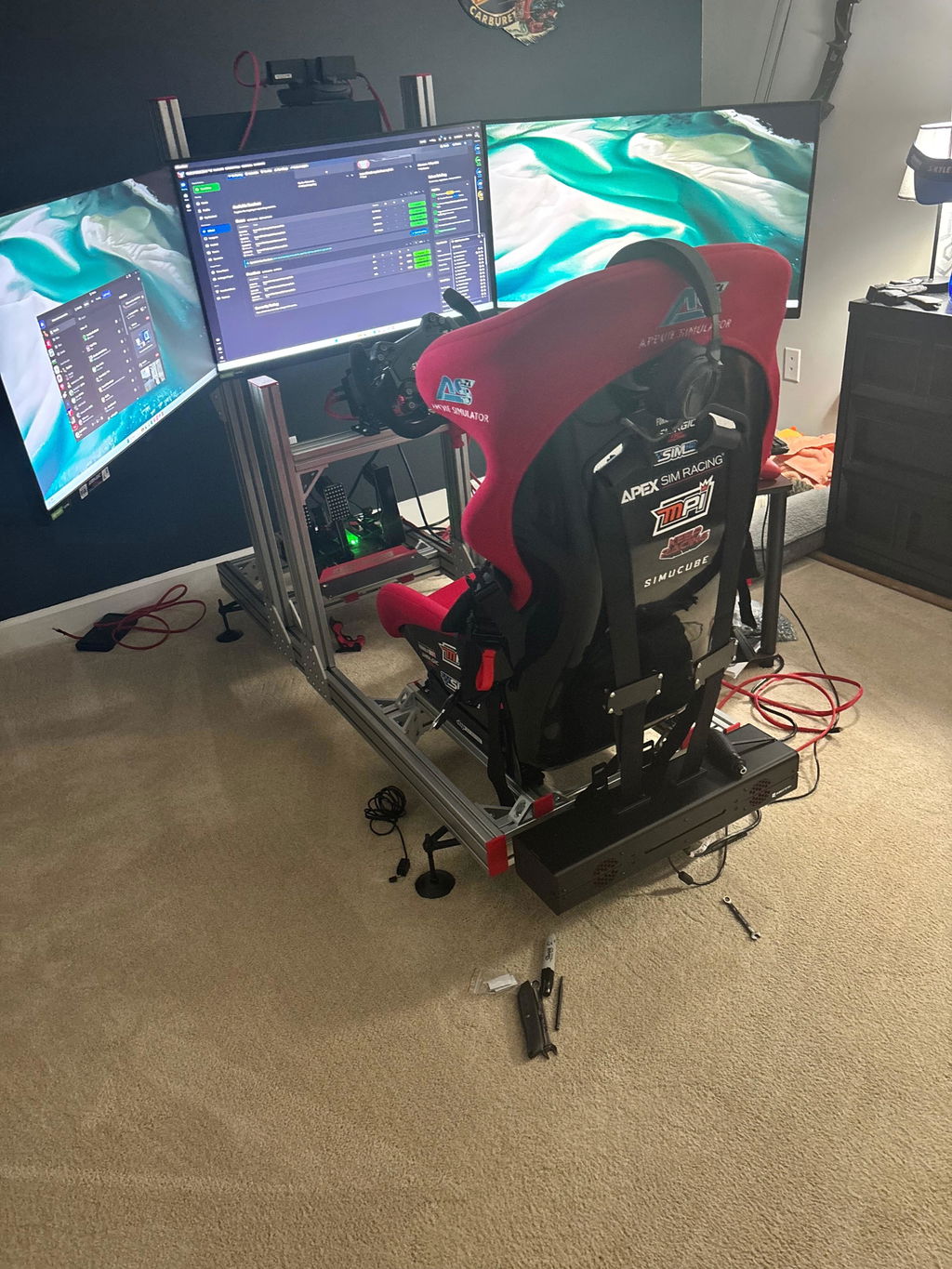
The chassis serves as the skeletal foundation of your custom racing simulator. If you've invested in a high-torque Simucube 3, mounting it to a flexible frame is a mistake that compromises the entire ecosystem. Every Newton-meter of torque that causes the frame to twist is feedback that never reaches your hands. While some manufacturers promote tubular steel for its aesthetic appeal, these frames often lack the modularity required for a truly professional build. In 2026, the industry standard has shifted toward heavy-duty aluminum extrusion for its unique combination of absolute rigidity and infinite adjustability.
The Aluminum Extrusion Advantage
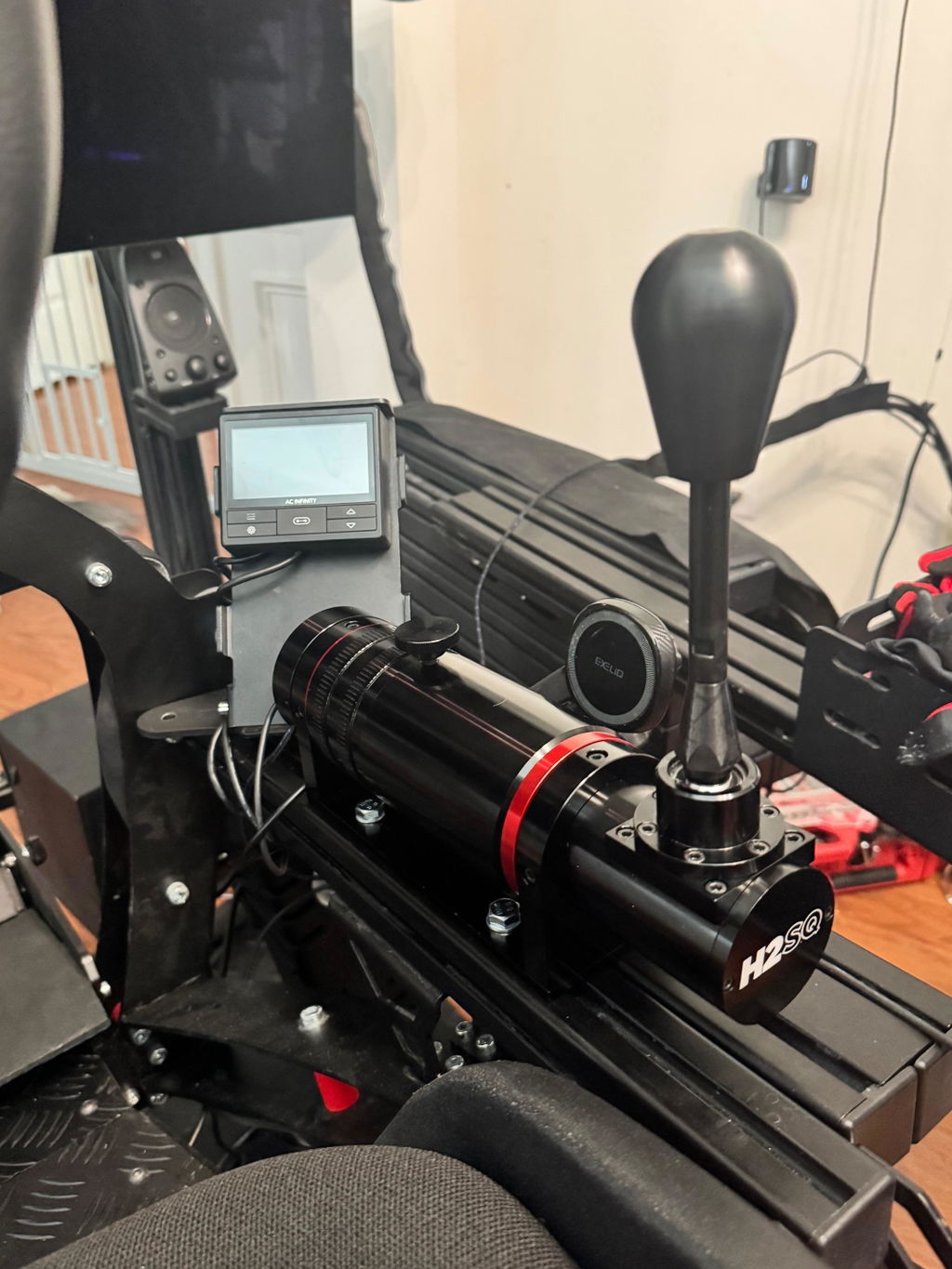
A Sim-Lab P1-X style rig represents the pinnacle of this design philosophy. These aluminum profiles allow you to mount heavy components, such as the Sigma Integrale DK2+ actuators, directly to the main frame without structural compromise. Unlike steel frames that require drilling or welding for new accessories, an extrusion rig uses a T-slot system. This means you can add keyboard trays, sequential shifters, or handbrakes exactly where your ergonomics dictate. Rigidity testing is paramount. A professional wheel deck must handle 25Nm or more of torque without oscillation, ensuring that the micro-vibrations from the physics engine reach your fingertips instead of being absorbed by the metal.
Active Motion and Haptic Feedback
Motion isn't a "ride" feature; it's a spatial awareness tool. Integrating the Sigma Integrale DK2+ motion system provides authentic chassis pitch and roll, allowing your inner ear to detect weight transfer before your eyes see it on the screen. Choosing between the standard DK2 and the DK2+ often comes down to your primary driving discipline. Formula drivers might prefer the tighter, faster response of the DK2, while GT and Rally racers benefit from the increased travel of the DK2+ to simulate elevation changes and rougher terrain. These systems are essential for professional training because they provide the vestibular cues necessary to catch a slide before it becomes a spin.
True immersion also requires high-frequency haptic feedback. While the motion actuators handle the large-scale movements, seat shakers and active belt tensioners communicate the fine details. You'll feel the subtle pulse of the ABS through the chassis and the high-frequency "scrub" of the front tires when you push into understeer. Managing this level of kinetic energy requires careful planning. A full motion platform can weigh several hundred pounds and generate significant vibration. We often recommend floor reinforcement or specialized isolation mounts to protect residential flooring and ensure the energy stays within the rig. This level of engineering ensures that your investment remains a precision tool rather than a source of structural fatigue.
Designing Your Performance Cockpit: Ergonomics and Immersion
The cockpit is where your engineering choices translate into driver performance. A custom racing simulator isn't just a collection of high-end parts; it's a workspace that must be mathematically aligned to your body. The "Golden Triangle," which describes the relationship between your seat, wheel, and pedals, determines your ability to remain consistent over a two-hour stint. If your wheel is too high or your pedals are too close, your brain spends energy managing physical discomfort rather than processing the subtle haptics from the Simucube motor. Professional builds prioritize this alignment to ensure that every input is natural and every output is felt clearly.
Visual Fidelity and Field of View (FOV)
Realism depends on a 1:1 scale representation of the track. If your FOV is incorrect, your perception of speed and braking distances will be distorted. In 2026, the choice between triple 32-inch 4K monitors and the latest ultrawide curved OLED standards is a matter of peripheral vision versus seamless immersion. Triple monitors offer a true 180-degree view, which is essential for side-by-side racing and spotting apexes in tight hairpins. Conversely, the new 57-inch ultrawide OLEDs eliminate bezels and simplify the rig's footprint. VR headsets provide unmatched spatial depth, but they can make it difficult to locate physical button boxes or adjust settings on your GSI wheel mid-race. High refresh rates and G-Sync are non-negotiable for eliminating the micro-stuttering that ruins a precise qualifying lap.
Ergonomic Sustainability for Long Sessions
Professional drivers often prefer FIA-rated GT bucket seats for their lateral support, especially when using high-performance motion systems. Formula-style reclined positions offer a different set of challenges, requiring careful steering column angle adjustment to prevent shoulder fatigue during endurance racing. Your seat material matters as much as its shape. High-intensity haptic feedback and motion generate significant body heat, making breathable fabrics superior to leather for long-term comfort. We also recommend organizing your button box layout for "blind-reach" accessibility. You should be able to adjust your brake bias or traction control by feel alone, without taking your eyes off the track. Integrated surround sound systems can provide better spatial awareness for engine notes and tire scrub, though high-fidelity haptic headphones are an excellent alternative for those in noise-sensitive environments.
If you're ready to design a cockpit that fits your specific needs, we recommend exploring a professional consultation for bespoke simulator builds to ensure every measurement is millimetre-perfect.
The Turnkey Advantage: Professional Calibration and Installation
Owning a collection of high-end parts is fundamentally different from owning a calibrated racing tool. While assembling an aluminum frame and bolting on a wheel base is a rewarding weekend project, the "last 10 percent" of the build defines the entire experience. This final stage involves the meticulous tuning of software filters and hardware offsets to ensure that what you feel in the seat perfectly matches the physics engine's output. For a custom racing simulator to function as a professional training device, the integration between the Simucube 3 motor and the latest 2026 physics models must be seamless. Without this expert calibration, even the most expensive rig can feel like a disconnected series of vibrations rather than a cohesive vehicle.
Expert Software Integration and Tuning
The complexity of modern simulation software requires a deep understanding of signal processing. Tools like Simucube True Drive and Heusinkveld SmartControl offer hundreds of adjustment combinations. Finding the right balance of damping, friction, and inertia for a specific GT3 car versus a high-downforce Formula car is a science. In a professional build, we create driver-specific profiles that eliminate the need for constant tinkering. Managing software updates and firmware conflicts across multiple brands is often the most time-consuming part of DIY ownership. A turnkey solution from ProSimu or Apevie Simulator includes professional diagnosis and remote support, ensuring high uptime for competitive seasons. You can find a detailed breakdown of these requirements in our 2026 Turnkey Racing Simulator Checklist.
The White-Glove Installation Process
For corporate clients and high-end residential installations, the aesthetic of the rig is just as important as its performance. Apevie Simulator provides a white-glove service that covers every detail, from floor reinforcement for heavy motion platforms to surgical-grade cable management. This process ensures that your simulator isn't a messy web of USB cables but a clean, professional installation that complements its environment. Beyond the physical setup, we include initial driver coaching to ensure you are fast from your very first lap. We calibrate the pedals to your specific leg strength and set the field of view to your exact eye level, removing the steep learning curve usually associated with new hardware.
Choosing a turnkey build means bypassing the hidden costs of troubleshooting multi-brand hardware. Instead of spending weeks chasing driver conflicts or electromagnetic interference issues, you receive a system that is ready for the 2026 Esports World Cup registration. Whether you need a rig for professional training or a high-performance home ecosystem, Apevie Simulator offers the expertise to deliver a finished product that exceeds expectations. Contact Apevie Simulator today for a professional consultation on your next turnkey build, high-end components, or professional installation service.
Mastering the Future of Digital Motorsport
Engineering a custom racing simulator in 2026 is no longer about simply finding the most expensive parts; it's about the deliberate integration of high-fidelity components into a stable, zero-flex environment. We've explored how the mechanical synergy between a Simucube 3 wheel base and a Sigma Integrale motion system creates a sensory loop that mimics real-world physics. A truly professional rig requires more than just high torque. It demands the structural rigidity of a heavy-duty aluminum extrusion chassis and the mathematical precision of a 1:1 field of view to ensure your muscle memory translates perfectly to the track.
As an authorized Simucube and Heusinkveld partner, Apevie Simulator provides the expert motorsport-grade engineering needed to bridge the gap between simulation and reality. Our white-glove national installation service ensures that every component is calibrated to your specific physiological needs, from pedal pressure to steering column alignment. Don't leave your performance to chance or struggle with complex software conflicts alone. Our turnkey solutions are designed to work flawlessly from the first time you press the ignition.
Request a Professional Consultation for Your Custom Turnkey Build and start your journey toward a flawless, high-performance racing experience. We're ready to help you build the ultimate cockpit.
Frequently Asked Questions
What is the difference between a custom racing simulator and a pre-built gaming rig?
A custom racing simulator is a tailored motorsport tool where every component is selected for specific mechanical properties, whereas a pre-built gaming rig often prioritizes retail convenience and cost-cutting. Bespoke builds allow for the integration of professional-grade hardware like GSI steering wheels and load cell pedals without the limitations of a closed ecosystem. This approach ensures that your rig is rigid enough to handle 25 Nm of torque and provides the specific ergonomics required for your chosen racing discipline.
How much space do I need for a full-motion custom racing simulator?
A full-motion simulator requires a dedicated footprint of approximately 2 meters in length and 1.5 meters in width to accommodate the movement of the actuators. You must also account for a safety clearance zone of at least 30 centimeters around the rig to prevent collisions with walls or furniture during intense pitch and roll maneuvers. If you're using a Sigma Integrale DK2+ system, ensure the flooring is reinforced and level to handle the dynamic weight shifts during high-G cornering.
Can I use a custom racing simulator with a console like PS5 or Xbox?
Professional-grade simulators are designed exclusively for PC to maintain signal purity and high-bandwidth communication with physics engines. While some entry-level wheel bases offer console compatibility, high-end hardware like the Simucube 3 or Heusinkveld Ultimate+ pedals requires the dedicated processing power and driver support found only on Windows. Using a console often introduces unwanted signal filtering and latency that masks the fine details essential for professional-level training and competitive sim racing.
Which is better for a custom build: triple monitors or a VR headset?
Triple 32-inch 4K monitors are the standard for competitive racing because they provide a true 180-degree field of view and easy access to physical button boxes. VR headsets offer superior spatial depth and immersion but can cause fatigue during long endurance stints and make it difficult to interact with your physical cockpit. For most professional builds, triple monitors offer the best balance of visual fidelity, peripheral awareness, and ergonomic sustainability for multi-hour racing sessions.
What maintenance is required for a high-end motion simulator?
Maintenance for a high-end motion platform primarily involves periodic hardware inspections and software management. You should check and tighten the bolts on your aluminum extrusion frame every few months, as the vibrations from haptic systems and motion actuators can cause minor loosening over time. Keeping your firmware and drivers updated for systems like the Sigma Integrale DK2 is also vital to ensure compatibility with the latest 2026 patches in iRacing or Assetto Corsa EVO.
Why do professional sim racers prefer aluminum extrusion rigs?
Professional racers prefer aluminum extrusion rigs because they offer infinite adjustability and absolute structural rigidity. The T-slot system allows you to mount heavy peripherals like sequential shifters or handbrakes at the exact millimeter required for your ergonomics. Unlike tubular steel frames, aluminum profiles don't require drilling for modifications. This modularity makes it the ideal foundation for a custom racing simulator that needs to evolve with new hardware or different driving positions.
How long does a professional turnkey simulator installation take?
A professional turnkey installation typically takes between one and three days depending on the complexity of your configuration. A standard static rig with triple monitors can often be assembled and calibrated in a single day, while a full-motion system with integrated haptics and floor reinforcement requires more extensive testing. This timeframe includes the physical assembly, meticulous cable management, and driver-specific calibration to ensure the system is ready for performance from the moment we leave.