Why Load Cell Pedals are the Ultimate Consistency Hack for Sim Racing (2026 Guide)
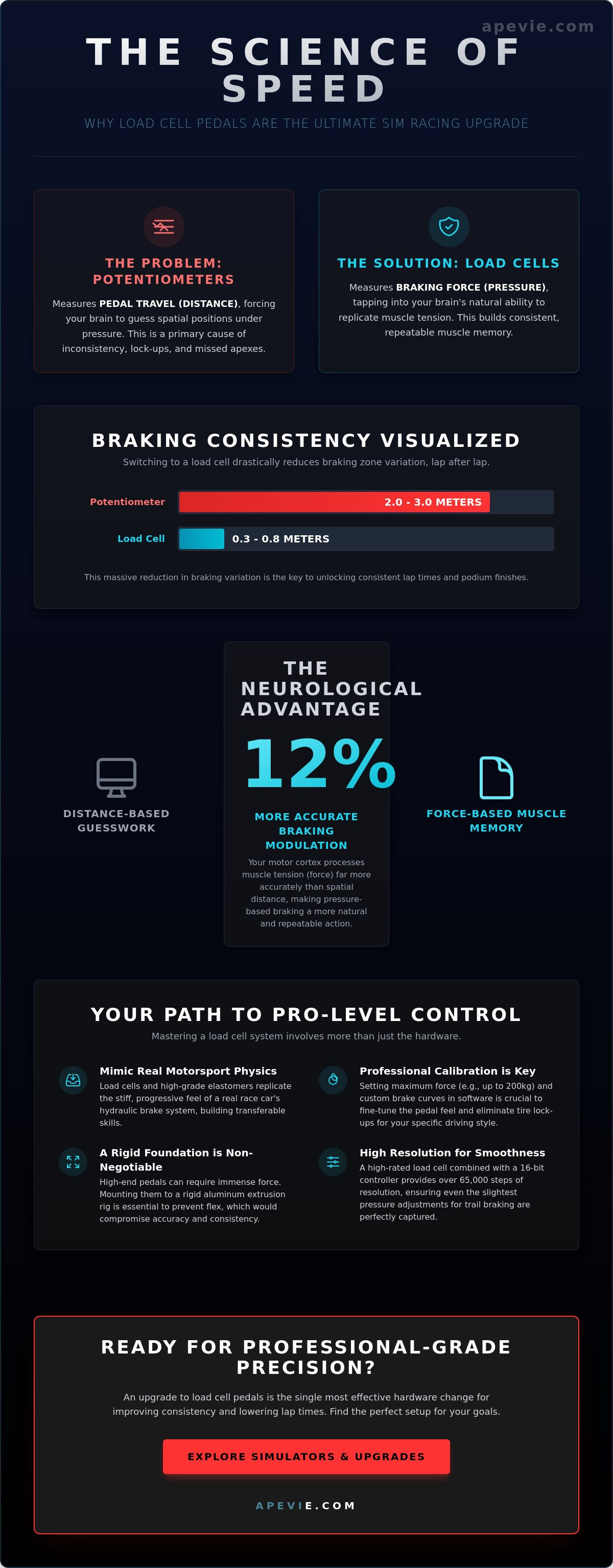
Research indicates that switching from standard potentiometer units to load cell pedals can improve your braking consistency from a variation of 2 to 3 meters down to just 0.3 to 0.8 meters. Most racers struggle with locking up tires or missing apexes because they rely on how far their foot moves, rather than how hard they press. In high-pressure race situations, your brain processes pressure much more accurately than distance. This is why the spongy feel of entry-level gear often leads to mid-race disasters and inconsistent lap times.
You likely already know that hitting your braking marks lap after lap is the difference between a podium finish and a frustrating DNF. This guide explains the physics of pressure-based braking and why this hardware upgrade is the most effective way to slash your lap times. We'll compare professional options like the Heusinkveld Sim Pedals Ultimate+ and the new 2026 Fanatec Podium Pedals to help you identify the best equipment for your specific budget and performance goals. Whether you're looking for a turnkey simulator build or a modular upgrade, understanding this technology is your first step toward professional-grade precision.
Key Takeaways
- Understand why pressure-based braking is 12% more accurate than measuring pedal travel and how it mimics real-world motorsport physics.
- Learn how load cell pedals utilize high-grade elastomers to build the muscle memory required for consistent, high-pressure braking.
- Compare high-performance hardware like the Heusinkveld Sim Pedals Ultimate+ against cutting-edge hydraulic and haptic systems.
- Master professional calibration techniques for setting maximum force and brake curves to eliminate frequent tire lock-ups.
- See why mounting professional hardware to a rigid aluminum extrusion rig is non-negotiable for maintaining accuracy under heavy loads.
The Physics of Braking: Why Potentiometer Pedals Hold You Back
Most entry-level sim gear relies on potentiometers to translate your physical inputs into digital data. These sensors measure the specific distance a pedal travels, meaning the software only cares about how far you've pushed the lever. If your brake has a 50mm throw, your brain must memorize exactly where 42.5mm is to achieve 85% braking force. It's an incredibly difficult spatial task to repeat accurately while you're hurtling toward a hairpin at 200 km/h. This distance-based system is the primary reason many racers struggle with inconsistency; it's simply not how the human body is designed to interact with high-performance machinery.
Travel vs. Pressure: A Mechanical Breakdown
Potentiometers offer a linear output based on rotation or sliding, essentially treating your brake pedal like a volume knob. This is fundamentally different from the hydraulic systems found in real GT3 or Formula cars. In a professional race car, the pedal moves very little once the pads make contact with the rotors. After that initial "bite," stopping power is determined by how hard you squeeze the fluid through the lines. Standard gaming pedals often feel "spongy" because they use light springs that lack the progressive resistance found in professional hardware like the Vesaro simulators we install for our clients.
When you upgrade to load cell pedals, you're moving away from these travel-based limitations. A load cell is a transducer that measures force rather than movement. To understand the technical foundation of this component, you can explore the basics of What is a Load Cell? on Wikipedia. Because these sensors can measure up to 200kg of pressure, they allow for a much stiffer pedal feel that accurately mimics a pressurized hydraulic line, providing the resistance your nervous system needs to gauge deceleration.
The Neurological Advantage of Force-Based Input
The human motor cortex is evolved to track muscle tension with far greater precision than spatial distance. It's much easier for your brain to replicate a specific level of physical exertion than it is to stop your foot at a precise millimeter in mid-air. Muscle memory in threshold braking is the subconscious ability to exert the exact amount of force required to keep tires at the limit of adhesion without triggering ABS or locking up the wheels. Professional drivers don't look at their feet; they rely on the tension in their calf and thigh muscles to find the limit of grip.
This is why racers in iRacing or Assetto Corsa Competizione often experience a breakthrough in performance after switching to load cell pedals. Trail braking requires a smooth, controlled release of the brake as you turn into a corner. With potentiometers, you're trying to modulate a moving distance while your foot is already under strain. With force-based sensors, you're simply relaxing your muscles in a controlled manner. Research suggests that pressure-based inputs allow for 12% more accuracy in braking modulation, turning a guessing game into a repeatable, scientific process that directly translates to faster, safer lap times.
What is a Load Cell? Engineering Consistency for the Sim
A load cell is a transducer that converts mechanical force into a measurable electrical signal. While our previous discussion highlighted why pressure is neurologically superior for braking, the physical engineering of load cell pedals is what makes that biological advantage possible. Unlike a potentiometer that relies on a sliding electrical contact, a load cell uses a strain gauge bonded to a structural metal component. When you press the brake, that metal deforms by a microscopic amount, and the sensor measures the resulting change in electrical resistance. This design is inherently more durable because it eliminates moving electrical parts that typically wear out or become erratic due to dust buildup.
One common misconception involves the "KG" rating of these sensors. You'll often see professional hardware like the Heusinkveld Sim Pedals Ultimate+ featuring a 200kg load cell. This doesn't mean you must exert 440 pounds of force to stop the car. Instead, a higher rating provides a larger window for the high-resolution controller, often 16-bit, to translate your input. A 16-bit controller offers 65,536 discrete steps of resolution. This allows for incredibly smooth braking telemetry in simulators like Assetto Corsa, ensuring that even the slightest relaxation of your foot during trail braking is captured with scientific precision.
Inside the Sensor: How Load Cells Work
The core of the system is the strain gauge. These are small, delicate circuits that detect the deformation of the pedal arm or sensor housing. Because the metal only bends a fraction of a millimeter, the signal remains consistent over years of heavy use. Premium manufacturers use CNC-machined aluminum to house these sensors. This rigidity is vital; any flex in the pedal assembly itself would absorb the force you're applying, muddying the data sent to the PC. To understand the technical foundation of this component, you can explore the basics of What is a Load Cell? on Wikipedia. If you're planning a high-end build, our team at Apevie Simulators can help you select a pedal set that matches your specific ergonomic requirements.
Elastomers and Pre-load: Tuning the Physical Feel
While the load cell handles the data, elastomers and springs define the "feel." Elastomers are rubber-like components rated by "Shore hardness." A higher Shore rating creates a stiffer, "Formula-style" pedal, while softer elastomers better replicate a GT3 car's braking system. By swapping these inserts, you can customize the progressive resistance of the pedal.
Many professional sets also include a pre-load spring. This small spring compresses before the elastomers, simulating the "gap" where the brake pads haven't yet touched the rotors. This two-stage feel is essential for immersion. It allows you to feel exactly when the "bite point" occurs, which is the moment you transition from taking up the slack to actually decelerating the vehicle. This physical feedback loop is why hardware from brands like Pro-Sim is favored by professional drivers for home training rigs.
Load Cell vs. Hydraulic vs. ActivePedals: Choosing Your Feel
Choosing the right pedal technology is about balancing immersion, maintenance, and raw performance. While load cell pedals like the Heusinkveld Sim Pedals Sprint are the industry standard for serious enthusiasts, the high-end market has expanded to include hydraulic and fully motorized systems. Most professional sim racers prefer high-end load cells because they offer a consistent, maintenance-free experience that doesn't sacrifice performance. You get 95% of the realism without the complexity of automotive fluids or specialized software-driven actuators.
Hydraulic Pedals: The Ultimate in Realism?
Hydraulic systems use a master cylinder to push fluid through lines to a slave cylinder, exactly like a real GT3 car. This creates a unique, non-compressible feel that elastomers struggle to replicate perfectly. Brands like Pro-Sim and the integrated solutions from Vesaro are the gold standard for this technology. However, hydraulics carry the risk of leaks over time and require periodic bleeding to keep the pedal from feeling "soft." For many, the minor gains in realism aren't worth the potential for a fluid spill on their carpet.
ActivePedals: The Future of Force Feedback
The Simucube ActivePedal has redefined what's possible by replacing all physical springs and elastomers with a software-controlled actuator. This allows you to customize the pedal's travel, stiffness, and "bite point" instantly via a digital interface. Beyond just feeling like a brake, it provides active haptic feedback. You'll feel the distinct pulse of ABS or the vibration of traction control directly through the sole of your shoe. It's the current pinnacle of simulation hardware, offering a "one-pedal" solution that can mimic any car on the grid without you ever picking up a wrench.
For most buyers, the decision comes down to your rig's purpose. If you want a reliable, "set-it-and-forget-it" tool that will reliably shave tenths off your lap times, premium load cell pedals are the logical choice. They provide the necessary pressure-based feedback without the high price tag or maintenance schedule of more exotic systems. If you're building a world-class simulator where budget is secondary to total immersion, the ActivePedal is the only way to experience the full spectrum of modern racing telemetry.
Setting Up for Success: Calibration and Deadzones
Setting up load cell pedals is where the precision of your hardware meets the unique physiology of your body. Most racers make the mistake of calibrating their maximum brake force to 100% of their physical strength. While this feels realistic for a few laps, it leads to fatigue and inconsistent pressure during an hour-long endurance stint. You should aim for a "comfortable maximum" where you can hit 100% braking force repeatedly without straining your quad or glute muscles. Setting your software limit to about 80% of your total leg power usually provides the best balance of feel and longevity.
Adjusting your brake curve is the next step in refining your performance. For cars without ABS, such as high-downforce Formula classes, a linear curve is usually best because it provides a 1:1 relationship between pressure and braking force. However, in GT3 cars, many drivers prefer a "Gamma" curve. This adds more resolution at the lower end of the pedal travel, making it much easier to manage trail braking as you bleed off the brakes toward the apex. It helps prevent those frustrating mid-corner lock-ups that ruin your tires and your lap time.
Don't ignore the importance of a top-end deadzone. Setting a 1% to 2% deadzone ensures that the weight of your foot resting on the pedal doesn't accidentally trigger the brakes. Even a tiny amount of "brake dragging" on a straight can cost you several tenths of a second per lap and overheat your virtual rotors. It's a simple software tweak that eliminates a common source of hidden time loss.
Ergonomics are the final, and perhaps most critical, piece of the puzzle. "Sim racer's knee" is a common injury caused by poor pedal alignment. If your seat is too low or your pedal plate is too flat, your ankle remains in a state of constant overextension. This not only causes physical pain but also makes it harder to modulate pressure accurately. Proper alignment ensures that your leg moves in a natural, powerful arc, allowing for the muscle memory we discussed in earlier sections to truly take over.
Step-by-Step Software Calibration
Use professional software like Heusinkveld SmartControl or DIView to monitor your raw inputs. Ensure your zero-point is rock-solid; if the signal flickers when you aren't touching the pedal, you have "signal noise" that needs to be tuned out with a deadzone. Calibrate the end-point so that your maximum comfortable leg extension equals 100% in-game force. This digital handshake between your foot and the simulator is what makes load cell pedals so much more effective than standard gear.
Physical Adjustments for Performance
Adjust the lateral spacing of your pedals to facilitate heel-and-toe downshifting if you're using a manual gearbox. The angle of your pedal face directly determines the mechanical leverage your leg can apply to the sensor, significantly impacting how easily you can hit your maximum braking targets. Finally, check your throttle; increasing the return spring tension can provide better resistance for fine-tuned corner exit control, preventing power-on oversteer in high-torque cars.
If you want a perfectly tuned cockpit without the trial and error, our team at Apevie Simulators offers expert consultation and turnkey calibration services.
Professional Integration: Why High-End Pedals Demand a Rigid Foundation
Integrating high-performance load cell pedals into your setup is only half the battle. Newton's third law states that for every action, there's an equal and opposite reaction. When you exert 80kg of pressure onto a brake pedal, that force doesn't just disappear into the sensor; it pushes back against your body and your rig. If you're using a rolling office chair or a flimsy wheel stand, you'll find yourself sliding away from your monitors long before you reach maximum braking force. This physical instability makes the neurological benefits of pressure-based braking impossible to realize because your brain is subconsciously compensating for the movement of your seat.
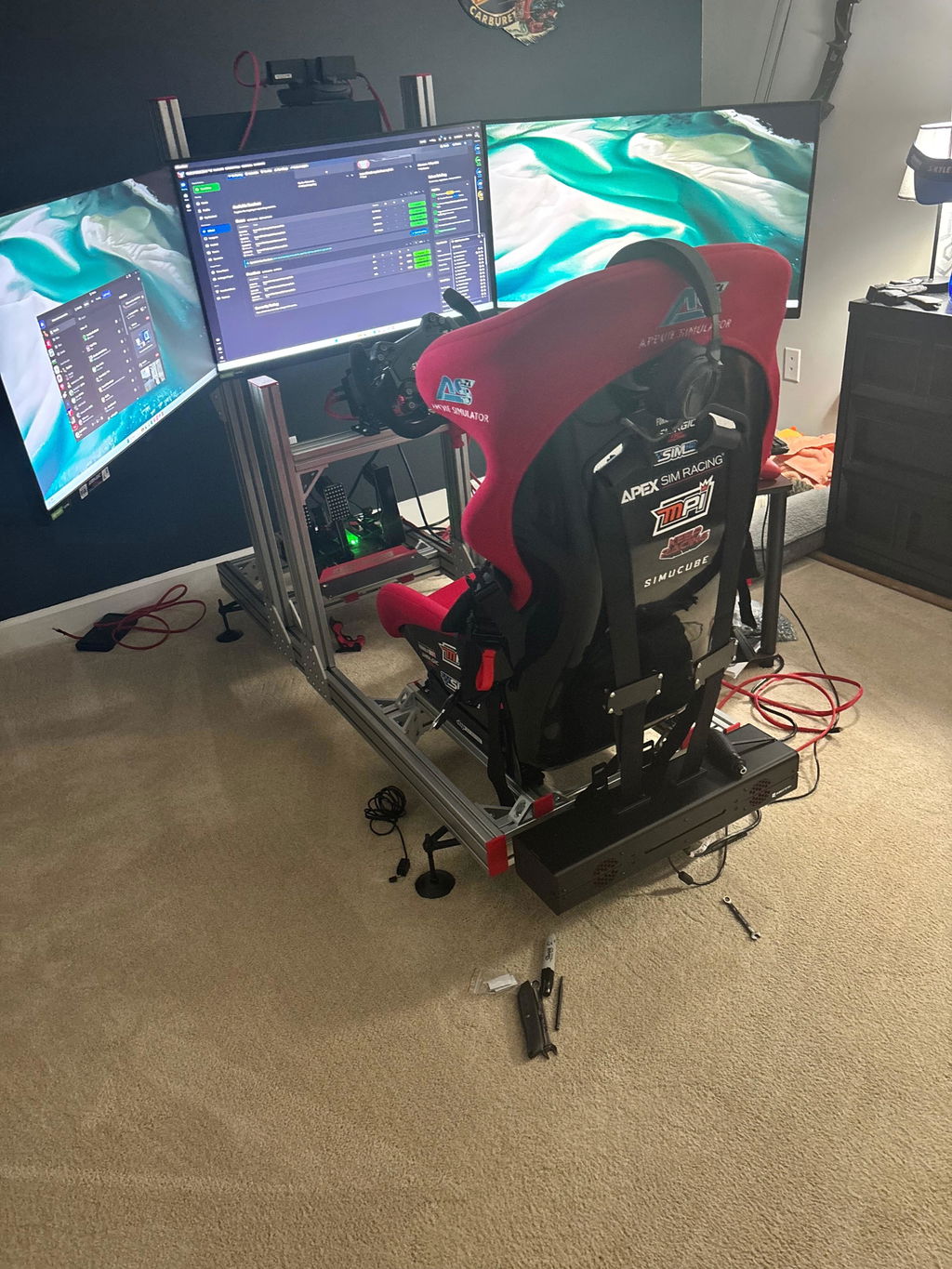
To achieve professional-grade consistency, an aluminum extrusion sim rig is non-negotiable. These 80/20 rigs provide the structural integrity required to handle the extreme forces generated by professional hardware without the creaking or swaying found in entry-level tubular frames. At Apevie Simulators, we specialize in integrating elite components like the Heusinkveld Sim Pedals Ultimate+ into zero-flex chassis systems. This ensures that every ounce of pressure you apply is captured by the load cell rather than being absorbed by a bending pedal plate or a twisting seat mount. When the foundation is rigid, the feedback loop between your foot and the software remains pure and repeatable.
Eliminating Flex for Maximum Precision
Even a single millimeter of flex in your pedal plate can compromise your threshold braking. This microscopic movement acts like an uncalibrated spring, introducing a variable that your brain can't predict. This inconsistency prevents you from finding the true limit of adhesion in simulators like iRacing. A rigid foundation also extends to your seat mounting. If your seat back flexes under heavy braking, you're losing energy and tactile feedback that should be going into your leg muscles. For a deeper look at building this foundation, you can explore the principles behind The Ultimate Sim Rig Guide.
Turnkey Solutions vs. DIY Headaches
Sourcing and installing elite hardware like load cell pedals often involves months of trial and error regarding compatibility and ergonomics. Professional consultation removes this friction. Our white-glove installation service ensures that your pedals are not only mounted securely but are also ergonomically perfect for your height and seating position from day one. We handle the calibration, the cable management, and the structural tuning so you can focus on driving. We don't just provide parts; we deliver a complete high-performance environment. If you're ready to move beyond "gaming" setups and into a professional-grade environment, contact Apevie Simulators for a professional turnkey build or hardware consultation.
Mastering the Art of Threshold Braking
Transitioning to load cell pedals is more than a simple hardware swap; it's a fundamental shift in how you interact with your simulator. By moving from distance-based travel to pressure-based modulation, you unlock the neurological advantage of muscle memory that professional drivers rely on. Remember that even the finest Heusinkveld or Simucube hardware requires a zero-flex foundation to perform as intended. Without a rigid aluminum extrusion rig, you're merely absorbing your braking potential into a flexing frame instead of the sensor.
Success on the track comes from the intersection of elite engineering and precise calibration. As an authorized dealer for Simucube, Heusinkveld, and GSI, we ensure your components are sourced from the best in the industry. Our white-glove installation service takes the guesswork out of ergonomics. We deliver custom-built rigs designed for zero-flex performance, calibrated specifically to your physical requirements. Explore our curated selection of professional-grade pedals and turnkey rigs to start your journey toward absolute braking consistency. The gap between you and the podium is measured in tenths of a second; it's time to close it with equipment that matches your ambition.
Frequently Asked Questions
Do load cell pedals actually make you faster?
Yes, they make you faster by significantly increasing your braking consistency and allowing for more precise trail braking. Research shows that pressure-based inputs are 12% more accurate than distance-based ones. This accuracy lets you find the limit of adhesion every single lap, rather than guessing your braking point. Over a 20-lap race, this consistency translates to a faster total race time and fewer mistakes.
Can I use load cell pedals on a desk?
You shouldn't use high-end pedals at a standard desk setup with a rolling chair. The physical force required to activate a 60kg or 80kg sensor will push your chair backward or lift the pedal set off the floor. For these components to function correctly, they must be hard-mounted to a rigid foundation. This prevents energy loss and ensures all your effort goes into the sensor rather than moving your furniture.
What is the difference between a 100kg and 200kg load cell?
The primary difference is the signal headroom and resolution available for your calibration. A 200kg sensor, found in professional gear like the Heusinkveld Sim Pedals Ultimate+, doesn't require 200kg of leg strength to operate. Instead, it provides a cleaner, more detailed signal at lower pressures. This extra headroom ensures the sensor remains in its most accurate operating range, even when you're exerting heavy force at a hairpin.
Do I need special shoes for load cell pedals?
Stiff-soled shoes are highly recommended for any pedal set rated over 50kg. Driving in socks or bare feet can lead to bruising or foot fatigue because the pressure isn't distributed evenly across your sole. Professional sim racing boots or thin-soled athletic shoes allow you to feel the pedal's resistance while providing the structural support your foot needs to exert high forces repeatedly during long race stints.
Are load cell pedals compatible with consoles like PS5 or Xbox?
Console compatibility depends entirely on the brand's ecosystem and the specific connection method. Pedals from Fanatec or Thrustmaster work on PS5 or Xbox when they are connected directly to a compatible wheel base. However, boutique high-end pedals are usually USB-only and designed specifically for PC. Using these on a console often requires a third-party translation device, which can sometimes introduce slight input latency or calibration issues.
How long do load cell sensors last compared to potentiometers?
Load cell sensors generally last for years, often outperforming the mechanical life of the pedal assembly itself. Unlike potentiometers that rely on a physical wiper arm that wears down with every movement, load cells are solid-state devices. They are rated for millions of cycles without degradation. This makes them far more reliable in dusty environments where traditional sensors would quickly fail or produce erratic signal telemetry.
Is it worth upgrading to hydraulic pedals over a high-end load cell?
Upgrading to hydraulics is a choice between raw performance and maximum immersion. High-end load cell pedals offer nearly identical lap time benefits with much less maintenance. Hydraulics provide that final 5% of "real car" feel but require monitoring for leaks and occasional fluid changes. For most professional sim racers, the reliability and consistency of a premium load cell setup are the preferred choice for daily training.
What happens if my load cell pedal is too stiff?
If your pedal feels too stiff, you can adjust both the physical elastomers and the software calibration to find a better balance. Swapping to a lower shore hardness elastomer will provide more physical travel and a softer feel. In the software, you can lower the "Maximum Force" setting so that 100% in-game braking is achieved with less physical effort. This prevents leg fatigue and ensures you can hit your braking targets consistently.