


Sim Racing Upgrade Parts and Accessories: The 2026 Professional Buying Guide
That slight creak in your wheel deck isn't just an annoying noise; it's a direct leak of telemetry data that should be reaching your hands. If you've ever missed an apex because your steering mount flexed under heavy load, you know that professional performance requires more than just raw power. Selecting the right sim racing upgrade parts and accessories is the only way to bridge the gap between a gaming setup and a true motorsport simulator. At Apevie Simulators, we understand that every millimeter of unwanted movement in your chassis represents a tenth of a second lost on the timing screen.
You've likely felt the frustration of inconsistent lap times caused by a pedal plate that bows under the pressure of a heavy load cell brake. We're here to help you eliminate those mechanical variables so your muscle memory can finally take over. This 2026 guide identifies the critical hardware upgrades needed to create a zero-flex environment. We'll walk you through the decision framework for choosing rigid aluminum rigs and advanced tactile feedback systems, giving you a clear path to a clean, professional cockpit that delivers podium-level consistency.
Key Takeaways
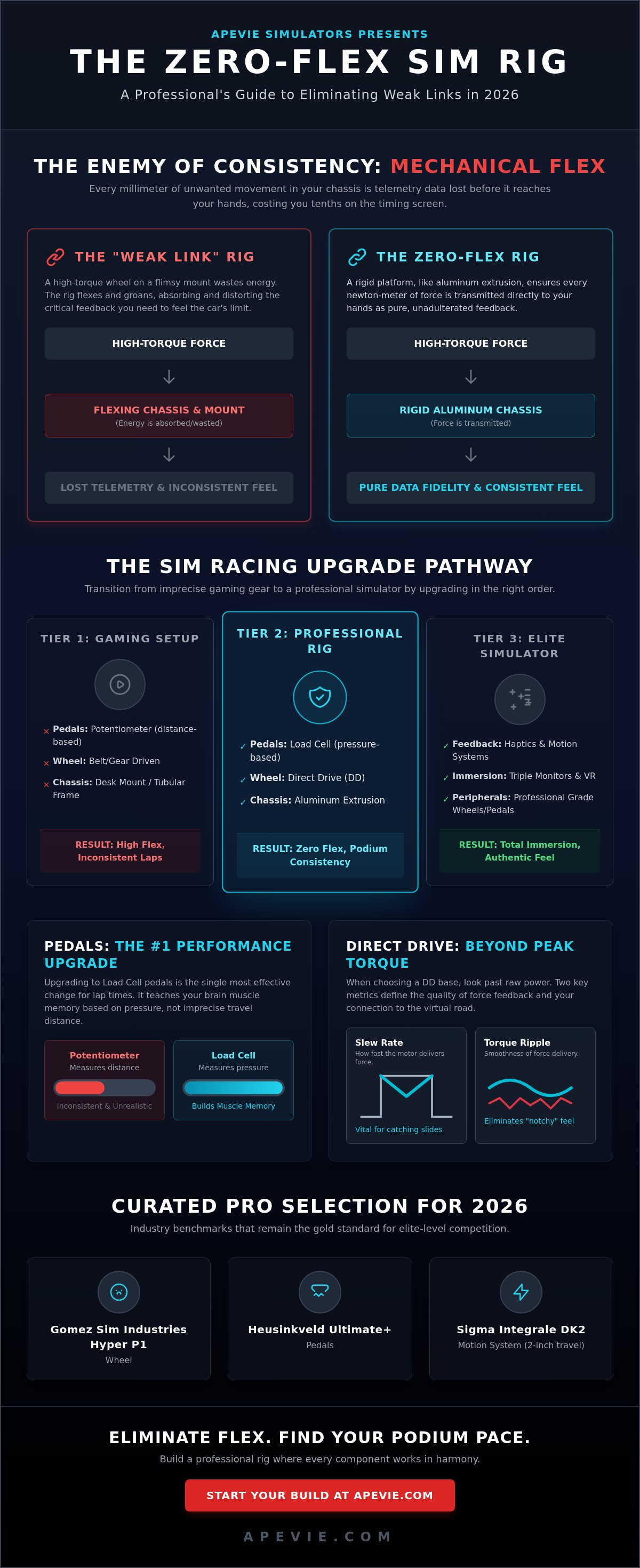
- Eliminate mechanical flex by understanding the "Weakest Link" theory, ensuring your high-torque wheel base isn't compromised by a vibrating or bowing mounting plate.
- Prioritize consistency by upgrading to load cell pedals and Direct Drive systems, which rely on pressure and direct force rather than imprecise travel distance.
- Master your visual immersion by choosing professional-grade sim racing upgrade parts and accessories, such as freestanding triple monitor stands and VESA fine-tuning mounts for perfect FOV.
- Explore the "sweet spot" of haptic feedback and motion, learning why a 2-inch travel system like the Sigma Integrale DK2 is ideal for replicating authentic GT chassis movement.
- Identify why industry benchmarks like the Gomez Sim Industries Hyper P1 wheel and Heusinkveld Ultimate+ pedals remain the gold standard for elite-level competition in 2026.
The Anatomy of a Professional Rig: Why Upgrades Matter
In the high-stakes environment of Sim racing, a professional upgrade is defined by its ability to improve structural rigidity or data fidelity. While many beginners prioritize the visual appeal of a steering wheel, veteran racers understand that performance-critical components are what actually reduce lap times. We categorize these essential improvements into three pillars: structural, performance, and ergonomic. It is vital to distinguish between aesthetic add-ons, like custom decals, and components that fundamentally change how information is transmitted from the software to your senses. Selecting the right sim racing upgrade parts and accessories is about ensuring that every piece of hardware works in harmony rather than fighting against the chassis.
The "Weakest Link" theory is the most important concept to master when building a high-end simulator. Mounting a high-torque motor onto a thin steel plate or a basic tubular frame is essentially a waste of technology. The motor's energy will not reach your hands; instead, it will be absorbed as the mounting hardware twists and groans under the load. You lose the subtle vibrations of a front-tire lockup or the weight transfer over a curb because the rig itself acts as a dampener. A professional rig requires a foundation that can handle these forces without a millimeter of deflection, ensuring the telemetry signal remains pure.
Eliminating Mechanical Flex
Mechanical flex is the primary enemy of consistency. When you apply significant pressure to a high-end pedal set, any movement in the pedal plate changes the travel distance required to reach maximum braking. This inconsistency prevents your brain from developing the precise muscle memory needed for advanced techniques like trail braking. High-torque direct drive bases require reinforced mounting plates, often made of 10mm thick CNC-machined steel. At Apevie Simulators, we emphasize that a rigid platform is the only way to ensure that your inputs are mirrored exactly in the simulation.
Data Fidelity and Tactile Feedback
Achieving professional-grade performance requires a clean flow of information. Premium systems translate raw telemetry into physical cues that tell you exactly what the car's chassis is doing in real-time. To maintain this level of data fidelity, you must also address signal interference. Shielded cables are essential for reducing Electro-Magnetic Interference (EMI), a common issue with high-torque setups. Most professional builds utilize an Aluminum Extrusion Sim Rig because its modular rigidity allows for the addition of heavy motion actuators while maintaining a completely solid frame. For those seeking a complete, professional solution, a turnkey racing simulator package ensures that every component is matched to eliminate these technical bottlenecks from day one.
Performance-Critical Hardware: Pedals and Wheel Bases
If you want to shave seconds off your lap times, stop looking at the screen and start looking at your feet. The hierarchy of pedal upgrades is a journey toward mechanical consistency, moving away from basic potentiometers found in entry-level gear and toward high-fidelity load cells. Upgrading to a set of Heusinkveld Sim Pedals Sprint is often the single most effective change a driver can make. These pedals measure pressure rather than distance, which allows your brain to develop precise muscle memory for braking points. According to the Racing Simulator Market Report, the demand for professional-grade hardware is surging as racers realize that standard consumer equipment cannot replicate the physical demands of a real GT3 or Formula car.
The evolution of Direct Drive (DD) technology has fundamentally changed the landscape of sim racing upgrade parts and accessories. Foundational upgrades like moving to a Simucube 3 or a Fanatec Podium base provide a level of detail that belt-driven systems simply can't match. When evaluating high-end bases, you need to look beyond raw peak torque. Two critical metrics are Slew Rate and Torque Ripple. Slew rate defines how quickly the motor can deliver a change in force, which is vital for catching a slide. Torque ripple refers to the smoothness of the delivery; a high-quality motor ensures you don't feel the "notchy" sensation of the internal magnets, allowing for a pure connection to the virtual road. For deeper engineering insights into how these forces affect your driving, you can refer to the Ultimate Guide to Sim Racing Pedals.
Load Cell vs. Hydraulic Pedal Upgrades
Choosing between load cell and hydraulic systems often comes down to your preference for maintenance versus "feel." The Heusinkveld Ultimate+ set is a industry standard because it offers a maintenance-free, incredibly robust load cell that can handle up to 140kg of force. While hydraulic pedals can provide a slightly more realistic "squish," they require fluid checks and seal maintenance. Beyond the internal tech, don't overlook pedal face geometry. The ability to adjust the angle and height of the pedal faces is a critical accessory upgrade that ensures your ergonomics match your real-world seating position. When it's time to choose a steering wheel to pair with your pedals, the Gomez Sim Industries (GSI) Formula Pro Elite offers a rugged, industrial build, while the Cube Controls F-Core provides a lighter, more agile feel for those who prefer high-speed formula steering.
Direct Drive Mounting Solutions
How you mount your 25Nm+ wheel base is just as important as the base itself. Front-mounting is generally superior to bottom-mounting for high-torque systems because it aligns the mounting points directly with the motor's axis, significantly reducing leverage and flex. At Apevie, we always recommend using heavy-duty Side Gussets on your uprights to prevent lateral movement during aggressive steering inputs. If you're looking for elite-level steering integration, Precision Sim Engineering offers wheels that are designed to handle these extreme forces without any internal flex. If you're unsure which combination of hardware will best serve your racing goals, our team can provide a professional consultation to help you design a perfectly balanced cockpit.
Structural and Ergonomic Accessories for 2026
While the wheel and pedals act as your primary interface, the surrounding architecture of your cockpit determines how long you can perform at your peak. High-end sim racing upgrade parts and accessories in the structural category are designed to solve the problem of environmental instability. A common mistake is choosing an integrated monitor mount for a rig equipped with a motion system. At Apevie Simulators, we recommend freestanding triple monitor stands for any professional build. By decoupling the screens from the chassis, you eliminate the screen wobble caused by high-torque wheel bases or the rapid movements of a motion system. This isolation ensures your vision remains clear, even when the rig is fighting to simulate a rough street circuit.
Achieving a perfect Field of View (FOV) requires more than just placing monitors in a row. Professional racers utilize VESA Fine-Tuning mounts to achieve "Zero-Sag" alignment. Standard brackets often allow the side monitors to droop by a few millimeters, which breaks the continuity of the horizon line across your screens. Fine-tuning mounts allow for micro-adjustments in height, tilt, and angle, ensuring that the precision of a professional cockpit design is maintained. When your monitors are correctly aligned, your brain stops seeing three screens and starts seeing a single, immersive window into the simulation.
Seating and Harness Upgrades
Your seat is a structural component, not just a place to sit. While many "sim" seats prioritize comfort, an FIA-rated bucket seat provides the lateral support necessary to keep your body centered during aggressive steering inputs. If your torso shifts even slightly under load, your steering accuracy drops because your arms are compensating for your body's movement. Integrating seat sliders and tilt brackets is essential for multi-driver environments, allowing for rapid adjustments without compromising the rig's rigidity. On motion-enabled platforms, adding a 4-point harness isn't just for show; it physically tethers you to the chassis, allowing you to feel the subtle heave and pitch cues that would otherwise be lost if you were sliding in the seat.
Cable Management and Power Distribution
A professional cockpit must be as organized as a real GT3 interior. Using profile-mounted cable clips to manage your sim racing upgrade parts and accessories prevents the "rat's nest" that often leads to signal interference or physical snags. For rigs with high-draw motion systems, industrial-grade power strips are a necessity to handle the peak current loads without tripping. We always implement "Drip Loops" and strain relief points for cables connected to moving components. These loops provide the necessary slack for motion actuators to travel their full distance without tensioning the connectors, which prevents long-term hardware failure and ensures your simulator remains operational during critical endurance sessions.
Haptics and Immersion: The Next Tier of Upgrades
Once you've established a rigid foundation and consistent pedals, the next phase of sim racing upgrade parts and accessories focuses on tactile feedback. Haptic transducers, such as the ButtKicker Gamer PLUS, provide high-frequency vibrations that simulate engine RPMs and road textures through your seat or pedal plate. However, full-motion actuators represent a significant leap in telemetry translation. The Sigma Integrale DK2 system is widely regarded as the sweet spot for GT racing because its 2-inch travel provides enough heave and pitch to simulate weight transfer without the disorienting, floaty feel of longer-stroke systems. Integrating these into the Ultimate Sim Rig foundation requires a methodical approach to software calibration. Whether you use SimHub for transducers or the D-BOX tuning suite for actuators, the hardware is only as effective as the telemetry filters you apply to the signal.
At Apevie, we believe that immersion isn't just about "realism" for its own sake; it's about providing the driver with more data points to make faster decisions. When you feel the rear tires losing grip through a seat-mounted transducer before you see it on screen, you can react instinctively. This sensory layer bridge is what separates a high-end simulator from a standard gaming setup. It's about creating a holistic environment where every vibration and movement carries a specific, actionable meaning for the driver.
Motion System Integration
Upgrading a static rig to a motion-capable platform isn't as simple as bolting on actuators. You must ensure the structural reinforcements of your chassis can handle the sudden, violent shifts in weight. We differentiate between "Seat Movers," which only tilt the chair, and "Full Chassis" systems that move the entire rig, including the wheel and pedals. Full chassis motion is superior for maintaining your ergonomic relationship with the controls during high-G maneuvers. If you're planning an actuator-based upgrade path, we recommend you consult ProSimu to ensure your current frame is compatible with high-performance motion hardware and won't suffer from long-term fatigue.
Dashboard and Telemetry Displays
Reducing cognitive load is essential during long endurance stints. While many wheels feature integrated screens, an external Data Display Unit (DDU) mounted at eye level is often a more effective choice. Dedicated telemetry displays, like those found in "Z-Dash" or 4th monitor setups, allow you to monitor tire temperatures and fuel deltas without looking away from the apex. These sim racing upgrade parts and accessories are vital for racers who need real-time data without the clutter of an on-screen HUD. By moving critical information to your peripheral vision, you can maintain focus on the racing line while staying informed on your car's health. If you're ready to add motion or advanced haptics to your setup, reach out for a professional consultation to ensure your rig is engineered for the task.
Curated Professional Selection: Standout Parts for 2026
Selecting the right sim racing upgrade parts and accessories requires a balance between raw performance and long-term reliability. For drivers seeking the pinnacle of steering technology, the Gomez Sim Industries (GSI) Hyper P1 stands alone. Its construction features 5mm carbon fiber faceplates and high-quality tactile buttons that offer immediate, positive feedback. This isn't just about the aesthetics of a formula wheel; it's about the precision of the encoder and the lack of internal flex during high-torque maneuvers. Pairing such a wheel with the Heusinkveld Ultimate+ pedal set creates a foundation that is considered the industry standard for professional sim racing. These pedals offer a level of hydraulic-like feel through a maintenance-free load cell system, capable of handling the extreme pressures required for authentic motorsport training.
For those moving into motion, the Sigma Integrale DK2+ system remains the definitive choice. Its response time and accuracy allow it to replicate the high-frequency vibrations of a track surface, making it an essential tool for serious drivers. However, even the best hardware can underperform if it isn't integrated correctly. This is why Apevie's White-Glove Installation is often the most important "accessory" you can choose. Our team ensures that your motion actuators are perfectly leveled and your telemetry software is calibrated to your specific driving style, removing the technical guesswork that often plagues DIY builds.
Top 3 Must-Have Upgrades for 2026
- Simucube 2 Pro: With 25Nm of torque and a class-leading slew rate, it remains the gold standard for direct drive force feedback.
- Heusinkveld Sprint Pedals: These are the most impactful upgrade for lap time consistency, offering a compact yet incredibly rigid load cell design.
- Cube Controls F-Core: This wheel provides professional-grade ergonomics and carbon fiber construction at a price point that makes it an accessible entry into high-end formula racing.
The Apevie Difference
We don't believe in offering every product on the market. Our Accessories & Parts Collection only features race-proven brands that we have personally tested in endurance conditions. When you work with us, you aren't just buying components; you're gaining access to expert consultation. We ensure that your new steering base is compatible with your current chassis and that your power distribution can handle the load of a new motion system. Our goal is to create a seamless, high-performance environment where you can focus entirely on the race.
Ready to transform your rig into a professional-grade simulator? Shop the full professional collection of accessories and parts here or contact Apevie Simulator today for a custom turnkey build or professional consultation.
Engineering Your Path to the Podium
Building a professional simulator is a journey of refinement. Every component must serve the goal of mechanical precision. You've learned that eliminating mechanical flex is the first step toward achieving podium-level consistency. Whether it's the industrial-grade stability of an aluminum rig or the nuanced feedback of a Simucube 2 Pro, the right hardware ensures your talent isn't masked by equipment deflection. We've also explored how haptic systems and motion actuators add a layer of sensory data, allowing you to react instinctively to the car's limit.
Selecting the right sim racing upgrade parts and accessories doesn't have to be a trial-and-error process. As an authorized Simucube and Heusinkveld dealer, Apevie Simulator provides a curated selection of hardware proven on the world's most demanding virtual tracks. We offer expert white-glove installation to ensure your setup is perfectly calibrated from the moment you sit in the cockpit. Our team is dedicated to providing the technical foundation required for elite motorsport training.
The difference between a mid-pack finish and a race win often comes down to the confidence you have in your equipment. Upgrade your rig with professional-grade parts at Apevie Simulators and experience a platform that matches your ambition. We look forward to helping you master the circuit.
Frequently Asked Questions
What is the most important sim racing upgrade for faster lap times?
Upgrading to load cell pedals is the most effective hardware change for improving consistency and reducing lap times. Unlike standard pedals that measure the distance the pedal travels, load cells like the Heusinkveld Sim Pedals Sprint measure the actual pressure applied. This allows your brain to rely on muscle memory for braking points, making it much easier to replicate the exact same braking force lap after lap.
Will professional pedals like Heusinkveld work with my existing wheel base?
Professional-grade pedals function as standalone USB devices on PC, meaning they don't need to connect to your wheel base. You can use Heusinkveld Ultimate+ pedals alongside a Fanatec, Simucube, or Moza base without any compatibility issues. On a PC, the simulation software recognizes each piece of hardware as a separate input, giving you the freedom to choose the best components for each specific task.
Do I need a new rig to upgrade to a high-torque direct drive wheel?
High-torque direct drive bases generally require a rigid aluminum extrusion rig to handle the forces involved without flexing. If you're moving to a 25Nm Simucube 2 Pro, a standard desk or basic tubular frame will often twist or groan under the load. Investing in the right sim racing upgrade parts and accessories for your chassis foundation is essential to ensure that the motor's feedback reaches your hands rather than being absorbed by a vibrating frame.
What is the difference between a load cell and a standard potentiometer pedal?
A load cell measures the physical force or weight you apply to the pedal, whereas a potentiometer measures the travel distance of the pedal arm. In a real race car, the brake pedal becomes increasingly firm as you press it, and a load cell mimics this sensation perfectly. This force-based input is significantly more intuitive for the human brain than trying to remember exactly how many centimeters you moved your foot into a turn.
How do I ensure my new sim racing accessories are compatible with my aluminum profile rig?
Aluminum profile rigs are inherently modular, but you must ensure you have the correct mounting plates and T-nuts for your specific hardware. Most professional accessories use standard M6 or M8 mounting patterns. At Apevie, we provide expert consultation to verify that your new steering mounts, pedal plates, and shifter brackets align perfectly with your existing 80/20 extrusion frame before you begin the installation process.
Is a motion system upgrade worth it for competitive iRacing?
A motion system like the Sigma Integrale DK2+ is an immersion upgrade that provides vital "seat-of-the-pants" telemetry cues. While it may not instantly lower your qualifying pace, it helps you catch slides and feel tire slip earlier than you would on a static rig. This increased sensory data can lead to better race craft and fewer mistakes during long endurance stints where maintaining focus is critical.
What are the essential cable management parts for a clean sim racing setup?
Essential cable management starts with profile-mounted clips, braided sleeves, and high-quality velcro ties. For motion-enabled rigs, you also need to implement strain relief points and drip loops to ensure cables don't pull tight during extreme movements. Using shielded USB cables is another vital step to prevent Electro-Magnetic Interference from high-torque motors, which can cause random hardware disconnects during a race.
Can I mix and match different brands like Simucube, GSI, and Fanatec?
You can absolutely mix and match different brands on a PC-based simulator. It is very common for professional drivers to pair a Simucube 3 wheel base with a Gomez Sim Industries (GSI) steering wheel and Heusinkveld pedals. This flexibility allows you to select the best-in-class hardware for each specific interface rather than being locked into a single manufacturer's ecosystem. Just ensure you have the correct adapters for your steering wheel's quick release system.