Heusinkveld Sim Pedals Sprint Review: The 2026 Sim Racing Benchmark
What if the secret to finding that missing half-second isn't in your hands, but under your feet? Most racers focus on the steering wheel, yet the braking zone is where races are truly won or lost. If you've felt the frustration of inconsistent braking points or a lack of mechanical feel in entry-level setups, you're likely ready for a serious hardware transition. The heusinkveld sim pedals sprint has long been the definitive choice for those who demand professional-grade consistency and precision. In this review, we'll explore why these pedals remain the benchmark for serious simulators in 2026.
You'll learn how they translate human intent into digital telemetry and why Apevie Simulators integrates them into our most demanding turnkey builds. We're diving into the engineering, software, and rig requirements to help you decide if this is the ultimate upgrade for your competitive journey. From the tactile feedback of the load cell to the depth of the SmartControl calibration, we're covering everything you need to know to master your consistency on the track.
Key Takeaways
- Understand why the heusinkveld sim pedals sprint remains the industry benchmark for professional-grade consistency through pressure-based load cell technology.
- Discover the technical impact of 12-bit electronics and the SmartControl software in eliminating signal jitter for repeatable braking performance.
- Compare the mechanical differences between the Sprint and Ultimate+ models to determine if you need hydraulic damping or higher brake force limits.
- Identify the structural requirements for your sim rig to prevent pedal plate flex, which is the leading cause of inaccuracy in high-end pedal sets.
- Learn how Apevie Simulator’s white-glove installation ensures your pedals are perfectly calibrated and integrated into a high-performance turnkey system.
Why the Heusinkveld Sim Pedals Sprint Remains the Professional Choice
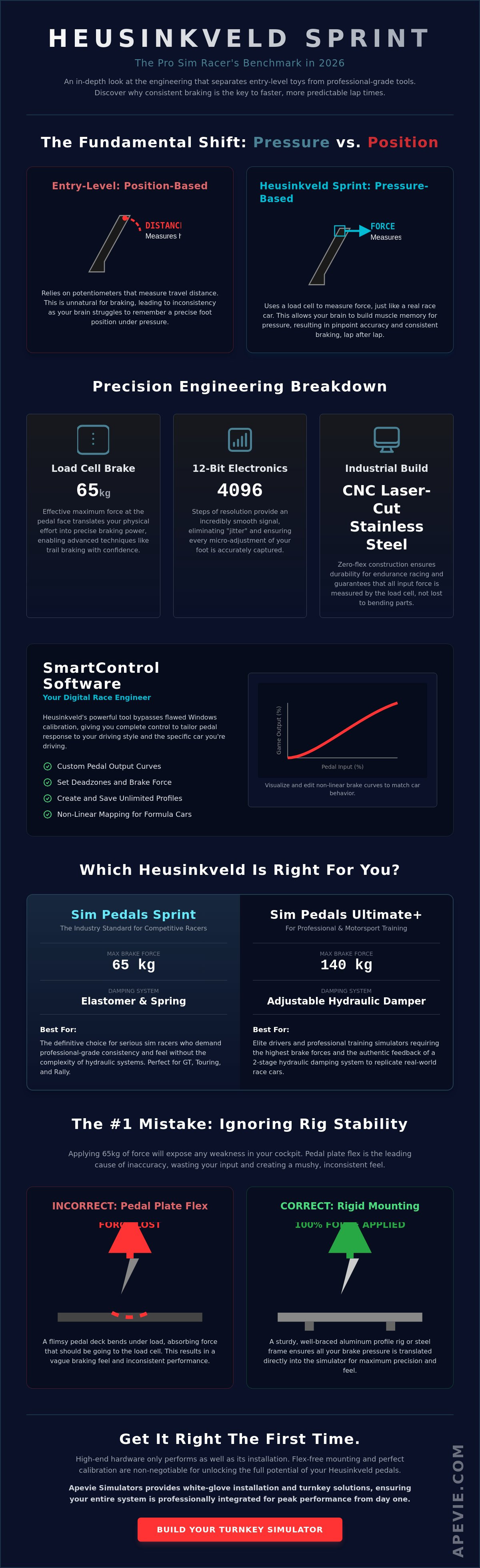
The heusinkveld sim pedals sprint has earned its place as the backbone of the serious sim racing community. It bridges the gap between mass-produced gaming peripherals and the heavy-duty hydraulic systems found in professional driver training rigs. For anyone diving into what is sim racing at a competitive level, the shift from position-based pedals to pressure-based technology is the single most important hardware upgrade you'll make. Most entry-level kits measure how far you've pushed the pedal. In a real race car, however, the car slows down based on how hard you press. This heusinkveld sim pedals sprint uses a high-grade load cell to mimic that exact physical relationship, providing an effective 65kg of brake force that demands real physical engagement.
Muscle memory is the secret to finding the same braking point lap after lap. Your brain is much better at remembering a specific pressure than a specific foot position. When you're trail braking into a tight corner at Monza, you need to feel the fine modulation of the pads against the rotors. At Apevie Simulators, we consider these pedals a non-negotiable staple for our custom high-performance builds. They provide the reliability our clients expect without the maintenance complexity of fully hydraulic setups. We often find that once a racer moves to a load cell, their lap times don't just get faster; they become much more predictable.
The Evolution of the Sprint Series
Heusinkveld changed the market by proving that professional gear doesn't have to be bulky or inaccessible. The 2026 iteration of the Sprint series continues this legacy by refining the internal electronics while keeping the footprint compact. While newer competitors enter the market every month, the Sprint remains the lead because it doesn't prioritize gimmicks. It focuses on the pure translation of force into data. It's a tool designed for the driver who spends hours practicing qualifying runs and needs hardware that won't drift or lose calibration over time.
Built for Performance: Materials and Aesthetics
The construction is unapologetically industrial. Using CNC laser-cut stainless steel, these pedals are built to withstand the high forces required for realistic braking. There are no plastic shrouds or decorative RGB lights to hide behind. This raw, metallic aesthetic reflects the philosophy of actual motorsport engineering. It's about function over form. For long-distance endurance racing, this durability is essential. You can't have a sensor failing three hours into a 24-hour race. The Sprints are engineered for that kind of abuse, ensuring that every input is as crisp on the final lap as it was on the first.
Engineering Precision: Load Cells and SmartControl Software
The technical soul of the heusinkveld sim pedals sprint lies in its ability to translate physical pressure into digital precision without losing a single bit of information in between. At the heart of the brake pedal is a 120kg load cell. While that number sounds intimidating, the pedal's geometry and leverage result in an effective 65kg of maximum brake force at the pedal face. This is plenty for most racers, as it allows for a stiff, realistic feel without requiring the leg strength of a professional endurance driver. Unlike entry-level sets that rely on potentiometers or Hall effect sensors to measure distance, this load cell measures the actual force you apply. It's the difference between guessing where your foot is and knowing exactly how much pressure you're putting on the rotors.
Signal processing is where many mid-range pedals fail, often introducing "jitter" or noise that makes your braking inputs look like a jagged saw blade in the telemetry. Heusinkveld solves this with custom 12-bit electronics. This high resolution ensures that every tiny modulation of your foot is captured smoothly. When you're slowly releasing the brake to rotate the car into a corner, that smoothness is what prevents the tires from locking up or the ABS from over-intervening. It's a level of fidelity that makes the heusinkveld sim pedals sprint feel like a professional instrument rather than a gaming peripheral.
SmartControl: Beyond Simple Calibration
The software is often an afterthought in sim racing hardware, but Heusinkveld’s SmartControl, currently at version 26.02.5, is a game changer. It completely bypasses the standard Windows game controller settings, which are notorious for losing calibration or having limited adjustment ranges. With SmartControl, you can set custom output curves that change how the game interprets your foot pressure. For example, a Formula car usually requires a very stiff pedal with almost no travel, while a GT3 car might benefit from a more progressive curve that simulates a larger master cylinder. You can save these profiles and switch between them instantly, ensuring your muscle memory stays sharp across different simulation titles like iRacing or Assetto Corsa Competizione.
Mechanical Adjustability and Feel
Hardware adjustability is equally impressive. You aren't stuck with a "one size fits all" ergonomic setup. You can adjust the pedal throw, height, and even the angle of the pedal faces to suit your seating position. The brake's stiffness is tuned by swapping out the included elastomers, allowing you to find the perfect "bite" point. Even the throttle has been given attention, featuring a solid return spring that provides the resistance needed for precise corner exits. If you're looking for a setup that's perfectly dialed in from day one, our white-glove installation service ensures your pedals are calibrated to your exact physical preferences before the first green flag drops.
We also use deadzones within the software to solve common racing pains. By setting a small deadzone at the start of the pedal travel, you prevent "dragging" the brakes on long straights if you tend to rest your foot on the pedal. These small details are what separate a frustrating setup from a professional-grade simulator that stays consistent through a four-hour stint.
Heusinkveld Sprint vs. Ultimate+: Which Should You Choose?
Matching your hardware to your physical driving style is a prerequisite for professional consistency. Deciding between the heusinkveld sim pedals sprint and its larger sibling, the Ultimate+, isn't just about your budget; it's about the specific physics of the cars you intend to master. While both sets utilize the same high-standard SmartControl software, their mechanical limits serve different purposes. The Sprint offers an effective 65kg of brake force, which is more than enough for the vast majority of enthusiasts. In contrast, the Ultimate+ is designed to handle up to 136kg of pressure, catering to drivers who need to replicate the extreme leg force required in high-downforce Formula cars.
The most significant difference you'll feel on the track is the damping system. The heusinkveld sim pedals sprint relies on a sophisticated elastomer stack to provide resistance. This results in a crisp, fast-reacting pedal that's perfect for the rapid inputs required in GT3 or Rally racing. The Ultimate+ features a 1-way hydraulic damper on the brake and throttle pedals. This adds a layer of fluid resistance that mimics the sensation of hydraulic fluid moving through a real race car's lines. It makes the "release" phase of trail braking feel slightly more organic, as the pedal doesn't just snap back but instead follows your foot with a controlled, damped motion.
When the Sprint is the Superior Choice
The Sprint is often the smarter choice for drivers using Aluminum Extrusion Sim Rigs that aren't specifically reinforced for triple-digit force loads. Because they're more compact, they fit into a wider variety of cockpits without needing custom mounting plates. If your primary focus is GT3, TCR, or road car simulations, the 65kg limit is actually much closer to the real-world pedal pressures of those vehicles. It provides all the precision you need without the unnecessary physical fatigue of a 100kg+ brake pedal.
The Case for the Ultimate+ Upgrade
The Ultimate+ is built for drivers who demand the absolute peak of hardware durability. If you're using a high-performance motion system, the heavier construction of the Ultimate+ helps maintain accuracy despite the G-forces acting on your body. The hydraulic dampers are essential if you're training for Formula-style racing where pedal feel is dictated by massive hydraulic pressures. For a more technical breakdown of these engineering differences, you can explore our Guide to Sim Racing Pedals. Ultimately, if you don't need the extreme 136kg force limit, the Sprints deliver the same elite-level telemetry at a much more accessible price point.
Installation and Rig Compatibility Requirements
Owning a pair of heusinkveld sim pedals sprint is only half the battle; the other half is ensuring your cockpit can actually handle them. Pedal plate flex is a significant hurdle that often goes unnoticed. When you exert force, any bend in your rig's mounting plate absorbs energy that should be going into the load cell. This movement confuses your sensory feedback because the pedal moves without a corresponding increase in digital braking pressure. To get the most out of professional-grade cockpits, you need a foundation that remains absolutely stationary under load.
Minimum rig requirements for these pedals are stricter than for entry-level gear. You can't simply bolt these to a wheel stand or a thin metal plate. We recommend an Aluminum Extrusion Sim Rig as the baseline to provide the structural integrity required. If you're mounting the heusinkveld sim pedals sprint directly to extrusion, ensure you have the proper T-nuts and bolts to secure each pedal individually. Alternatively, using the optional Heusinkveld baseplate can simplify the process, especially if your rig's mounting holes don't perfectly align with the pedals' footprints.
Rig Stiffness and Performance
Evaluating your chassis for concentrated force is essential before the first lap. If you notice your seat or pedal tray moving even a few millimeters, your consistency will suffer. At Apevie Simulators, our custom builds utilize heavy-duty profiles to eliminate this issue entirely. The relationship between your pedal height and seat position also changes depending on whether you're using a GT Simulator Cockpit or an Open Wheel Simulator Cockpit setup. In a GT position, your heels are usually slightly below your hips. For a Formula position, you'll want the pedals raised so your feet are nearly level with your chest to prevent lower back strain during long endurance stints.
Connectivity and Cable Management
Connectivity is refreshingly simple with the Sprints. They use a USB-only connection, meaning you don't need a separate controller box cluttering your floor. Each pedal plugs into the brake's main PCB, which then connects to your PC. One detail often overlooked is grounding. High-end wheel bases, like the Simucube 3 Wheel Base, can sometimes generate electromagnetic interference. If your pedals feel twitchy or lose calibration, ensuring your rig is properly grounded to the PC chassis usually solves the problem. If you want a setup that's ready to race without the troubleshooting, you can book a professional consultation for your turnkey build today.
Proper spacing is the final touch for ergonomic perfection. Since the pedals are independent units, you can set the distance between the throttle and brake to perfectly match your foot size. This is particularly useful for racers who still practice heel-toe downshifting or those who prefer a wider gap for comfortable left-foot braking. Taking the time to dial in these physical dimensions is what separates a generic gaming station from a professional-grade simulator.
Apevie’s High-Performance Turnkey Integration
The heusinkveld sim pedals sprint is a masterfully engineered component, but its true performance is unlocked through precise system integration. At Apevie Simulators, we don't just supply hardware; we curate high-performance environments where every input is translated with absolute fidelity. Our turnkey racing simulator packages frequently feature the Sprints because they offer the mechanical reliability and precision required for competitive longevity. Through our White-Glove installation service, we handle the complex structural mounting and signal grounding that these pedals demand. We ensure your system is free from the electronic noise or structural flex that often limits the effectiveness of load cell technology in home setups.
Expert consultation is the cornerstone of our process. We speak directly with you to understand your primary racing categories. If your focus is GT3, we'll tune the elastomer stack and SmartControl curves to replicate a specific master cylinder feel. For Formula training, we can adjust the pedal throw for the short, stiff engagement those cars require. This level of personalized hardware maintenance ensures that professional clients spend their time on the track rather than in the settings menu. We verify every calibration point before the simulator ever leaves our floor.
Beyond the Parts: The Apevie Simulators Experience
Choosing a professional build over a DIY setup is about more than just convenience; it's about uptime and reliability. We provide custom tuning for professional motorsport teams and high-end residential clients who require their equipment to be race-ready at all times. Our philosophy aligns with industry leaders like CXC Simulations, where the focus is on a seamless, high-fidelity experience from the moment you sit in the cockpit. We optimize every detail, from the pedal spacing to the heel rest height, ensuring your physical comfort matches your digital pace. This holistic approach prevents the ergonomic fatigue that can ruin a long-distance endurance stint.
Ready to Upgrade Your Braking Performance?
The heusinkveld sim pedals sprint represents a sophisticated balance of tactile feel and software depth that few competitors can match. It's the definitive benchmark for industrial durability and repeatable precision. If you're ready to transition to a professional-grade setup that rewards your skill with consistent telemetry, our team is here to guide the way. Contact Apevie Simulators today for a custom simulator consultation or to explore our complete turnkey builds. Let's build a foundation that turns your racing intent into podium finishes.
Master the Braking Zone with Precision Engineering
Mastering the technical nuances of the braking zone is the most effective way to lower your lap times and increase your competitive edge. The heusinkveld sim pedals sprint stands as a precision instrument that bridges the gap between digital simulation and real-world motorsport physics. By focusing on high-fidelity load cell technology and industrial-grade construction, these pedals provide the repeatable feedback necessary for elite-level trail braking and car rotation.
At Apevie Simulators, we specialize in transforming these individual components into cohesive, high-performance systems. As an authorized dealer, we offer more than just the parts; we provide white-glove installation and expert calibration for iRacing and ACC, ensuring your pedals are perfectly matched to your driving style. Whether you're a professional driver training for the next season or a serious enthusiast building your first premium rig, our engineering expertise ensures your hardware never limits your potential.
Contact Apevie Simulators for a Custom Turnkey Simulator Consultation and secure the foundation of your racing success. The quickest path to the podium starts with equipment you can trust implicitly.
Frequently Asked Questions
Do Heusinkveld Sprints work on PS5 or Xbox?
No, the heusinkveld sim pedals sprint is a PC-only device that connects via a standard USB cable. It requires a Windows environment to run the SmartControl software for calibration and profile management. While some third-party adapters exist to bridge connectivity to consoles, we don't recommend them because they often degrade the 12-bit signal resolution and eliminate the custom tuning features that define this hardware.
How often do I need to calibrate my Heusinkveld pedals?
You only need to calibrate your pedals once during the initial setup process. The calibration data is stored directly on the pedal's internal controller, so your settings remain identical every time you start your simulator. Recalibration is only necessary if you perform a firmware update or physically swap the elastomers to change the brake's resistance levels.
What is the difference between a load cell and a potentiometer?
A load cell measures the actual pressure or force you apply, whereas a potentiometer measures the physical distance the pedal travels. Pressure-based sensing is the industry standard for professional simulators because it allows your brain to build muscle memory based on leg force. This is much more repeatable and accurate than trying to remember a specific foot position during a high-speed braking zone.
Can I use the Heusinkveld Sprint pedals with a desk chair?
No, these pedals aren't suitable for use with a standard desk chair on wheels. The 65kg of force required for maximum braking will simply push your chair backward the moment you apply pressure. To use the heusinkveld sim pedals sprint effectively, you must mount them to a rigid chassis or an aluminum extrusion rig that can withstand the concentrated force without moving.
What elastomers should I use for a GT3 car feel?
For a realistic GT3 sensation, we suggest using a medium-to-stiff elastomer stack with a small amount of initial deadzone. This configuration mimics the slight "play" of the brake pads before they bite the rotors, followed by a very firm pressure stage. You can further refine this by using SmartControl to set a non-linear output curve, which helps with fine modulation during trail braking.
Is the Heusinkveld baseplate necessary for installation?
The baseplate is optional but highly recommended if your rig's pedal tray has any inherent flex. It provides a reinforced, stationary foundation for the individual pedal units and includes a comfortable heel rest for better ergonomic alignment. If you're mounting directly to heavy-duty aluminum profiles, you may not need it, but it certainly simplifies the installation and adjustment process.
How do I clean and maintain my stainless steel pedals?
Maintenance is straightforward thanks to the industrial stainless steel construction. Use a dry, lint-free cloth to wipe away dust from the sensors and pivot points every few weeks. If the bushings begin to make noise after heavy use, a single drop of dry PTFE lubricant is usually enough to restore smooth operation. Don't use water or harsh chemicals, as these can interfere with the load cell electronics.
Can I upgrade the Sprints to Ultimate+ later?
No, the Sprint and Ultimate+ pedals are built on entirely different mechanical platforms. Because the chassis, load cell ratings, and damping systems are unique to each model, there is no upgrade kit to convert one into the other. If your training requires hydraulic damping or brake forces exceeding 65kg, it's better to choose the Ultimate+ set from the beginning of your build.