


Fanatec Buying Guide 2026: Choosing the Right Ecosystem for Professional Sim Racing
Is chasing the highest possible torque actually sabotaging your lap times by masking the subtle road textures you need to stay on the limit? It's a common trap for those building a professional fanatec ecosystem. You want the raw immersion of a heavy wheel, yet you can't afford to lose the granular feedback that signals a split-second loss of traction. Finding that balance is the difference between a casual gaming rig and a professional-grade simulator designed for serious training.
We understand the confusion surrounding the transition from QR1 to QR2 hardware or deciding if the 15Nm ClubSport DD+ justifies the investment over a standard CSL DD. This guide provides a clear path through the 2026 product lineup, ensuring every component you choose serves your specific racing discipline. We'll explore the recent price reductions on high-end wheel bases and why the upcoming Podium Pedals are the missing link for elite muscle memory. Whether you're looking for a specific component or a complete turnkey build installed by Apevie Simulators, you'll find the technical clarity needed to invest with confidence.
Key Takeaways
- Learn why the transition to the QR2 system is essential for maintaining signal fidelity and mechanical rigidity across your entire hardware setup.
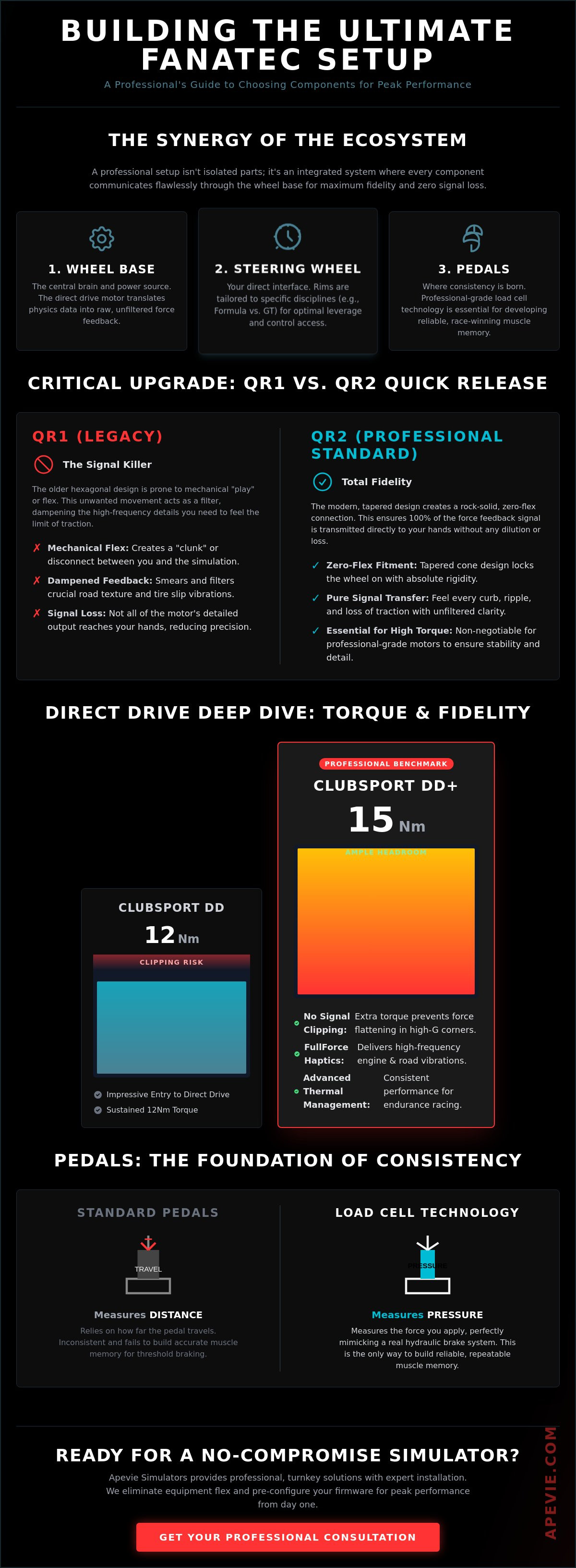
- Identify the ideal torque range for professional training and why the 15Nm ClubSport DD+ is the current benchmark for fidelity and heat management.
- Discover how to choose the correct steering wheel diameter to optimize leverage and button access for your specific racing discipline.
- Understand the critical role of load cell technology in the fanatec ecosystem for building reliable, race-winning muscle memory.
- See how professional turnkey integration eliminates equipment "flex" and ensures your firmware is pre-configured for peak performance from day one.
Understanding the Fanatec Ecosystem: More Than Just a Steering Wheel
Choosing a professional setup isn't about picking isolated parts. When you enter the fanatec ecosystem, you're investing in a synergy where every component speaks the same language. Unlike mix-and-match setups that require multiple USB inputs and conflicting driver suites, this ecosystem routes everything through the wheel base. Your pedals, shifters, and handbrakes plug directly into the motor, which then connects to your PC via a single cable. This streamlined architecture doesn't just reduce clutter; it ensures that telemetry data and input signals remain perfectly synchronized for maximum fidelity.
Understanding Fanatec's corporate history reveals a long-standing commitment to this integrated approach. They've evolved from basic belt-driven units to industry-leading direct drive systems, categorizing their gear into three distinct tiers. The CSL line serves as an entry point, while the ClubSport and Podium series provide the high-fidelity feedback required for professional-grade simulators. For serious buyers, the goal is to skip the entry-level compromises and focus on components that offer long-term durability and precision.
The Core Components of a Fanatec Build
Building a high-performance rig requires a balanced selection of components. The wheel base acts as the central brain and power source, housing the direct drive motor that translates physics data into physical resistance. For the interface, you'll choose steering wheel rims tailored to your discipline. A Formula rim offers the high-speed leverage and button density needed for open-wheelers, while a larger GT rim suits endurance racing. Finally, the pedal set is where consistency is born. Professional builds always prioritize load cell technology, which measures the pressure of your foot rather than the distance the pedal moves, mimicking the feel of a real hydraulic brake system.
QR1 vs. QR2: Why Mechanical Rigidity Matters
The most significant technical shift in recent years is the move from the legacy QR1 to the QR2 quick-release system. If you've ever felt a slight clunk or play when turning the wheel, you've experienced the limitations of the older hexagonal design. Mechanical play acts like a filter, dampening the high-frequency vibrations that tell you when your tires are graining or when you've clipped a curb. Precision is lost in the gaps of the hardware.
The QR2 system utilizes a tapered, rock-solid fitment that eliminates this unwanted movement. This rigidity is vital for high-torque motors, as it ensures 100% of the force feedback reaches your hands without signal loss. At Apevie Simulators, we recommend QR2 for all professional installations. When we build a custom high-performance racing simulator, we ensure the mechanical connection is as precise as the digital signal driving it, providing the stability needed for elite-level competition.
Direct Drive Wheel Bases: Comparing Torque and Fidelity
Torque isn't merely about how hard the wheel pulls against your arms; it's about the dynamic range available to communicate physics. Professional sim racing requires a base that can handle the sustained loads of a high-downforce corner without losing the subtle vibrations of a tire scrub or a shifting weight balance. For a serious fanatec setup, we look at the 12Nm to 20Nm range as the professional standard. This provides enough overhead to ensure that the motor never "clips" or flattens the signal when the forces peak.
The rapid sim racing market growth has pushed manufacturers to refine Direct Drive technology, moving away from legacy belt-driven systems that once dominated the industry. Direct Drive provides an instant, 1:1 response that is non-negotiable for developing the muscle memory needed to catch a slide. In a professional rig, every millisecond of latency between the physics engine and your hands is a potential lost tenth on the stopwatch.
ClubSport DD vs. DD+: The Professional Choice
The ClubSport DD+ (15Nm) represents the 2026 sweet spot for fidelity. While the standard 12Nm ClubSport DD is impressive, the extra 3Nm in the DD+ provides the necessary overhead to prevent signal clipping during high-G maneuvers. This base also features FullForce technology, a new haptic protocol that delivers high-frequency engine and road vibrations directly through the steering rack. Because the DD+ is engineered for endurance, its advanced thermal management ensures that torque consistency remains rock-solid even during a two-hour stint in a custom high-performance racing simulator.
Podium DD1 & DD2: When Do You Need 25Nm?
The role of torque headroom is often misunderstood. You might not want to fight 25Nm of force in every corner, but having that capacity prevents the motor from saturating. Simulating a vintage IndyCar or a heavy GT rack requires massive force. If your motor is already at 90% capacity just to hold a corner, it has no room left to communicate the bumps in the track. This is where the Podium series excels, offering a level of fidelity that rivals other professional units like the Simucube 3 Wheel Base. We often utilize these high-torque bases in turnkey packages for professional driver training to ensure the simulation matches the physical demands of the real track.
If you're unsure which motor capacity fits your specific racing goals, our experts can help you select the right Fanatec Wheel Base for your professional setup.
Steering Wheels: Selecting by Racing Discipline
The diameter of your steering wheel is the final variable in the torque equation. If you've spent hours calibrating a high-performance motor, choosing a wheel that's too large or too small can completely alter the perceived fidelity. A compact wheel provides faster rotation and snappier feedback, while a larger rim offers the leverage needed for precise, smooth inputs in heavy GT cars. This ergonomic choice is why the fanatec ecosystem is so widely utilized in the current wave of professional motorsport adoption.
Selecting the right interface is about more than just aesthetics. It's about how the force feedback is translated to your hands. Smaller diameters increase the perceived torque from the base, making an 8Nm motor feel significantly more violent. Conversely, a larger rim dampens those forces, providing a more stable platform for endurance racing where micro-corrections are key to tire preservation.
Formula and Open-Wheel Configurations
For those focusing on single-seaters, the ClubSport Steering Wheel Formula V2.5 remains the industry benchmark. Its 270mm diameter is specifically designed to allow for rapid steering inputs in tight chicanes without your elbows hitting the sides of your cockpit. Beyond the size, the integrated vibration motors provide tactile feedback for ABS and wheel lock-up, adding a layer of communication that purely visual cues can't match. Utilizing the dual-clutch paddles on this wheel is essential for achieving consistent race starts in high-stakes F1 simulations. You can find these professional configurations integrated into turnkey setups at Vesaro, where the hardware is tuned for elite-level competition.
GT and Endurance Racing Rims
Endurance racing requires a different ergonomic approach. Rims like the Podium Steering Wheel GT3 Endurance, developed in collaboration with Porsche, feature a 320mm diameter that mirrors the physical dimensions of a modern GT3 car. This larger surface area provides the leverage needed to manage high-torque loads during long stints without inducing excessive driver fatigue. Choosing between Alcantara and leather isn't just about personal preference. Alcantara offers superior grip when using gloves, while leather provides better longevity for those who prefer racing bare-handed. When setting up a professional rig, button mapping becomes a strategic exercise. You'll need dedicated rotary encoders for brake bias and traction control, ensuring you can adjust on the fly as track temperatures and tire wear evolve during a race.
Every professional rim in the lineup now features magnetic shifters. These use a neodymium magnet to provide a crisp, snap-action feel that eliminates the mushy sensation found in entry-level gear. This tactile confirmation is critical for reliability, ensuring you never miss a gear during a high-pressure qualifying lap.
Pedals and Accessories: The Key to Consistency
Consistency is the currency of the podium. When building a professional fanatec ecosystem, the pedals are often the most undervalued component by newcomers, yet they're the most critical for lap time. While the Direct Drive motor provides the sensory immersion of the road, the pedals are what allow you to repeat a braking point lap after lap with millimeter precision. If you're still using entry-level pedals that measure how far you push the lever, you're fighting against your own biology. Your brain is far better at remembering pressure than distance.
The ClubSport Pedals V3 represent a significant leap into professional-grade hardware. These pedals utilize hall-effect sensors on the throttle and clutch for magnetic, wear-free precision. However, the centerpiece is the 90kg load cell brake. This technology mimics a real hydraulic system by measuring the actual force you apply. While it's a formidable tool, it represents a different engineering philosophy than the high-end hydraulic units found at Vesaro. Instead of fluid compression, Fanatec relies on a robust load cell sensor to translate your leg strength into digital braking force.
For any serious user, the Brake Performance Kit is a mandatory upgrade. The standard V3 pedals have a relatively long, soft throw that can feel "mushy" during trail braking. This kit replaces the internal foam with high-density elastomers, allowing you to stiffen the pedal and shorten the travel. This creates a rock-solid platform that is essential for high-downforce cars where you need to bleed off brake pressure quickly and accurately. For those seeking even more specialized gear, the ClubSport Handbrake V2 and Shifter SQ V1.5 provide the tactile resistance needed for Rally and Drift disciplines, ensuring every peripheral input feels as deliberate as the steering itself.
Load Cell vs. Potentiometer: Why You Can’t Be Fast Without One
Developing muscle memory is difficult when your equipment uses potentiometers to measure distance. In a real race car, the brake pads meet the disc, and the pedal stops moving; from that point, you're only varying pressure. The 90kg load cell in the ClubSport V3 provides enough resistance to simulate this physical limit. If you prefer the ergonomics of a road car, the Inverted V3 model offers a hanging pedal design that mirrors street-car geometry, providing a more natural feel for those transitioning from track days to the simulator.
H-Pattern and Sequential Shifting
The ClubSport Shifter SQ V1.5 is a masterclass in versatility. It's one of the few units on the market that allows you to switch between a traditional 7-speed H-pattern and a sequential mode with the flick of a switch. This is vital for drivers who jump between vintage machinery and modern GT4 cars. The internal mechanism is designed to provide a heavy, mechanical "thunk" that replicates the sensation of a racing transmission engaging. To maintain this fidelity, these accessories require mounting to high-performance cockpits. Without a rigid frame, the forces required to operate the shifter or the 90kg brake will cause the rig to flex, compromising your consistency.
Ready to build a rig that translates your inputs into podium finishes? Explore our Fanatec Sim Gear to find the perfect pedal and accessory configuration for your professional setup.
High-torque direct drive bases demand more than just a sturdy surface; they require an uncompromising foundation. When you're managing 15Nm or 25Nm of force, a standard gaming desk will flex and vibrate, absorbing the very fidelity you paid to experience. This structural weakness doesn't just ruin the immersion. It introduces mechanical noise into the feedback loop, making it harder to feel the subtle tire scrub that precedes a spin. Professional fanatec integration is about ensuring that every Newton Meter of torque is delivered to your hands, not lost in a wobbling frame.
At Apevie Simulator, we provide a White Glove installation service that bridges the gap between a box of high-end parts and a competitive racing platform. Our experts handle the complex firmware updates and pre-configure your iRacing or Assetto Corsa Competizione settings before the rig even arrives. This meticulous preparation ensures that your hardware is optimized for peak performance from the very first lap, eliminating the technical friction that often plagues DIY builds. We believe that your time should be spent on the track, not troubleshooting driver conflicts or cable management issues.
Building Around the ClubSport GT Cockpit
The Fanatec GT Cockpit is engineered specifically to handle the sustained 15Nm forces of the ClubSport DD+ without a hint of structural deflection. Its robust steel construction provides the rigidity necessary for consistent braking and steering inputs. Beyond pure strength, the cockpit offers a clean, professional appearance with integrated monitor mounts and keyboard trays that keep your peripherals within reach. For multi-driver households, the tool-free adjustment system allows you to swap seating positions in seconds, ensuring that every driver maintains the correct ergonomic posture for endurance stints.
The Apevie Advantage: Turnkey Solutions
Buying a "box of parts" often leads to a cycle of frustration where hardware bottlenecks prevent you from reaching your full potential. A professional fanatec setup is only as fast as the PC driving it. Our turnkey solutions integrate the latest RTX 50 Series GPUs to ensure your simulator maintains high frame rates and low input latency, even on triple 4K monitor arrays. We match your specific racing goals to the correct equipment tier, ensuring you don't overspend on torque you won't use or underspend on pedals that limit your consistency.
Don't leave your performance to chance with a DIY assembly. Browse our curated Fanatec collection and turnkey packages today to start your journey with a system that is ready to race the moment it's installed.
Mastering the Limit with a Professional Foundation
Success in professional sim racing is built on the synergy between your physical inputs and the digital physics engine. By choosing a high-performance fanatec ecosystem, you've selected a platform capable of delivering elite-level fidelity, provided the integration is handled with precision. From the mechanical rigidity of the QR2 system to the pressure-sensitive consistency of load cell pedals, every component must serve your goal of building reliable muscle memory. Skipping the entry-level compromises allows you to focus on the granular road textures that separate the champions from the field.
Apevie Simulators is your partner in this pursuit. As an Authorized High-Performance Hardware Distributor, we specialize in Turnkey 15Nm+ Racing Systems that eliminate the variables of cockpit flex and software conflicts. Our White-Glove Professional Installation Available ensures your rig is calibrated for peak performance from the moment you sit in the seat. Don't let a "box of parts" slow your progress toward the podium.
Ready to elevate your training? Shop the Curated Fanatec Collection at Apevie Simulators and secure the setup your talent deserves. We look forward to seeing you at the top of the leaderboards.
Frequently Asked Questions
Is Fanatec compatible with PS5 and Xbox Series X?
Compatibility depends on a specific combination of hardware. PlayStation support is built into the wheel base itself, while Xbox support is housed within the steering wheel. To race on both consoles, you must use a PlayStation-licensed base like the ClubSport DD+ paired with an Xbox-compatible steering wheel. This cross-platform flexibility is a significant advantage for those investing in a fanatec ecosystem for multi-platform use.
What is the difference between a load cell and a standard brake pedal?
A load cell measures the physical pressure you apply, whereas standard pedals measure the distance the lever travels. Because the human brain is significantly better at repeating a specific force than a specific distance, load cells are essential for consistent trail braking. This technology allows you to build reliable muscle memory, mimicking the physical resistance found in a real hydraulic racing brake system.
Can I use a Fanatec wheel on a Simucube base?
You cannot natively use these steering wheels on a Simucube base due to proprietary electronic pins and communication protocols. While third-party conversion kits exist, they often require permanent modifications and can result in the loss of integrated displays or button functionality. For a professional setup, it's better to stay within the ecosystem or choose a universal USB wheel like the Gomez Sim Industries Formula Pro Elite.
How much torque (Nm) do I actually need for realistic sim racing?
Most professional drivers find that 12Nm to 15Nm provides the ideal balance of strength and detail. While higher torque bases offer up to 25Nm, that extra power is primarily used as "headroom" to prevent signal clipping during high-load corners. Having at least 12Nm ensures the motor can communicate subtle road textures without being overwhelmed by the heavy steering racks of GT3 or Formula cars.
What is the QR2 system and do I need to upgrade my old gear?
The QR2 is a redesigned quick-release system that uses a tapered fit to eliminate the mechanical play found in the legacy QR1. You should upgrade if you want to experience the full fidelity of a direct drive motor without "clunking" or vibrations during rapid direction changes. New 2026 hardware typically ships with QR2, but older steering wheels will require a QR2 Wheel-Side adapter for compatibility.
Does Fanatec hardware work with all racing games like iRacing, ACC, and F1 24?
Yes, this hardware is natively supported by every major racing title on the market. Because fanatec is an industry standard, developers prioritize their drivers during the game creation process. This ensures that advanced features like RevLEDs, OLED telemetry displays, and dual-clutch bite point settings work immediately upon plug-in without the need for complex third-party software workarounds or manual mapping.
Is a dedicated sim rig necessary for the Fanatec ClubSport DD+?
A dedicated aluminum extrusion sim rig is mandatory for any motor producing 15Nm of torque or more. Mounting a high-performance direct drive base to a standard desk will lead to significant flex, which absorbs the fine force feedback details and can eventually cause structural damage to your furniture. A rigid frame ensures that 100% of the motor's fidelity is transferred directly to your hands.
What is Fanatec FullForce and how does it improve the driving experience?
FullForce is a high-frequency haptic protocol designed specifically for direct drive motors to simulate engine vibrations and granular road effects. Unlike standard force feedback which handles the large-scale movements of the car, FullForce adds a layer of tactile detail that you feel through the steering rack. It provides a more immersive sensation of the mechanical "heartbeat" of the vehicle, making the simulation feel significantly more alive.