
Simucube vs Fanatec 2026: The Professional Guide to Direct Drive Supremacy
The most expensive wheel base on the market is essentially a paperweight if it feels like you're turning a notched gear through a bucket of sand. In the high-stakes world of professional simulation, the Simucube vs Fanatec debate has shifted away from raw torque numbers toward the purity of the signal and the underlying stability of the software. You've likely experienced that frustrating "grainy" force feedback feel or the anxiety of a firmware update that threatens to disrupt your training session. These are the hurdles that separate consumer-grade toys from industrial-grade tools.
This guide provides a clear path to your next wheel base by evaluating which titan actually delivers on the promise of professional supremacy in 2026. We'll examine how the surgical precision of the Simucube 3 Ultimate compares to the integrated ecosystem of Fanatec's latest hardware. You'll discover which platform offers the best flexibility for elite peripherals like the GSI Formula Pro Elite or Cube Controls F-Core. Whether you're seeking an open-standard powerhouse or a seamless turnkey solution, we'll break down the reliability and fidelity required for a world-class sim rig.
Key Takeaways
- Learn the fundamental difference between Fanatec's consumer-ready ecosystem and Simucube’s industrial-grade motor control to determine which level of fidelity your driving style requires.
- Understand the long-term implications of the Simucube vs Fanatec ecosystems, specifically how open standards allow for the integration of elite wheels from Gomez Sim Industries or Cube Controls.
- Compare the technical responsiveness and slew rates of the Simucube 2 Pro against the Fanatec Podium DD2 to see which base handles rapid physics changes with more transparency.
- Explore why Simagic has emerged as a disruptive professional alternative in 2026, offering industrial build quality that challenges the dominance of the traditional market leaders.
- Use our professional decision matrix to calculate the total cost of ownership for a turnkey simulator setup, factoring in pedals, mounting solutions, and software stability.
Simucube vs Fanatec: Understanding the Direct Drive Philosophies
Choosing the foundation of your professional rig requires looking beyond simple torque specifications. The Simucube vs Fanatec rivalry represents two fundamentally different approaches to sim racing engineering. While both brands dominate the 2026 market, their design philosophies originate from opposite ends of the manufacturing spectrum. Understanding these roots is essential for any driver who prioritizes long-term reliability and physical transparency over flashy marketing. At Apevie Simulators, we specialize in integrating these bases into turnkey professional rigs, ensuring that the industrial precision of a Simucube 3 or the vast ecosystem of Fanatec is optimized for your specific driving goals.
Simucube, a brand under the Granite Devices umbrella, built its reputation on industrial motor control and robotics. This heritage is the core of the Simucube vs Fanatec distinction. While one focuses on industrial longevity, the other focuses on the holistic user experience. Fanatec pioneered the concept of the all-in-one ecosystem, bringing direct drive technology to a wider audience through integrated software and broad hardware compatibility. By 2026, advanced firmware has significantly narrowed the gap in raw performance, but the tactile feel of these bases remains distinct due to their hardware architecture.
The Simucube Approach: Precision Over Everything
Drivers who prioritize surgical feedback often gravitate toward the Simucube 2 Pro or the flagship Simucube 3 Ultimate. Because these units utilize industrial-grade encoders, they offer a level of detail that consumer motors struggle to replicate. The signal processing is remarkably clean; it translates track textures and tire slip with a smoothness that feels organic rather than digital. There's a no-nonsense quality to the build. You won't find plastic shrouds or proprietary connectors that might fail under heavy use. Instead, you get a solid metal housing designed to survive thousands of hours of high-torque training without thermal throttling or mechanical play.
The Fanatec Approach: Ecosystem Synergy
Fanatec excels at providing a cohesive, user-friendly experience that caters to both serious enthusiasts and professional users. Their QR2 quick-release system is a masterclass in mechanical stability, offering a play-free connection that rivals industrial standards. The primary advantage here is the walled garden. When you buy a Fanatec Direct Drive Wheel Base, you gain access to a massive catalog of first-party wheels, pedals, and shifters that work together without complex configuration. For professionals who need console compatibility for specific events or licenses, Fanatec remains the only viable high-end choice that bridges the gap between PC-grade performance and PlayStation or Xbox accessibility.
Force Feedback Fidelity and Build Quality Comparison
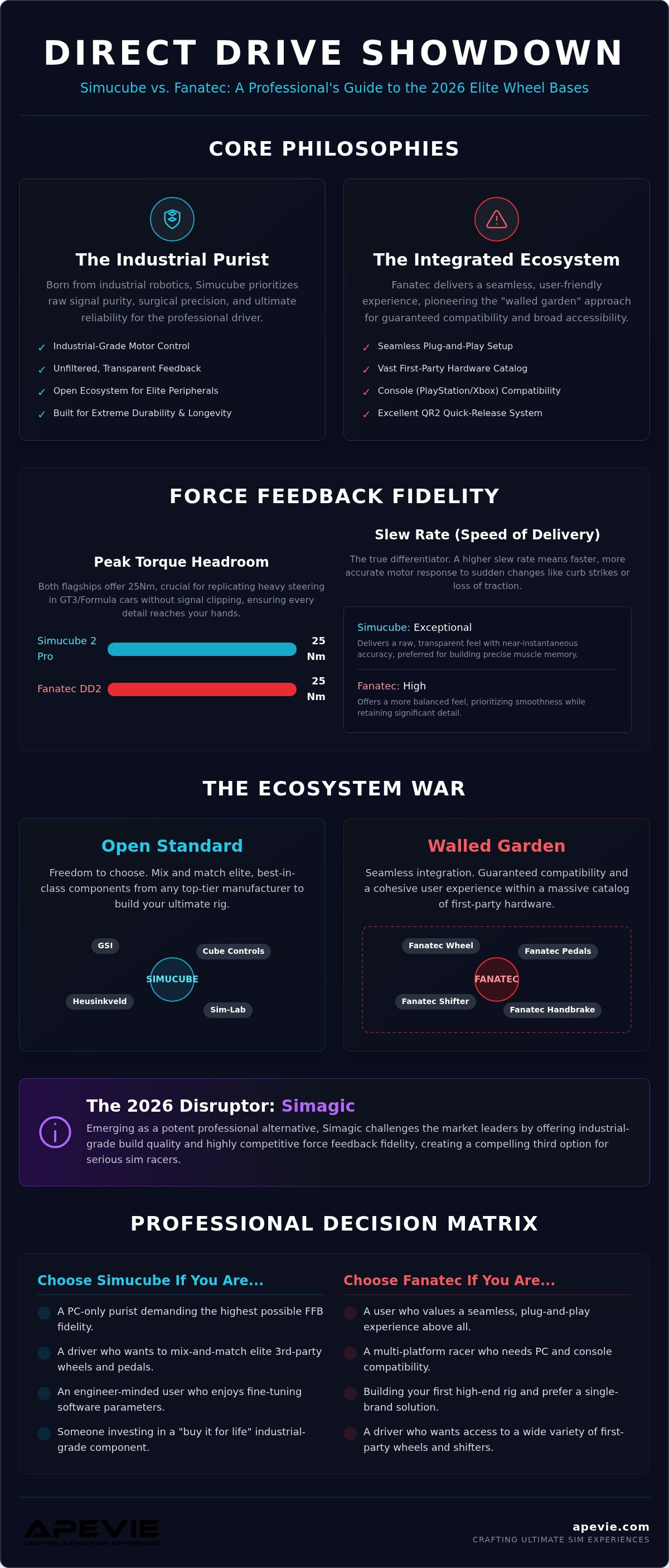
The peak performance of a direct drive system isn't just about how hard it can pull your arms. It's about how much information survives the journey from the simulation physics to your fingertips. When evaluating Simucube vs Fanatec, the Simucube 2 Pro and the Fanatec Podium DD2 both offer a substantial 25Nm of peak torque. This headroom isn't for the faint of heart; it's essential for replicating the heavy steering racks of modern GT3 or formula cars without clipping the signal. When a motor hits its limit, the fine details of the road surface vanish, which is why professional drivers insist on this level of overhead.
Raw Power vs. Usable Detail
While torque gets the headlines, the speed of that power is what defines the tactile "feel" of the car. Slew rate is the speed of torque delivery measured in Nm/ms. A higher slew rate means the motor can react to a sudden curb strike or a loss of traction with near-instantaneous accuracy. Simucube has historically led this metric, providing a raw and transparent feel that experienced drivers prefer for building accurate muscle memory. To manage this power, Simucube True Drive provides sophisticated filtering that eliminates the digital graininess often found in high-torque motors. Fanatec Fanalab takes a different route, offering a more accessible interface that balances smoothness with detail, though some purists find it slightly masks the finest vibrations of the track surface.
Industrial Reliability and Longevity
Professional simulator rigs often run for hours at a time, making thermal management a top priority. Simucube bases are built like industrial equipment, featuring CNC-machined aluminum housings that act as massive passive heatsinks. This design prevents thermal throttling, ensuring that the force feedback you feel in the final hour of an endurance race is identical to the first lap. Fanatec's Podium series uses a mix of materials, and while the QR2 system has improved mechanical stability, the internal cooling and connector durability still lean toward high-end consumer electronics standards rather than industrial robotics.
For drivers building a permanent rig, the industrial ports on a Simucube base offer a more secure, long-term connection than the standard plugs found on many consumer units. If you're looking for an expert to help integrate these components into a professional-grade simulator, choosing a base with a robust mounting system is the first step toward a play-free experience. A rigid foundation allows every Newton-meter of torque to reach the driver rather than being dissipated through a flexing chassis.
The Ecosystem War: Walled Garden vs. Open Standards
The choice between Simucube vs Fanatec often boils down to how much freedom you want over your hardware. Fanatec offers a seamless, plug-and-play experience that works brilliantly if you stay within their product line. It's a cohesive world where everything from shifters to handbrakes connects directly to the base. However, this convenience comes with a trade-off in flexibility. Simucube takes the opposite path, acting as a high-performance foundation that welcomes third-party innovation. This open-standard approach is why Simucube is the preferred choice for drivers building high-end, custom rigs that need to evolve over time.
Integrating Elite Steering Wheels
Professional sim racers rarely settle for off-the-shelf rims. If you want to use a Gomez Sim Industries (GSI) Formula Pro Elite, Simucube makes the process effortless. There's no need for proprietary hubs or restrictive data conversion modules. The Simucube Wireless Wheel system allows many boutique wheels to connect without messy coiled cables, maintaining a clean aesthetic on your rig. In contrast, using an elite wheel like the Cube Controls F-Core on a Fanatec base requires a Podium Hub. This adds cost and complexity, essentially forcing the base to allow a non-Fanatec peripheral to function. For those who want the absolute best steering hardware, the open standard is the only logical path.
Software and Customization
Software stability is the silent partner in your racing performance. Simucube True Drive is designed for the professional who values set and forget reliability. It provides granular control over signal processing, allowing you to tune out unwanted oscillations in iRacing or Assetto Corsa Competizione without losing the car's organic feel. Fanatec Fanalab is undeniably more user-friendly for beginners, offering visual LED synchronization and easy profile switching. While Fanalab has matured significantly by 2026, True Drive remains the gold standard for those who demand industrial-grade stability. It doesn't distract you with flashy interfaces; it just ensures your force feedback remains consistent session after session.
Scalability is a major factor in the Simucube vs Fanatec debate. With an open system, you can upgrade your pedals to Heusinkveld or your dash to a dedicated display unit without worrying about brand compatibility. You aren't locked into one company's release cycle. This freedom allows you to build a rig that truly reflects your specific racing requirements, piece by piece, ensuring your investment retains its value as technology advances.
The 2026 Alternative: Why Simagic is Disrupting the Duo
While the Simucube vs Fanatec debate continues to dominate the high-end market, a third contender has fundamentally changed the value proposition for professional sim racers. Simagic has successfully carved out a space as the professional middle ground, offering industrial-grade build quality that challenges the traditional hierarchy. They don't position themselves as a budget brand. Instead, they provide a level of tactile feedback and mechanical precision that rivals boutique European manufacturers at a more accessible price point. This disruption is a result of their commitment to open standards and high-performance engineering.
Simagic Alpha Series: Performance Breakdown
The Simagic Alpha Ultimate, delivering 23Nm of peak torque, stands as a direct competitor to the established professional bases. By 2026, the Alpha EVO Pro has emerged as a favorite for serious enthusiasts, offering 18Nm of torque for $699. This represents a market-leading value of approximately $38.83 per Newton-meter, making high-fidelity racing more accessible without sacrificing detail. Simagic’s wireless transmission system is remarkably stable, avoiding the interference issues that can sometimes affect other wireless setups. Their quick release is based on a zero-play ball-bearing design, ensuring that every bit of force feedback reaches your hands with surgical accuracy.
Standout Simagic Products to Consider
For drivers who specialize in formula racing, the Simagic FX Pro wheel is a masterclass in hardware integration. It features a professional-grade integrated display that provides real-time telemetry, removing the need for secondary dash units on your chassis. This level of sophistication is why Simagic is currently the fastest-growing brand in the professional sector. At Apevie Simulators, we recommend Simagic for drivers who want the flexibility of an open ecosystem but prefer a more cohesive product line that includes high-performance pedals and shifters designed to work in perfect harmony with the wheel base.
If you are looking for a system that balances industrial durability with modern features, you can explore the full Simagic collection for your professional rig to see how these components fit into a custom build. Whether you are starting with the highly capable Alpha Mini or the flagship Alpha Ultimate, Simagic provides a clear path to professional-grade simulation without the boutique markup.
Final Verdict: Choosing the Foundation for Your Professional Rig
Choosing between Simucube vs Fanatec in 2026 requires a shift in perspective. It's helpful to remember that the wheel base represents only about 30% of the professional simulation equation. While the motor provides the feedback, the remaining 70% of your performance comes from the rigidity of your chassis, the precision of your pedals, and the quality of the installation. A high-torque motor on a flexing frame is a wasted investment. Realizing the total cost of ownership means looking at the entire assembly, including mounting solutions and peripheral compatibility, rather than just the price of the base itself.
For the serious buyer, the decision matrix usually settles on three factors: motor fidelity, ecosystem flexibility, and ease of use. If your goal is a turnkey professional solution, the integration process is just as vital as the hardware. Expert consultation and white-glove installation ensure that your firmware is optimized, your seating position is ergonomically correct, and your hardware is calibrated for the specific car classes you intend to race. This professional oversight eliminates the "notched" feel and software instability that often plague home-built setups.
When to Choose Simucube
Simucube remains the definitive choice for the "no-compromise" racer who demands the highest level of motor transparency. It's the ideal foundation for a PC-only rig that prioritizes industrial-grade reliability. If you plan to pair your base with professional-grade footwork like the Heusinkveld Sim Pedals Ultimate+, the Simucube 3 series provides the signal purity needed to match that level of precision. This platform is perfect for drivers who want the freedom to use boutique rims from GSI or Cube Controls without being tethered to a single manufacturer's ecosystem.
When to Choose Fanatec (or Simagic)
Fanatec is the logical path for drivers who require a unified, plug-and-play ecosystem or those who need cross-platform compatibility for specific console-based events. It offers a streamlined experience where every peripheral speaks the same language. However, for those seeking professional performance with a more modern, open-standard approach, Simagic has become the smarter alternative in 2026. It offers the build quality of boutique brands with a more intuitive software experience. You can upgrade your setup with premium Simagic hardware today to experience a system that balances raw power with exceptional value.
Ultimately, the best foundation is the one that disappears when you're on track, allowing you to focus entirely on your racing line and braking points. Whether you choose the industrial precision of Simucube or the versatile performance of Simagic, the goal is a stable, high-fidelity environment that translates every physics change into usable data for your muscle memory.
Securing Your Professional Racing Foundation
The 2026 racing landscape has moved beyond raw torque figures. It's now about signal transparency and hardware reliability during intense endurance sessions. The Simucube vs Fanatec choice represents more than a brand preference; it's a strategic decision about the scalability and fidelity of your professional environment. Whether you choose the industrial precision of Simucube or the versatile performance of Simagic, your foundation must support your long-term competitive growth.
At Apevie Simulators, we serve as your authorized high-performance hardware dealer, offering more than just components. We provide curated professional-grade gear paired with expert white-glove installation to eliminate the technical friction of high-end builds. Our team ensures your direct drive system is calibrated to work with elite motion platforms and boutique wheels, delivering a turnkey solution ready for immediate competition.
The path to a world-class simulator starts with a foundation that won't compromise your focus. We invite you to build your dream professional rig with Simagic accessories or consult with our experts at Apevie Simulators to find your ideal match. Your journey toward ultimate sim racing fidelity begins with the right partner.
Frequently Asked Questions
Is Simucube 2 Pro better than Fanatec DD2 in 2026?
Simucube 2 Pro remains the superior choice for professional applications due to its higher slew rate and industrial-grade encoder. While the Fanatec Podium DD2 offers comparable peak torque, the Simucube hardware provides a more transparent signal with significantly less digital filtering. This creates a more organic connection to the car's physics. For drivers who prioritize raw data and long-term durability, the industrial heritage of the Simucube 2 series makes it the preferred tool for building accurate muscle memory.
Can I use a Fanatec wheel on a Simucube base?
You cannot natively connect a Fanatec wheel to a Simucube base because Fanatec utilizes a proprietary electronics protocol. While third-party conversion kits can adapt some Fanatec rims to a standard USB connection, this often negates the plug-and-play benefit of the ecosystem. For a Simucube setup, we recommend using open-standard wheels from manufacturers like Gomez Sim Industries or Cube Controls. These professional-grade peripherals integrate seamlessly without requiring complex modifications or proprietary adapters that can introduce points of failure.
Does Simucube require more maintenance than Fanatec?
Simucube bases actually require less maintenance because they are engineered with industrial-grade components and passive cooling systems. There are no internal fans to fail or collect dust, and the all-metal housing is designed for thousands of hours of operation under high load. Fanatec systems are reliable but often include more consumer-focused electronics and plastic components that may be more susceptible to wear over time. Both systems benefit from occasional firmware updates to ensure the latest physics and software optimizations are active.
Is 25Nm of torque too much for a home simulator?
A peak torque of 25Nm isn't about using maximum strength at all times; it's about providing the dynamic range needed for high-fidelity feedback. High torque prevents clipping, which occurs when the motor cannot replicate the strongest forces in a turn, causing fine details to vanish. Having this headroom allows the simulator to replicate the heavy steering of a GT3 car while still delivering the subtle vibrations of a curb or tire slip with surgical accuracy and clarity.
Which direct drive base has the best software for iRacing?
Simucube True Drive is widely regarded as the gold standard for iRacing due to its granular filtering and stable signal processing. It allows professional drivers to tune out specific oscillations without masking the car's natural self-aligning torque. While Fanatec Fanalab offers excellent user-friendly profiles and LED synchronization, True Drive provides the set and forget reliability that professional training environments require. The software's ability to handle high-frequency data makes it exceptionally responsive during intense competitive sessions.
What is the best quick release system for professional sim racing?
The Simucube SQR and the Fanatec QR2 are both excellent, but the SQR is often preferred for permanent professional rigs. It features a zero-backlash, wedge-shaped design that ensures a perfectly rigid connection between the wheel and the motor shaft. Fanatec's QR2 is a significant improvement over their previous generation, offering a stable and play-free experience. However, the industrial simplicity of the Simucube system makes it nearly impossible to wear out or develop mechanical play over years of use.
Do Simagic wheels work with Simucube wheel bases?
Simagic wheels can work with Simucube bases if they are equipped with a standard 70mm bolt pattern and a USB conversion. Most Simagic wheels are designed for their own proprietary wireless ecosystem, but several models offer USB connectivity for use on other platforms. When building a professional rig, it's often more efficient to choose wheels designed specifically for open standards. This ensures that features like telemetry-based LEDs and integrated displays function correctly without requiring specialized technical workarounds.
Is Simucube worth the extra cost over a Fanatec ClubSport DD?
The value depends on your commitment to professional-grade fidelity and your long-term upgrade path. The Simucube vs Fanatec price gap reflects the difference between industrial robotics and high-end consumer electronics. If you plan to build a high-end rig with motion and elite pedals, the Simucube’s superior signal processing and open-standard flexibility justify the investment. For those seeking a unified ecosystem with console compatibility, the ClubSport DD offers a more integrated and cost-effective entry point into direct drive technology.