Formula vs GT Seating Position: Which Sim Rig Fits Your Driving
The cockpit that looks most like an F1 car isn’t automatically the better fit. The formula vs GT seating position choice is really about how you sit and reach the pedals: Formula setups place you lower and more reclined, with your feet raised, while GT setups keep you more upright, with your feet lower and forward.
If you struggle to find a comfortable position or reproduce the same braking feel from one session to the next, the differences between Formula and GT seating matter. Both layouts can work well. The right choice depends on the cars you drive most and how your body fits the seat, wheel, and pedals.
This guide compares posture and pedal placement, then explains how to set repeatable seat reference points. Use it to choose between a dedicated Formula cockpit and a GT or more adaptable rig, based on fit and driving habits rather than appearance.
Key Takeaways
- Choose a Formula layout for a lower, more reclined posture with raised pedals; prioritize sustainable knee and ankle movement.
- A more upright GT position can suit endurance sessions and drivers who want one cockpit for different racing disciplines.
- Set seat distance so you can press the brake without locking your knee, then mark the seat and pedal positions to repeat your setup.
- Match monitor height and placement to your posture so the cockpit supports a natural view of the track.
Formula seating posture and pedal placement
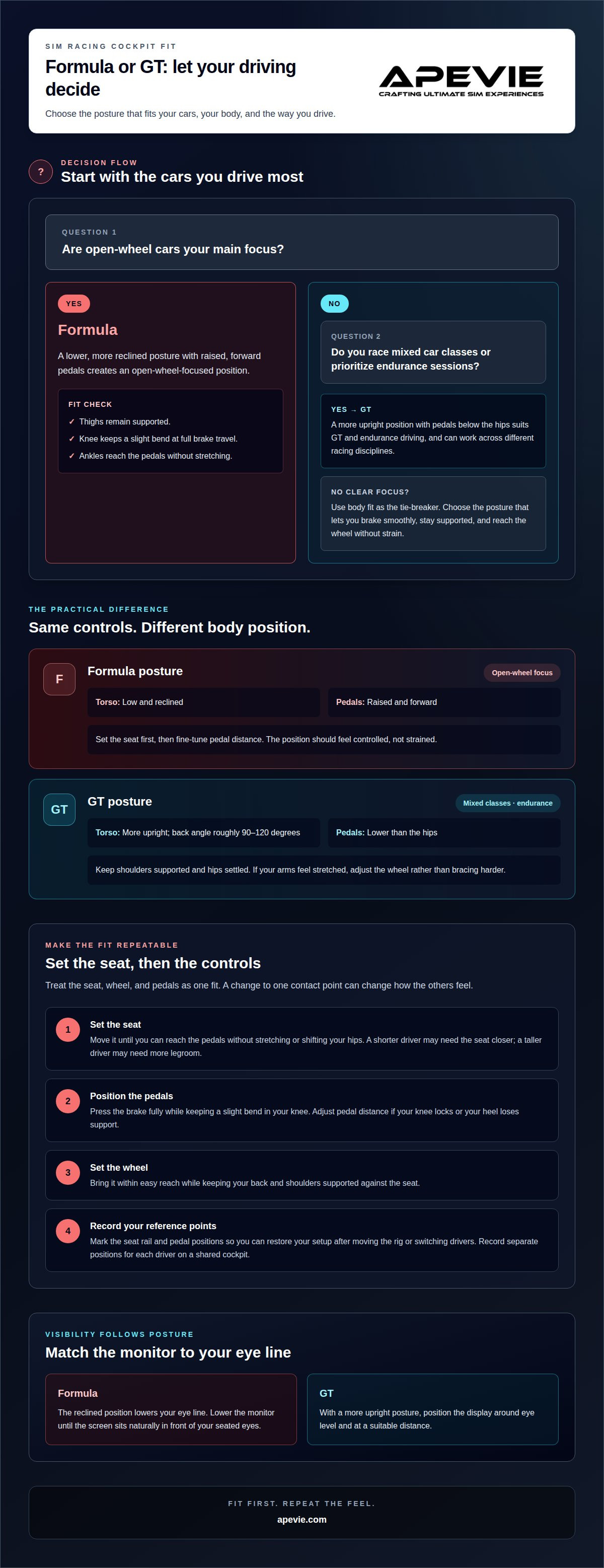
A Formula cockpit places you low and reclined, with your legs extended and your feet raised toward hip level. The pedals sit forward, creating a different leg position for braking and throttle inputs than in an upright GT rig. This geometry can make open-wheel racing feel more immersive, with your body oriented toward the controls as one cockpit system.
Set the seat so your thighs remain supported, then position the pedals so you can press the brake firmly without locking your knee. Keep a slight bend for controlled pressure changes, and avoid stretching your ankles to reach the pedal faces. Dedicated Formula cockpits may adjust the pedals rather than use a seat slider, so set your seat position before fine-tuning pedal distance.
How does seating position affect handling, control, and driver feedback? A stable back and supported thighs help you make smooth pedal inputs. Raised Formula pedals can also let you put body weight behind braking. Since the position changes how your legs move, the pedal travel should feel consistent, not strained.
A controllable posture matters throughout a sim racing session. Keep your knee slightly bent at full brake travel, support your thighs, and place the wheel within comfortable reach. If your leg straightens fully or your hips shift when braking, adjust the seat or pedals before driving.
| Option | Posture | Pedal placement | Best fit |
|---|---|---|---|
| Formula | Low and reclined | Raised, forward | Open-wheel focus |
| GT | More upright | Lower than hips | Mixed car classes |
Choose Formula for open-wheel immersion; choose GT for a more upright, adaptable driving position.
GT and endurance seating posture
A GT cockpit keeps the torso more upright than a dedicated Formula setup. The back angle is roughly 90-120 degrees, with the pedals below the hips. This posture suits GT and endurance driving, where supported shoulders and stable hips help maintain a consistent relationship with the wheel during longer stints.
Set the seat back so your shoulders stay supported and your hands reach the wheel comfortably. Keep your hips settled against the seat, then adjust the wheel if your arms feel stretched. In GT cars with frequent steering corrections, a stable upper-body position can help you avoid bracing through your shoulders.
How do Formula and GT seating positions affect comfort on long drives? A more upright GT posture resembles familiar seated positions and may reduce lower-back or neck strain for some drivers. A reclined Formula setup may become uncomfortable sooner if it does not provide suitable lumbar support.
GT also suits drivers who switch among car classes. One cockpit can work for GT racing, endurance events, and other disciplines without requiring a specialized open-wheel posture. For rally or drift, stay upright enough for quick hand movements and easy access to the shifter or handbrake.
- For endurance: Support your shoulders and keep your hips stable against the seat.
- For mixed racing: Choose a neutral posture that feels natural across the cars you drive.
- For shoulder fatigue: Bring the wheel slightly closer instead of gripping harder.
The GT position isn’t automatically comfortable just because it’s upright. Seat support, wheel reach, and pedal access all shape how your body feels over a long session. A GT-focused cockpit layout can help align those contact points around the driving you do most.
Seat reference points and repeatability
A racing cockpit stays consistent when the seat, wheel, and pedals return to familiar positions. Once you find a comfortable baseline, mark the seat rail and pedal positions. Use the marks after moving the rig or switching drivers.
Formula and GT seats can fit drivers with different heights and body types, but their adjustments differ. Set seat distance and pedal reach to suit each driver’s leg length, then place the wheel within comfortable arm’s reach. A shorter driver may need the seat closer, while a taller driver may need more legroom.
For a good fit, adjust the seat before fine-tuning the controls. Press the brake fully while keeping a slight bend in your knee. Then check that your back is supported and your shoulders stay relaxed as you hold the wheel.
- Set the seat: Move it until you can reach the pedals without stretching or shifting your hips.
- Position the pedals: Press the brake fully and adjust pedal distance if your knee locks or your heel loses support.
- Set the wheel: Bring it within easy reach, with your shoulders supported against the seat.
- Record the setup: Mark the seat rail and pedal positions so you can restore them after changes.
These reference points are useful when a sim racing session starts to feel different. If braking requires more reach after you adjust the seat, the pedals may need repositioning too. Treat the seat, wheel, and pedals as parts of one fit, not as isolated controls.
For a shared rig, record separate seat and pedal positions for each driver. A Formula layout may require pedal adjustment for different leg lengths, while a GT cockpit may let you move the seat along its rail. Set the wheel to match as well. Returning to these positions helps preserve comfort and familiar control feel between sessions.
How do Formula and GT driving positions affect visibility?
Your seat changes your eye point, so monitor placement should match your posture. A GT position keeps you more upright and may feel neutral across different racing categories. A reclined Formula position lowers your eye line, which can make a monitor mounted for GT driving feel too high.
For a Formula setup, lower the monitor until the screen sits naturally in front of your seated eye line. This keeps the simulated horizon in a comfortable viewing area. For GT driving, position the display around eye level and at a suitable distance for your field of view. The right placement depends on the rig, display, and your posture.
Adjust the screen after setting the seat, pedals, and wheel. When you switch from an upright GT position to a reclined Formula posture, your eyes move relative to the display. Recheck screen height and distance instead of relying on the previous position. A monitor that suits one posture may not suit the other.
- GT posture: Begin with the display at eye level, then set its distance to support your intended field of view.
- Formula posture: Check whether the lower eye line calls for a lower monitor mount.
- Mixed disciplines: Reassess screen placement whenever you change seating position.
Visibility also depends on matching the view to the car and game. A GT cockpit can feel more neutral when you switch racing categories, while a Formula setup focuses your sightline on open-wheel driving. Neither position guarantees better visibility on its own. Match the seated eye point to the monitor height and viewing distance.
Once the seat and screen align, review the in-game field of view from your normal driving posture. If the view feels too high, low, or distant, adjust the display position first, then reassess the cockpit. Explore simulator setup options for a configuration built around your preferred driving position.
Apevie Simulators
Apevie Simulators builds custom high-performance racing simulators around your preferred driving style. Its turnkey configurations bring cockpit priorities and equipment together, helping you consider the rig as a complete setup rather than a collection of separate components.
Heusinkveld Sim Pedals Sprint can be part of a build where pedal feel matters, while a Sigma Integrale DK2 Motion System is an option when motion is part of your goals. White-glove installation brings the finished simulator together in your space.
Contact Apevie Simulators to discuss a turnkey build suited to the racing you want to drive.
Build Around the Racing You Want to Do
Start by deciding how specialized your cockpit should be. If open-wheel racing dominates your sessions, a focused Formula layout can make the rig feel purpose-built. If you regularly switch car classes, prioritize a configuration that can adapt. The right choice in the formula vs GT seating position debate supports your driving habits now and allows room for your setup to evolve.
Apevie Simulators can build a custom high-performance rig around your driving style and equipment. Share your priorities, whether you want a dedicated cockpit or a broader simulator configuration. The goal is a considered fit, not a choice based on appearance alone.
Contact Apevie Simulators to discuss your simulator build and find a setup that feels right for the racing ahead.
Frequently Asked Questions
F1 Simulator vs GT-Style Sim Rig: Which Wins?
Neither position is a universal winner. Consider how you use the simulator in a typical week. If you mainly drive one class, a dedicated cockpit can keep the setup focused. If you drive several classes, consider how often you would reposition the controls. For a shared home rig, also consider whether each driver can use its adjustment points comfortably.
Is an F1® simulator more realistic?
It can feel more convincing during open-wheel sessions when the cockpit, controls, and game content work together. Realism also depends on details beyond the seat, including the steering wheel, pedal response, screen view, and how consistently the simulator is configured. A dedicated Formula build may suit an F1-focused driver, while a GT setup can still run F1 games effectively.
Making the Final Call: Which Rig is for You?
List the cars and games you return to most, then consider whether the rig will be shared. The formula vs GT seating position choice should suit your regular habits, not just an occasional session or the cockpit’s appearance. If your interests often change, favor adjustability. If they stay focused, a specialized layout can better match your preference.
Who is the GT position for?
The GT position is a practical choice for drivers who want a familiar cockpit for varied sim racing. It can suit a first premium rig, a shared setup, or a home space where one simulator serves several driving interests. Drivers with back discomfort may also find a conventional seated posture easier to adapt to than a deeply reclined layout.
What is the difference between Formula and GT seating positions?
The main difference is cockpit geometry: Formula places the driver in a more reclined position, while GT is more upright. This changes the eye point and the relationship among the seat, controls, and display. For example, switching between the styles may require a different monitor height, even when you keep the same screen.
What are the typical seat angles in Formula and GT cars?
A GT-style sim position commonly places the driver’s back at roughly 90-120 degrees. Formula seating is described as more reclined, with the feet raised toward hip level. Treat those descriptions as starting points for simulator fit, not exact measurements for every real car. Seat shape, driver proportions, and control placement all affect the angle that feels workable in a cockpit.