Motion Platforms Buying Guide: Elevating Professional Sim Racing in 2026
If your motion system merely shakes your rig when you clip a curb, is it actually helping you find the limit, or is it just a noisy distraction? Many enthusiasts invest heavily in motion platforms only to realize they've purchased a vibration kit rather than a sophisticated telemetry-delivery system. You need to feel the subtle weight transfer and the precise moment your rear tires lose traction to truly master a car. Professional racing requires more than just movement; it demands the kind of high-fidelity feedback that informs your muscle memory and sharpens your instincts.
We understand that the technical jargon surrounding Degrees of Freedom and actuator speed can be overwhelming. This guide simplifies those complexities to help you choose a system that provides professional-grade immersion. You'll discover how high-end solutions like the Sigma Integrale DK2+ or the D-BOX G5 transform digital data into physical reality. We'll explore everything from rig rigidity to the ROI of full-chassis movement versus seat movers. By the end, you'll have the clarity needed to select a turnkey setup that bridges the gap between simulation and the track.
Key Takeaways
- Distinguish between simple vibration and telemetry-driven movement to ensure your system provides actionable feedback for improved car control.
- Master the framework for evaluating motion platforms by calculating total payload and assessing the structural integrity of your aluminum profile chassis.
- Compare the technical specifications of industry leaders like Sigma Integrale and D-BOX to match your performance requirements with the right actuator travel.
- Recognize why a professional 40-series foundation and precise cable management are essential for a reliable, snag-free motion experience.
- Learn how a turnkey build and white-glove installation service can eliminate the complexities of integrating high-end haptics into your simulator.
Understanding Motion Platforms: Degrees of Freedom (DOF) Explained
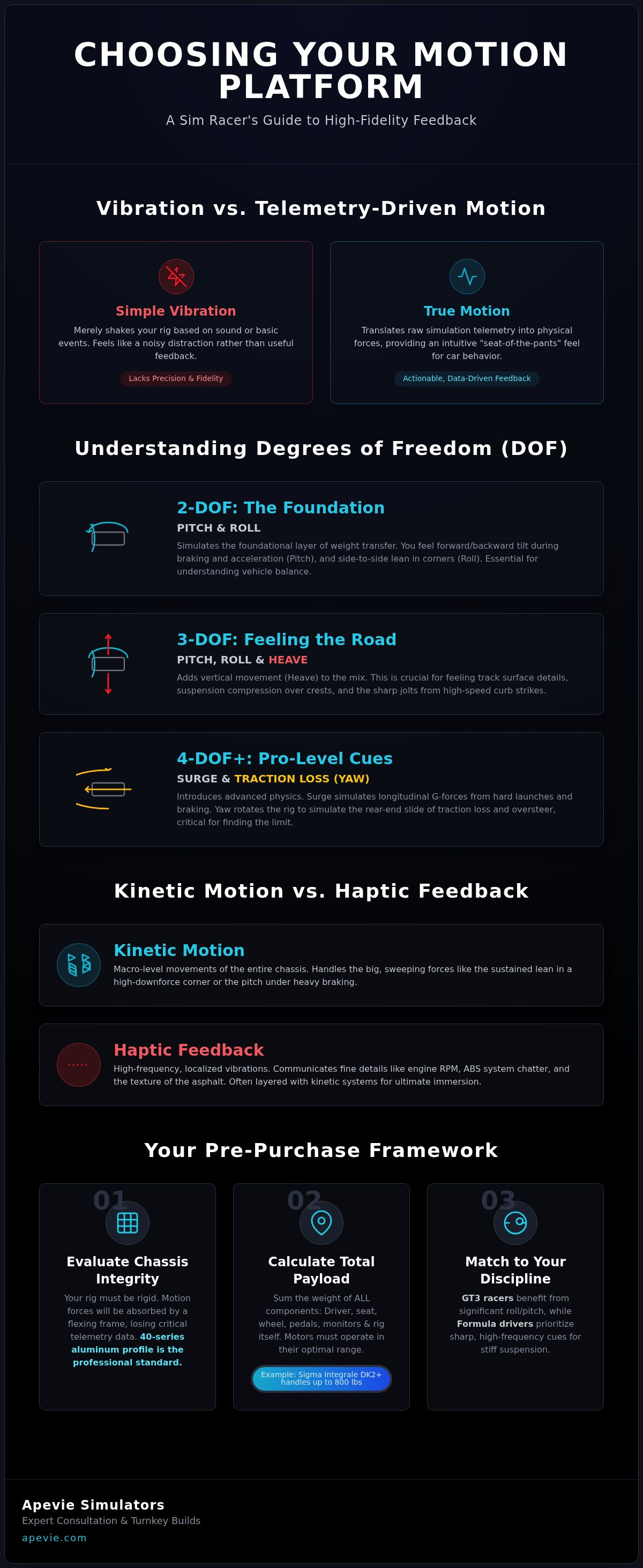
True motion platforms are data translators. They take raw telemetry from the simulation and convert it into physical forces that your body interprets as speed, grip, and momentum. Unlike simple vibration motors that react to sound, these systems use Motion simulator technology to physically tilt and lift your entire rig. This movement provides the "seat-of-the-pants" feel that's often missing in static setups, allowing you to react to the car's behavior before your eyes even register the change on screen.
The most common entry point for serious enthusiasts is a 2-DOF configuration. This setup manages Pitch and Roll; the forward and backward tilt during braking and acceleration, and the side-to-side lean during cornering. It's the foundational layer for feeling weight transfer. However, professional-grade training often requires 3-DOF or higher. By adding Heave, or vertical movement, you can finally feel the compression of the suspension over a crest or the sharp jolt of a high-speed curb strike. Advanced systems that reach 4-DOF or 6-DOF introduce Surge and Traction Loss, simulating the longitudinal forces of a hard launch and the rear-end rotation of a slide. These high-end motion platforms prioritize fidelity over travel, ensuring you get the data you need exactly when you need it.
- 2-DOF: Focuses on Pitch and Roll to simulate basic weight transfer.
- 3-DOF: Adds Heave to communicate track surface changes and vertical suspension travel.
- 4-DOF+: Introduces Surge and Traction Loss (Yaw) for realistic oversteer and longitudinal G-forces.
The Science of Motion Cueing
Your brain is incredibly sensitive to the mismatch between what your eyes see and what your inner ear feels. This is why motion cueing is a delicate balance. High-end systems use washout filters, which are software algorithms that slowly return the platform to its neutral position after a movement. If done correctly, your vestibular system doesn't detect the return, leaving you ready for the next force. In professional sim racing, less is often more. Excessive movement just adds latency; you want sharp, accurate cues that inform your driving without overwhelming your senses. This pursuit of total sensory alignment is what makes professional simulation so compelling, much like the physical immersion found in the escape rooms created by Prizoners.
Haptics vs. Kinetic Motion
It's vital to distinguish between kinetic motion and haptic feedback. Kinetic motion handles the macro movements, like the long, sweeping lean of a high-downforce corner. Haptics deal with high-frequency data, such as engine RPM or the chatter of an ABS system. While premium actuators like the Sigma Integrale DK2+ can handle some haptics, many professionals layer their setups. They use primary actuators for chassis movement and dedicated haptic pucks for localized vibrations. This multi-layered approach ensures that a heavy curb strike doesn't drown out the subtle feel of the tires scrubbing across the asphalt.
The Buying Framework: How to Choose Your Motion System
Selecting the right hardware for your simulator isn't just about looking at peak velocity or actuator travel. It's an engineering decision that starts with your foundation. Before you invest in motion platforms, you must evaluate the structural integrity of your current chassis. An aluminum extrusion rig, specifically one built with 40-series or 80/20 profile, is the industry standard for a reason. Tube frames often suffer from micro-flexing under the intense forces of high-speed actuators, which absorbs the very telemetry data you're trying to feel. If your rig flexes, you lose the "seat-of-the-pants" fidelity required for professional-level training.
Once your chassis is verified, your next step is a precise payload calculation. This isn't just your body weight; it's the sum of your seat, wheel base, pedals, monitors, and the rig itself. Systems like the Sigma Integrale DK2+ are designed to handle up to 800 lbs, ensuring the motors operate within their optimal performance envelope without overheating or losing step-rate accuracy. This level of precision is why advanced simulation research utilizes similar motion tech to study human reaction times and vehicle dynamics. Your choice should also reflect your primary racing discipline. GT3 racers benefit from significant roll and pitch to simulate weight transfer, while Formula drivers often prioritize high-frequency, low-amplitude cues that mimic a stiff, high-downforce suspension.
Seat Movers vs. Full Cockpit Motion
You'll encounter two main philosophies: seat movers and full cockpit platforms. Seat movers are often more affordable and compact, but they only move the driver. This creates a disconnect because your hands and feet stay stationary while your body moves, which can interfere with muscle memory during counter-steering. Full cockpit motion moves the entire assembly, including the wheel and pedals. This preserves the physical relationship between your inputs and the car's response, making it the superior choice for serious drivers who want their sim sessions to translate directly to real-world track performance.
Actuator Technology: Electric vs. Hydraulic
In 2026, high-speed electric linear actuators have largely superseded hydraulic systems in the premium market. Electric systems, such as those found in the D-BOX G5, offer near-instant response times with zero maintenance and no risk of fluid leaks. They're also significantly quieter, making them ideal for home environments where noise is a concern. When comparing systems, look for actuators that offer a high "hz" rating for haptic response, allowing you to feel engine rumbles and tire scrub alongside the larger kinetic movements of the car. If you're unsure which configuration fits your space and goals, seeking an expert consultation can prevent costly compatibility errors during your build.
Standout Motion Systems: Sigma Integrale and D-BOX G5
When you're pushing a GT3 car through a high-speed corner, every millisecond counts. While many manufacturers focus on how far their motion platforms can move, the real differentiator is how quickly they react. End-to-end latency, the time it takes for a telemetry change in the sim to result in physical movement, is what separates professional training tools from expensive toys. In the current market, two names dominate the conversation for high-fidelity response: Sigma Integrale and D-BOX.
Sigma Integrale has set a high bar with their DK series. The DK2 remains a favorite for its 2-inch travel, but the DK2+ is the gold standard for haptic motion in 2026. For those seeking a versatile, multi-axis setup, the DOF Reality Pro Series offers a unique way to achieve complex movement, though it lacks the sheer industrial refinement of the top-tier systems. Choosing between these isn't about which is better in a vacuum. It's about matching the actuator's characteristics to your rig's weight and your specific racing goals.
Sigma Integrale DK2+ Deep Dive
D-BOX G5 systems, including the 2250i and 4250i, approach simulation from a haptic-first perspective. They're the only systems officially licensed by the FIA, which speaks volumes about their authenticity and accuracy. The G5 series uses a single Haptic Bridge to control up to four actuators, which simplifies wiring and reduces the clutter of your sim room. The tactile feedback is unique; it combines kinetic movement with high-frequency vibrations. This means you feel the engine's RPM and tire scrub through the same unit that's tilting your rig into a corner. At Apevie Simulators, we specialize in integrating D-BOX into our custom builds, ensuring the software and hardware are tuned to eliminate latency and maximize the "seat-of-the-pants" feel.
Reducing the delay between the virtual car's actions and your physical perception is the ultimate goal. Whether you prefer the raw, mechanical speed of Sigma Integrale or the nuanced, FIA-licensed haptics of D-BOX, both systems provide the data delivery required for professional-grade sim racing.
Integration Requirements: Is Your Rig Ready for Motion?
Installing high-performance motion platforms isn't a simple bolt-on procedure. It's a structural transformation. When a system like the Sigma Integrale DK2+ fires its actuators to simulate a hard curb strike, the peak forces can be violent. If your cockpit isn't built to withstand these stresses, the energy meant for your body will dissipate into the frame through flex. This not only ruins the fidelity of the telemetry data but can eventually lead to fatigue cracks in the metal or loosening bolts over time.
Beyond the frame, you must consider the logistical realities of a moving simulator. A high-travel system requires a significant radius of clear space. Cable management becomes a critical safety concern; a single loose USB or power lead can easily snag during a maximum pitch or heave movement, causing hardware damage or system crashes. We recommend a systematic approach to your integration:
- Structural Integrity: Reinforce every profile joint with steel gussets to handle multi-axial torque.
- Cable Clearance: Use high-flex braided sleeving and drag chains to prevent "the snag" during 6-DOF travel.
- Power Stability: Check your electrical capacity; a full-motion rig with triple monitors can approach the limits of a standard 15-amp household circuit.
- Vibration Isolation: Use industrial-grade isolation mounts to protect your floorboards and reduce noise for others in the building.
Rig Rigidity and Reinforcement
Identifying flex points is the first step in preparing your foundation. Most standard rigs exhibit movement in the wheel deck and pedal plate under heavy load. When adding motion, these issues are magnified significantly. We insist on a 40-series (or higher) aluminum profile foundation as the bare minimum. You should reinforce every major joint with heavy-duty brackets to handle the intense motion torque. For a deeper look at structural requirements, read our Ultimate Sim Rig Guide to ensure your chassis is truly professional-grade.
Software and Telemetry Tuning
Hardware is only half the battle. The software layer, such as Sim Racing Studio or proprietary drivers from D-BOX, determines how that telemetry feels in the seat. Tuning is highly subjective and varies between titles. For instance, iRacing provides very clean telemetry that benefits from high-frequency haptic detail. In contrast, Assetto Corsa Competizione often requires more aggressive smoothing to prevent the actuators from feeling overly mechanical. Balancing these cues is an art form that transforms a vibrating chair into a precision instrument. You can learn more about this in our Professional Guide to Haptic Systems. If you want to skip the trial and error, you can consult with our installation experts to have your system professionally calibrated for your favorite titles.
High-performance actuators can transmit significant vibrations through the floor. Using high-density rubber matting is essential to protect your home's structure and keep the noise levels acceptable. A well-integrated rig doesn't just move; it communicates with clarity and stability.
The Apevie Advantage: Expert Consultation and Turnkey Builds
Choosing between various motion platforms is rarely a simple matter of clicking a button. At this level of performance, you aren't just buying actuators; you're investing in a complex ecosystem where every component must communicate perfectly. A Sigma Integrale system paired with a Simucube 3 wheel base and a Gomez Sim Industries (GSI) Formula Pro Elite wheel requires precise calibration to ensure the haptic signals don't conflict. We view every project as a deep consultation. Our goal is to understand your specific racing goals, whether you're training for a real-world GT3 season or seeking the ultimate home immersion for 2026.
Your final decision should be guided by a clear framework based on your primary discipline. If your goals involve endurance racing, a system like the D-BOX G5 offers the subtle haptic detail needed to manage tire wear over long stints. For those focused on rally or flight simulation, the greater travel of a Sigma Integrale system might be more appropriate. We help you navigate these nuances, ensuring the hardware matches your physiological needs and your simulator's physical footprint. Our white-glove installation service removes the technical burden, handling structural reinforcement and the complex cable routing required for 6-DOF travel.
Turnkey Motion Solutions
The turnkey packages from Apevie Simulators represent the pinnacle of sim racing convenience. We don't just ship boxes; we deliver a fully tested, pre-configured environment. This includes ensuring total software-to-hardware synergy between your high-performance PC, the motion controllers, and peripheral haptics. Whether we're integrating Heusinkveld Sim Pedals Ultimate+ or a Cube Controls F-Core wheel, every input is calibrated to work in harmony with the motion cues. Our systems come with comprehensive support and warranty coverage, providing the peace of mind that high-end investments deserve. We ensure your rig remains a stable, reliable platform for years of competitive use without the headache of constant troubleshooting.
Get Started with Professional Motion
The journey toward a motion-equipped studio begins with an honest assessment of your available space and electrical capacity. Once the foundation is settled, you can Browse our Motion Platforms to see the specific hardware we trust for our professional builds. If you're ready to move beyond off-the-shelf parts and generic setups, we invite you to reach out for a professional consultation. We'll help you design a custom turnkey solution that integrates the latest technology into a seamless, high-performance reality. Contact Apevie Simulators today to discuss your custom build or to schedule a white-glove installation that brings professional-grade motion to your home.
Mastering the Physics of Professional Simulation
Transitioning from a static setup to a dynamic one represents a fundamental engineering shift. Throughout this guide, we've explored how motion platforms serve as sophisticated telemetry-delivery systems rather than simple vibration kits. By mastering the nuances of actuator travel and haptic integration, you ensure that every physical cue translates directly into refined muscle memory and faster lap times on the track. This technical clarity is what separates a gaming setup from a true professional training tool.
As an authorized dealer for both Sigma Integrale and D-BOX, Apevie Simulators provides a level of expertise that goes beyond a standard retail transaction. Our curated PC-only builds are engineered for the most demanding motorsport-grade components, ensuring that your hardware works in absolute harmony. If you're ready to eliminate the technical complexity of high-end haptics, Shop the Full Collection of Professional Motion Platforms or contact our team for a professional consultation. Our expert white-glove installation is available to bring this level of precision directly to your sim room, ensuring your journey into professional motion is seamless and performance-focused.
Frequently Asked Questions
Do motion platforms actually make you faster in sim racing?
Motion platforms can indeed lead to faster lap times by providing immediate physical feedback that visual cues alone cannot match. This "seat-of-the-pants" feel allows you to detect rear-end rotation or tire slip milliseconds before it registers on your monitor. By reacting faster to these telemetry-driven cues, you develop better car control and more consistent muscle memory. It's not just about immersion; it's about receiving the data necessary to stay on the limit.
Will a motion platform work with my existing aluminum profile rig?
Most high-quality aluminum profile rigs are compatible with motion systems, provided they use a 40-series profile or higher. The structural integrity of an 80/20 foundation is essential to prevent the frame from flexing under the torque of high-speed actuators. If you currently own a lightweight tube frame or a thin-walled profile rig, you might need structural reinforcements or a chassis upgrade to ensure the motion forces aren't lost through mechanical play.
What is the difference between 2-DOF and 3-DOF motion platforms?
A 2-DOF system focuses on Pitch and Roll, simulating the forward tilt of braking and the side-to-side lean of cornering. A 3-DOF system introduces Heave, which provides vertical movement. This third axis is critical for feeling track surface details, such as road textures, curb strikes, and suspension compression over crests. Adding Heave transforms a tilting chair into a platform that communicates the physical reality of the asphalt beneath your tires.
Do I need special software to run a Sigma Integrale or D-BOX system?
Both Sigma Integrale and D-BOX systems require specialized software to translate game telemetry into physical movement. Sigma Integrale typically utilizes Sim Racing Studio, while D-BOX uses its proprietary GameCenter and MotionCore drivers. These applications allow you to fine-tune the intensity of specific cues like engine rumble or gear shifts. Without this software layer, the actuators wouldn't know how to interpret the data coming from titles like iRacing or Assetto Corsa Competizione.
Is motion sickness common with sim racing motion platforms?
Motion sickness can occur during the initial adjustment period, but it's often mitigated through professional tuning and the use of "washout filters." These software algorithms return the rig to a neutral position so subtly that your inner ear doesn't detect the movement. We recommend starting with shorter sessions and lower intensity settings. As your brain adapts to these cues, most users find that motion platforms actually reduce the disorientation common in static VR setups.
How much space do I need for a full-motion simulator setup?
You'll need a dedicated clearance radius around your simulator to account for the maximum travel of the actuators. For a standard 4-actuator setup, a space of approximately 8 feet by 5 feet is usually sufficient. It's vital to ensure no furniture or walls are within the "strike zone" of the rig's pitch and roll limits. Additionally, you should leave extra room for cable slack to prevent tension during high-amplitude movements like 6-DOF surge or heave.
Can I add motion to my rig later, or do I need to buy it all at once?
You can absolutely add motion to your rig later if your initial chassis is built with a motion-ready foundation. Starting with a high-quality aluminum extrusion rig allows you to upgrade in stages, beginning with a 2-DOF seat mover or a basic actuator kit. However, buying a turnkey solution all at once ensures that every component is pre-configured for synergy. This avoids the common compatibility headaches that arise when mixing different hardware generations or software ecosystems.
What maintenance is required for professional-grade linear actuators?
Modern electric linear actuators, like those from Sigma Integrale or D-BOX, are designed to be virtually maintenance-free. Unlike older hydraulic systems that required fluid checks and seal replacements, these units use sealed ball screws and high-performance electric motors. You'll only need to perform occasional inspections of the mounting bolts and cable connections to ensure nothing has vibrated loose. This reliability is a primary reason why professional-grade electric actuators have become the industry benchmark for 2026.