Professional Racing Simulator Package Buying Guide: Choosing Your Turnkey Rig in 2026
Buying the most expensive steering wheel and wheelbase separately doesn't guarantee a faster lap time or a realistic feel. Often, a mismatched collection of high-end parts leads to more time spent troubleshooting software than hitting apexes. You've probably felt the frustration of analysis paralysis while researching a professional racing simulator package, worrying if your chosen frame can actually handle the immense torque of a modern direct drive motor without flexing.
Selecting a turnkey system shouldn't feel like a second job. We know you want a rig that replicates the visceral feedback of a real race car without the headache of complex driver updates or calibration. This guide will teach you how to evaluate high-performance ecosystems and select a package that delivers professional-grade results from the moment it's installed. We'll examine the latest 2026 standards, including Simucube 3 wheelbases and Heusinkveld Sim Pedals Ultimate+, to help you find a rig that fits your home as perfectly as it fits your driving style.
Key Takeaways
- Learn why a professional-grade rig is a calibrated ecosystem where chassis rigidity and software optimization are just as critical as the hardware itself.
- Discover why Direct Drive wheelbases with 20Nm+ torque and high-fidelity pedals like the Heusinkveld Sim Pedals Ultimate+ are the non-negotiable standards for 2026.
- Understand the technical differences between 3DOF, 4DOF, and 6DOF motion systems to determine which configuration best simulates traction loss for your training.
- Evaluate the "Time vs. Money" calculation to see how a professional racing simulator package saves over 40 hours of assembly while providing expert-level force feedback calibration out of the box.
- Compare flagship turnkey solutions like the AS1 6DOF and AS4 5DOF to find the perfect balance between GT training realism and high-end aesthetic integration.
What Defines a Professional Racing Simulator Package?
A Sim racing setup isn't just a collection of parts; it's a precision instrument. A true professional racing simulator package is a turnkey system where the chassis, electronics, and software are pre-integrated and calibrated to work in harmony. It's the difference between a technical project and a performance tool. We define a professional simulator as a sophisticated platform for muscle memory development and technical driver training.
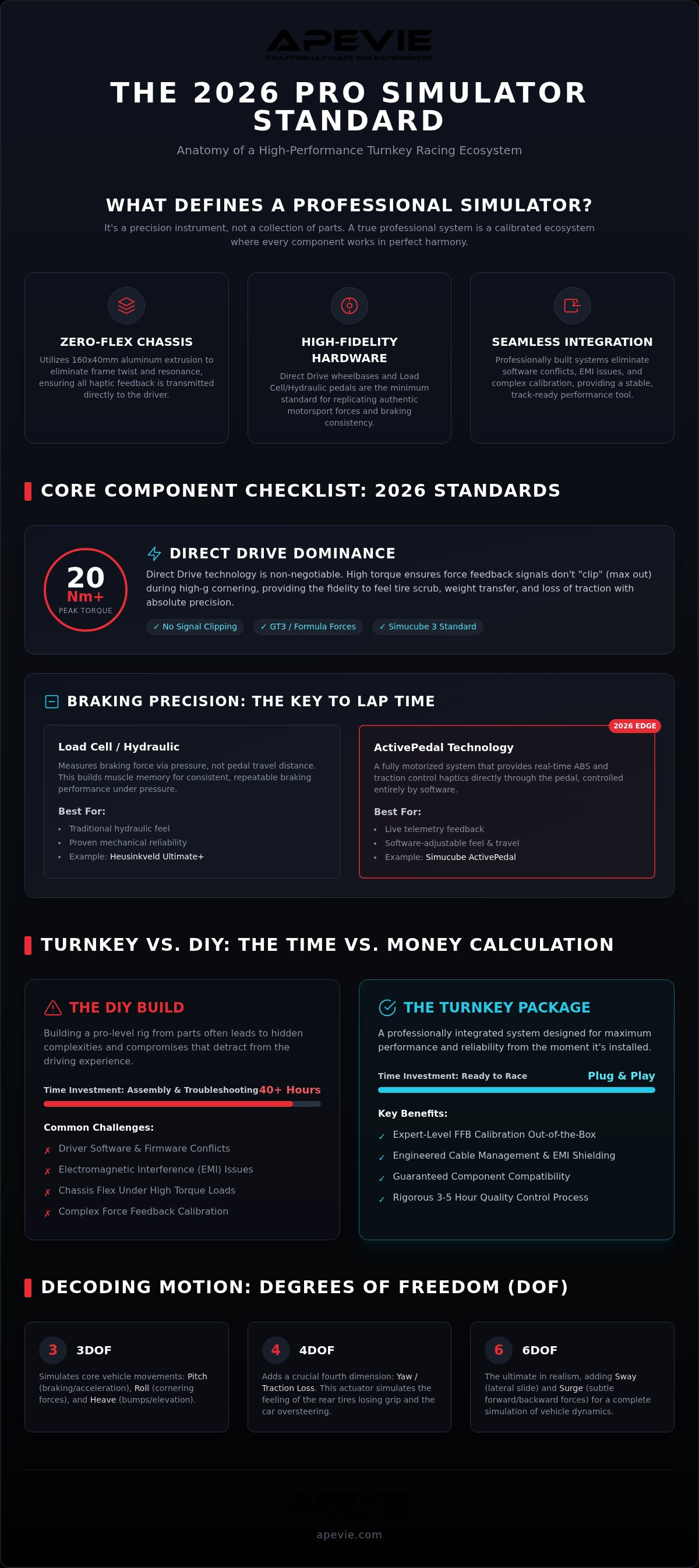
To meet the professional standard, hardware must pass specific technical benchmarks. This starts with a Direct Drive wheelbase capable of at least 20Nm of peak torque, such as the Simucube 3 Pro. Anything less fails to replicate the heavy steering rack forces found in GT3 or Formula machinery during high-speed cornering. Pedals must use Load Cell or Hydraulic sensors, like the Heusinkveld Sim Pedals Ultimate+, to prioritize braking consistency through muscle memory pressure rather than pedal travel distance. This PC-focused architecture provides the telemetry depth required for serious software like iRacing and Assetto Corsa Competizione, allowing for real-time data analysis that console hardware simply cannot match.
The Role of Rig Rigidity and Aluminum Extrusion
High-torque motors like the Simucube 3 Ultimate generate forces that can twist a standard gaming desk or a thin steel frame. Professional packages utilize 160mm x 40mm aluminum extrusion profiles to eliminate flex entirely. If the chassis moves, you lose the subtle haptic feedback meant for your hands. Chassis resonance is another factor; a rigid frame ensures that every vibration from the Sigma Integrale DK2+ motion system reaches the driver instead of being absorbed by a vibrating frame.
Turnkey Integration vs. DIY Components
Building a high-end rig yourself often leads to hidden complexities like driver software conflicts or Electromagnetic Interference (EMI) that disrupts signal quality between the wheelbase and pedals. Professional packages solve this through engineered cable management and shielding, ensuring your professional racing simulator package remains stable during intense sessions. These systems include pre-configured gaming PCs equipped with optimized RTX 40 or 50-series GPUs to maintain high frame rates on triple monitor setups. Every Apevie build undergoes a rigorous 3-5 hour QC process. We map every button on wheels like the GSI Formula Pro Elite and calibrate every actuator to ensure the system is ready for the track the moment you power it on.
Core Components: Evaluating the High-Performance Ecosystem
A professional racing simulator package is only as strong as its weakest link, requiring a balanced ecosystem of high-fidelity parts. While the chassis provides the structural skeleton, the electronic components serve as the central nervous system. Selecting high-performance hardware isn't about picking the most expensive items on a list. It's about finding tools that translate digital telemetry into physical sensations without lag or signal loss.
Direct Drive Dominance: Simucube 3 and Beyond
Direct Drive technology is the non-negotiable standard for professional feedback. The Simucube 3 Ultimate, featuring 25Nm of torque, provides the fidelity needed to feel tire scrub and weight transfer with surgical precision. Lower-powered bases often clip the signal when cornering forces peak, but a high-torque motor maintains the overhead required to simulate the heavy steering of a high-downforce GT3 or Formula car. Pairing this base with elite steering wheels like the GSI Hyper P1 or the Simucube Valo GT-23 ensures that every tactile encoder and telemetry display provides vital data at high speeds. Tactile encoders on these wheels allow you to adjust brake bias or traction control on the fly without looking away from the track, providing the same ergonomic advantage as a real motorsport steering wheel.
Braking Precision: Heusinkveld and Simucube ActivePedals
Braking is where lap times are found, and consistency is the priority. The Heusinkveld Sim Pedals Ultimate+ use a sophisticated load cell system to measure pressure rather than pedal travel, mirroring the feel of a real racing brake stack. For those seeking the absolute edge in 2026, Simucube ActivePedal technology introduces a fully motorized system. This allows for real-time ABS and traction control haptics felt directly through the pedal face. Input precision is guaranteed through these configurations:
- Heusinkveld Ultimate+: Ideal for drivers who prefer a traditional hydraulic feel and mechanical reliability.
- Simucube ActivePedal: Best for drivers who want software-adjustable travel and live telemetry haptics for ABS.
Visual Immersion and Field of View
Your monitor strategy dictates your spatial awareness and ability to judge braking points. Triple 55-inch displays offer a 180-degree field of view, which is essential for door-to-door racing. In contrast, an ultrawide curved display provides a seamless image that works well in space-constrained professional environments. Accurate FOV settings ensure the distance to the apex looks the same on screen as it does in reality. This geometric accuracy helps your brain calculate speed and distance instinctively, reducing the learning curve when switching between different tracks. If you're looking for a setup that integrates these high-end components into a ready-to-race system, exploring our professional racing simulator package options is the most effective path to performance.
Motion Systems Explained: 3DOF vs. 4DOF vs. 6DOF
Motion systems are often the most misunderstood part of a professional racing simulator package. Many buyers assume that more movement always equals better immersion, but in a professional context, motion is about data delivery, not just a thrill ride. The goal is to provide the driver with physiological cues that trigger instinctive reactions. When your body feels the weight transfer before your eyes register the car's rotation, your lap times become more consistent.
A 3DOF (Degrees of Freedom) setup serves as the foundation for high-fidelity haptics. It covers Pitch, Roll, and Heave. Pitch simulates the nose-dive under braking and lift during acceleration. Roll provides the sensation of lateral lean in corners. Heave is perhaps the most vital for realism; it translates vertical track data like curbs, expansion joints, and road texture directly into the chassis. Without heave, the car feels like it's floating rather than gripping the tarmac.
Stepping up to 6DOF adds Surge and Sway, providing full spatial orientation. Surge replicates the longitudinal G-forces felt during sustained acceleration or heavy braking, while Sway handles the lateral forces of high-speed sweeps. For those using a simulator for professional flight training alongside racing, 6DOF is the only way to accurately model the physics of flight. It ensures the vestibular system is fully engaged, which is critical for preventing motion sickness and building genuine skill.
Why Traction Loss is Critical for Driver Development
For serious GT or formula training, 4DOF is often the preferred configuration because it introduces Traction Loss. This simulates the rear end of the car breaking away, providing that elusive "seat of the pants" feel. It's the only way to catch a slide before your eyes even register the movement on screen. Our AS4 5DOF system utilizes the QS-CH2 platform to provide dedicated traction loss, allowing drivers to explore the limit of grip with confidence. You can learn more about these nuances in The Professional Guide to Haptic Systems in High-Performance Simulation.
Qubic System vs. Sigma Integrale: Actuator Technology
The hardware driving these movements varies significantly in philosophy. Sigma Integrale DK2+ and DK6+ systems are renowned for their incredible response times. They're designed to handle high-frequency road vibrations, making them feel extremely organic and connected to the track surface. This is why elite hardware standards, such as those found at SimCraft, prioritize this level of tactile fidelity.
In contrast, Qubic System actuators, such as the QS-220, are engineered to handle the heavy loads of full-cockpit motion without sacrificing speed. They offer a larger travel range, which is beneficial for simulating significant elevation changes or the violent jolts of off-track excursions. Whether you choose the surgical precision of Sigma or the robust power of Qubic, both represent the gold standard found in Pro-Sim level hardware. Selecting the right actuator depends on whether you prioritize subtle road feel or large-scale physical movement.
Turnkey vs. DIY: Addressing the #1 Objection
Choosing between a custom build and a professional racing simulator package often comes down to how you value your time. While the DIY route seems cost-effective on paper, the reality of assembling a high-torque rig is a 40+ hour commitment. This estimate doesn't include the weeks spent chasing driver conflicts or refining force feedback profiles to find a realistic feel. When you buy a turnkey system, you're buying an engineered result rather than a technical project.
Professional calibration is the silent hero of a high-end rig. A Simucube 3 base feels entirely different when tuned by a professional who understands how to balance damping, friction, and inertia to match a specific GT3 or Formula car. Stock settings are often too raw or artificially heavy. Furthermore, having a single point of contact for support is invaluable. If a component fails on a DIY rig, you're often stuck in the middle of "finger-pointing" between different hardware manufacturers. With a turnkey solution, one expert team handles the entire ecosystem.
Aesthetics also play a significant role in a professional environment. A DIY setup often looks like a "gaming corner" with a bird's nest of cables and exposed power bricks. Our turnkey builds feature integrated cable management and custom mounting solutions that turn the simulator into a centerpiece for a luxury home or professional office. If you're ready to skip the troubleshooting and start training, you can explore our turnkey racing simulator packages to see the difference a professional build makes.
The Engineering Behind the Build
High-end electronics are incredibly sensitive to their environment. Apevie experts manage EMI (Electromagnetic Interference) through dedicated grounding and shielded cabling to prevent ghost inputs that can ruin a qualifying lap. We also perform deep software optimization, stripping Windows of all bloatware and background processes. This ensures 0.1% low frame rate stability, meaning you won't experience a micro-stutter at the most critical point of a corner. Our White Glove installation service goes beyond delivery; it includes on-site setup, driver training, and precise ergonomic adjustments to ensure the seat, pedals, and wheel are perfectly positioned for your physique.
Future-Proofing Your Investment
A common fear is that a turnkey system might become obsolete. However, our rigs use modular aluminum extrusion, such as the AS X1 chassis, which allows for hardware upgrades without replacing the foundation. You can easily swap out a steering wheel for a Precision Sim Engineering rim or upgrade your pedals as new technology emerges. Recognized turnkey brands also maintain a much higher resale value than unbranded DIY builds. Buyers on the secondary market prioritize the peace of mind that comes with a system engineered by experts to a specific technical standard.
Top Apevie Turnkey Simulator Packages for 2026
Choosing a professional racing simulator package requires matching the hardware's capabilities to your specific training goals. Apevie offers a range of engineered ecosystems designed for different space requirements and budget levels without compromising on technical standards. These systems arrive fully assembled, calibrated, and ready for the first green flag.
The Elite Tier: AS1 and AS2 6DOF Systems
The AS1 6DOF Racing Simulator represents the pinnacle of our current offerings. It features the Simucube 3 Ultimate wheelbase and the ultra-premium GSI Hyper P1 steering wheel. Built on the heavy-duty QS-S35 motion system, this $134,999 rig provides the most complete spatial orientation available today. Every AS1 includes Apevie X1 Carbon Fiber seats to ensure maximum chassis rigidity. This is essential for feeling the high-frequency haptics of the actuators without the frame absorbing the data. If space is a concern, the AS2 'Spider' motion cockpit offers a more compact footprint while maintaining full 6DOF movement, making it ideal for luxury home environments where floor space is at a premium.
Versatile Performance: AS3 and AS4 Series
For those focused on GT and touring car training, the AS3 and AS4 series provide a balance of motion and value. The primary difference lies in the degrees of freedom. While the 4DOF AS3 handles pitch, roll, heave, and surge, the AS4 5DOF system adds a dedicated traction loss platform. This allows you to feel the rear end break away, which is a critical cue for mastering oversteer. Both systems utilize Simucube 3 Pro bases and Heusinkveld pedals as standard. This ensures your inputs are as precise as the motion feedback you receive from the chassis.
The Haptic Showcase and Professional Entry
The AS X1 Turn-key is our most advanced haptic showcase. It combines the Sigma Integrale DK6+ system with Simucube ActivePedals. This setup allows you to feel ABS pulses and traction control intervention directly through the pedal face, providing a level of immersion that mechanical pedals can't replicate. For drivers transitioning from high-end console setups to serious PC simulation, the Apevie SP-2 Package serves as the ideal professional entry-point. It removes the complexity of DIY builds while providing the foundation needed for competitive iRacing. You can browse the full Turn-Key Package collection here to compare specific component lists and find the right fit for your simulator room.
Engineering Your Ultimate Competitive Edge
We've explored how a calibrated ecosystem outperforms a collection of loose parts. From understanding the physics of 6DOF motion to selecting the right Direct Drive wheelbase, the choice of a professional racing simulator package is about prioritizing driver development over technical troubleshooting. You now have the technical framework to distinguish between simple gaming bundles and engineered training tools like the flagship AS1 or the haptic-focused AS X1 systems.
Ready to transform your training room? Explore Our Professional Turnkey Simulator Packages today and experience the pinnacle of motorsport simulation.
Frequently Asked Questions
What is included in a turnkey racing simulator package?
A turnkey professional racing simulator package includes a rigid aluminum extrusion chassis, a high-torque direct drive wheelbase like the Simucube 3, and professional pedals such as Heusinkveld Sim Pedals Ultimate+. It also encompasses a motion system, a formula or GT steering wheel, and a pre-configured high-end PC. We include all mounting hardware and cables, ensuring the system arrives pre-calibrated with software and drivers already optimized for immediate use.
Can I use a professional racing simulator with an Xbox or PS5?
Most professional-grade components are designed for PC to handle complex telemetry and high-fidelity motion data. While specific Fanatec wheelbases offer console compatibility, a full motion system requires a PC to run specialized haptic software. We focus on PC-based systems because they offer the depth of data needed for genuine driver training. This architecture allows for the high refresh rates required for professional software like iRacing.
How much space do I need for a motion simulator rig?
You generally need a dedicated floor area of approximately 2.5 meters by 2 meters for a standard motion rig. This provides enough clearance for the physical travel of the actuators and the monitor stand. If you choose a large triple 55-inch monitor setup, you should plan for additional width. It's vital to ensure there is at least 30cm of safety clearance around the moving parts of the chassis.
Is it better to buy a turnkey system or build my own sim rig?
A turnkey system is better for those who prioritize training time over technical assembly projects. Building your own rig often involves over 40 hours of labor and significant troubleshooting regarding driver conflicts or EMI shielding. Our professional racing simulator package options include expert calibration and white-glove installation. This ensures the force feedback and motion profiles feel realistic from the very first lap without any technical headaches.
What kind of PC specs are required for a 6DOF motion simulator?
A 6DOF system requires a high-performance PC with at least an RTX 4080 or 50-series GPU to maintain stable frame rates. You'll also need a modern i7 or i9 processor and 32GB of RAM to handle the simultaneous processing of physics and motion telemetry. We optimize our PCs by removing bloatware and background processes. This ensures the lowest possible input latency and 0.1% low frame rate stability during intense sessions.
What is the difference between 3DOF and 6DOF motion?
3DOF provides the foundational movements of Pitch, Roll, and Heave, which simulate braking, cornering lean, and road texture. 6DOF adds Surge, Sway, and Yaw to provide full spatial orientation. This includes longitudinal forces from acceleration and lateral forces from high-speed sweeps. While 3DOF is excellent for GT training, 6DOF is the gold standard for drivers seeking total physical immersion and realistic spatial awareness.
How long does it take to get a custom simulator delivered and installed?
Delivery timelines depend on the complexity of the build and current component availability. Once the hardware is ready, every simulator undergoes a rigorous 3-5 hour internal quality control process at our facility. After passing QC, we schedule our white-glove installation service to set up the rig at your location. This ensures the ergonomics and software are perfectly tailored to your physique and driving style before we leave.
Do professional simulators come with games like iRacing and ACC pre-installed?
Yes, our turnkey packages arrive with essential simulation software like iRacing and Assetto Corsa Competizione pre-loaded and tested. We configure the graphics settings and control mappings for your specific hardware before delivery. This allows you to log in and start driving immediately without spending hours in calibration menus. We also provide initial training on how to manage these platforms during our professional installation process.