Professional Racing Simulator Package Buying Guide: Engineering Your Elite Setup in 2026
Why do so many ambitious sim racing setups fail to deliver the professional edge they promise? It's a common frustration for enthusiasts who find that high-torque force feedback quickly exposes the structural weaknesses of a sub-par frame. If you've ever felt your steering column vibrate with rig flex instead of road texture, you know that raw power is useless without structural integrity. Investing in a professional racing simulator package is about more than just buying the fastest motor; it's about engineering a balanced ecosystem where every component works in harmony.
You deserve a system that respects your time and your passion for motorsport. We'll show you how to select a professional-grade setup that bridges the gap between digital pixels and real-world track performance. This guide breaks down the essential hardware for 2026, from the precision of the Simucube 3 wheel base to the hydraulic feel of Heusinkveld Ultimate+ pedals. You'll discover how a turnkey solution, like those meticulously assembled by the experts at Apevie Simulator, eliminates the complexity of DIY assembly and provides the industrial-grade durability required for elite competition.
Key Takeaways
- Understand why a professional racing simulator package must prioritize PC-only ecosystems to unlock elite telemetry and high-fidelity haptic feedback.
- Identify the core components required for motorsport-grade realism, including the Simucube 3 wheel base and Heusinkveld Ultimate+ pedal sets.
- Learn how to match hardware ergonomics to your specific racing discipline, whether you specialize in GT endurance or open-wheel Formula competition.
- Discover why chassis rigidity and EMI shielding are just as critical as your electronics for maintaining consistent lap times and signal integrity.
- Evaluate the performance advantages of a turnkey, professionally installed solution over the time-consuming complexities of a DIY build.
What Defines a Professional Racing Simulator Package in 2026?
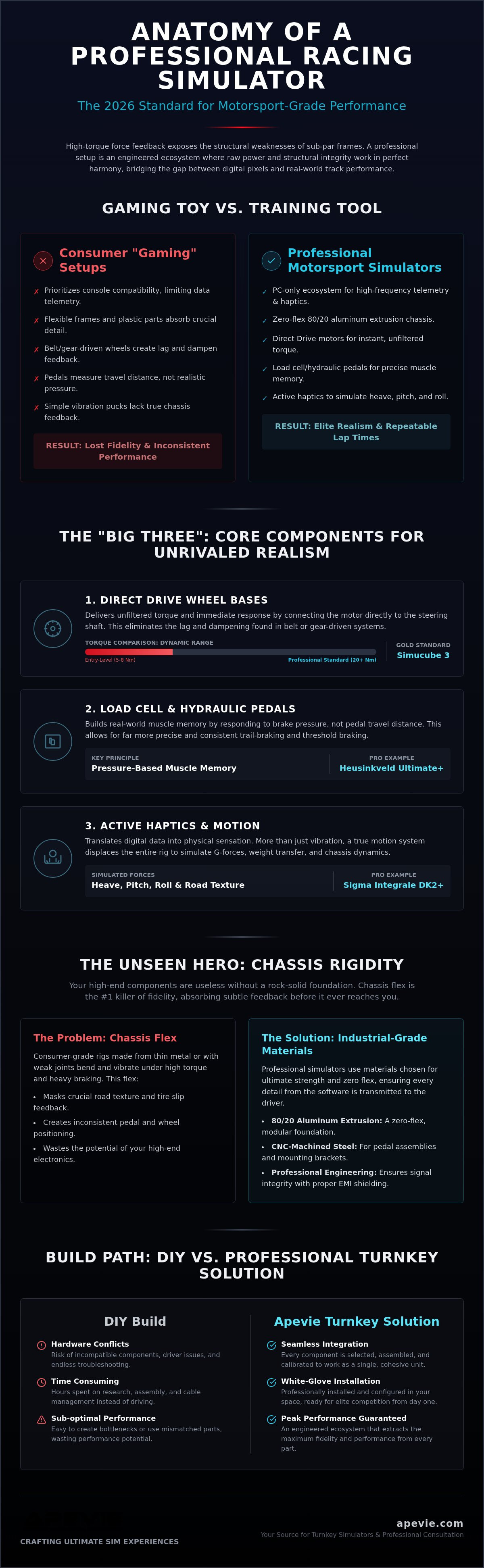
The distinction between "gaming" and "motorsport simulation" has never been clearer than it is in 2026. A professional racing simulator package isn't a retail toy; it's a high-fidelity training tool designed to replicate the exact physical forces found in a GT3 or Formula cockpit. Unlike consumer setups that prioritize console compatibility, professional systems rely exclusively on PC ecosystems. This isn't about brand snobbery. It's about data. Consoles often limit the frequency of telemetry output, which throttles the performance of elite hardware like the Simucube 3 wheel base.
System synergy is the invisible thread that connects your hardware. If you pair a high-torque motor with a flexible frame, the subtle vibrations of tire slip are lost in the chassis flex. A true professional setup requires the "Big Three" of simulation:
- Direct Drive wheel bases for unfiltered torque and immediate response.
- Load Cell or hydraulic pedals for pressure-based muscle memory rather than distance-based travel.
- Active Haptics to communicate road texture, engine RPM, and ABS engagement through the chassis.
The Threshold of Realism: Torque and Fidelity
While entry-level direct drive bases offer 5 to 8 Nm of torque, professional standards in 2026 have shifted toward the 20 Nm+ range. This isn't just about making the wheel harder to turn. High torque provides the dynamic range necessary to feel the weight transfer of the car without the motor "clipping" or losing detail during high-load corners. Telemetry software in these setups processes physics at a much higher frequency than arcade titles, allowing you to sense a loss of grip before it becomes a spin. High-frequency haptics, such as those found in the Sigma Integrale DK2+ system, add a layer of biological feedback that translates digital data into physical sensation.
Industrial Grade Materials vs. Consumer Plastics
Durability is the hallmark of professional engineering. A professional racing simulator package utilizes 80/20 aluminum extrusion for the chassis, providing a zero-flex foundation that can withstand the massive forces generated by high-end pedals and wheels. You won't find plastic clamps or thin metal sheets here. Professional pedals, such as the Heusinkveld Sim Pedals Ultimate+, are constructed from CNC-machined stainless steel to ensure every millimeter of travel is consistent. When we talk about a "turnkey" solution, we mean a system where every bolt, cable, and software driver has been calibrated to work as a single, cohesive unit. This level of integration, often featuring components from precisionsimengineering.com, is what allows you to focus on your lap times rather than troubleshooting hardware conflicts. This same philosophy of industrial-grade durability and electric motor efficiency is also vital in specialized commercial transport; to see how these standards apply to high-performance electric trikes, check out Xion Motors.
The Anatomy of a High-Performance Turnkey System
A professional racing simulator package is defined by the seamless integration of high-performance components that communicate with zero perceptible delay. When we engineer these systems, we aren't just looking for the strongest motors; we're looking for the highest fidelity. This synergy begins with the wheel base and extends through the pedals to the motion platform, ensuring that every bit of telemetry from the software reaches your hands and feet with surgical precision. It's the difference between playing a game and operating a piece of motorsport equipment.
The tactile interface is where your connection to the car is solidified. Beyond the wheel, the motion system provides the most significant leap in realism. Traditional haptic pucks only offer vibration, but the Sigma Integrale DK2+ motion system provides actual displacement. It moves the entire rig to simulate heave, pitch, and roll, allowing you to feel the car's weight transfer as you dive into a corner. High-end steering wheels like the Gomez Sim Industries Formula Pro Elite or the Cube Controls F-Core complement this by offering industrial-grade buttons and shifters that provide a satisfying, mechanical click that consumer gear simply lacks.
Direct Drive: The Simucube Standard
In the world of professional simulation, Simucube remains the gold standard for direct drive technology. The Simucube 3 wheel base uses a high-torque motor that connects directly to the steering shaft, removing the belts or gears that dampen feedback in cheaper systems. This results in latency-free communication between the car's physics engine and your hands. Professional drivers often opt for the Pro or Ultimate models because they provide a high dynamic range. This range allows the motor to communicate subtle road textures even while you're fighting the heavy steering forces of a high-downforce corner. For those seeking the perfect pairing, exploring the best F1 steering wheels for professional sim racing in 2026 can help you find a rim that matches this motor's capability.
Braking Physics: The Importance of Load Cells
Consistency in lap times comes from the brake pedal. Heusinkveld Sim Pedals Ultimate+ use load cell technology, which measures the pressure you apply rather than the distance the pedal travels. This mimics a real hydraulic brake system where muscle memory is built on force. By swapping out high-end elastomers, you can replicate the stiff pedal of a Formula 1 car or the slightly softer, more progressive feel of a GT3 machine. You can learn more about this in our ultimate guide to sim racing pedals. Beyond the pedals, adding a motion system transforms the experience from a visual exercise into a full-body physical one. If you're unsure which combination fits your racing style, the team at Apevie Simulator can help you spec a build that balances these complex variables.
Comparing Professional Simulator Tiers: Finding Your Spec
Selecting the right professional racing simulator package isn't just about picking the most expensive parts. It's about matching hardware to your specific training objectives. If you're a GT3 driver, your rig must facilitate long stints with ergonomic comfort and a wide field of view. Formula specialists, on the other hand, need a rig that replicates the cramped, high-G environment of an open-wheel cockpit. Every tier of professional simulation serves a different physiological purpose, and understanding these differences prevents you from investing in hardware that doesn't serve your goals.
GT vs. Formula Ergonomics
Seating position is a fundamental factor in simulation that many buyers overlook. A GT specialist sits in a relatively upright position, which is ideal for endurance racing and maintaining peripheral awareness of triple-monitor setups. Formula drivers require a reclined "feet-up" position where the pedals are nearly level with the hips. While dedicated cockpits exist for each discipline, many 2026 builds utilize hybrid aluminum extrusion rigs. These modular systems allow you to adjust the seat and pedal tray to find a compromise between the two styles. Wheel rim selection is equally critical for these tiers. Butterfly-style rims, such as the GSI Formula Pro Elite, are designed for the quick, limited steering racks of Formula cars. Round or D-shaped rims are better for the larger steering inputs required in GT or rally simulation.
Motion System Integration: 2-Post vs. 4-Post
Motion systems are the final layer of professional integration, turning a static visual experience into a physical training tool. Choosing between a 2-post and 4-post setup depends on how much "chassis data" your brain needs to process. A 2-post Sigma Integrale DK2 system provides essential pitch and roll, helping you feel the nose dive under braking or the body roll as you clip an apex. The 4-post DK2+ system introduces heave. This allows you to feel the car lift over crests and compress into dips, providing the full vertical dimension of the track. This hardware doesn't just add immersion; it provides the telemetry-based cues your brain needs to find the absolute limit of grip. For a deeper dive into how these technologies communicate with your nervous system, read the professional guide to haptic systems.
Critical Considerations: Rig Rigidity, Haptics, and Integration
The most sophisticated electronics in the world cannot compensate for a weak structural foundation. When you invest in a professional racing simulator package, you're buying a system capable of generating immense physical forces. If your cockpit is constructed from thin-walled steel or consumer-grade tubing, the energy from a 25Nm Simucube 3 motor won't reach your hands. Instead, that energy is absorbed by the frame. This "rig flex" acts as a low-pass filter, muddying the high-frequency details of tire scrub and road texture that are essential for elite performance. A professional setup must be completely inert under load.
Electromagnetic Interference (EMI) is another factor that often ruins high-end DIY builds. Direct drive motors and motion actuators generate significant electrical noise. Without industrial-grade shielding and meticulous grounding, this interference leads to "ghost inputs" or sudden hardware disconnects. Professional integration ensures that every cable is routed and shielded to maintain signal integrity. Beyond the electronics, your visual field of view (FOV) dictates your spatial awareness. Triple 32-inch or 42-inch monitors remain the gold standard for 180-degree peripheral vision. While an ultrawide display offers a cleaner aesthetic, it cannot replicate the "side window" view necessary for defending your position in wheel-to-wheel combat.
Eliminating Flex with Aluminum Extrusion
To handle the peak torque of modern wheel bases, Apevie utilizes heavy-duty 80/20 aluminum profile rigs. This modular system allows for infinite adjustability without sacrificing structural rigidity. Every joint is secured with reinforced brackets to ensure that 100% of the motor's feedback is transmitted to the driver. This zero-flex environment is the only way to develop the consistent muscle memory required for professional competition. You can explore the engineering behind these foundations in the ultimate sim rig guide. If you want a setup that remains stable under the highest braking pressures, consult with our experts to spec a rig that matches your hardware's output.
The Software Stack: Beyond the Hardware
Hardware is only half of the equation. The software stack serves as the translator between the simulation physics and your haptic devices. Professional calibration involves tuning Simucube True Drive settings to match the specific steering rack of the car you're driving in iRacing or Assetto Corsa Competizione. Similarly, the motion profiles for the Sigma Integrale DK2+ must be balanced so that the heave and vibration don't overwhelm the primary telemetry data. For those looking to analyze how drivers process this information through behavioral research, you can discover Ergoneers and their specialized software. A turnkey system arrives with these profiles pre-configured, ensuring that your first drive is calibrated for maximum realism rather than spent troubleshooting software filters.
Acquiring the world's finest simulation hardware is only the first step. The true challenge lies in the integration. Most elite components arrive in separate boxes with complex manuals that assume you have the time and technical expertise of a motorsport engineer. A professional racing simulator package from Apevie eliminates the frustration of DIY assembly. We recognize that for our clients, time is the most valuable asset. Instead of spending weeks troubleshooting driver conflicts or cable management, you receive a fully synchronized system that is ready for the track the moment it's powered on.
Professional installation is about more than just tightening bolts. It involves precise grounding to prevent the EMI issues discussed earlier and the meticulous routing of high-bandwidth data cables to ensure signal integrity. Our white-glove service includes on-site setup and calibration, ensuring that the physical ergonomics and software profiles are tailored specifically to your height, reach, and driving style. If a technical hurdle arises later, our team provides remote troubleshooting and ongoing support, keeping your seat time consistent and productive.
Bespoke Turnkey Engineering
We don't believe in one-size-fits-all solutions. Every Apevie build is a curated selection of the industry's most reliable hardware. We source steering interfaces from Gomez Sim Industries (GSI) and Cube Controls, pairing them with the precision of Heusinkveld pedals and Simucube motors. For those seeking the absolute pinnacle of tactile luxury, we often integrate options from Precision Sim Engineering. Before any system leaves our facility, it undergoes a rigorous 48-hour burn-in and calibration process. This stress test ensures that every actuator, load cell, and cooling fan performs flawlessly under the sustained heat and vibration of endurance racing.
Ready to Race: Your Path to Professional Simulation
Your journey begins with a bespoke consultation where we match hardware specs to your real-world racing goals or vehicle. Whether you're a professional driver looking to shave tenths off your qualifying lap or a dedicated enthusiast building a home sanctuary, we handle the engineering complexity for you. This professional racing simulator package represents a long-term investment in your development as a driver. By removing the technical barriers of simulation, we allow you to focus entirely on the physics of the car and the strategy of the race. When you are ready to transition from a collection of parts to a cohesive motorsport tool, you can explore our professional turnkey simulator packages to begin your build.
Mastering the Circuit with Precision Engineering
Engineering a professional racing simulator package is an exercise in balancing raw power with high-frequency fidelity. We've explored how 2026 standards prioritize zero-flex aluminum frames and the surgical precision of Simucube 3 wheel bases. Success on the track requires more than just high-end parts; it demands a calibrated ecosystem where telemetry and haptics communicate without interference. When your hardware is perfectly synchronized, the digital world fades away, leaving only the pure physics of the race.
As an authorized dealer for elite brands like Simucube and Heusinkveld, Apevie specializes in bespoke systems engineered specifically for professional driver training. Our nationwide white-glove installation ensures your setup is optimized for performance from the very first lap. Don't let technical complexities or rig flex hold back your development as a driver. By investing in a turnkey solution, you're choosing a platform that translates directly to real-world results.
Build Your Dream Rig: Browse Turnkey Simulator Packages
Your path to the podium begins with hardware you can trust. We look forward to helping you engineer a setup that meets the highest standards of motorsport excellence.
Frequently Asked Questions
What is included in a professional racing simulator package?
A comprehensive professional racing simulator package includes a zero-flex aluminum extrusion chassis, a high-torque direct drive wheel base like the Simucube 3, and professional-grade pedals such as the Heusinkveld Ultimate+. Beyond the core controls, these systems feature a dedicated high-performance PC, triple monitors for a 180-degree field of view, and a motion system like the Sigma Integrale DK2+. Every component is integrated with industrial-grade cabling and professional software calibration for a turnkey, motorsport-ready experience.
Can I use a professional sim package on a console like PS5 or Xbox?
No, professional-grade systems are built exclusively for PC ecosystems. While some consumer wheels offer console compatibility, they cannot support the high-frequency telemetry data required for elite motion systems or high-torque direct drive bases. A professional racing simulator package relies on the open architecture of a PC to run advanced software like Simucube True Drive and iRacing. This allows for the precise haptic feedback and physics processing that consoles simply aren't engineered to handle.
How much space is required for a full-motion simulator setup?
A full-motion simulator requires a dedicated footprint of approximately 6 feet by 8 feet. This space accounts for the aluminum chassis, the width of a triple 32-inch monitor setup, and the necessary clearance for motion actuators like the Sigma Integrale DK2+. It's vital to leave at least 12 inches of safety zone around the moving parts of the rig to prevent collisions with walls or furniture during high-intensity heave and roll maneuvers.
Why is a Direct Drive wheel better than a belt-driven one?
Direct drive wheels are superior because the steering shaft is mounted directly to the motor's rotor, eliminating the belts or gears found in consumer setups. This design removes mechanical friction and latency, providing a transparent link between the car's physics and your hands. In a professional racing simulator package, this translates to higher torque peaks and the ability to feel micro-details, such as tire scrub or subtle weight shifts, that belts would otherwise dampen.
What is the benefit of a load cell brake pedal?
Load cell pedals, like the Heusinkveld Sim Pedals Sprint, measure the pressure you apply rather than the distance the pedal travels. This replicates the physics of a real hydraulic braking system, where stopping power is determined by leg force. Since the human brain develops muscle memory more effectively through force than through distance, load cells allow you to hit your braking markers with surgical consistency, significantly reducing lap time variability during high-pressure race stints.
Do I need a special PC to run a professional simulator package?
Yes, a professional system requires a high-performance PC with a top-tier GPU and CPU to process complex physics and high-resolution visuals. Running triple 4K monitors or high-refresh-rate 1440p displays while simultaneously managing motion software and haptic telemetry demands significant processing power. We typically spec our builds with the latest NVIDIA RTX series cards and high-clock-speed processors to ensure zero frame drops, which is critical for maintaining visual immersion.
What is white-glove installation for a racing simulator?
White-glove installation is a comprehensive, on-site service where our experts handle the assembly, cable management, and software calibration of your system. Instead of receiving a dozen boxes, our team arrives to build the rig, shield it against EMI, and tune the motion profiles to your specific driving style. We don't leave until you are fully trained on the software stack, ensuring your professional racing simulator package is optimized for performance from the moment you sit down.
How long does it take to receive a custom turnkey simulator?
The timeline for a custom turnkey simulator depends on the specific hardware selection and our current build queue. Each system undergoes a meticulous 48-hour burn-in and testing phase at our facility to ensure component reliability. Typically, the process from initial consultation to final on-site installation takes several weeks. This duration allows us to source elite parts, such as Gomez Sim Industries wheels or Sigma Integrale actuators, and perform the deep software integration required for a professional-grade experience.